


Collagen shows up constantly in gut-health advice, usually attached to a figure claiming 93% of people saw their digestive symptoms improve. If you have IBS and you’ve seen that number, the honest answer is that it didn’t come from people with IBS.
This guide does two things. It walks you through a simple checklist for judging any supplement claim, using that 93% study as a worked example so you can see exactly where it holds up and where it falls apart. Then, if you still want to test collagen yourself, it gives you a safe way to do it: which type and dose to start with, how to read an ingredient panel so you’re testing one variable instead of three, what to track over 4 to 8 weeks, and the stop and switch rules that tell you when to quit.
You’ll also see where collagen sits against options with stronger IBS evidence, so you know what to try if a trial doesn’t work out. Collagen isn’t a cure, and current research doesn’t show consistent improvement in core IBS symptoms. What it can be is a reasonable experiment for bloating and abdominal discomfort, if you run it properly and know in advance what would count as a real result.
Collagen for IBS Key Takeaways
- No trial has tested collagen in people with diagnosed IBS, so effectiveness for IBS remains unproven.
- The widely quoted 93% figure came from healthy women without IBS, where 13 of 14 completers reported improvement in an open-label study.
- Buy single-ingredient hydrolyzed collagen peptides; unflavored doesn’t mean additive-free, and maltodextrin or sugar alcohols can trigger symptoms.
- Start below the studied 20 g daily dose and titrate up, splitting doses if you’re sensitive.
- Run a 4 to 8 week trial with a weekly symptom log, keeping fiber, probiotics and diet steady.
- Stop if a clear flare pattern appears, and switch strategies if there’s no trend by week 4.
- Talk to a clinician first if you have inflammatory bowel disease, and seek care for bleeding, fever or unexplained weight loss.
How Do You Translate Collagen Claims Into IBS Evidence

The short answer: evidence for collagen and IBS is limited, and most collagen studies do not test people with irritable bowel syndrome (IBS) using blinded, placebo-controlled methods that measure the core symptoms you care about. Use this checklist to turn any collagen claim into the facts that matter before you spend money or start a 4 to 8 week trial.
Apply this IBS evidence filter to any study claim before you buy or try a supplement:
- Population: Confirm the trial recruited people diagnosed with IBS and reported subtypes (IBS with constipation, IBS with diarrhea, or mixed IBS).
- Design: Prefer randomized, double-blind, placebo-controlled trials. Open-label or single-arm studies are prone to expectation and natural-variation effects.
- Endpoints: Look for measured changes in abdominal pain and stool form or frequency rather than only general digestive comfort.
- Dose and duration: Note the collagen form and daily dose used, and whether the study ran long enough to capture usual IBS fluctuation.
- Additives and formulation: Check whether the product was pure collagen peptides or a blend with sweeteners, flavorings, or carriers that can trigger symptoms.
- Funding and affiliations: Record who funded the trial and any author ties to the product maker.
- Completion and statistics: Compare number enrolled versus number completed and whether reported percentages reflect completers or the full cohort.
A worked example shows how the filter sorts evidence instead of simply dismissing collagen. The most-cited collagen digestion trial, the source of the “93%” figure repeated across supplement blogs, is Abrahams M, O’Grady R, Prawitt J, “Effect of a Daily Collagen Peptide Supplement on Digestive Symptoms in Healthy Women,” JMIR Formative Research, 2022 (source).
The trial enrolled healthy women without an IBS diagnosis, used an open-label single-arm design, and had 40 starters with 14 completers, so 13 of 14 completers produce the 93 percent figure. Authors reported ties to the collagen manufacturer. Because the population lacked IBS patients, the design had no placebo, and endpoints focused on general digestive comfort, this study provides weak direct evidence for people with IBS. The study title says “Healthy Women,” which is the fastest way to see the problem.
Use this compact checklist for quick comparison:
Checklist item | How that study performed | What to conclude |
|---|---|---|
Population | Healthy women, no IBS diagnosis | Not generalizable to people with IBS |
Design | Open-label, single-arm | No placebo control; effect may reflect expectation |
Endpoints | General digestive symptom reports | Does not map to abdominal pain or stool outcomes |
Dose/duration | Short follow-up; small completer number | Hard to map to a 4 to 8 week IBS trial |
Additives | Branded collagen peptide tested | Blended ingredients could explain effects |
Funding | Industry-linked authors | Lowers impartiality confidence |
Completers vs enrolled | 14 completed of 40 enrolled, 13 of 14 = 93% | Percentages reflect completers, not all starters |
Now run the same filter across other options, because the point is that it sorts the shelf rather than condemning one product. Two comparisons show what a higher score looks like:
- Iberogast: a randomized, double-blind, placebo-controlled trial in 208 IBS patients found it reduced IBS symptom scores by 1.5 points more than placebo, a difference that was statistically significant at p<0.0004. A review of 12 clinical trials since 1990 reported an adverse drug reaction incidence of 0.04 percent (Ottillinger B, Storr M, Malfertheiner P, Allescher HD, Wiener Medizinische Wochenschrift, 2013, source). Note that this review has manufacturer-associated authors, so apply the funding check here too.
- Bifidobacterium longum 35624: tested in a multicenter, randomized, double-blind, placebo-controlled dose-ranging trial of 362 primary care IBS patients across all bowel-habit subtypes (Whorwell PJ, et al., American Journal of Gastroenterology, 2006).
Set those against collagen’s 14 completers with no control group and no IBS participants. Same filter, three different verdicts, and that contrast is what proves the checklist works. The wider set of supplements for IBS sorts the same way once you run each claim through these seven checks, and Iberogast for IBS is the option here that clears the bar collagen’s evidence does not.
Practical guidance before you start a personal trial: require at least one placebo-controlled trial in people with a formal IBS diagnosis that measures abdominal pain and stool-related outcomes, or treat effectiveness as unproven. If you still try collagen, run a time-limited trial of 4 to 8 weeks using the same dose and form used in any supporting study, and track outcomes objectively each week using an abdominal pain score, stool form with the Bristol Stool Form Scale, and frequency of bloating.
What to watch for and when to stop:
- Symptoms that suggest the supplement is the cause: new or worse bloating, increased abdominal pain, or changes in stool that match known triggers for you.
- Formulation red flags: sugar alcohols, inulin, or high-FODMAP flavorings listed on the label can provoke symptoms and confound results.
- Data red flags: small sample sizes, high dropout rates, no placebo group, or endpoints that do not measure pain and stool outcomes.
Keep one clear expectation: current human research does not show consistent, meaningful improvement in core IBS symptoms from collagen alone, so enter any trial cautiously and use the checklist to judge new studies you read.
Who Is Collagen Worth Trying for IBS
Collagen is not a cure for irritable bowel syndrome (IBS); think of it as a time-limited experiment you can try for specific symptom patterns rather than a first-line treatment. If your main problems are bloating, intermittent cramping, or mixed stool patterns, collagen is more worth testing than if unrelenting diarrhea or untreated constipation is your main issue.
A short evidence-grounded snapshot sets realistic expectations. The widely repeated figure of 10 to 15 percent comes from the International Foundation for Gastrointestinal Disorders (source) and reflects older criteria and a global estimate.
The current US measurement is 6.1 percent, from a nationwide survey of nearly 89,000 adults using Rome IV criteria (Almario CV, et al., Gastroenterology, 2023, source). Three things separate the numbers: diagnostic criteria, geography, and the fact that only about 5 to 7 percent of adults have a formal diagnosis. If you are undiagnosed but symptomatic, that is the norm rather than the exception.
When to consider a collagen trial and what to try first:
- IBS with constipation (IBS-C): Treat collagen as an add-on, not the starting point. Begin with constipation-focused levers that have stronger support for stool frequency and consistency, starting with a structured psyllium approach: psyllium fiber for IBS works to a week-by-week titration rather than a single dose. Aim for consistent fluids and regular movement before layering supplements, and consider medication only if lifestyle and fiber changes do not reach your symptom goals.
- IBS with diarrhea (IBS-D): Collagen is a cautious fit rather than a primary strategy. Prioritize timing-focused dietary tweaks, soluble fiber adjustments, and urgency-management tactics first. Collagen may be reasonable to test when bloating or abdominal discomfort is the dominant problem and other measures have not helped.
- Mixed IBS (IBS-M): Collagen is a realistic experiment because the goal is often to reduce overall bloating and pain across phases rather than fix one stool pattern. Tracking both stool form and symptom burden matters more than labeling a single phase.
- Post-infectious IBS: If your symptoms began after a gastroenteritis episode, inflammation or motility changes may play a role; discuss any collagen trial with your clinician rather than self-prescribing.
If you decide to try collagen, follow a clear decision rule: commit to a 4 to 8 week trial with predefined measures and stop rules, track symptom changes weekly, and discontinue or switch if symptoms clearly worsen.
How Should You Choose Collagen Type and Dose for IBS
Hydrolyzed collagen peptides, particularly type I hydrolyzed collagen peptides, are the practical default when you want a product most likely to affect intestinal wall integrity while keeping extras to a minimum.
Start by confirming the powder is truly single-ingredient. Read the ingredient panel and make sure it lists only the collagen source, for example Bovine Hide Collagen Peptide Hydrolysate. Many powders labeled unflavored still include additives such as silicon dioxide, maltodextrin, artificial sweeteners, or sugar alcohols like sorbitol and xylitol. Maltodextrin and some carriers are rapidly fermentable carbohydrates that can trigger bloating or loose stools for people with IBS. A one-item ingredient list is the only reliable way to isolate collagen supplementation from these additives during a 4 to 8 week trial.
Two limits of the single-ingredient rule affect how you interpret results:
- Protein load matters: A 20 g dose delivers 20 g of protein at once, and that volume can cause bloating for people sensitive to a protein bolus. Splitting the dose or titrating reduces this confounder.
- Labels are claims, not guarantees: Dietary supplements are not pre-approved by the FDA, so manufacturer labels can be incomplete. Third-party testing, such as NSF certification or independent heavy-metal testing, reduces uncertainty.
Try one of these single-ingredient powder options as the product you keep constant for your trial:
- Anthony’s Collagen Peptide Powder, 1 lb, 4.7 stars from over 13,100 reviews, single ingredient and gluten free
- NAKED Collagen Peptides, 20 oz, 4.7 stars, NSF Certified
- It’s Just! Collagen Peptides, 1.25 lb, 4.6 stars, third-party heavy metal tested
- Sports Research Collagen Peptides, 16 oz, 4.6 stars from over 129,000 reviews, 11 g per scoop for easy titration
- Nutricost Collagen Peptides, 1 lb, 4.6 stars, the budget option
- Anthony’s Hydrolyzed Marine Collagen, 1 lb, 4.6 stars, for non-bovine preference
If your IBS overlaps with lactose or gluten sensitivity, prioritize powders labeled dairy-free and gluten-free. Powder format makes it easier to measure and titrate doses precisely.
Avoid these products during a clean trial because added actives make the result uninterpretable. They are not bad products, they simply fail the single-variable test for a 4 to 8 week evaluation:
- Vital Proteins Collagen Peptides Advanced adds hyaluronic acid and vitamin C
- NatureWise Hydrolyzed Liquid Collagen in Mixed Berry is a flavored liquid with biotin, vitamin C, B complex, and hyaluronic acid
- NATURE TARGET Multi Collagen is a multi-source blend with added actives
- Wholesome Wellness Multi Collagen is a multi-source blend with added actives
If you already own a multi-ingredient product, finish the bottle and then run a proper single-ingredient trial rather than discarding what you have.
Set a dose and timeline you can actually evaluate. A commonly cited studied dose is about 20 grams per day, with benefits, when they occur, typically appearing after 6 to 8 weeks of consistent intake. Start near the middle of that range rather than jumping straight to 20 g. One practical titration plan is 5 to 10 g per day in week 1, 10 to 15 g in week 2, then roughly 20 g from week 3 if tolerated.
Track symptoms weekly so you can detect trends rather than one-off changes.
Separate a collagen problem from a food problem before you commit to weeks of supplementation. If bloating or diarrhea consistently follows specific meals rather than the collagen dose, the supplement is not the variable you are testing and you may want to explore enzyme supplements for bloating before continuing.
The single rule that makes a trial interpretable is this: stick with one single-ingredient product for the entire evaluation period. Switching brands, flavors, or formats mid-trial replaces the ingredient deck and leaves you unable to tell what caused any symptom change.
This content is for educational purposes only and is not a substitute for personalized medical advice. Digestive symptoms can have many causes; consult a qualified healthcare professional for persistent, severe, or worsening symptoms. Results vary by person, and any dietary or supplement changes should be individualized.
How Do You Run a 4 to 8 Week Collagen Trial Safely
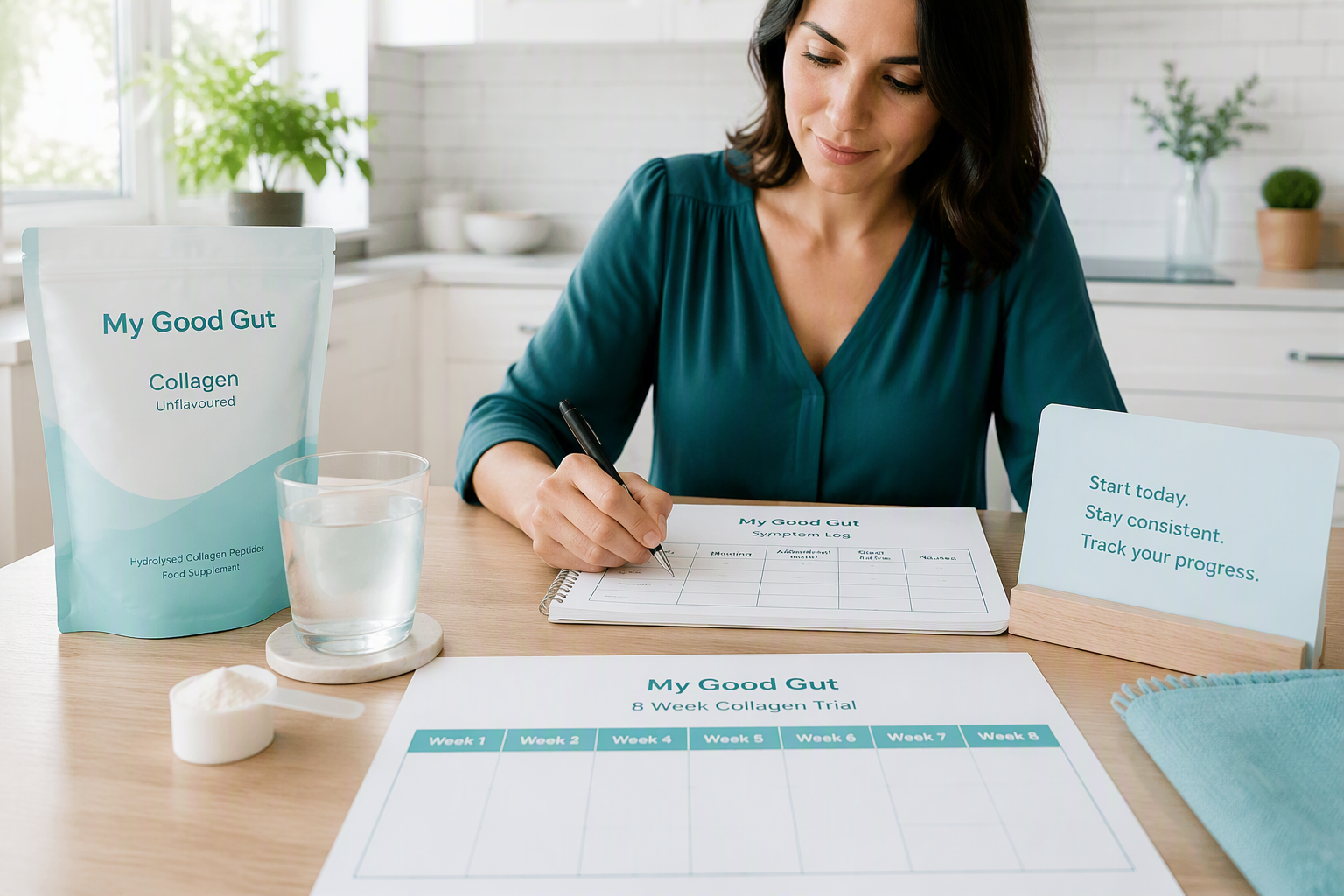
A 4 to 8 week, safety-first trial is the clearest way to find out whether collagen supplementation helps your IBS while limiting risk.
Follow this numbered setup and titration checklist to run the trial safely and practically:
- Choose a single-ingredient collagen product and note its scoop or serving size so you can raise the dose in predictable steps.
- Start at roughly half the studied 20 g dose and hold each step for a full week before increasing, which matches the weekly pacing in the dose section above. For a product with 11 grams per scoop, that works out to half a scoop in week 1, one scoop in week 2, then one and a half scoops from week 3 if symptoms stay calm.
- Use a split-dose schedule when possible. The 20 g per day split into two doses used in the most-cited study gives a useful template for pacing, though as the evidence-filter section explains, that study had no IBS participants and no control group.
- Keep everything else stable during the 4 to 8 week window, especially fiber supplements and probiotics, so collagen is the variable you are testing.
- Track symptoms weekly with a simple log that captures bloating, abdominal pain, stool form, and nausea so you judge trends over weeks rather than reacting to a single bad day.
Watch these early safety signs in weeks 1 and 2, and pause the trial if any appear:
- Increasing abdominal pain: Pain that does not ease after reducing the dose.
- Persistent nausea: Nausea that begins with starting or increasing collagen.
- IBS flare that persists: An episode that fails to settle within several days of stepping back to the last tolerated dose.
Stop the trial immediately and seek prompt medical care for any red flag such as visible gastrointestinal bleeding, fever, or unexplained rapid weight loss.
Talk to a clinician before trialing collagen if you have inflammatory bowel disease, especially colitis. Be precise about why: this is a precaution, not a proven harm. A 2022 review raised general safety questions about dietary collagen supplements (source), but no study establishes that collagen worsens inflammation in severe IBD. Active inflammatory disease is a situation where a monitored approach and specialist input make sense regardless of what any single supplement does.
If your gut is sensitive, prefer a minimal-ingredient formula to reduce the chance that additives trigger symptoms. Avoid products with sugar alcohols, added fibers, or flavoring agents that commonly cause bloating.
Consider how collagen fits with other evidence-based options. Soluble fiber and targeted probiotics often have stronger support for IBS symptom control, so weigh collagen against those approaches and your current plan. Which strain you pick matters more than the CFU count, and probiotic strains for IBS are matched to your dominant symptom rather than chosen by dose.
End the trial after 4 to 8 weeks unless you notice clear, sustained improvement. If benefits are unclear or symptoms worsen, stop the product and discuss next steps with your clinician. This guarded, measurable approach helps you decide whether collagen supplementation is worth continuing.
How Do You Track Symptoms and Decide Stop or Switch
Start with a simple, structured 4 to 8 week symptom log so you can turn small changes into a clear decision instead of guessing day to day. Track the domains that matter for your IBS subtype: bloating, abdominal discomfort or pain, constipation and straining for IBS-C, diarrhea or urgency for IBS-D, and mixed patterns for IBS-M. Also note stool frequency and consistency using the Bristol stool chart, and write one-line notes about likely triggers in the past 24 hours such as large meals, stress spikes, new foods, or medications. This turns day-to-day noise into trend information you and your clinician can use.
A paper log often keeps people consistent better than a blank notes app because the prompts are pre-printed. If you prefer a ready-made tracker, consider these options:
- HAMIEW Food Diary & Symptom Log, 4.7 stars, with a Bristol stool chart and fields for meals, bowel movements, and sleep
- A5 spiral Food Diary and Symptom Log, 4.5 stars from 395 reviews, built for IBS and IBD and the most portable
- 56-day hardcover Food Diary & Symptom Log, which maps exactly to an 8-week window
- 75-Day Food Diary & Symptom Tracker, 4.5 stars, the budget entry point
A free printable or spreadsheet works too; these products are a convenience, not a requirement.
Set up your weekly routine with three short steps to keep tracking useful and manageable. Prepare the log for 4 to 8 weeks and list the domains you will score each week. Use a 0 to 10 severity rating for each domain and add one-line notes about major changes that week, such as new fiber, a course of antibiotics, travel, or increased stress. Record stool frequency and whether stool form shifted toward constipation relief or toward looser stools.
Use consistent scoring so you spot trends rather than single good or bad days. A typical weekly entry takes under five minutes and produces comparable data across weeks.
Translate weekly scores into action with three decision rules:
- Interpret: Label each domain as Improved, Unchanged, or Worse and look for a sustained upward trend in the domains that matter most to your quality of life for at least 2 to 3 weeks. If gains and losses cancel out, treat that as no net benefit.
- Stop: Stop the supplement immediately if a clear flare pattern appears after starting or escalates as you continue. Return to your baseline routine, wait several symptom-free days, and reassess before deciding the next step.
- Switch: If by week 4 there is no meaningful upward trend, either tighten tracking through week 6 to look for delayed benefit or stop early. If the full 8 weeks stays flat, move on to approaches with stronger clinical backing rather than prolonging a trial with no signal.
Be alert for red flags and act quickly: if you develop severe pain, fever, bloody stool, or unintentional weight loss, seek medical care immediately and stop the supplement until a clinician evaluates you. Otherwise, treat a negative result as useful information. A clear non-response rules out collagen as the cause and frees you to try other options.
Look at your trial the way a study reader would. Your single-person, unblinded experiment has the same design limits as the studies behind popular claims, which is why you focus on a sustained trend across weeks rather than one good week. A true personal benefit is reason to continue, not proof that collagen treats IBS for everyone, and that careful tracking is what lets you tell the difference between reduced bloating after collagen and ordinary week-to-week variation.
Collagen for IBS FAQs
These FAQs explain whether collagen supplements are likely to help your IBS symptoms and what to watch for during a short, safety-minded trial. Use them to understand the evidence, compare common collagen types and doses, notice additives that may trigger symptoms, and set simple tracking and stop rules before you buy.
1. Can collagen peptides trigger IBS flare-ups in some people?
Yes. Collagen peptides can trigger IBS symptoms in some people, most often during the first week or two. The usual causes are taking too much too fast or reactions to additives in the product rather than the collagen itself.
Starting at a high dose can produce temporary bloating, gas, or mild nausea in a sensitive gut, and many powders contain artificial sweeteners or sugar alcohols such as sorbitol or xylitol that may pull water into the intestines and worsen bloating or loose stools. Pause the supplement for several days to see if symptoms ease, then restart at a lower dose with slower titration. If flare symptoms recur, stop the product and consult a healthcare professional. This content is for educational purposes only and is not a substitute for personalized medical advice.
2. Will collagen help constipation-predominant IBS symptoms?
Collagen might help with constipation-related bloating for some people with IBS-C, but there’s no IBS-specific evidence that it reliably treats constipation, so use it as an add-on experiment rather than a primary constipation relief plan.
The theory is that collagen digestion yields amino acids like glycine and peptides that could change water balance in the gut and soften stool, which might support smoother movement; this is a biological hypothesis, not a measured IBS-C outcome. Prior trials in healthy women (the 93% figure) don’t prove benefit for IBS-C. Keep psyllium fiber, adequate hydration, and regular movement as your first steps and limit any collagen trial to 4–8 weeks with clear stop rules.
3. Will collagen help diarrhea-predominant IBS symptoms?
The evidence for collagen helping diarrhea-predominant IBS (IBS-D) is weaker than for constipation-predominant IBS, so any benefit is uncertain. If your stools loosen after starting collagen, that is your signal to stop rather than push through.
Collagen research targets different biology than IBS-D, which usually responds better to targeted trigger management and symptom-specific options. For abdominal discomfort and pain, peppermint oil for IBS has the stronger IBS-specific evidence base of the two, which is the honest comparison to make here rather than talking collagen up.
On dosing, refer back to the studied 20 g per day covered earlier in this guide and start below it, increasing slowly. The exact starting number matters far less than the stop rule.
Track stool frequency, urgency, and abdominal discomfort daily, and avoid adding multiple changes at once. If you do not improve within your 4 to 8 week window, switch strategies and talk with a healthcare professional.
4. Is liquid or powder collagen better for IBS?
For IBS, powder is usually the safer pick because powders are more often a single ingredient while liquid collagen more often adds flavors, sweeteners, vitamins, or thickeners that can irritate a sensitive gut. Look for products that list hydrolyzed collagen peptides or type I hydrolyzed collagen peptides as a single line, ideally third-party tested, and confirm dairy-free and gluten-free if those foods bother you. Start with the simplest option, track symptoms for several days, and stop if things worsen. This content is for educational purposes only and is not a substitute for personalized medical advice.
5. Should I avoid collagen if I have histamine intolerance?
You do not necessarily need to avoid collagen if you have histamine intolerance, but additives in many products are the more likely problem. Pick a simple hydrolyzed collagen peptides powder that is dairy-free and gluten-free when needed, and choose collagen supplements with minimal ingredients while avoiding added sweeteners and sugar alcohols.
Treat use as a cautious 4 to 8 week trial, the same window used everywhere else in this guide, while keeping your usual diet steady so you can spot changes. If bloating, cramps, or stool changes get noticeably worse, stop immediately and check with your clinician or dietitian. This is for educational purposes only and is not a substitute for personalized medical advice.