


Most advice about fiber for IBS stops at "start low and go slow," which tells you nothing about what dose to actually take or when to stop climbing. This guide gives you a week-by-week schedule with real numbers, and a different one depending on whether your IBS runs toward constipation, diarrhea, or both.
You'll also find the two things that cause most Metamucil failures, and neither is the fiber itself. The first is not drinking enough water, which produces cramping people blame on the psyllium. The second is taking it too close to medications, since fiber binds to several common drug categories and quietly reduces how much you absorb.
There's also a three-tier guide to telling normal adjustment gas from a genuine fiber mismatch, and from the symptoms that mean you should stop and call someone. If psyllium turns out not to suit you, that doesn't mean fiber is wrong, only that this fiber is, and there are non-fermenting alternatives worth trying instead.
Starting Metamucil for IBS Key Takeaways
- The standard adult dose is 3.4 g of psyllium husk, but start at half that and build up over 2 to 4 weeks.
- IBS-C, IBS-D and IBS-M each follow different weekly titration targets, not one generic schedule; IBS-D should hold at half a serving through week 2 and take it with food.
- Take every dose with about 8 oz of water so psyllium forms its gel properly, since under-hydration causes most of the cramping blamed on the fiber.
- Space other oral medications 1 to 2 hours before or after fiber, especially thyroid, diabetes, heart medications and mineral supplements.
- Mild gas or bloating in the first week or two is normal adjustment, not treatment failure; gas that worsens on a slow, well-hydrated titration means psyllium is the wrong fiber for you.
- Judge results at the end of week four on your tolerated dose, not on day three.
- Choose unflavored: sugar-free flavored versions still carry sweeteners, and generic psyllium has no active-ingredient disadvantage.
- Seek medical care for trouble swallowing, severe pain, rectal bleeding, unexplained weight loss or waking at night to use the bathroom.
How Does Metamucil Help IBS With Psyllium Husk
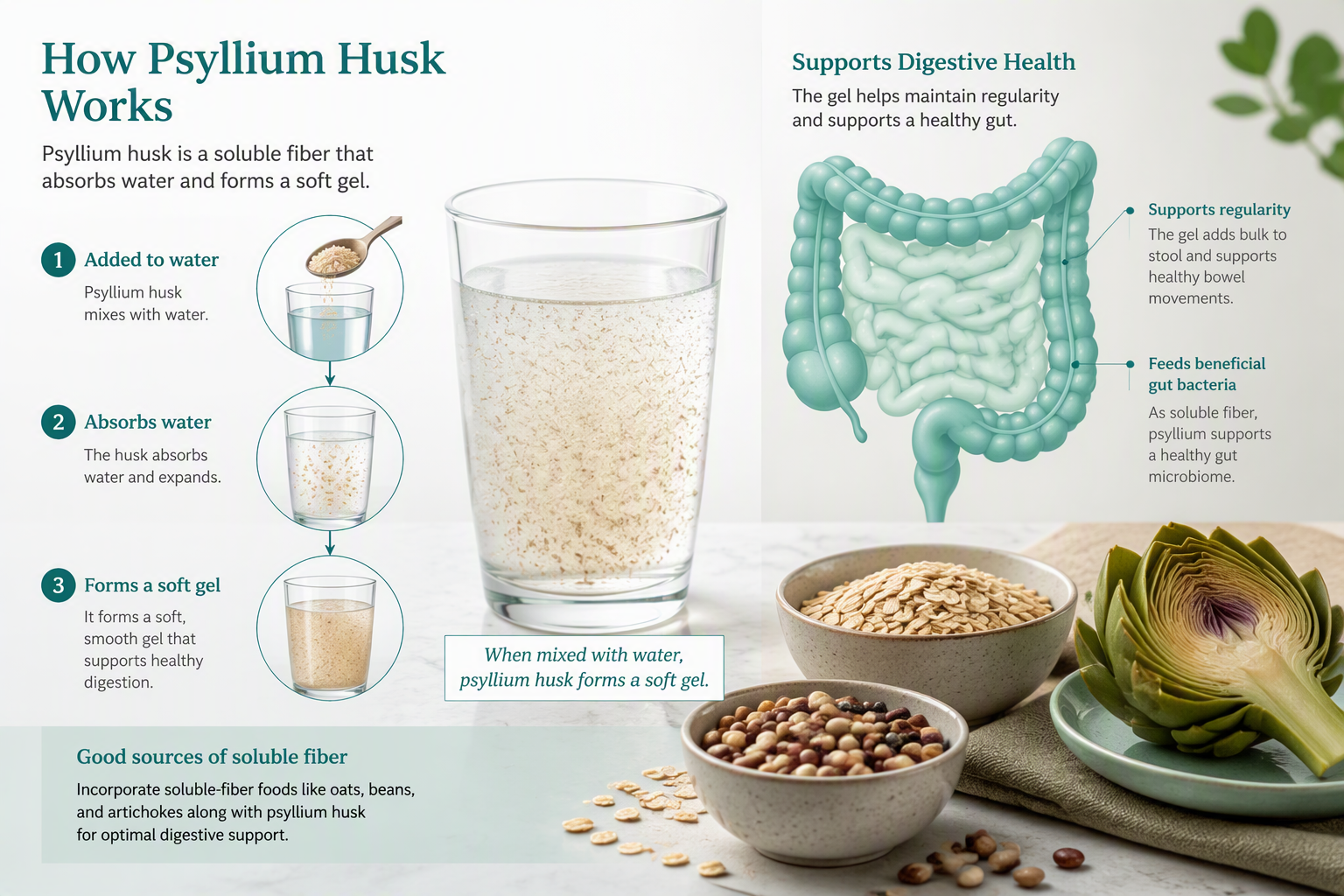
Irritable bowel syndrome (IBS) affects everyone differently, and if you're weighing Metamucil for IBS symptom relief, it helps to know upfront that this non-prescription soluble fiber supplement built on psyllium husk tends to work gradually rather than delivering relief the moment you take it. It acts mainly through physical effects inside your gut, bulking stool and absorbing water, so your response in the first few weeks may look nothing like what a friend or coworker experiences with the same product.
Psyllium husk absorbs water as it moves through your digestive tract, forming a gel that thickens stool and helps it pass more easily. That mechanical shift can steady bowel habits that swing between too loose and too firm, which is the real target of any fiber supplement for IBS. The goal isn't chasing one specific stool type, it's nudging your gut's usual pattern back toward the middle.
For constipation-predominant IBS (IBS-C), that water-absorbing action softens stool while adding bulk, turning what was hard and difficult to pass into something your body can move more comfortably. One thing worth knowing about how Metamucil helps IBS-C is that firmness tends to change before frequency does. Starting with a smaller dose and building up gives your gut time to adjust, which lowers the odds you'll feel worse before you feel better.
Metamucil and IBS-D work through the same fiber but the opposite fluid problem. Diarrhea-predominant IBS, or IBS-D, often means your gut holds more water than it can handle, and psyllium's gel structure soaks up that excess, firming loose stool and slowing transit enough to ease urgency. That's how Metamucil helps IBS-D in practical terms: less excess water moving through your system, and more time between the urge and the bathroom.
Psyllium carries the strongest guideline support of any fiber studied for constipation-related IBS symptoms. Both Harvard Health's integrative overview of IBS treatments (source) and Mayo Clinic's guidance on IBS home remedies (source) point to the same slow-and-steady, well-hydrated approach used throughout this guide.
Not all fiber behaves the same way, and that distinction matters more than most guidance admits. Psyllium is soluble fiber, the type with real evidence behind IBS symptom control, while insoluble fiber, the kind in wheat bran and many bran cereals, adds roughage without gelling and commonly makes IBS symptoms worse instead of better. My Good Gut's food and fiber chart shows where soluble fiber actually lives:
Food (per listed portion) | Soluble fiber |
|---|---|
Artichoke, cooked, medium | 4.7 g |
Dark kidney beans, 1/2 cup | 2.8 g |
Butter beans, 1/2 cup | 2.7 g |
Black beans, 1/2 cup | 2.4 g |
Oat bran cereal, 3/4 cup | 2.2 g |
Light kidney beans, 1/2 cup | 2.0 g |
Brussels sprouts, 1/2 cup | 2.0 g |
Orange, 1 small | 1.8 g |
Fresh apricot, 4 | 1.8 g |
Asparagus, 1/2 cup | 1.7 g |
Mango, 1/2 small | 1.7 g |
Turnip, 1/2 cup | 1.7 g |
Plain oatmeal, 1/3 cup | 1.4 g |
The foods people reach for when told to eat more fiber are overwhelmingly insoluble, and stacking them alongside Metamucil can work against what the supplement is trying to do:
- Wheat bran (1/2 cup): 12.3 g total fiber, 11.3 g of it insoluble.
- Fiber One cereal (1/2 cup): 11.9 g total, 11.1 g insoluble.
- All-Bran (1/3 cup): 8.6 g total, 7.2 g insoluble.
- Dry bran (1/4 cup): 6 g total, nearly all insoluble.
GoodRx dosing guidance lists the standard adult dose of Metamucil at 3.4 grams of psyllium husk for ages 12 and up (source), and that single dose already delivers more soluble fiber than almost any food portion in the chart above. Layering a wheat bran habit on top of it tends to backfire rather than add benefit. That same figure explains why gas, bloating, or cramping often shows up in the first week or two: adding fiber faster than your gut bacteria can adjust, or without enough fluid for the psyllium to gel properly, hands your gut microbes more to ferment than your system is ready for. Starting below a full dose if you're sensitive, working up as tolerated, and adding a second daily dose only once the first sits comfortably gives your gut room to adapt instead of overwhelming it in one step.
Metamucil is one option worth comparing before you commit to a routine. Fiber changes stool form, a narrower job than the rest of the category covers, and which IBS supplements help depends on the symptom you are trying to move. Enzymes work on a different mechanism again, breaking down specific trigger foods rather than changing stool texture, so enzymes matched to trigger foods only pay off when your symptoms track to a meal.
How Do You Start Metamucil With Week By Week Titration?
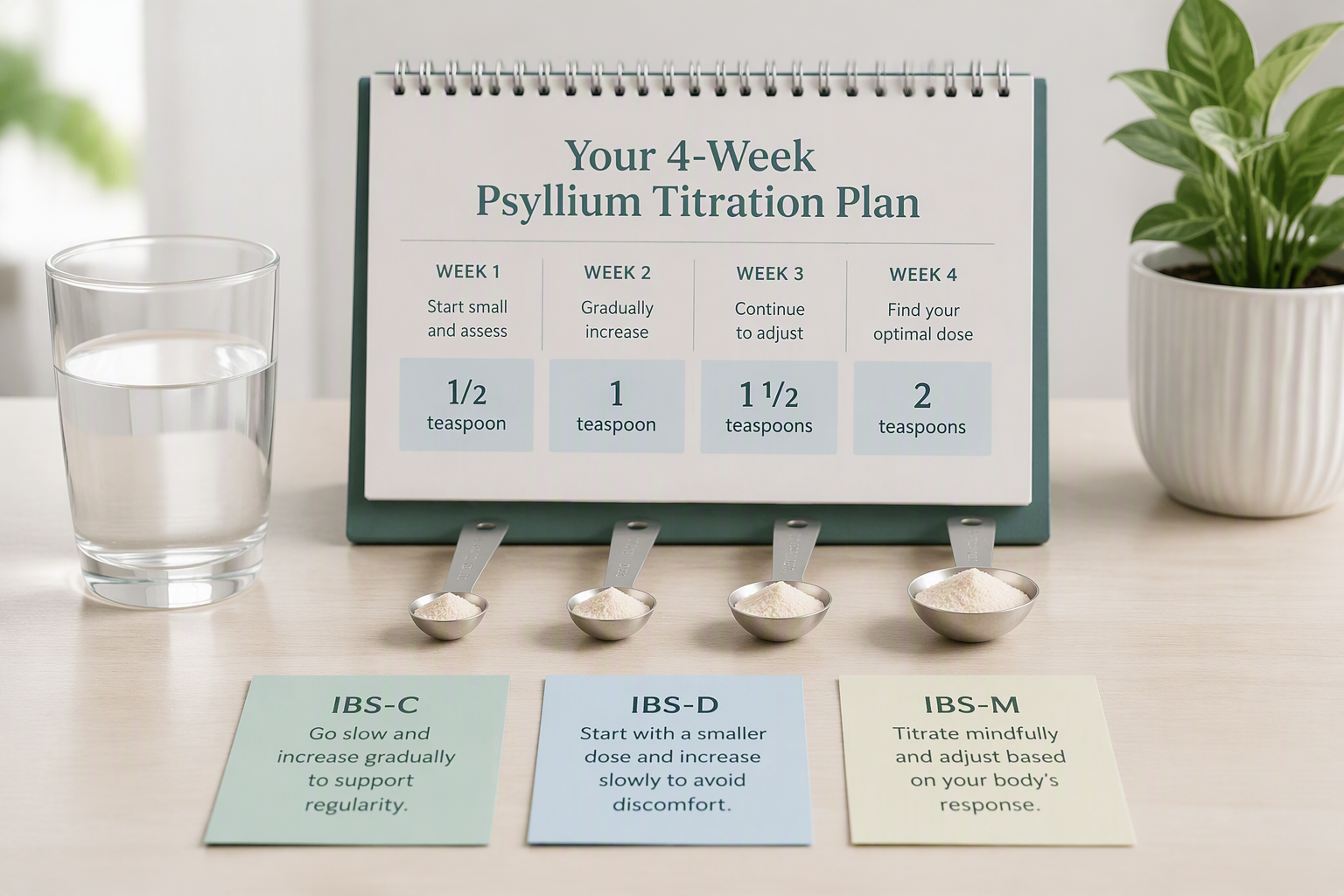
Since that 3.4 gram serving is the target dose, not the starting one, the safest way to start Metamucil for IBS, whether you're managing IBS-C, irritable bowel syndrome with diarrhea (IBS-D), or mixed irritable bowel syndrome (IBS-M), is a low, once-daily dose gradually increased over several weeks, rather than jumping straight to a full serving. Psyllium husk, the fiber inside Metamucil, is a fiber supplement for IBS that's especially well studied for IBS-C, though that research doesn't mean your gut skips the adjustment period. During the first few days, early gas or a stretched, full feeling in your belly is a normal part of learning how to take Metamucil, not a sign the plan is failing. A reasonable starting point is about 1/2 to 1 teaspoon of powder once daily, or an equivalent capsule dose, building slowly toward the standard 3.4 gram serving over the following weeks. Keep your water intake steady and take meds 1-2 hours before fiber, a spacing habit the safe-use section covers in more detail.
Because IBS-C, IBS-D, and IBS-M respond to added fiber in different ways, one generic ramp-up schedule shortchanges most readers. The table below sets weekly targets for each subtype:
Week | IBS-C | IBS-D | IBS-M |
|---|---|---|---|
Week 1 | Half a 3.4 g serving once daily, taken in the morning | Half a serving once daily, taken with a meal rather than on an empty stomach | Half a serving once daily, taken at the same time each day |
Week 2 | Increase to one full serving once daily if symptoms have stayed mild | Hold at half a serving for the full week. Going up too fast is the most common cause of the loosening people mistake for failure | Hold and note which pattern dominates, constipation or diarrhea, since that determines which column you follow next |
Weeks 3-4 | Hold at one full serving. Add a second daily serving only if stools are still hard and the first serving is well tolerated | Increase to one full serving only once stools have firmed | Follow the IBS-C or IBS-D column above based on the dominant pattern you tracked in week 2 |
Target | 1 to 2 full servings daily | 1 full serving daily. More is rarely better for this subtype | Matches whichever column fits your dominant pattern |
Hold your current dose rather than increasing it during any week when symptoms get worse, no matter which subtype applies to you. A held week is a normal, expected part of this schedule, not a setback.
If you'd rather skip the table, week one looks similar for almost everyone. Take your starting dose once daily, at roughly the same time and with a similar meal each day, so you can tell what's actually causing any change you notice. Mild gas or a fuller feeling in the first few days counts as adjustment feedback, not failure. Most people who give up on psyllium do it on day two or three, right when the body is still calibrating to the new fiber load.
If gas, bloating, or a too-full feeling ramps up after a dose increase, hold steady where you are or step back to the last dose that felt comfortable, and stay there for several days before trying again. Sharper, crampy discomfort calls for a fuller pause: stop increasing, let things settle, then restart at the prior lower dose and move more slowly than before. Most people who stick with a slow titration see symptoms ease within 1 to 2 weeks, though full adjustment can take closer to a month for some guts. Aim for the highest dose you tolerate without triggering a flare, since more fiber isn't automatically better for IBS symptoms. Red-flag symptoms call for a different response entirely, covered later in this guide.
Cramping that keeps stalling your titration is a different problem than the too-much-too-fast gas most people expect, and it's worth naming before you give up on fiber altogether: herbal options for IBS cramping are a parallel path worth exploring, not a reason to abandon fiber-based symptom management.
Side effects that fade during that stretch are a green light to keep going toward your tolerated dose. Side effects that persist past that window, worsen even after you've slowed down, or leave you unsure whether fiber fits your IBS subtype are a signal to check in with a clinician before pushing the dose any further.
How Long Should You Expect Metamucil To Work?
Most people notice the first shift in stool urgency or consistency within 2 to 3 days of steady dosing, though full relief from IBS symptoms takes longer to settle in. No change after a day or two doesn't mean the fiber isn't working, so hold off judging results until the real checkpoint below rather than deciding in week one.
Give the fiber a fair test by keeping three things constant for several days:
- Same product: Stick with one Metamucil formula.
- Same amount: Keep your dose consistent.
- Same timing: Take it at the same time daily, earlier in the day rather than right before bed.
Keep hydration steady through this window too, following the mixing and water guidance in the safe-use section below.
Mild gas or bloating during adjustment is common and doesn't mean the fiber is wrong for you. Watch direction instead: less urgency and firmer stools for Metamucil and IBS-D, or easier, less strained passage for constipation. Either pattern means the fiber is starting to regulate bowel movements.
This few-day window is unusually fast for a supplement, and it's worth knowing why. Psyllium is a soluble fiber that works mechanically, absorbing water and physically changing stool texture, so changes show up in days rather than weeks. Options that work by shifting gut bacteria need far more time, which is part of why IBS probiotic trials typically run 4 to 12 weeks before showing benefit, and the mechanisms proposed for hydrolyzed collagen for gut symptoms would likely take even longer, if they work at all. Recognizing fiber as the fast mover keeps you from abandoning slower approaches too soon.
Use this to decide what comes next:
- Continue: Stick with your current dose when the trend moves the right way for your subtype: stools loosening toward normal, a real drop in overall symptom severity, or a move to reduce the frequency of loose watery stools if diarrhea has been the main issue.
- Pause or reduce: Cut back if stools get looser or urgency rises soon after dosing. Drop to a lower amount until things settle, then restart slower.
- Reassess: Judge results at the end of week four on the dose you've actually tolerated, not day three on a starting dose, since those are two different tests.
Any symptom that looks less like normal adjustment and more like a warning sign belongs in the decision-tree guidance later on this page, and that guidance takes priority no matter where you are in this timeline.
How Do You Take Metamucil Safely With Hydration And Timing?
The safest way to take Metamucil comes down to three habits: thorough mixing, enough water, and enough space between doses and other medications. Get those three right, and most of what people blame on "the fiber not working" disappears. That's the core of how to take Metamucil day to day, and the specifics below fill in the rest.
Psyllium husk needs time in liquid to form its gel, so stir each dose until no dry powder clings to the glass, then drink it right away instead of letting it sit. Powder left standing clumps and gets harder to swallow, which makes you less likely to keep the routine going tomorrow. Hydration and proper mixing do more for your comfort than which flavor you pick.
Water volume matters just as much as the mixing itself. Follow the label serving and take each dose with about 8 ounces (240 mL) of water, adding an extra full glass later in the day if you lean toward IBS with constipation. Under-hydration is the most common reason psyllium causes cramping in the first place, and it often gets mistaken for the fiber not working when more water, not more powder, is the real fix.
Fiber can bind to certain drugs in your gut and lower how much your body absorbs, so plan to take meds 1 to 2 hours before fiber or wait that same window after your Metamucil dose. Your pharmacist can flag anything on your specific list, but a few categories are worth double-checking on your own shelf:
- Thyroid hormone: Levothyroxine is already sensitive to timing and food, so fiber on top of that can shift how much gets absorbed.
- Diabetes medications: Metformin and insulin dosing depend on predictable absorption, and fiber taken too close by can affect glucose control.
- Heart and blood pressure medications: Digoxin and some statins can be affected by fiber binding in the gut.
- Antidepressants: Lithium and tricyclic antidepressants fall into this same sensitive category.
- Anticonvulsants: Carbamazepine absorption can drop if taken too close to a fiber dose.
- Mineral supplements: Iron, zinc, and calcium can bind with psyllium and lose potency together.
This list isn't exhaustive, so run your own medication cabinet past a pharmacist before settling into a routine. One pattern that clears both gaps without watching a clock: thyroid medication on waking, breakfast an hour later, Metamucil mid-morning. If your other medications are evening doses, taking Metamucil with lunch or dinner leaves the same buffer on both sides.
Sugar-free doesn't mean additive-free, and the flavored options still carry sweeteners that sensitive guts should skip during a trial, so start with the plainest formula on the shelf.
Unflavored, no added sweetener:
- Metamucil Daily Psyllium Husk Powder, 114 tsp, 4.4 stars from over 3,200 reviews, the cleanest branded default
- Metamucil Unflavored Clear Mixing Powder, 75 tsp, 4.5 stars, dissolves clear in water
Flavored, only if sweeteners sit fine with you:
- Metamucil 4-in-1 Orange Sugar-Free, 180 tsp, 4.7 stars from over 35,200 reviews and an Amazon best seller
- Metamucil 4-in-1 Orange Sugar-Free, 72 tsp, the smaller size for a first trial
Generic psyllium, same active ingredient, lower cost:
- NOW Psyllium Husk Powder, 12 oz, 4.5 stars from over 24,100 reviews
- Yerba Prima Psyllium Husk Powder, 24 oz, 4.5 stars
The Metamucil name doesn't add any active-ingredient advantage over plain psyllium husk, and the generic options typically run well under half the branded price, so pick based on cost, texture, and how well you tolerate sweeteners rather than the brand on the label.
If gas and bloating never settle even after a slow, well-hydrated titration, a non-fermenting fiber might reduce bloating where psyllium hasn't, since it skips the fermentation step that produces gas in your gut:
- Citrucel methylcellulose fiber powder, methylcellulose does not ferment, which is the mechanism behind the switch
- Tomorrow's Nutrition Sunfiber, 30 servings, partially hydrolyzed guar gum, unflavored, 4.6 stars from over 3,700 reviews, carrying a low FODMAP designation
Fiber itself likely isn't your problem here, this particular type of fiber just is.
Skip these while you're testing whether plain psyllium is the fix, since each one adds a second variable to a trial that only works if you isolate one factor:
- 9-in-1 Probiotic Fiber Gummies stack psyllium with FOS, inulin, and a probiotic strain, three fermentable or biologically active ingredients layered onto the fiber
- Smart Eats Fiber Lift adds iron and a vitamin complex
- Pinch Magic Tropical psyllium adds bromelain, vitamins, and tropical flavoring
- Species Nutrition Fiberlyze Fruit Punch is flavored, and blends soluble with insoluble fiber
None of these are bad products. They're just not useful for figuring out whether psyllium alone is what helped you.
If you forget a dose, take it when you remember unless the next one is already close, then skip it rather than doubling up. Doubling raises your odds of worse bloating, cramping, or constipation, which defeats the purpose of a slow, careful start.
How Do You Know When To Adjust Or Stop Metamucil?
Adjusting your dose, stepping back after an increase, and switching to a non-fermenting fiber if psyllium isn't working are covered in the titration steps and FAQ above. This section answers something different: how to tell ordinary gut adjustment from a symptom that actually needs a clinician's attention.
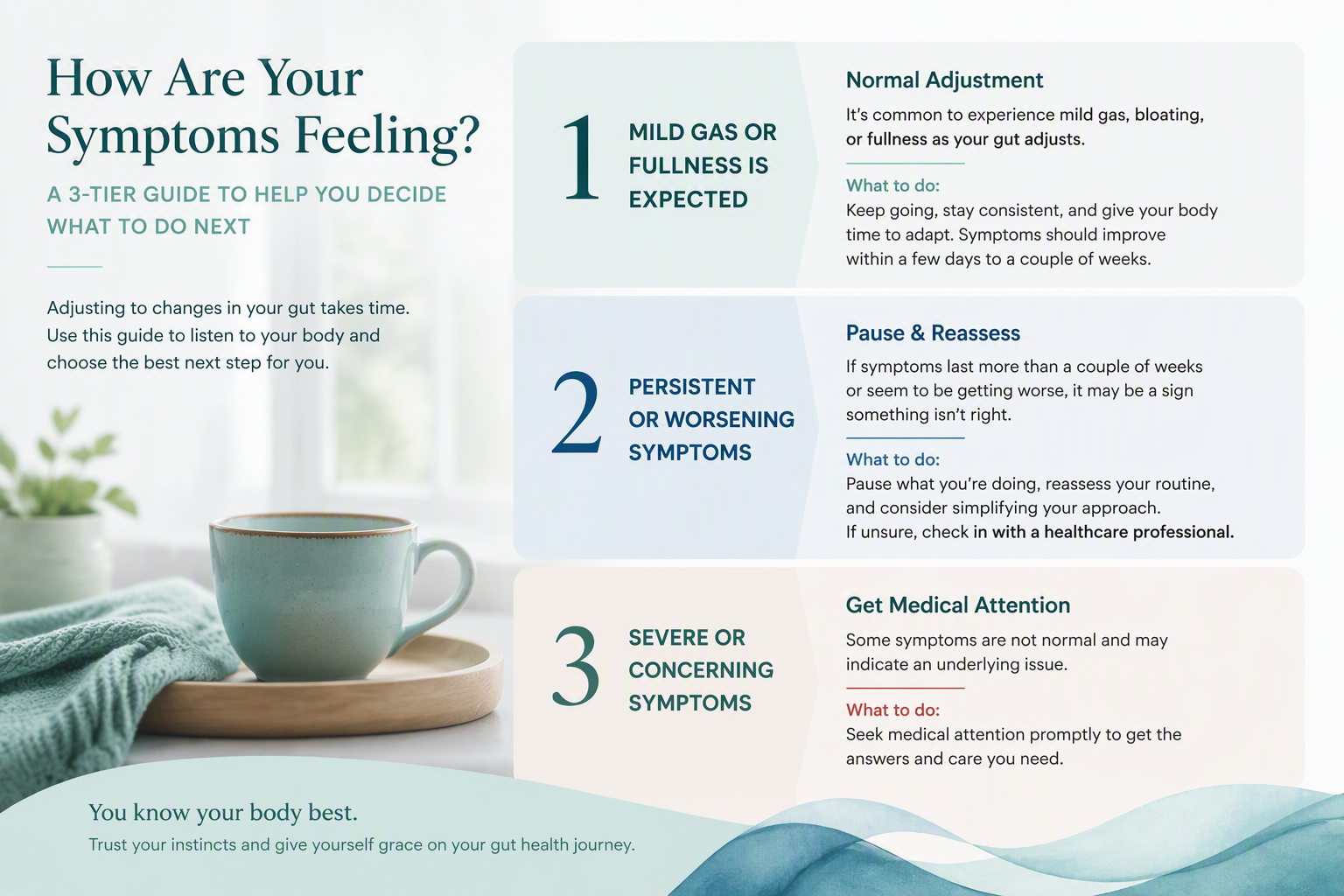
A simple three-tier system makes that call easier:
Tier | What you notice | What to do |
|---|---|---|
Tier 1: Expected adaptation | Mild gas, bloating, or fullness after a dose increase, easing within a few days at a steady dose | Hold your current dose, keep drinking water, and give it time |
Tier 2: Pause and check in | Symptoms worsening day after day despite slow titration and good hydration, constipation or diarrhea trending the wrong direction, or no improvement after a fair trial | Stop and talk with your clinician or dietitian before changing anything else |
Tier 3: Seek care | Trouble swallowing, a feeling that something is stuck, severe or worsening abdominal pain, visible swelling, rectal bleeding, unexplained weight loss, waking at night to use the bathroom, or fever | Stop the supplement and get medical care, urgently for swallowing trouble, severe pain, or bleeding |
Tier 1 accounts for most of what people describe as Metamucil side effects, and psyllium side effects generally, once fiber gets introduced slowly with enough fluid. Staying at a well-tolerated dose tends to reduce bloating and reduce abdominal pain over a couple of weeks, showing up as a real drop in overall symptom severity rather than an overnight change.
Tier 2 has one distinction worth drawing out. If the symptom stalling your progress is cramping rather than gas, that points at gut motility rather than at fiber tolerance, and it is a different problem with a different answer. Peppermint oil for cramping has the strongest IBS-specific evidence for that pattern. Knowing the difference keeps you from abandoning fiber over something fiber was never going to fix.
Tier 3 includes a few signs that sound unrelated to fiber at first: unexplained weight loss, rectal bleeding, waking at night to use the bathroom, and a sudden change in your usual bowel pattern. These are red flags for conditions beyond IBS, and they matter no matter which supplement you're taking. If any were present before you ever started Metamucil, get your diagnosis confirmed by a clinician first, rather than treating it as a reason to simply switch fiber products.
Mechanical risks are rare, but worth naming plainly. Choking, a blocked esophagus, and bowel obstruction have all been reported with psyllium, almost always linked to too little liquid or swallowing it dry, which is exactly why the mixing and hydration steps aren't optional. Anyone with a history of swallowing trouble or bowel narrowing should check with a clinician before starting, and that history matters just as much if you're considering a switch to methylcellulose because bloating keeps coming back.
Most people who give up on psyllium do so in the first week or two, right when Tier 1 symptoms are most noticeable and most temporary. Knowing which tier you're actually in keeps you from quitting too soon on something that would have settled, and from pushing through something that genuinely needed a second look.
This content is for educational purposes only and is not a substitute for personalized medical advice. Digestive symptoms can have many causes, and results vary by person. Consult a qualified healthcare professional for persistent, severe, or worsening symptoms, and before starting a new supplement if you take regular medication.
Metamucil for IBS FAQs
Here are quick answers to the questions people ask most before starting Metamucil for IBS-D or IBS-C, covering dosing, timing, and safety so you can decide with confidence.
1. How long does Metamucil take to work for IBS-D?
With Metamucil and IBS-D, most people notice their first change in stool consistency or urgency within 2 to 3 days of consistent use. That's the mechanical effect: psyllium husk absorbs water in your gut and starts firming loose stools almost right away. If you're wondering how long Metamucil takes to work at the symptom level, plan for 1 to 4 weeks, since you're still adjusting your dose during that stretch.
The two timelines matter because confusing them is why people quit too soon. Fewer urgent episodes and a steadier daily pattern depend on reaching a dose your gut tolerates, not the starting dose. Judge results at the end of week 4 on that tolerated dose, not on day 3. If it doesn't seem to reduce the frequency of loose watery stools by then, or things feel looser or more urgent right after starting, treat that as a cue to lower the dose or pause rather than push through.
2. Should you take Metamucil in the morning or at night?
Morning works best for most people, and Metamucil is one supplement you'll want to skip right before bed. That bedtime rule protects your comfort and safety, not your results.
Psyllium needs fluid to move through your system properly, and lying down soon after a dose can leave you with overnight fullness or cramping. A morning dose gives you the rest of the day to stay ahead on hydration and proper mixing, which matters more than the exact hour you pick. Timing also hinges on your other medications, since fiber can bind to them and blunt absorption. The safest habit is to take meds 1-2 hours before fiber or wait 1-2 hours after, whichever fits your schedule. Pick a slot, whether that's right after breakfast or mid-afternoon, that reliably clears that window, then repeat it daily. A steady routine is part of learning how to take Metamucil in a way that keeps your symptom tracking easy to interpret.
3. Can Metamucil make IBS worse?
Yes, psyllium can worsen gas, bloating, and cramping for some people, usually within the first two weeks of starting Metamucil. These Metamucil side effects and other psyllium side effects most often trace back to increasing the dose too quickly or not drinking enough water, though for a smaller group the fiber itself is the problem. You can tell the two situations apart by watching how symptoms behave over time. Adaptation is mild, shows up right after a dose increase, and starts to reduce bloating and gas within a few days once you hold the dose steady. A genuine fiber mismatch does not ease that way. Gas and bloating stay elevated or even worsen despite a slow, well-hydrated titration, because psyllium ferments, and that fermentation is exactly what triggers symptoms in some IBS guts.
If your symptoms match adaptation, hold your current dose or step back to the last comfortable amount, then wait several days before increasing again. If they match a mismatch, stop pushing psyllium and look at a Metamucil vs Citrucel comparison: methylcellulose (Citrucel) and partially hydrolyzed guar gum are non-fermenting fibers that often work better for fermentation-sensitive guts. Not responding to Metamucil doesn't rule out fiber as a strategy, it just means psyllium isn't the right fit for your gut.
4. Is Metamucil powder or capsules better for IBS?
Powder usually works better while you're titrating psyllium husk for IBS, since you can nudge the dose up in small increments, something capsules make clunky. Once you've settled on the amount that keeps symptoms calm, capsules become the easier daily habit.
What's mixed into the product matters more than the format itself. Flavored Metamucil powders often carry sweeteners or sugar alcohols that can worsen gas and bloating in a sensitive gut, so an unflavored or sugar-free version removes one more variable while you're testing how a fiber supplement for IBS affects you. Check the ingredients panel instead of assuming a plain-looking canister is additive-free.
Capsules deliver a fixed dose each time, so increasing intake means adding a whole capsule, a coarser step than powder allows. If capsules are genuinely what you'll take every day, that consistency often does more to reduce bloating and keep symptoms steady than chasing perfect dose precision with a product you'll end up skipping.
5. Can you take Metamucil long term for IBS?
Yes, you can generally take psyllium husk as an ongoing daily supplement rather than a short course, since it's a bulk-forming soluble fiber and not a stimulant laxative. The dependency worry people carry over from other products doesn't apply the same way here.
That distinction matters because stimulant laxatives act directly on the bowel wall to force a contraction, which is the mechanism behind concerns about the gut becoming reliant on them over time. A bulk-forming laxative like psyllium works differently: it absorbs water and physically changes stool consistency, and your bowel doesn't adapt to that process the way it can to repeated stimulation.
Ongoing use makes sense when you keep the hydration habit going, since the water requirement never disappears, and when you maintain spacing from other medications. Check periodically whether your current dose still works to regulate bowel movements. If new symptoms or a change in bowel pattern show up while your dose has been stable, mention it to a clinician instead of adjusting the fiber on your own.