


Probiotic effects in IBS are strain-specific, which sounds like a technical detail until you try to shop on it. A scan of about 30 best-selling digestive probiotics found that almost none name a clinical strain code. The category’s top seller, with over 143,000 reviews, advertises ten strains and not one code. For the underlying detail, a full guide to probiotic strains covers how codes are assigned and what they signal.
That’s the actual problem this guide solves. It names the five strains with randomized placebo-controlled trial evidence in IBS, shows you how to spot those codes on a label, and explains why the same strain can appear under two different genus names depending on when the packaging was printed.
Products are sorted into three tiers by how closely their evidence matches an IBS reader’s question, rather than ranked by effectiveness the research doesn’t support. That structure also makes clear which products are worth a strain-specific trial and which are better thought of as daily maintenance.
Best Probiotics for IBS Key Takeaways
- Five single strains have demonstrated IBS efficacy in randomized placebo-controlled trials: 35624, 299v, L. rhamnosus GG, S. cerevisiae CNCM I-3856 and B. coagulans Unique IS2.
- B. longum subsp. infantis 35624 has the strongest evidence, from a 362-patient multicenter placebo-controlled trial.
- Match the number, not the genus: 35624 and 299v appear under both old and new genus names on different labels.
- Check CFU amounts stated through expiration, storage directions, and third-party testing that covers strain identity as well as live counts.
- B. lactis HN019 and BB-12 lack IBS-specific evidence, so treat fiber as the first option when constipation or stool form leads.
- S. boulardii and S. cerevisiae CNCM I-3856 are different yeasts, and evidence for one does not transfer to the other.
- Review the ingredient panel for inulin, chicory fiber or FOS, which can worsen gas and bloating in IBS.
- Track stool pattern, urgency, pain and bloating across a 4 to 12 week trial, then stop, switch, or seek medical advice if symptoms worsen or fail to improve.
How Do You Determine Your IBS Subtype and Main Symptoms?

Your IBS subtype is best identified by the bowel pattern that repeats over several weeks or months, not by one flare. Irritable bowel syndrome (IBS) is a chronic gut-brain condition, and changes along the gut-brain axis can influence pain, stool patterns, and urgency.
Use these patterns as a starting point:
- IBS-D: Loose stools, diarrhea, or frequent urgency occur most often.
- IBS-C: Constipation, hard stools, or straining are the main pattern.
- IBS-M: Diarrhea and constipation alternate over time.
Bloating, abdominal pain, cramping, and gas can occur with any subtype. Mucus with diarrhea or urgency is worth recording and discussing with a healthcare professional, particularly when it is new or persistent.
A quick symptom scan helps separate your main treatment goal from related discomforts:
- Primary symptom: The change you most want to improve, such as urgency with IBS-D, hard stools with IBS-C, or shifting bowel habits with IBS-M.
- Secondary symptoms: Problems that accompany the main concern, including gas, bloating, cramping, or other pain episodes.
- Outcome to track: The measure that matters most to you, such as stool frequency, stool consistency, urgency, pain, bloating, or gas.
Symptom targeting matters because probiotics for IBS are not interchangeable. A product that helps bloating may not improve bowel regularity, while one that affects stool consistency may not ease abdominal discomfort. There is no single best probiotic for irregular bowel movements, because the right choice depends on your subtype, your dominant symptom, and the strain that was actually studied for it.
When hard or loose stools lead your list, fiber generally has more consistent support for changing stool form than any individual probiotic strain (source). Probiotics are one branch of a wider category, and supplement options for IBS sets out what each one is actually for. Metamucil and fiber titration is the fiber route to discuss with a healthcare professional. Increase fiber gradually because a sudden increase may worsen gas or bloating.
Probiotics may make more sense when discomfort, bloating, or gas is your main concern, or after stool-form strategies have been tried. Whatever you are searching for, check the claim against the exact strain and the exact symptom studied. Evidence varies by strain, and greater gut microbiota diversity does not automatically mean fewer IBS symptoms.
During a trial, judge the product against your primary goal. For IBS-D, a useful early change might be less urgency or less loose stool with reduced cramping, rather than less gas alone. If the main symptom does not improve, the strain may not match your needs. Stop and seek medical advice for persistent, severe, or worsening symptoms. Results vary by person, and probiotics should not replace evaluation or prescribed care.
Which Probiotic Strains Match Your IBS Symptoms?
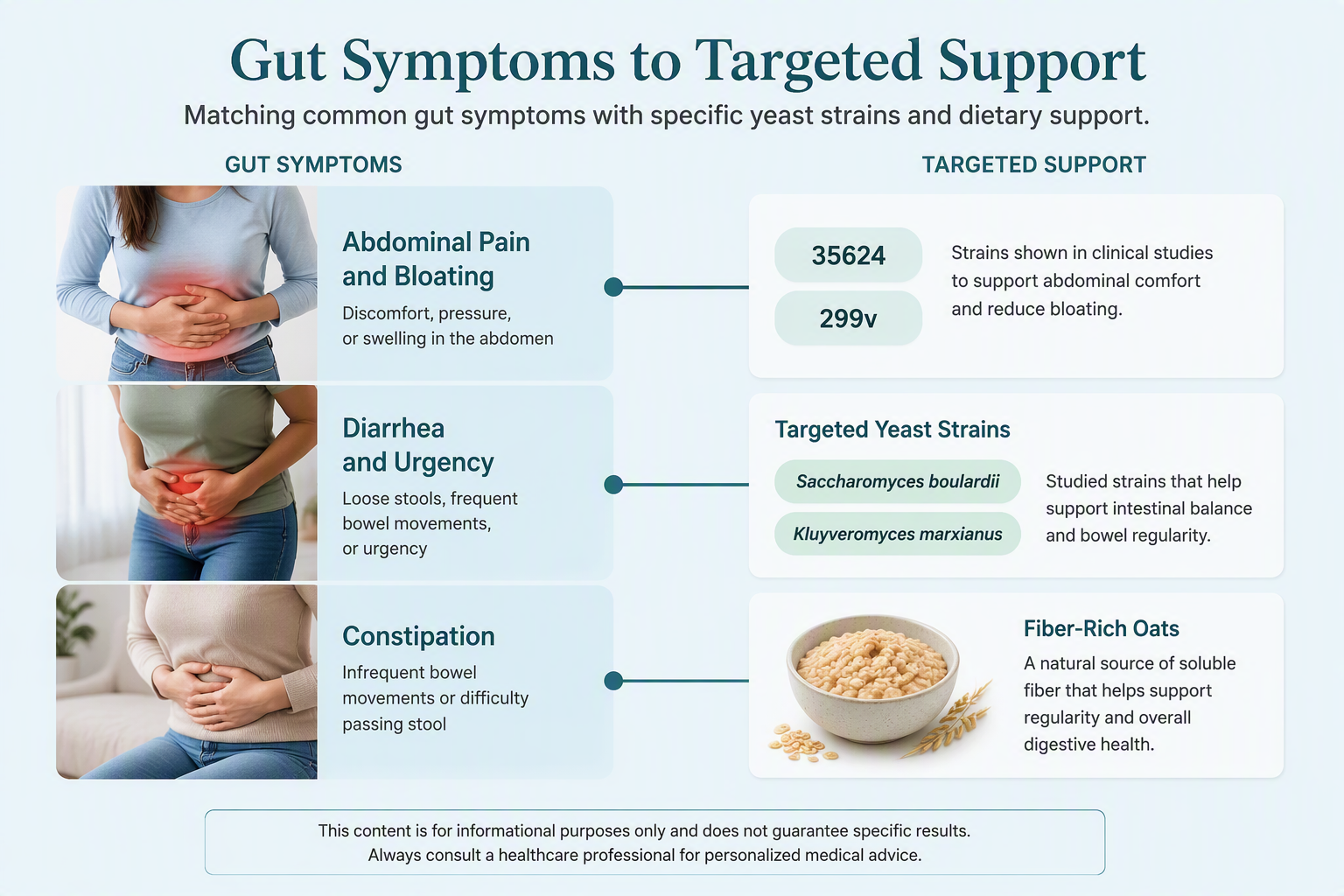
Probiotic effects in IBS are strain-specific, so targeted options make more sense than generic blends. The strain that fits pain and bloating may not be the one most relevant to diarrhea, urgency, or constipation. Match the strain to your main symptoms, with the expectation that results vary by person.
A systematic review and meta-analysis searched randomized, placebo-controlled trials through December 2025. Among 32 articles covering 10 single strains, five showed efficacy for at least some key IBS symptoms:
Strain to look for on the label | Symptoms or IBS pattern it may fit | What to know |
|---|---|---|
Bifidobacterium longum subsp. infantis 35624, formerly Bifidobacterium infantis 35624 | Overall symptoms, abdominal pain, and bloating | The strongest overall fit in this shortlist |
Lactiplantibacillus plantarum 299v, also called DSM 9843 | Pain and bloating | Positive older trial data, though one study was small |
Saccharomyces cerevisiae CNCM I-3856 | Overall IBS symptoms, including some diarrhea-related concerns | A specific yeast strain, separate from S. boulardii |
Lactobacillus rhamnosus GG | Selected IBS symptoms | Trial support exists, but the symptom match is less specific |
Bacillus coagulans Unique IS2, also called MTCC 5260 | Selected IBS symptoms | Included in the review, with less practical guidance for choosing it |
For overall symptoms, abdominal pain, and bloating, 35624 has the strongest case for a first trial. A multicenter, randomized, double-blind, placebo-controlled, dose-ranging study included 362 primary-care patients across IBS bowel-habit subtypes and reported improvement in several IBS symptoms (Whorwell PJ, et al., American Journal of Gastroenterology, 2006, source).
An earlier mechanistic study examined how Lactobacillus and Bifidobacterium affected symptoms and cytokine profiles, which are immune-signaling markers related to inflammation. In that study, 35624 outperformed placebo on symptoms other than bowel movement frequency and stool consistency (O’Mahony L, et al., Gastroenterology, 2005, source). These findings support 35624 for pain and bloating, but they do not establish that it will improve stool frequency for every person.
Packaging can make the same strain look unfamiliar. Match the identifying code rather than relying only on the genus name:
- 35624: Bifidobacterium infantis 35624 may also appear as Bifidobacterium longum subsp. infantis 35624.
- 299v: Lactobacillus plantarum 299v may also appear as Lactiplantibacillus plantarum 299v or DSM 9843.
For pain and bloating at a potentially lower price point, 299v is a reasonable alternative to compare. A small controlled, double-blind trial reported abdominal pain resolution in all 20 participants taking 299v, compared with 11 of 20 receiving placebo (Niedzielin K, Kordecki H, Birkenfeld B, European Journal of Gastroenterology and Hepatology, 2001, source). Because only 20 people were in each group, that result carries less weight than the larger evidence review. Products marketed for gas and bloating should show the exact 299v code on the label.
Diarrhea-predominant IBS requires careful attention to the yeast name. Saccharomyces boulardii may reduce stool frequency and urgency, particularly in post-infectious IBS (source). Saccharomyces cerevisiae CNCM I-3856 is a different yeast and the only one of these two included in the five-strain meta-analysis shortlist. Both may be considered for IBS-D, but evidence for one does not automatically apply to the other.
Constipation-predominant IBS calls for more restraint. Bifidobacterium lactis HN019 and Bifidobacterium lactis BB-12 have research involving gut transit and bowel movement frequency in general adult populations, but they were not among the five strains with demonstrated IBS-specific efficacy in the review. Fiber should come first for IBS-C, with probiotics treated as secondary rather than the main strategy.
A practical starting point is 35624 or 299v when pain and bloating lead, a clearly identified yeast when diarrhea and urgency lead, and fiber-first care when constipation leads. If your symptoms do not fit these patterns, pause before buying a broader blend and discuss other causes or treatment options with a qualified healthcare professional.
How Do You Verify Strain Codes, CFU, and Product Quality?
The label is your best first filter because strain-specific probiotics for IBS are not interchangeable. Evidence is mixed, so matching the label to the strain studied in research gives you a more informed starting point than choosing by a high CFU number alone.
A July 31, 2026 review of about 30 best-selling IBS and digestive probiotics on Amazon US found that almost none named a clinical strain code. Most listed only a genus and species, such as Lactobacillus acidophilus or Bifidobacterium infantis, or placed the contents in a proprietary blend. Physician’s CHOICE Probiotics 60 Billion CFU, the category’s top seller with 4.6 stars from 143,800 reviews, lists 10 strains and organic prebiotics but no strain code on its front label. Buying by strain code removes much of the shelf, but it makes the product’s research match easier to assess.
Use this on-pack workflow:
- Find the complete strain name: Look for a code such as 35624, 299v, or LRa05 after the species. A label that says only Bifidobacterium infantis is not specific enough.
- Check the dose: Confirm the colony-forming unit (CFU) amount and make sure the serving size matches how you plan to take it. Look for potency measured through expiration, not only at manufacture.
- Count identified strains: Ten strains matter only when each is individually named, coded, and assigned a meaningful amount. A proprietary blend can hide both identities and doses, so more strains is not automatically better.
- Review viability and storage: Check storage directions, the expiration date, and whether live counts are stated through the end of shelf life.
- Check testing and added ingredients: Third-party testing is more useful when it covers strain identity, live counts, and contaminants. Review the ingredient panel for inulin or FOS, which can worsen gas and bloating for some people with IBS.
This standard differs from the usual supplement check. With collagen for IBS, fewer unnecessary ingredients may be the main concern. Probiotics are different because the active ingredient is meaningful at the strain-code level. A tidy label can still provide too little information to judge its relevance.
Rather than ranking products by effectiveness, which the evidence rarely supports, it helps to sort them into three tiers by how closely the research matches an IBS reader’s question.
Tier 1: strain-specific trials in diagnosed IBS patients. Only two products here meet this standard, and it is the highest bar on this page.
- Align Probiotic supplies Bifidobacterium longum subsp. infantis 35624, backed by a 362-patient multicenter randomized double-blind placebo-controlled dose-ranging trial
- Metagenics UltraFlora Intensive Care, 4.4 stars, names clinically tested Lactobacillus plantarum 299v at 20 billion CFU
Highest evidence, highest price. Strain-verified products typically cost several times what an unlabeled blend does, because they provide better identification, not because they guarantee better results.
Tier 2: full strain disclosure with published trials on those strains, but not in IBS. YourBiology Gut+, positioned for women, and Biotics 8, positioned for men, share the same strain base at different concentrations and name every strain on the label: L. acidophilus LA85, L. paracasei LC86, L. rhamnosus LRa05, L. casei LC89, L. fermentum LF61, L. plantarum N13, B. breve BBr60, B. bifidum BBi32, B. longum BL21, and S. boulardii SB01. Naming ten coded strains puts them ahead of almost the entire shelf from the market scan above.
Four of those ten have published human randomized controlled trials. L. rhamnosus LRa05 has the most: a trial in 111 children with acute diarrhea cut duration from 143.9 to 121.4 hours, and a randomized double-blind placebo-controlled H. pylori trial in 72 adults used the Gastrointestinal Symptom Rating Scale as an endpoint. L. acidophilus LA85 has a randomized placebo-controlled trial for preventing antibiotic-associated diarrhea. B. bifidum BBi32 has an 8-week randomized double-blind placebo-controlled trial in 40 adults measuring tolerability and gastrointestinal symptom scores. B. longum BL21 has a 12-week randomized controlled trial on glycemic control, which is a real trial but not gut-relevant.
Three caveats belong in the same breath. First, none of these strains has an IBS trial; the closest relevance is diarrhea, which maps to IBS-D, so the honest phrasing is that they have been studied for diarrhea-related outcomes rather than proven for IBS. Second, nearly all of this research is sponsored or co-authored by the strain manufacturer, the same disclosure standard applied to manufacturer-funded research elsewhere on this site. Third, six of the ten strains have no human trial data at all. Four of ten, not ten of ten.
Both products also contain added prebiotic fiber, FOS in YourBiology Gut+ and chicory root inulin in Biotics 8, which is exactly the trigger this page warns prebiotic-sensitive readers about. And because they combine probiotics, digestive enzymes, and prebiotic in one capsule, they are not the right choice while you are isolating a single variable. Treat them as daily gut maintenance with an unusually readable label, not as trial products.
Tier 3: no strain identification. Use these as teaching examples rather than purchases:
- Vitamatic Bifidobacterium Infantis names the species but no strain code, and is made with prebiotic inulin fiber, so it fails twice over for an IBS reader
- Vitamatic Lactobacillus Plantarum has the same two problems
- Toniiq Lactobacillus Plantarum advertises third-party tested potency, a genuine quality signal, but includes FOS and still names no strain code
Testing can support quality, but it cannot replace strain identification.
This content is for educational purposes only and is not a substitute for personalized medical advice. Results vary by person, and any dietary or supplement advice should be individualized. Digestive symptoms can have many causes. Consult a qualified healthcare professional for persistent, severe, or worsening symptoms.
When Should You Start a Probiotic and Avoid Common IBS Triggers?
Start a probiotic during a relatively stable IBS window rather than in the middle of a major flare. Keeping meals, medications, and daily routines fairly consistent makes your response easier to interpret. The studies behind the strains discussed on this page measured results over weeks, not days, so an improvement during the first week may be encouraging without proving the product is helping. Judging it after two days mostly captures normal IBS variation.
How long probiotics take for IBS depends on the strain, formulation, and person. Avoid introducing several supplements or major diet changes at the same time. A steady routine gives you a clearer view of whether symptoms are changing because of the probiotic, another variable, or ordinary fluctuation.
Prebiotic ingredients deserve close attention when gas and bloating are concerns. Fermentable carbohydrates such as inulin, chicory fiber, and FOS can increase symptoms for some people with IBS. They’re common in probiotic-plus-prebiotic products, so a formula with an appropriate strain may seem ineffective when the added fiber is actually worsening symptoms.
Check the label for these details before you buy:
- Added prebiotics: Look for inulin, chicory fiber, or FOS if these ingredients have triggered symptoms before.
- FOS-free wording: A product labeled FOS-free can help you test the probiotic without adding a carbohydrate trigger.
- Strain information: Choose a formula that names its strains instead of using unclear abbreviation lists.
Testing one change at a time can give you a cleaner result than choosing a longer ingredient list. That distinction matters most if high-fiber foods or supplements have caused problems for you before.
Keep meals simple and familiar during the trial. Reduce only the triggers you already recognize, such as large portions of onions, garlic, greasy meals, sugar alcohols, or carbonated drinks, rather than starting a strict elimination diet alongside the probiotic. A brief daily note can include stool pattern, abdominal pain, bloating, gas, meals, and product timing.
A multi-strain formula may be reasonable when its strains and evidence are clearly stated. A 2023 network meta-analysis ranked one five-probiotic mixture highest for IBS-related quality of life, but that ranking cannot predict your individual response (Zhang T, et al., Nutrients, 2023, source). Use it to frame a conversation with a clinician rather than as a substitute for medical advice.
Stop using the product and contact a healthcare professional for severe or worsening symptoms, blood in the stool, fever, dehydration, or unexplained weight loss. This content is for educational purposes only and is not a substitute for personalized medical advice. Results vary by person, and supplement advice should be individualized.
How Do You Run a 4 to 12 Week At Home Probiotic Trial?

A probiotic trial is a structured test, not a guaranteed fix. IBS responses vary by strain and symptom type, so one person may notice a stool change while another notices little or no difference. Probiotics may help some stool-related symptoms, especially diarrhea, while abdominal pain and bloating may improve later or remain unchanged.
Four weeks is a reasonable minimum before you draw any conclusion. Many people need 4 to 8 weeks to judge a product, and a specific strain may deserve 8 to 12 weeks before you decide it isn’t helping. How long it takes depends on the strain, your IBS subtype, and the symptom you’re tracking.
Choose one main target and record symptoms separately instead of relying on your overall impression:
- IBS-D: Track bowel movement frequency, urgency, and stool form with the Bristol Stool Form Scale. Also record abdominal pain and bloating.
- IBS-C: Track bowel movement frequency, ease of passing stool, and straining. Include abdominal pain and bloating.
- IBS-M: Record both loose and hard stools, along with urgency, straining, pain, and bloating.
A label that identifies the full strain, rather than only listing a broad species or genus, makes your trial easier to interpret. Keep the product, dose, and routine consistent, and follow its food and storage directions.
Take the probiotic at the same time each day and keep other variables as steady as practical. Adding a new fiber supplement, laxative, IBS medication, or major diet change during the same week can make it difficult to tell what caused a shift.
Your tracking note can include the date, dose, stool type, bowel movement count, urgency or straining, pain, bloating, and missed doses. A small number of people notice a change in diarrhea within the first day or two, but an early shift doesn’t confirm that the full trial will help.
Review your notes at these points:
- Weeks 2 to 3: Look for an early signal, such as fewer urgent bowel movements or easier stools. If stool symptoms improve but pain or bloating hasn’t, continue rather than switching immediately.
- Weeks 4 to 8: Base the main decision on your primary target and the pattern across several days. Meaningful improvement supports completing the planned trial.
- Weeks 8 to 12: Use this longer window when the product’s strain-specific guidance supports it or changes are gradual. Don’t continue indefinitely without a clear reason.
If your main symptoms improve, complete the planned 4 to 12 weeks, then discuss whether continued use makes sense. If little changes after an adequate trial, stop that strain and consider another approach matched to your IBS subtype with professional guidance. Benefits can be temporary, and some people notice symptoms return within days of stopping.
Pause self-experimenting and contact a qualified healthcare professional if symptoms become severe, worsen quickly, or feel unusual for you. Digestive symptoms can have many causes, so persistent, severe, or worsening symptoms need medical evaluation. This content is for educational purposes only and is not a substitute for personalized medical advice. Results vary by person, and supplement decisions should be individualized.
When Should You Stop, Switch, or Combine Probiotics?
Set success before starting a probiotic trial. Major US gastroenterology guidance doesn’t recommend probiotics as routine treatment for IBS, and the evidence remains mixed (source). Aim for a measurable change in the symptoms that matter most to you, not permanent improvement. Results vary by person.
Track symptoms during a defined trial instead of judging the product by one good or bad day. A practical stop-or-switch plan includes:
- Stop: Discontinue the product if symptoms worsen or new concerning symptoms appear. If there’s no meaningful improvement after about 8 to 12 weeks, stop that strain and consider a different approach rather than continuing indefinitely.
- Switch: A reduction in pain or bloating doesn’t necessarily improve diarrhea, constipation, or bowel regularity. When your main IBS pattern stays the same, a different strain or formulation makes more sense than extending an unhelpful trial.
- Reassess early: If a relevant improvement appears during a well-run 4 to 8 week trial, consider whether the change is steady and meaningful enough to support continued use. Temporary benefit still provides useful information, but it doesn’t establish a lasting effect.
Change the product logic, not just the brand name. A single-strain product that produced little or partial benefit may justify trying a multi-strain formula, particularly one containing both Lactobacillus and Bifidobacterium species, though evidence for that approach isn’t consistent for everyone.
A 2023 network meta-analysis of 81 randomized controlled trials involving 9,253 participants found that four single strains and five mixtures performed better than placebo on the IBS Symptom Severity Scale. Lactobacillus acidophilus DDS-1 ranked highest for that outcome, while a five-probiotic mixture ranked highest for IBS quality of life (Zhang T, et al., Nutrients, 2023, source). SUCRA rankings organize treatments within an evidence network, so they aren’t head-to-head proof that one product is superior.
A second failed probiotic may mean the category doesn’t match your symptom pattern, and what your log showed points to where to look next. If symptoms clustered after specific meals, digestive enzymes for IBS may be a better-matched topic to discuss with a healthcare professional. If cramping occurred independently of food, that points at motility rather than the microbiome: peppermint oil trials for IBS have the strongest evidence for pain and cramping specifically, and Iberogast dosing and cautions covers the multi-herb alternative. A well-run probiotic trial that fails still earns you that information, which is why the tracking mattered.
Combining probiotics should be temporary and purposeful. Partial improvement in one symptom domain with no change elsewhere may support a cautious combine-and-retest approach, but small studies, publication bias, and inconsistent study designs limit confidence. Stop or reassess when your symptoms don’t improve.
This content is for educational purposes only and is not a substitute for personalized medical advice. Digestive symptoms can have many causes, so consult a qualified healthcare professional for persistent, severe, or worsening symptoms. Any probiotic plan should be individualized and should not replace medical care, prescribed treatment, or diagnosis.
What Safety Checks Prevent Serious Side Effects With IBS Probiotics?
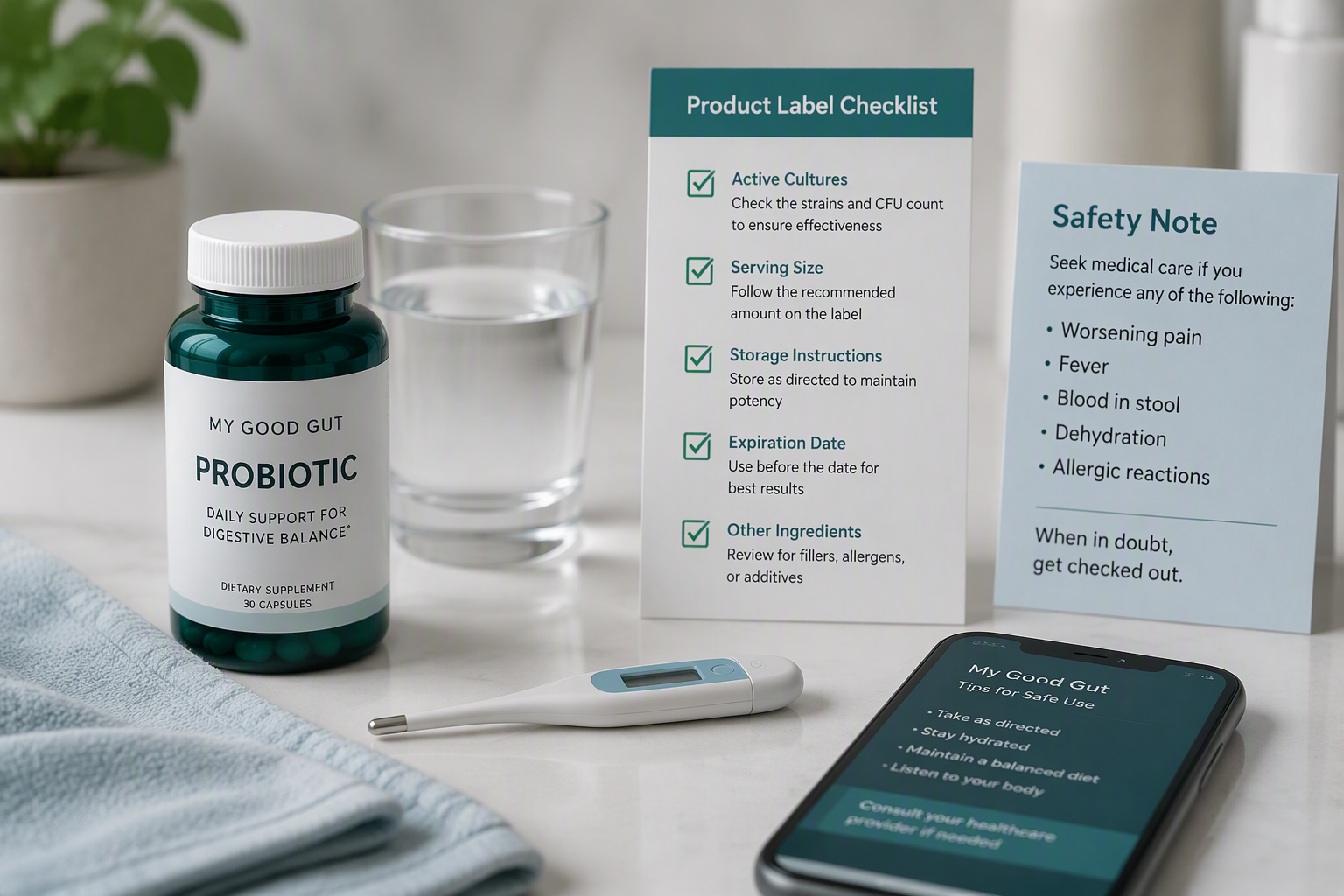
Probiotics are best treated as a monitored trial, not risk-free relief. Major US gastroenterology guidance does not recommend them as routine IBS treatment for everyone, and benefits may vary by strain, dose, and IBS subtype (source).
Choose a product that makes symptom changes easier to interpret. Some supermarket “gut health” blends hide exact strains, which may lead to disappointing results and make gas or cramps harder to connect with the product rather than an IBS flare. Check for:
- Specific strain names: The label should identify the full strain, not only a species such as Lactobacillus or Bifidobacterium.
- CFU per serving: A stated colony-forming unit (CFU) amount gives you a consistent daily dose to track.
- Storage and viability details: Check whether the CFU count applies through expiration or only at manufacture.
- Simple additives: Fewer added ingredients make potential triggers, such as sweeteners, easier to spot.
- Third-party testing: Independent testing can provide added information about label accuracy and certain contaminants.
Individual strains can carry their own trial data, which is why strain-level labeling matters. One randomized, double-blind, placebo-controlled study of Bifidobacterium bifidum MIMBb75 reported significant relief of IBS symptoms and improved quality of life (source). That result belongs to MIMBb75 specifically and does not transfer to other B. bifidum products carrying a different strain code.
Safety data also needs careful interpretation. A 2023 review of 81 randomized trials involving 9,253 participants reported adverse events in 11.62% of probiotic recipients (452 of 3,891) and 10.61% of placebo recipients (379 of 3,572). Serious events occurred in 0.15% (6 of 4,081) and 0.22% (8 of 3,679), respectively (Zhang T, et al., Nutrients, 2023, source).
These were raw pooled counts, not a formal statistical comparison. The authors did not assess whether events were caused by probiotics, and some studies classified ordinary IBS symptoms, including pain, bloating, and diarrhea, as adverse events. The rates look broadly similar, which is different from proving that probiotics and placebo have identical safety profiles.
Stop the trial and seek prompt clinician advice for:
- Worsening abdominal pain, fever, or blood in your stool.
- Severe diarrhea with signs of dehydration.
- Hives, facial swelling, wheezing, or another allergic-type reaction.
If bloating, cramping, or stool changes become clearly more intense after starting, keep other routines stable and stop the probiotic. Persistent symptoms, rapid relapse, or a change that does not fit your usual IBS pattern warrants medical guidance before you switch strains or formulations.
This content is for educational purposes only and is not a substitute for personalized medical advice. Digestive symptoms can have many causes, results vary by person, and supplements should not replace diagnosis, prescribed treatment, or medical care.
Best Probiotics for IBS FAQs
These FAQs cover common questions about choosing probiotics for IBS, from matching strains to reading product labels and setting realistic trial expectations. They also address when to reassess your choice, since results vary by person and evidence remains limited for some products.
1. Is VSL#3 still a good probiotic for IBS?
The research often cited for VSL#3 concerns a formulation the brand no longer contains. If you want the blend used in those studies, look for Visbiome in the United States rather than assuming current VSL#3 has the same formula. The history matters because a brand name can stay the same after the product inside changes.
Professor Claudio De Simone created the eight-strain, high-potency probiotic in the early 1990s, and it was sold under the VSL#3 name from 2002 through 2016. After De Simone separated from VSL Pharmaceuticals in 2016, the original formulation and its strain bank moved with him, while the VSL#3 brand continued under a different formula.
The dispute was settled in court, which is what makes this verifiable rather than a marketing disagreement. In November 2018 a US federal jury found VSL#3’s sellers liable for false and misleading advertising, awarding De Simone and ExeGi Pharma more than $18 million. A federal court issued a permanent injunction in June 2019 barring claims that the newer product continued the original formulation or that pre-2016 clinical studies applied to it, and a federal appeals court upheld that position in 2021 ( source ).
The original formulation is now sold as Visbiome in the US and Canada, distributed by ExeGi Pharma, and as Vivomixx in parts of Europe.
The lesson generalizes beyond this one product: judge a probiotic by the strain codes on the label, not by a brand’s reputation or by studies that predate a formulation change. This case is the clearest available proof that a trusted name and a studied product can quietly become two different things, which is exactly why the strain-code check earlier on this page matters.
2. Do probiotics need refrigeration, and does a higher CFU work better?
Refrigeration depends on the probiotic strain and manufacturing method, so follow the label rather than a general rule. A higher CFU count does not reliably mean better IBS results.
CFU/mL dosing matters less than whether a named strain studied for your symptom appears at the studied dose. A blend advertising 60 or 100 billion CFU without naming its strains tells you less than a smaller, clearly identified product, which is why strain-specific probiotics for IBS deserve closer attention than products marketed as the best probiotics for IBS.
Check whether the label lists viability through the end of shelf life, not only at manufacture. Choose a storage requirement you can follow consistently, since a refrigerated product left in a work bag may be less useful than a shelf-stable option you take as directed.
3. Can you get the same benefit from yogurt or kefir instead?
No, yogurt or kefir won’t provide the same benefit as a strain-verified probiotic supplement. Fermented foods contain live cultures, but they rarely identify the exact strains or amounts studied in IBS, so they can’t show whether a particular strain helped your symptoms. A supplement gives you a known strain at a known dose, which makes it easier to trial, track, and stop.
That doesn’t make yogurt or kefir unhelpful. If you tolerate them, they can add microbial variety and support gut microbiota diversity as part of a regular routine. IBS adds an important catch: dairy-based options may contain lactose, while other fermented foods can also trigger symptoms. A reaction may come from the food rather than the bacteria. Try one item at a time, start with a small amount, and monitor symptoms for several days. Use fermented foods as an ongoing habit when they suit you, and choose a strain-verified supplement when you’re testing a specific question about probiotics for gas and bloating IBS or probiotics for IBS. They’re different tools, not substitutes.
4. Who should avoid probiotics or ask a doctor first?
Probiotics are safe for most healthy adults with IBS, but ask a clinician first if you’re immunocompromised, take chemotherapy or immunosuppressants, have a central venous catheter or other indwelling line, are critically ill, recently had major abdominal surgery, or have a condition affecting the gut wall. Premature infants need specialized medical guidance.
These situations can let live organisms reach places they shouldn’t, creating a rare infection risk. That concern differs from temporary gas or bloating during the first week and doesn’t automatically apply to fiber or enzymes. If you’re comparing probiotics for IBS or the best probiotics for IBS, ask before starting when any risk factor applies. Results vary by person. This content is for educational purposes only and is not a substitute for personalized medical advice.