


Digestive enzymes only work when your symptoms follow a specific food, which is why so many people buy a bottle and feel nothing. The useful question isn't which enzyme is best, it's whether your symptoms are food-timed at all.
This guide starts with a simple table that maps a trigger pattern to the enzyme worth testing: dairy to lactase, beans and lentils to alpha-galactosidase, wheat and onion to the fructan blends. It includes a row most articles leave out, which is what to do when no food pattern shows up, because that answer points away from enzymes entirely.
You'll also see what the evidence actually shows for each, including a trial where a third of IBS participants turned out not to be sensitive to the carbohydrate the enzyme targets. That single finding explains more product disappointment than anything else in this category.
Digestive Enzymes for IBS Key Takeaways
- Match the enzyme to the specific food trigger, not to your IBS subtype; symptoms should appear within roughly zero to six hours of eating it.
- Lactase works best when dairy reliably triggers bloating, gas or diarrhea within hours, though it treats lactose digestion rather than IBS itself.
- Alpha-galactosidase has the strongest IBS-specific evidence, from a randomized placebo-controlled trial in 31 patients.
- In that trial only 21 of 31 were GOS-sensitive, so roughly a third of people with IBS have nothing for the enzyme to act on.
- Enzymes ease symptoms tied to fermentable carbs, not the underlying causes of IBS.
- Run a focused 2 to 4 week trial, taking the enzyme with every trigger meal rather than daily.
- Avoid blends with added prebiotics, probiotics or sweeteners that can mask whether the enzyme worked.
- Stop trialing and see a clinician if you notice blood in your stool, fever or unexplained weight loss, and ask about a fecal elastase test if no food pattern emerges.
What do digestive enzymes do for IBS
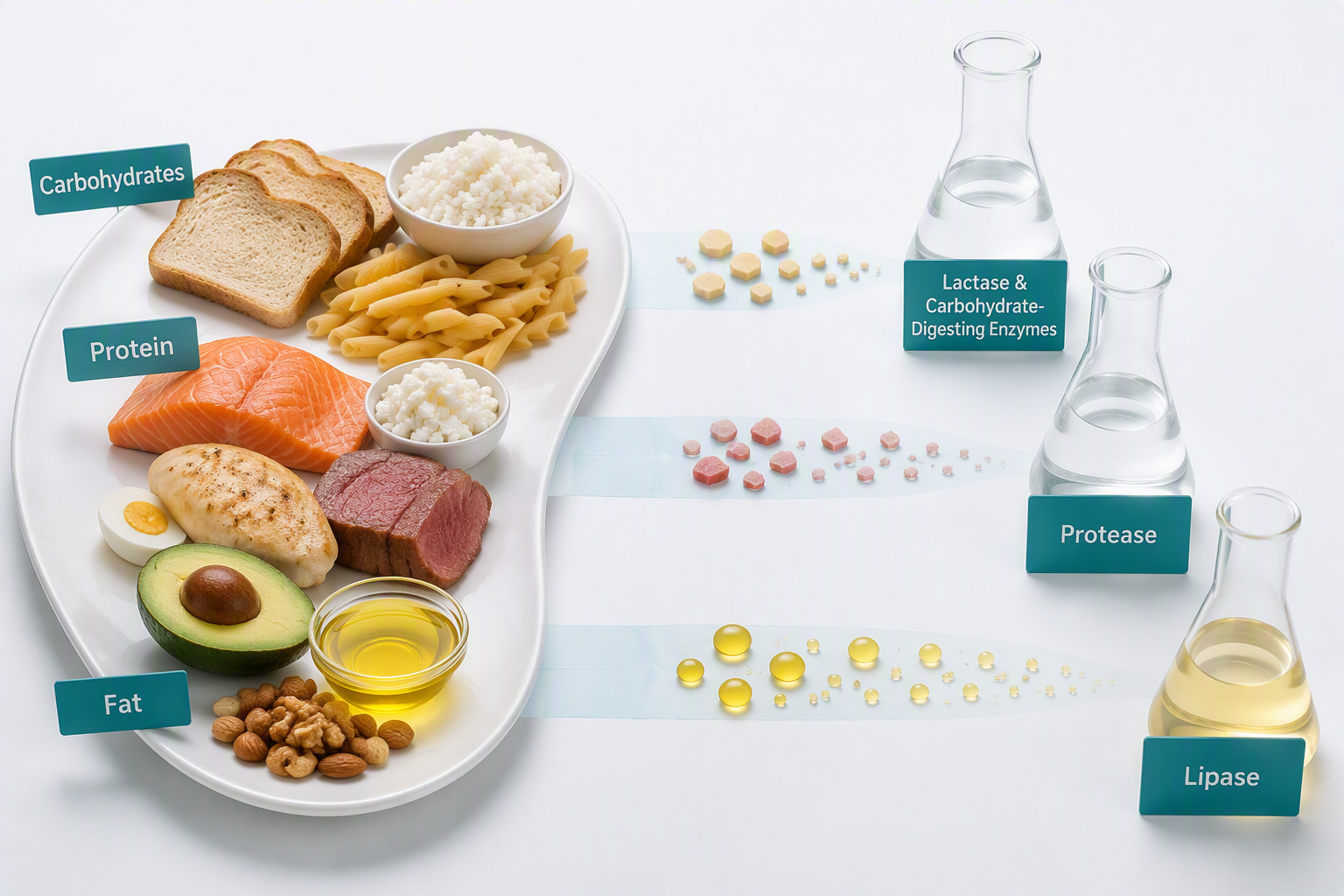
Digestive enzymes are proteins your body makes to break food into pieces small enough for your gut to absorb. When people talk about irritable bowel syndrome (IBS), three groups usually come up:
- Lipase: Breaks down fats.
- Protease: Breaks down proteins.
- Carbohydrate-digesting enzymes: Such as lactase (for lactose) and sucrase (for sucrose).
Taking digestive enzymes for IBS doesn't treat the syndrome itself. It targets one narrow piece of digestion, breaking down specific carbohydrates before gut bacteria ferment them and produce the gas behind bloating and cramping.
That narrow focus is the whole case for IBS digestive enzymes. If a trigger food is packed with fermentable carbohydrates your gut struggles to process, taking the matching enzyme with that meal can ease IBS bloating and gas, along with the IBS abdominal pain that follows. Enzymes belong among the other IBS supplement options you might weigh, but they do a distinct job:
- Fiber: Changes stool form.
- Probiotics: Shift the microbial environment in your gut.
- Herbal formulas: Work mainly on motility and cramping.
Enzymes act the moment food arrives, which makes them a meal-timing tool rather than a daily treatment.
You're a realistic candidate if bloating, gas, pain, or a shift in bowel habits reliably follows lactose-containing dairy or beans. That pattern makes a short, targeted trial worth considering. Sorting out lactose malabsorption vs IBS matters here, since lactose intolerance symptoms such as cramping and loose stools within a couple hours of dairy can look identical to an IBS flare but call for a different fix. Symptoms that feel random and don't track to specific meals make an enzyme trial unlikely to help, and that's worth knowing before spending money on supplements.
Most people with IBS don't have one clean enzyme shortfall across every food, and the published evidence stays mixed. Johns Hopkins Medicine notes there is no definitive evidence that enzyme supplements help IBS (source), while the Monash FODMAP team frames the answer as more nuanced, with the strongest support limited to specific triggers such as lactose and GOS (source). Digestive enzymes are not a cure for IBS and don't address the underlying cause for every IBS type. Think of them as an adjunct worth trialing alongside the habits that already help you, with a review from a gastroenterologist or registered dietitian if symptoms stick around.
This content is for educational purposes only and is not a substitute for personalized medical advice. Results vary by person, digestive symptoms can have many causes, and you should consult a qualified healthcare professional for persistent, severe, or worsening symptoms.
Which enzyme matches your food triggers and symptoms
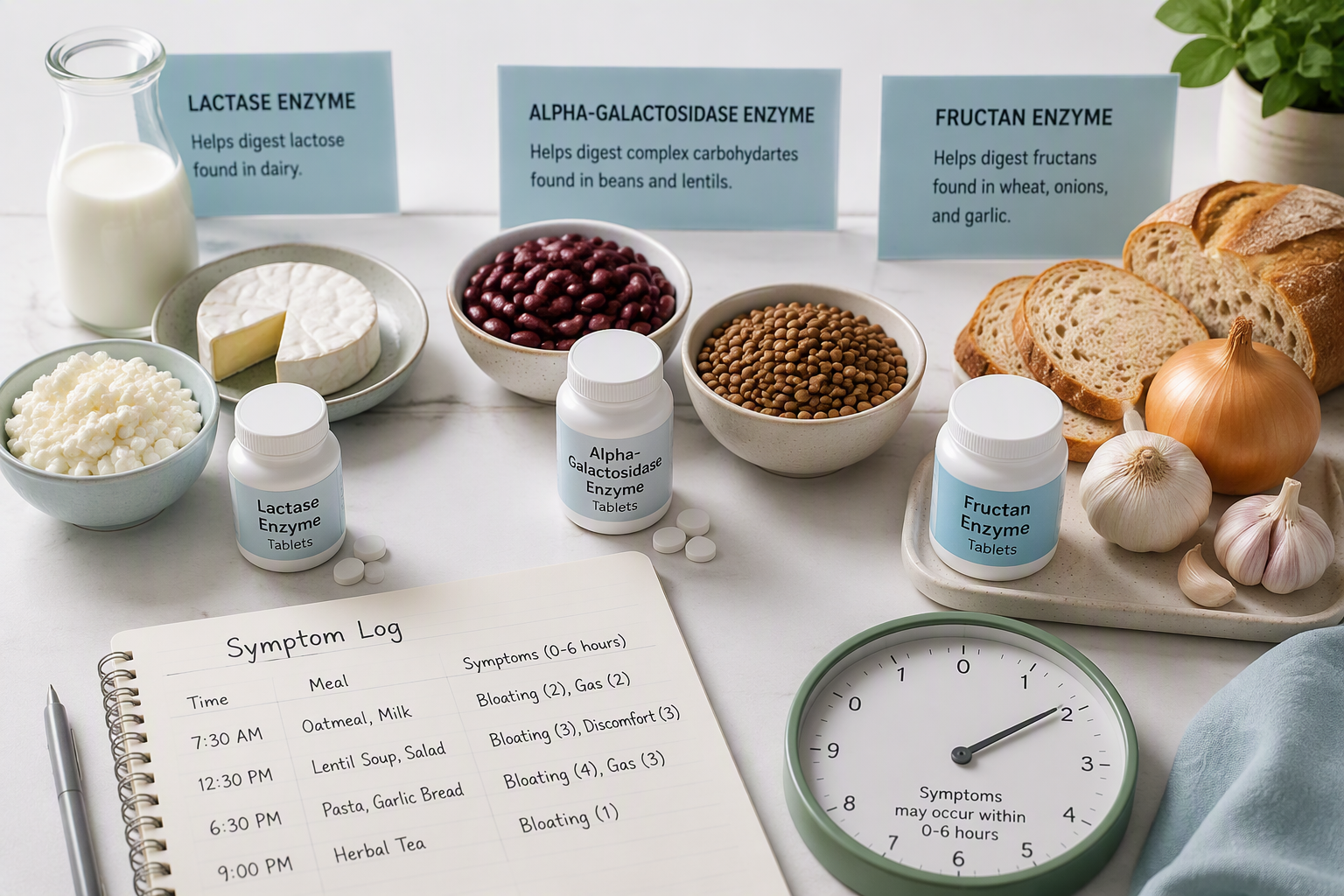
The food behind a symptom flare tells you which enzyme category is worth testing. That food usually contains a fermentable carbohydrate, a sugar your gut can't fully absorb before bacteria ferment it into gas. Use the table below as a filter before you spend money on a bottle.
Your trigger pattern | Enzyme to try | What the evidence looks like |
|---|---|---|
Dairy only (milk, soft cheese, ice cream, some yogurts) | Lactase | Solid evidence for lactose intolerance, but it doesn't treat IBS itself |
Beans, lentils, cruciferous vegetables (GOS) | Alpha-galactosidase | The strongest IBS-specific evidence here, limited to people genuinely sensitive to galacto-oligosaccharides (GOS) |
Wheat, onion, garlic, fruit (fructans and fructose) | Blend enzymes | Thinner, mostly early-stage evidence |
No clear food pattern | No enzyme yet | Points toward fiber or gut motility instead of a specific trigger food |
Before buying anything, list the foods you suspect and pair each one with its matching category above. Treat an enzyme trial as an adjunct you run alongside symptom tracking, not a fix that works the same for everyone, and loop in a qualified clinician if symptoms are persistent, severe, worsening, or could have another cause.
If dairy reliably sets you off, lactase is your first test. It breaks down lactose so it doesn't sit undigested in your gut pulling water into the small intestine, which is what produces the classic lactose intolerance symptoms of bloating, gas, and diarrhea within an hour or two of eating dairy. Lactase targets lactose digestion specifically, not IBS itself, so a dairy-only pattern is your clue this is the right lane.
If beans, lentils, or cruciferous vegetables trigger you, alpha-galactosidase is worth testing, since your body lacks the enzyme to break down GOS, leaving gut bacteria to ferment it instead. A randomized trial gave 31 people with IBS a diet low in every fermentable oligosaccharide, disaccharide, monosaccharide, and polyol (FODMAP) except GOS, then compared full-dose enzyme, half-dose enzyme, and placebo across separate periods (Tuck CJ, Taylor KM, Gibson PR, Barrett JS, Muir JG, American Journal of Gastroenterology, 2018, source). Only 21 of the 31 met the threshold for GOS sensitivity, meaning roughly a third weren't sensitive at all. In that sensitive group, full-dose enzyme cut median symptom scores from 24.5 mm to 5.5 mm and bloating from 20.5 mm to 6.5 mm.
That result only holds for people who are truly GOS-sensitive. Alpha-galactosidase for IBS isn't a universal bean fix, since a third of the study group saw no benefit, so confirm your own bean-to-bloat pattern before you buy.
FODMAPs and IBS don't always trace back to one food group, which is why some blend enzymes try to cover several fermentable carbohydrates at once, though that evidence stays thinner than the GOS data. If your main complaint is stool form rather than gas, whether that's hard and straining or loose and urgent no matter what you eat, Metamucil for IBS targets that mechanism better than any enzyme. If your pattern is broad and hard to pin to any single food, choosing a probiotic for IBS is a more sensible next step than guessing at the best digestive enzymes for IBS.
And if cramping and spasm are what dominate, arriving with no consistent link to meals at all, that is a motility problem rather than a digestion problem. Enzymes have nothing to act on in that case, and enteric-coated peppermint oil is the option with the strongest IBS evidence for that specific pattern. Knowing which lane you are in saves you weeks of testing the wrong category.
What does the evidence say for IBS enzyme targets
Research on digestive enzymes effectiveness for IBS stays mixed, and one test lets you judge any study on your own: check whether it was placebo-controlled or open-label. Open-label means there's no comparison group, so you can't rule out expectation effects or natural symptom swings. That single design flaw limits the FODMAP-blend enzyme study just as it limits the numbers often cited for collagen peptides for IBS, which came from people without confirmed IBS. Spotting that pattern lets you size up any supplement claim you meet next, and that skill matters more than any single recommendation on this page. The alpha-galactosidase for IBS trial, by contrast, was randomized and placebo-controlled in diagnosed patients, which is what a stronger study design looks like.
Broad-spectrum digestive enzyme blends for IBS combine general pancreatic-style enzymes, usually amylase, protease, and lipase, aimed at digestion overall rather than one specific trigger. In uncomplicated IBS, evidence for these blends stays minimal or inconsistent unless you have a real enzyme insufficiency, such as a pancreatic condition. Without that underlying issue, taking a blend becomes trial-and-error instead of a real test, and it won't give you the structure a low-FODMAP diet and IBS elimination plan can.
The takeaway is simple: match the enzyme to the trigger you've actually identified, whether that's lactase for lactose intolerance or alpha-galactosidase for the GOS in beans and lentils. A blend is the fallback for when you genuinely can't isolate a trigger, not the safer default to reach for first.
How should IBS subtype change what you try first
Your IBS subtype is not what tells you which enzyme to try. Timing does. Enzymes act on food as it moves through your gut, so what matters is whether symptoms show up within roughly zero to six hours of eating a specific food, not whether your chart says IBS-D, IBS-C, or IBS-M. A simple log of what you ate and when symptoms started tells you more than any subtype label ever could.
Subtype still plays a supporting role. IBS-D often lines up with fast-fermenting foods like dairy or certain fruits, while IBS-C tends to pair with bloating-heavy carbohydrates like beans and lentils. Either way, the food you can pinpoint on your log is what selects the enzyme, lactase for dairy or alpha-galactosidase for legumes and cruciferous vegetables, not the subtype itself. This distinction also settles the lactose malabsorption vs IBS question many people ask: if dairy reliably triggers symptoms within a few hours, that's a food-timing pattern an enzyme can address, whatever your broader diagnosis says.
If you're vegetarian or vegan and legumes carry most of your protein, cutting beans isn't a realistic fix. That's exactly where alpha-galactosidase earns its keep, letting you keep eating the foods you rely on instead of just easing one symptom. If you tried a broad-spectrum enzyme blend expecting all-purpose relief and noticed nothing change, that usually means your symptoms were never tied to a specific meal to begin with.
Enzymes have nothing to act on when symptoms track stress, poor sleep, or general gut sensitivity rather than meals. Cramping and spasm that arrive without a food trigger point to a motility problem, not a digestion problem, and Iberogast herbal drops are the option studied for that pattern.
Some symptoms mean it's time to stop trialing anything and call a clinician instead:
- Blood in your stool
- Fever
- Unintentional weight loss
- Anemia
- Persistent nighttime symptoms
- Steadily worsening pain
Celiac disease, inflammatory bowel disease, and exocrine pancreatic insufficiency all overlap with IBS symptoms, and an over-the-counter enzyme can mask a diagnosis that needs different treatment entirely. If a careful trial changes nothing at all, bring that result to a gastroenterologist or registered dietitian rather than raising the dose or switching products on your own.
How do you take enzymes safely and when should you stop
Enzyme timing matters as much as which enzyme you choose. Match the dose to your trigger meal, and take it right before or with your first bite so it mixes with food as digestion begins. If you're testing on an as-needed basis, take the enzyme only on days you actually eat the trigger food you've identified, and skip it the rest of the time.
Give the trial a real timeframe rather than judging it meal by meal. Use the matching enzyme with trigger-related meals for about 2 to 4 weeks, tracking bloating, gas, pain, and bowel habit changes. Aim for a meaningful improvement, not full symptom elimination, since enzymes support digestion of one food group rather than treat IBS itself. Stop early if symptoms clearly worsen with each use, since that usually points to a different problem than the one you're testing.
Once you know your trigger, let that guide product choice rather than star ratings alone.
For dairy and lactose triggers:
- Lactase Enzyme Tablets target lactose digestion, not IBS itself, so this helps only when dairy is the clear trigger
For high-GOS foods (beans, lentils, cruciferous vegetables), the enzyme with a placebo-controlled IBS trial behind it:
- Beano Digestive Enzyme, 100 tablets, 4.6 stars from over 19,700 reviews, the most-reviewed default
- Enzymedica BeanAssist, 30 capsules, 4.5 stars, the cheapest way to test whether GOS foods are really your trigger
- Bean-Zyme Extra Strength, 150 tablets, 4.4 stars from over 2,800 reviews, best cost per dose for ongoing use
- SOLARAY Bean Enzyme, 60 servings, 4.7 stars, the vegcap option
For mixed FODMAP triggers:
- FODZYME On-The-Go, 30 doses, 4.3 stars, built on a proprietary fructan hydrolase with no cheaper equivalent. It runs several times the cost of a single-target bean enzyme, which is the honest case for the price and also the reason to confirm fructans really are your trigger first
- FODAWAY, 60 count, 4.6 stars, a lower-cost four-enzyme blend at roughly half the price of FODZYME, though with far fewer reviews behind the rating
One label detail matters here: alpha-galactosidase potency is measured in GALU units, and amounts differ widely between brands. Don't treat one product's serving as equal to another's. Start with the label's recommended serving, then adjust from there.
A few popular blends work against a targeted trial because they mix in ingredients that hide what's actually causing a reaction. These aren't bad products, they just aren't built for isolating one trigger:
- Physician's CHOICE Digestive Enzymes pairs 16 enzymes with added prebiotics and probiotics, so a flare could come from any of three sources
- Zenwise Digestive Enzymes with Probiotics and Prebiotics combines that same mix of enzymes, live bacteria, and fiber
- Culturelle Bloating & Gas Defense adds probiotic CFUs to an enzyme blend, running two experiments in one capsule
- BIOptimizers MassZymes is a broad-spectrum, pancreatic-style formula, a category with limited evidence for straightforward IBS
- Garden of Life Organic Digest+ is a flavored chewable, so sweeteners come along with the enzymes
If you already own one of these, finish the bottle, then run a cleaner trial with a single-purpose product.
Enzymes themselves tend to be mild, and side effects like nausea, cramping, constipation, or diarrhea are usually minor when they happen at all. More often, the real issue is hidden triggers in digestive enzyme supplements, things like inulin, chicory root, FOS, or sugar alcohols such as sorbitol and xylitol added for taste. These fermentable carbohydrates can worsen IBS bloating on their own, so a supplement that seems to have failed may just be carrying one of them.
Dietary supplements aren't held to the same manufacturing and testing standards as prescription medication, so potency and purity can vary between bottles, even within the same enzyme type. Don't respond to a flat result by raising the dose. If symptoms improve, pause the enzyme for a few days to confirm the benefit fades without it, then restart only around that same trigger food. Persistent or worsening symptoms call for a gastroenterologist or registered dietitian, not more self-adjusting.
Digestive Enzymes for IBS FAQs
These quick answers cover the questions you're likely weighing as you consider digestive enzymes for IBS, from how lactase and alpha-galactosidase work to when a trial makes sense and when it's time to loop in your doctor instead.
1. Do digestive enzymes worsen IBS pain for some?
Yes, digestive enzymes can make IBS pain worse for a minority of people. Possible side effects include mild nausea, abdominal cramps, constipation, or diarrhea. Any new or worsening pain is a signal to pause and reassess, not a symptom to push through while hoping it settles on its own.
Two things usually explain a flare, and both are fixable. Timing is the first: enzymes taken well away from a meal may not reach the food they're meant to break down, so the trigger passes through undigested anyway. Trigger matching is the second: lactase won't help symptoms driven by fructose or other FODMAPS, so you could be treating the wrong culprit entirely. It's also worth checking for hidden triggers in digestive enzyme supplements, since some enzyme and probiotic blends quietly add inulin, chicory root, or FOS, prebiotic fibers that can paradoxically spike gas, bloating, and pain in people with IBS. If symptoms spike soon after starting a new product, switch to a simpler, single-purpose enzyme without these additives and retry carefully before ruling out enzymes altogether.
2. How do you know if you actually have an enzyme deficiency?
Most people with IBS do not have an enzyme deficiency, and the two are separate problems. IBS is a gut-brain and motility condition, while a true deficiency means your pancreas isn't producing enough enzymes at all, a condition called exocrine pancreatic insufficiency (EPI).
This distinction matters in practice. Taking over-the-counter enzymes for a suspected deficiency can quiet symptoms just enough to delay a real diagnosis, and EPI, celiac disease, and inflammatory bowel disease all overlap with IBS symptoms yet none responds to a bean enzyme off a supermarket shelf. Dietary supplements don't require proof of effectiveness before sale, so testing beats guessing.
Clinicians rule EPI in or out with a fecal elastase-1 test, a single stool sample rather than blood work. Most labs read above 200 mcg/g as normal, 100 to 200 mcg/g as possible mild to moderate insufficiency needing follow-up rather than a diagnosis, and below 100 mcg/g as consistent with severe insufficiency, per reference ranges from the Canadian Digestive Health Foundation (source). Two recent systematic reviews concluded a single 200 mcg/g cutoff is generally sufficient to separate normal results from EPI (source), so treat that middle band as a cue to retest rather than a verdict.
A watery sample can dilute results and read falsely low, which matters if you have diarrhea-predominant IBS tested mid-flare, so borderline numbers are often repeated rather than treated as final. Unexplained weight loss, greasy stools that are hard to flush, or symptoms with no food pattern point away from IBS. Ask your clinician about testing instead of self-treating, and talk with a registered dietitian before adding any new supplement.
3. Do enzymes work for wheat, onion, garlic, or fruit triggers?
Yes, enzymes exist for these triggers, but the evidence behind them is thinner than what backs lactase or alpha-galactosidase for dairy and beans. Wheat, onion, and garlic are fructan sources, while apples, pears, and honey lean on fructose, and each pathway has its own enzyme.
Fructan hydrolase targets the fructans in wheat, garlic, and onions. It isn't a standard ingredient across the category, though: the maker of FODZYME describes its fructan hydrolase as proprietary and says it is the only enzyme shown to break down a range of fructans, so a reader shopping for one has essentially a single option rather than a shelf of them. Xylose isomerase works differently, converting fructose into glucose, which your body absorbs more easily. That targets fructose malabsorption specifically rather than IBS as a whole.
The main human study behind the fructan enzyme is a single-arm, open-label cohort of people who had already bought the product online. After 4 weeks, 78.0 percent (95% CI 69.7 to 84.5) reported meaningful improvement in bloating and flatulence, and 75.0 percent of IBS-D participants improved on diarrhea (source).
Run that through the evidence test from earlier on this page, using the limitations the authors themselves list. There was no placebo arm. The manufacturer funded the research. And only 11 percent of people who took the baseline survey completed the follow-up, a gap the authors flag as likely selection bias toward people already feeling better. That is a different confidence level than the randomized, placebo-controlled alpha-galactosidase trial in diagnosed IBS patients.
If wheat, onion, and garlic are your clear triggers, a low-FODMAP approach carries stronger backing than any fructan enzyme, so try that first and save the enzyme for meals you can't control, like eating out. A 2 to 4 week trial while tracking symptoms is reasonable, and unlike vitamins, these enzymes don't build up in your body. Treat them as a flexibility tool, not a treatment.
4. Do enzymes for bloating also reduce gas?
Yes, when your bloating and gas trace back to the same fermentable carbs, one enzyme can ease both at once. Bloating often reflects the buildup of gas and fluid behind visible distension, so cutting down what feeds fermentation lowers both symptoms together rather than treating them as separate problems. Alpha-galactosidase drives this GOS enzyme breakdown, targeting galacto-oligosaccharides GOS and galactans your body can't digest on its own but gut bacteria happily ferment into gas. This overlap shows up most reliably when your triggers are lactose or GOS-rich foods, since research on alpha-galactosidase for beans, lentils, and root vegetables consistently confirms that connection.
The honest limit matters too. In the same 2018 trial cited earlier for enzyme selection, only 21 of 31 participants were GOS sensitive individuals, meaning close to a third had no GOS for the enzyme to act on. For those readers, the enzyme wouldn't be expected to ease gas or bloating regardless of dose. Two people sharing an IBS diagnosis can still have completely different underlying triggers.