


Finding corn or beet color in the toilet soon after a meal can make it seem as though food rushed straight through you. Usually, it hasn't: bowel transit time is the full trip from eating to passing stool, and a single bowel movement cannot measure it. The colon often sets much of the pace by absorbing water and forming stool.
A bathroom trip after eating may reflect the gastrocolic reflex, which moves stool already in the colon rather than the new meal. A simple home check uses a familiar marker food, meal and bowel-movement times, and notes on stool form using the Bristol Stool Chart. Persistent changes matter more than one unusual result, particularly with black or bloody stool, severe pain, fever, dehydration, or ongoing bowel-habit changes.
Bowel Transit Time Key Takeaways
- Bowel transit time measures food's full journey from eating to passing stool.
- Bowel movement frequency alone cannot show whether transit is fast or slow.
- The colon absorbs water, forms stool, and accounts for much of overall transit time.
- Eating can trigger the gastrocolic reflex without moving a new meal through the colon.
- Marker foods and Bristol Stool Chart notes offer only a rough home observation.
- Radiopaque marker tests and wireless capsules can assess transit clinically.
- Black or bloody stool, severe pain, fever, dehydration, or persistent changes need timely care.
How Does Food Travel Through Your Gut?
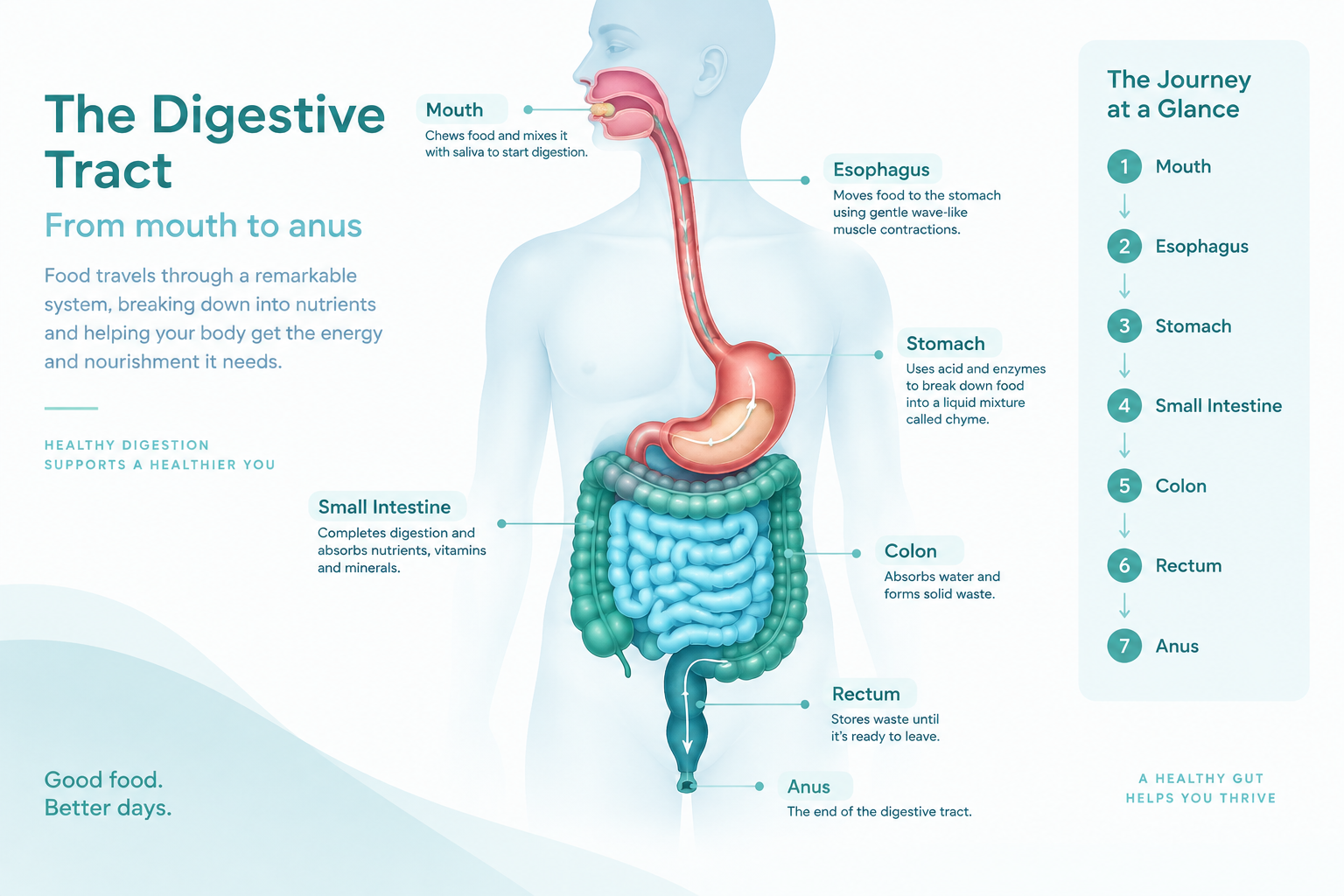
Food travels through the digestive tract in several stages, rather than as one package moving at a fixed speed. Chewing and saliva begin breaking food down, and swallowing carries it through the esophagus, stomach, small intestine, colon, rectum, and anus. How the digestive system works provides a fuller look at this route. Bowel transit time describes the entire journey.
The stomach holds and mixes a meal into a semi-liquid mixture, then releases it gradually into the small intestine. Gastric emptying time is only one part of the process. A review of wireless motility capsule testing reports a normal gastric emptying range of two to five hours (assessing gut transit time, J Neurogastroenterol Motil 2014). Meals higher in fat may stay in the stomach longer.
Most digestion and nutrient absorption take place in the small intestine, so what enters it is still food material your body can use. Intestinal transit does not happen at one uniform pace:
- Liquids: May leave the stomach differently from solid food.
- Fats: Can slow gastric emptying.
- Fiber: May affect movement through the intestines.
- Stress, activity, routines, medicines, and digestive conditions: Can temporarily speed up or slow down digestion.
In the colon, water and salts are absorbed, gut bacteria act on remaining material, and stool forms before the rectum signals the urge to go (physiology of digestion, StatPearls). Tracking changes alongside meals and symptoms can give useful context for a healthcare conversation.
What Does Bowel Transit Time Measure?
Bowel transit time captures that full journey from eating a meal to passing stool. It includes movement through the stomach, small intestine, and large intestine, so it is not the same as bowel movement frequency or a day of bloating. If you are wondering how long food takes to pass through you, the answer involves whole-gut transit time, also called gut transit time.
Colonic transit time measures only the portion of that journey through the colon. This is where water is absorbed and stool becomes more formed. Clinicians often focus on colonic transit when constipation is a concern, while whole-bowel transit offers a broader picture of digestive movement.
A normal bowel transit time is a population reference, not a deadline your body must meet. Among people without constipation, average colonic transit is about 30 to 40 hours, and up to 72 hours is often within a typical reference range, according to UCSF Health on bowel transit time. Transit differs between individuals and may be longer in women.
One meal, home observation, or bowel movement cannot confirm slow or fast transit. A more useful pattern includes:
- Stool changes: Consistency, frequency, straining, or urgency.
- Daily factors: Food choices, hydration, activity, sleep, and medicines that can affect digestion.
- Ongoing symptoms: Discomfort, bloating, or bowel changes that are new or persistent.
A clear pattern over time gives a healthcare professional more useful context than one isolated observation.
How Does the Colon Set the Pace?
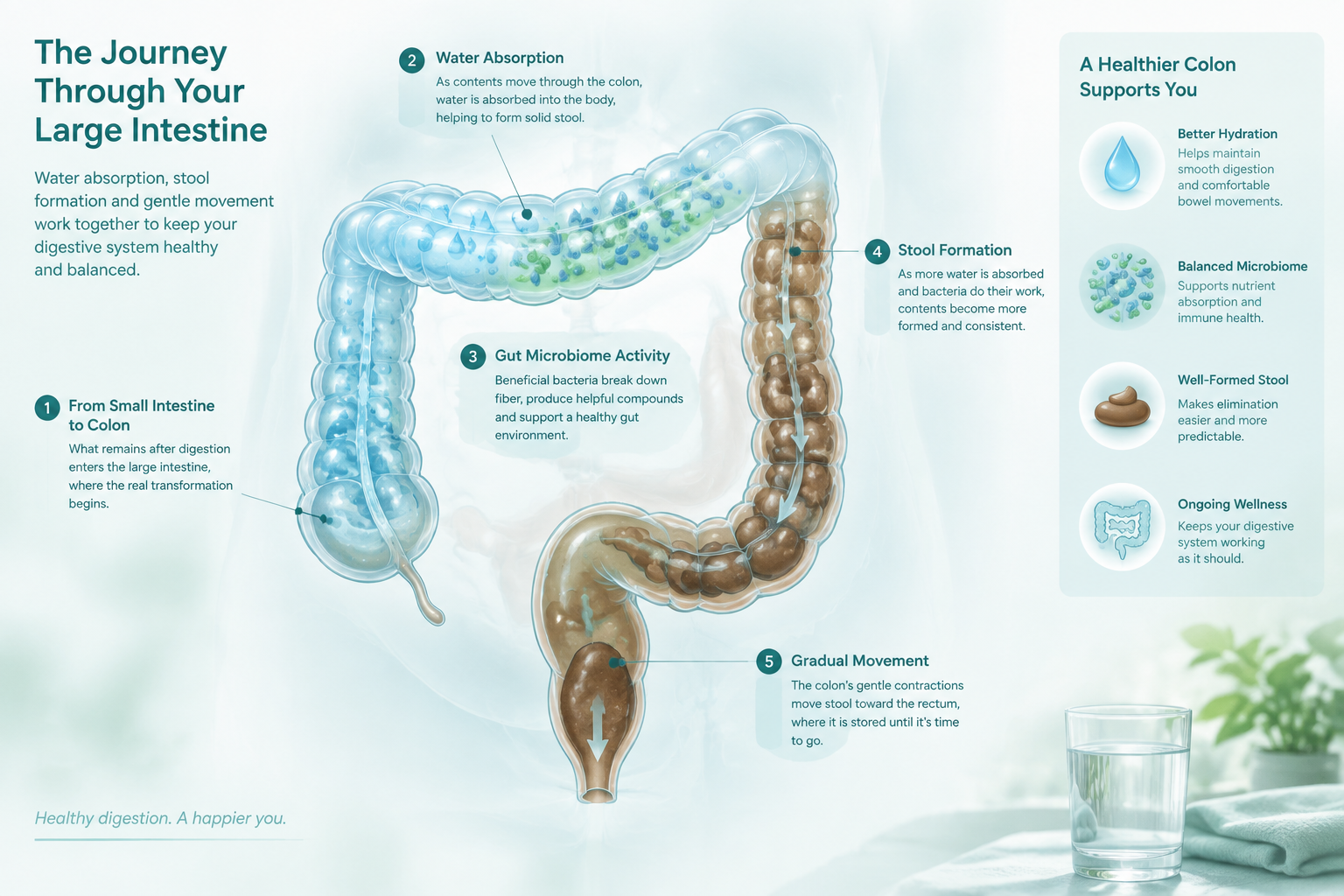
Once material crosses the ileocecal junction, the colon accounts for much of the digestive clock because its slow movement lets it reclaim water and gives the gut microbiome time to ferment fiber. UCSF Health lists typical colonic transit time as 30 to 40 hours. Because this stretch can dominate whole-gut transit, extra water removal can produce firmer stool, a common concern with constipation and slow bowel function.
Slow-transit constipation means movement through the colon is delayed, which is different from normal-transit constipation or an outlet problem at the pelvic floor, but a single transit estimate cannot explain every shift in bowel function. For a clearer picture of water balance, stool formation, and daily habits, learn what the large intestine does.
What Counts as a Typical Transit Pattern?
Because colon timing is only one part of whole-gut movement, a typical transit pattern is not one universal number or a diagnosis. Bowel transit time provides one measure, while your stool timing, frequency, and form can shift with meals, sleep, stress, routines, and ordinary day-to-day variation.
A normal bowel transit time cannot be judged by how often you have a bowel movement. What a healthy bowel movement is also includes stool form, ease of passing, and whether you feel fully emptied.
Clinical testing separates intestinal transit into digestive segments, with the reference points below drawn from the J Neurogastroenterol Motil 2014 capsule review cited above:
Digestive segment | Clinical reference points | What it can tell you |
|---|---|---|
Small-bowel transit time | Healthy volunteers had a median of 4.6 hours, with a reference range of 4.0 to 5.9 hours. Capsule testing considers less than 2.5 hours rapid and more than 6 hours delayed. | Movement through the small intestine, not the time between bowel movements. |
Colonic transit | Radiopaque-marker studies average roughly 30 to 40 hours, with an upper limit near 70 hours. Capsule testing considers less than 5 hours rapid and more than 59 hours delayed. | Stool storage and passage, without setting a required daily schedule. |
Whole-gut transit time | Capsule results below 10 hours are rapid, while results above 73 hours are delayed. | Combined movement through the stomach, small bowel, and colon, not the source of a specific symptom. |
A fast transit time may occur with loose stools or urgency. Slower gut transit time may coincide with hard stools, straining, or less frequent bowel movements. Pain and bloating add useful context, but frequency alone cannot identify the affected segment or confirm a motility disorder.
These clinical ranges are reference points, not at-home targets. New, persistent, or disruptive changes, especially when everyday observations do not match a test result, are worth discussing with a healthcare professional.
Why Do Meals Speed Things Up?
Even within typical transit ranges, eating can trigger a bowel movement because a filling stomach sends signals that make the colon more active. The meal itself has not reached your colon, so a trip to the bathroom after eating does not show how quickly that food moved through your digestive tract.
This normal response can make bowel transit time harder to judge from meal timing alone, especially when your bowel habits are sensitive or irregular. Although it may feel stronger after a larger meal, this response reflects activity already happening farther along in your digestive system and is often called the urge to go after eating.
How Can You Observe Transit at Home?

A home observation can give you a rough estimate of whole-gut transit time. It cannot diagnose a digestive condition or show exactly where movement slowed or sped up. For a simple way to learn how to measure transit time at home, eat a usual meal with a noticeable food, such as beets or corn, and note the meal time.
Record the first bowel movement after that meal, then the first stool in which you notice beet-related color or recognizable corn. Although research has used colored markers for similar observations, food dye and commercial kits are not needed for an informal personal check, and repeating the observation on several typical days is more useful than relying on one unexpected result. A large citizen-science project known as the blue poop study used a blue-dyed muffin the same way and found that longer transit time tracked with differences in the gut microbiome (Gut 2021 blue dye transit study).
Keep your notes simple and consistent:
- Marker meal: Record the food you ate and the time of the meal.
- Bowel movements: Note when each occurs, including the first one containing the marker.
- Stool and symptoms: Track stool form with the Bristol Stool Chart, along with urgency, pain, bloating, nausea, straining, or a feeling of incomplete emptying.
- Possible influences: Include medications, supplements, recent antibiotics, laxatives, fiber products, and anti-diarrheal medicines that may affect bowel habits.
A change in meals, stress, illness, travel, or daily routine can shift your usual pattern. Corn may remain visible even when digestion is normal, while beets, leafy greens, food coloring, supplements, and some medicines can change stool color for reasons unrelated to transit.
Dated notes give a healthcare professional more useful context than a single alarming-looking stool. Clinicians may use standardized markers, imaging, or other tests when symptoms continue or raise concern. Seek timely medical care for black or bloody stool, severe or worsening pain, fever, signs of dehydration, or unexplained ongoing changes in bowel habits.
How Does the Between-Meal Sweep Affect Transit?
Beyond home observations, between meals, your stomach and small intestine create a sweeping wave that pushes leftover material toward the colon. This housekeeping pattern supports gastrointestinal motility, while intestinal motility also includes the contractions that mix and move food after meals. The migrating motor complex is a fasting pattern that is interrupted by feeding, so frequent snacking can reduce the time this between-meal wave has to occur (Nat Rev Gastroenterol Hepatol 2012 review of the migrating motor complex, Dig Dis Sci 1992 study of meal composition and motility). Clinicians can assess bowel movement through the digestive tract with a bowel transit time test.
Home observations may suggest a pattern, but clinical testing can assess individual digestive regions. Research also separates whole-gut transit testing from tests focused on particular areas. Learn more about the migrating motor complex.
How Do Clinical Transit Tests Work?
Clinical testing can show whether altered gastrointestinal motility appears limited to the colon or involves more of the digestive tract when symptom notes leave that unclear. A gastroenterology clinician may recommend a bowel transit time test for persistent constipation, unexplained diarrhea, or irregular bowel habits.
In a radiopaque marker test, you swallow tiny radiopaque markers that appear on X-rays. A common protocol, as UCSF Health describes it, includes an abdominal X-ray five days, or 120 hours, later. Clinicians count the remaining transit markers and map where they sit, while markers retained or clustered in the colon can suggest slow colonic transit and help determine whether further evaluation is needed. Preparation varies by clinic and may include a high-fiber diet and a temporary pause in laxatives, enemas, or other bowel-altering medicines. Do not stop prescribed medication without guidance.
A wireless motility capsule offers a broader, radiation-free view. After you swallow it, the capsule sends pH, pressure, and temperature data to a receiver worn for up to five days. This capsule transit study estimates stomach emptying along with small-bowel, colonic, and whole-gut transit, though availability and suitability vary. Other tools include gastric emptying scintigraphy and colonic transit scintigraphy, which follow a tiny amount of radioactive tracer through one region, lactulose or hydrogen breath tests that estimate small-bowel transit, and anorectal manometry when the problem seems to sit at the outlet. Gastroparesis, delayed stomach emptying, is a separate diagnosis from slow colonic transit, and transit testing is also used in functional gastrointestinal disorders such as IBS, where symptoms are real but routine tests look normal.
Test | What it measures | Main limitation |
|---|---|---|
Radiopaque marker test | Marker location and movement in the colon | Uses X-rays and offers a narrower view |
Wireless motility capsule | Transit across multiple digestive regions | May not be available or appropriate for everyone |
Results are considered alongside your symptoms and other findings, not as a stand-alone diagnosis. Bring a concise record that includes:
- Bowel frequency and stool changes
- Pain and bloating
- Recent diet changes
- Medicines and bowel products
A typical result can still occur with disruptive symptoms, while a delayed region may guide additional testing or treatment discussions.
Bowel Transit Time FAQs
These FAQs address common questions about bowel transit time, helping you make sense of everyday digestive patterns and recognize when persistent symptoms deserve a conversation with a healthcare professional.
1. Can You Speed Up Bowel Transit Time?
You may support bowel function when lifestyle factors contribute to difficulty passing stool, but you cannot reliably force your body into a set schedule. Drinking enough fluids, adding an appropriate fiber source gradually, and regular movement may help. Fiber needs adequate water and can worsen bloating for some people. Persistent constipation, a major bowel-habit change, or suspected slow transit needs clinical guidance. Review medicines and supplements with a clinician or pharmacist, especially before changing laxatives, enemas, or preparing for transit testing.
2. Why Do Undigested Foods Appear Quickly?
Seeing recognizable food in your stool soon after eating rarely means the whole meal moved through your digestive tract quickly. Eating can prompt a bowel movement that passes stool already farther along in the colon while the new meal is still being digested. Movement through the gut is uneven, and plant skins, corn, seeds, and other fibrous foods may remain visible because they do not break down completely. Visible pieces alone cannot tell you your overall bowel transit time.
3. What Is the 3-and-3 Rule?
The 3-and-3 rule is informal shorthand for bowel habits ranging from three movements a day to three a week. It is not a medical standard, since frequency alone cannot reveal digestive transit time or whether your usual pattern is healthy for you. Constipation, rapid transit, and slow transit also involve stool consistency, straining, pain, urgency, incomplete emptying, and meaningful changes from your baseline. Clinical transit testing measures movement when a clinician considers it necessary.
4. When Does Slow Transit Need Medical Care?
Constipation or difficulty passing stool warrants prompt assessment when it persists, interferes with daily life, or does not improve with routine self-care, especially with worsening pain, vomiting, abdominal swelling, bleeding, black stools, fever, anemia, weight loss, or a new bowel-habit change. NIDDK describes these concerning symptoms of constipation (constipation, NIDDK).
A gastroenterology evaluation may help with infrequent stools or a suspected blockage. A radiopaque marker test, or bowel transit time test, tracks radiopaque markers through defined gut regions to assess slow bowel function. One visible-food observation cannot diagnose slow transit constipation or pinpoint where movement is delayed.