


Search how common IBS is and you’ll get two very different answers. Some sources say 10% to 15% of adults. The largest recent US study puts it at 6.1%. Neither is wrong, and the gap between them turns out to be the most useful thing on this page.
Most of that difference comes down to definitions. The Rome criteria decide who counts as having IBS, and they were tightened, which cut the estimate roughly in half without anyone’s symptoms changing. Geography accounts for some of the rest, and the way researchers count, whether by symptom survey or confirmed diagnosis, accounts for the remainder.
There’s a third number that matters more than either of those. Only about 5% to 7% of US adults have a formal diagnosis, well below the share reporting symptoms. If you’ve had recurring bloating, pain or bowel changes for years without ever having them looked at, you’re in the majority, not the exception.
What follows covers who IBS affects most and why, how the subtypes break down, and the specific symptoms that mean your pattern needs checking rather than reassurance.
IBS Prevalence Key Takeaways
- Global IBS estimates commonly range from 10% to 15% of adults.
- A 2023 US study found IBS in 6.1% of adults.
- Diagnostic criteria and research methods cause prevalence estimates to differ.
- Many people with IBS-like symptoms never receive a formal diagnosis.
- IBS is diagnosed more often in women and adults younger than 50.
- IBS-C, IBS-D, and IBS-M describe different bowel habit patterns.
- Blood in stool, weight loss, fever, or nighttime symptoms require evaluation.
How many adults have IBS worldwide and in the US?
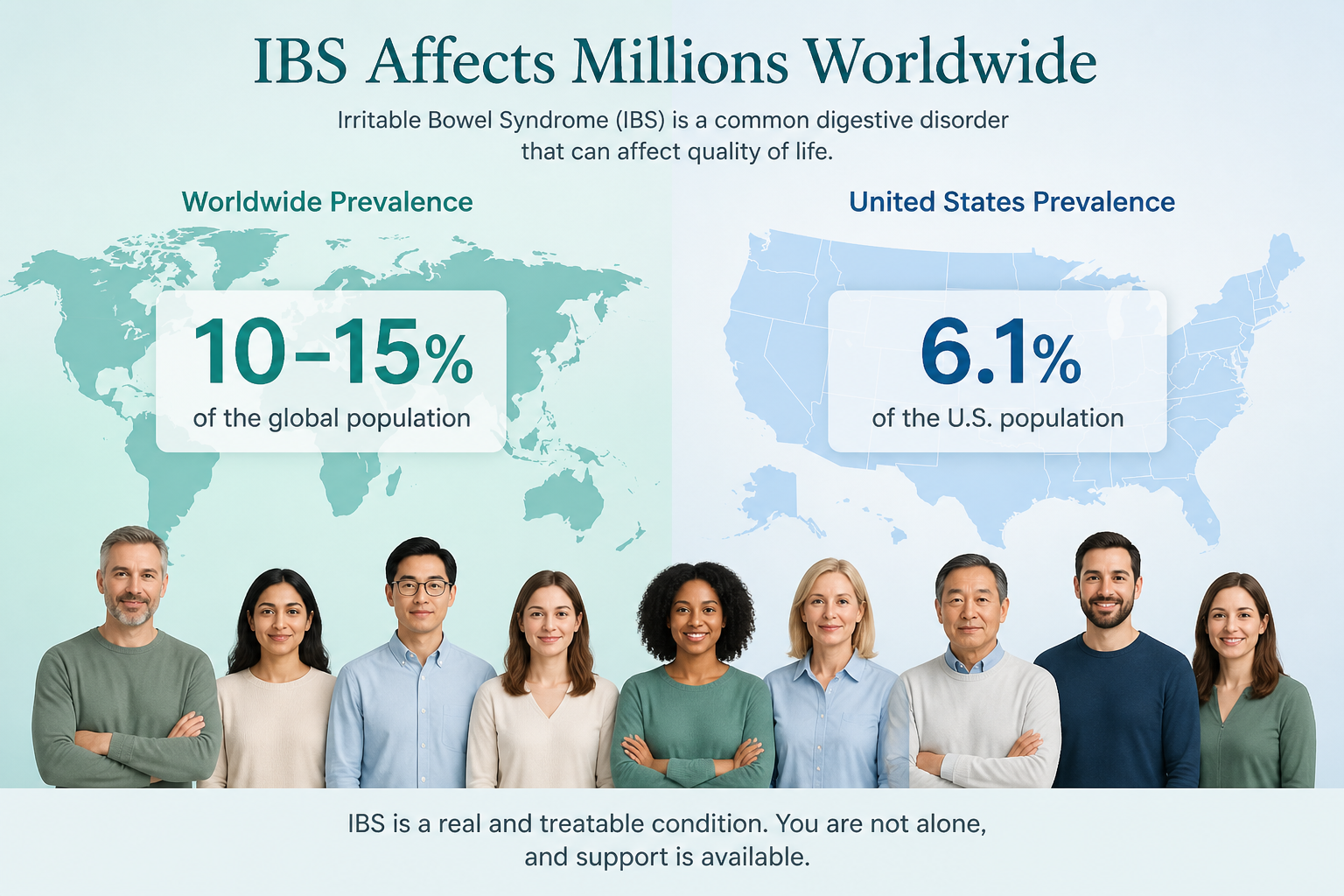
Irritable bowel syndrome (IBS) is common, but the answer to “how common?” depends on how researchers define it. The widely cited estimate is that IBS affects 10% to 15% of adults, while the most current large US study found IBS in 6.1% of adults. Both figures come from credible research, and the difference explains why IBS prevalence estimates can look inconsistent.
The 10% to 15% figure comes from the International Foundation for Gastrointestinal Disorders and is often used when discussing global prevalence. The 6.1% figure comes from a nationwide study of nearly 89,000 US adults that used the newer Rome IV criteria, published in Gastroenterology in 2023 (source).
The main estimates describe different slices of the same condition:
- 10% to 15% of adults: This global-leaning estimate relies largely on older diagnostic standards and is frequently repeated by medical organizations.
- 6.1% of US adults: This estimate reflects IBS in the United States under Rome IV criteria. Earlier US studies found rates of 4.7% and 5.3%, but those included roughly 2,000 participants each rather than 89,000.
These percentages aren’t competing answers. Three factors account for most of the gap:
- Diagnostic criteria: The Rome criteria are symptom-based rules for identifying IBS. Rome III produced an estimated worldwide rate of about 10.1%, compared with about 4.1% under the stricter Rome IV criteria. Much of the difference reflects how IBS is counted, not a sudden change in how many people have symptoms.
- Geography: The 10% to 15% estimate is global-leaning, while 6.1% describes IBS in the United States. Rates can differ across countries and populations.
- Research method: Symptom surveys can include people with IBS-like symptoms who have never received a formal diagnosis. Clinical diagnosis captures a narrower group.
At 6.1% of US adults, IBS affects roughly 16 million American adults. That headcount belongs specifically to the newer US estimate. Older articles that cite 25 million to 45 million people, or over 35 million Americans, generally apply the 10% to 15% range, so those totals reflect a broader definition and shouldn’t be presented as a single settled count.
Even the lower estimate means most workplaces, classrooms, and families likely include someone managing IBS, often without discussing it. Only about 5% to 7% of US adults have a formal diagnosis, so many people with IBS symptoms have not had them confirmed by a healthcare professional.
Recurring abdominal pain, bloating, constipation, diarrhea, or changes in bowel habits can be worth tracking before a medical visit. A plain-language look at what IBS actually is can help you prepare, but these figures cannot diagnose you. Digestive symptoms can have many causes, and persistent, severe, or worsening symptoms should be discussed with a qualified healthcare professional.
What do prevalence numbers mean compared with diagnosed cases?
IBS prevalence and the IBS diagnosis rate describe different groups. Symptom surveys estimate how many adults report an IBS-like pattern, while clinical diagnosis estimates count people whose symptoms were evaluated and matched accepted criteria.
In the United States, symptom-survey estimates often range from 10% to 15% of adults. Formal diagnosis estimates are closer to 5% to 7%. The groups overlap, but neither number represents the whole other group.
A plain-language reading of these figures looks like this:
- Symptom-survey prevalence: Adults who report symptoms that resemble IBS, whether or not they have seen a clinician.
- Clinically diagnosed IBS: Adults whose symptoms were assessed and classified as IBS by a healthcare professional.
- The difference: Symptoms, medical evaluation, and diagnosis are related steps, not interchangeable measures.
Diagnostic criteria account for part of the gap. Rome IV requires a different frequency and duration of symptoms than the older Rome III criteria. As a result, some people who would have met the earlier definition may not meet the newer one, even though their symptoms have not changed. The definition moved, not the person’s experience.
IBS is also a syndrome, which means a recognizable pattern of symptoms rather than one abnormality confirmed by a single test. There is no single test that proves IBS. A clinician usually reviews symptom details, personal and family medical history, and selected tests that help rule out other causes.
That process helps explain why underdiagnosed IBS is common. Symptoms may seem manageable, get blamed on stress or food, or go unaddressed because a person assumes nothing can help. Estimates suggest that up to three-fourths of cases go undiagnosed, while only about one-third to one-half of people with IBS symptoms seek medical care.
Overlapping symptoms do not always mean IBS. Celiac disease, inflammatory bowel disease, infections, medication effects, and other conditions can cause abdominal pain, diarrhea, constipation, or bloating. A symptom pattern can support a conversation with a clinician, but it cannot confirm the cause.
Use IBS prevalence to put symptoms in context, not to self-diagnose. A short record of bowel changes, pain, bloating, food patterns, stress, sleep, and daily disruption can make a medical visit more useful, especially when symptoms persist, worsen, or interfere with work, eating, sleep, or normal routines.
Who is more likely to have IBS and why?
IBS is diagnosed more often in women than men, and the nationwide US survey found higher odds among women. It does not report a specific multiplier, so the honest summary is that the pattern is consistent rather than precisely quantified. These gender differences reflect how IBS is diagnosed and reported, not a sign that something is inherently wrong with you.
IBS affects adults younger than 50 more often than older adults. Symptoms commonly begin in the late teen years or during young adulthood, although they can start later. New symptoms after age 50 deserve medical evaluation rather than an assumed IBS label, because digestive symptoms can have many causes.
IBS is a disorder of gut-brain interaction. Communication between the digestive tract and brain can become more sensitive or reactive, but that does not make symptoms imaginary. This helps explain why a work deadline may trigger symptoms for one person while a different routine affects someone else.
Stress isn’t the only factor involved in IBS, but it’s often associated with flares. It can affect gut movement, increase sensitivity, and change how strongly discomfort registers. Exams, major life changes, and disrupted sleep may make symptoms more noticeable without being the original cause.
Several patterns may help explain why symptoms appear:
- Menstrual cycle changes: Abdominal pain, bloating, constipation, or diarrhea may shift around your period.
- Food-related patterns: A meal or ingredient may repeatedly affect you without causing the same response in someone else.
- After a gut infection: Symptoms can continue after a digestive infection, a pattern sometimes called post-infectious IBS.
- Stress-related changes: Bowel habits or symptom intensity may shift during demanding periods.
A symptom diary can give your clinician more useful detail than trying to recall one trigger from memory. It may also support a conversation about the causes of IBS and whether testing is appropriate.
Digestive symptoms can have many causes, so persistent, severe, or worsening symptoms should be discussed with a qualified healthcare professional. Seek care sooner for blood in the stool, unexplained weight loss, fever, or symptoms that repeatedly wake you at night.
How common is IBS by subtype IBS-C IBS-D and IBS-M?
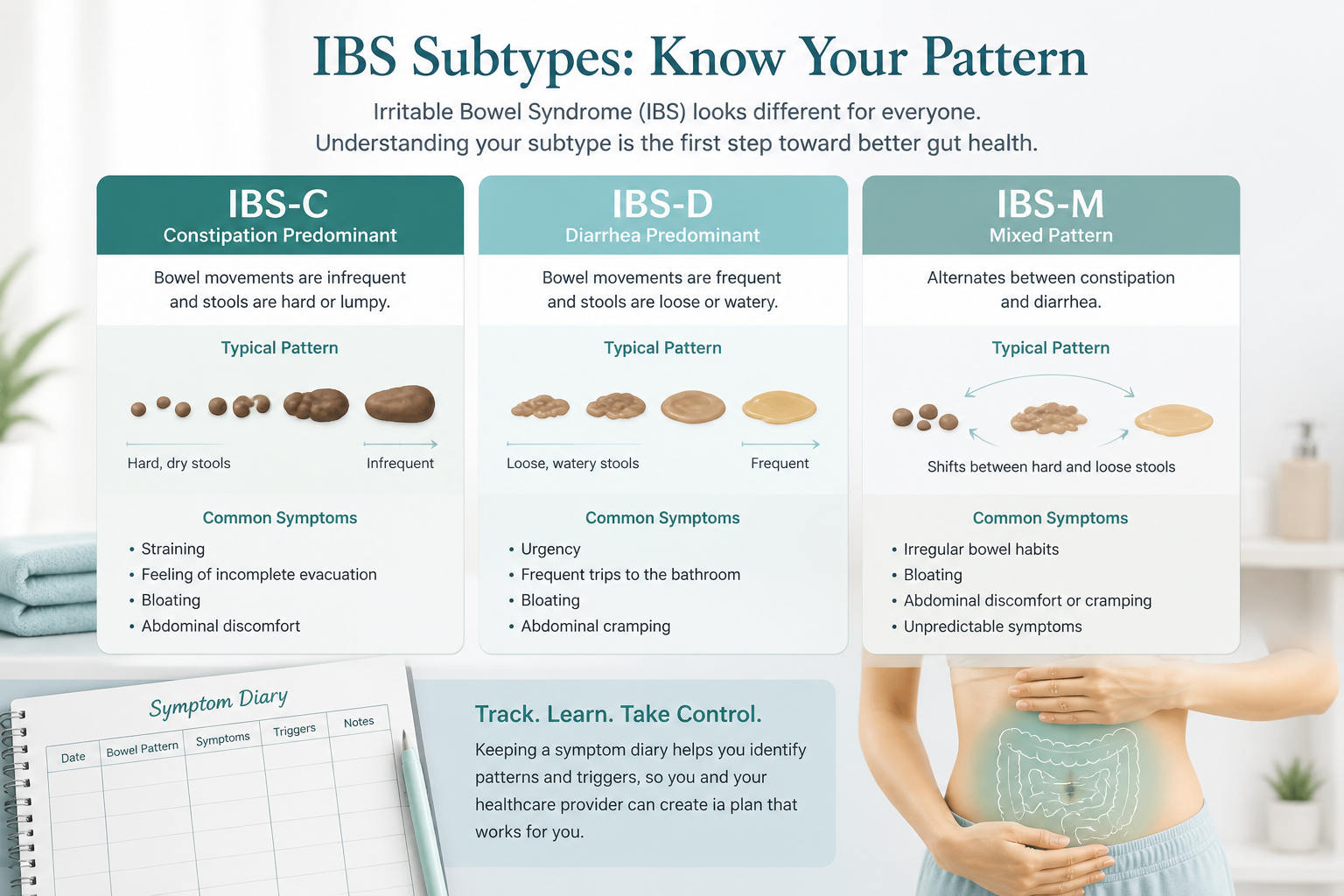
IBS is divided into three main types based on bowel habits: IBS-C, IBS-D, and IBS-M. These labels describe how your stools usually look over time, not how severe your symptoms are. Because IBS is a long-term condition with symptoms that come and go, your pattern may change from one day to the next.
Stool consistency, urgency, and shifts between constipation and diarrhea offer the clearest clues:
- IBS-C, constipation-predominant: Hard or less frequent stools, straining, or a feeling that a bowel movement is incomplete, along with recurring abdominal pain or cramping.
- IBS-D, diarrhea-predominant: Loose or watery stools, urgency, or frequent bowel movements with abdominal pain or cramping. Bloating or a feeling of fullness may also occur.
- IBS-M, mixed: Periods of constipation alternate with periods of diarrhea, often with pain, cramping, bloating, or fullness.
Bloating and abdominal discomfort can occur with any subtype. The pattern over several weeks matters more than one unusual day, since symptoms can overlap. Your clinician can use that pattern to assess whether your symptoms are constipation-dominant, diarrhea-dominant, or mixed. Which IBS subtype fits your pattern is worth comparing in plain language before that visit.
These categories still matter when symptoms seem manageable. IBS can disrupt work, school, sleep, travel, and social plans, while fluctuating symptoms may lead you to wait for them to pass. A changing pattern remains worth discussing with a healthcare professional.
A short record before your visit can make the conversation more focused. Track these details:
- Stool pattern: Your usual pattern and any recent change.
- Pain: How often abdominal pain or cramping occurs.
- Bloating: When bloating or fullness appears.
- Shifts: Whether symptoms move between constipation and diarrhea.
- Possible triggers: Foods, stress, routines, or medicines that occur before symptoms.
When symptoms don’t fit IBS-C, IBS-D, or IBS-M clearly, a clinician may consider IBS-U, or undefined IBS, while reviewing the pattern and other possible causes. Persistent, severe, or worsening symptoms warrant medical evaluation. A symptom record can help you ask clearer questions without treating a single day as the whole picture.
What should you do next with IBS prevalence statistics?

Prevalence statistics can reassure you that IBS is common, but they cannot diagnose your symptoms. Underdiagnosed IBS is common because symptoms vary, some people do not seek care, and several conditions can cause similar digestive problems.
Your next step is to look at your own symptom pattern and decide whether a healthcare professional should evaluate it. A two-week record of pain, bowel changes, stool pattern, timing, and possible triggers can make that conversation clearer. Prevalence tells you how often a condition occurs, not whether it explains your symptoms.
IBS is usually identified from a recurring symptom pattern while other causes are considered or ruled out. That evaluation may include inflammatory bowel disease, such as Crohn’s disease or ulcerative colitis, and celiac disease. IBS does not cause the intestinal inflammation associated with inflammatory bowel disease, while celiac disease involves an immune response to gluten. Comparisons between those conditions and IBS can provide context, but a clinician must apply it to your history. Which IBS tests rule out other conditions is worth reviewing before that discussion.
Some symptoms call for prompt evaluation rather than a wait-and-see approach. These red flags may point to another explanation:
- Unexplained weight loss: Weight loss without a clear reason needs medical review.
- Blood in the stool: Bleeding is not a typical IBS feature.
- Persistent fever: Ongoing fever may signal inflammation or infection.
- Anemia or abnormal bloodwork: These findings can change which conditions need checking.
- Nighttime symptoms: Diarrhea or pain that wakes you deserves attention.
- Symptoms beginning after age 50: New symptoms later in life should be assessed rather than assumed to be IBS.
For your visit, bring a brief record that includes:
- Symptoms: When pain occurs, how long it lasts, bowel movement timing, frequency, and stool pattern.
- Possible triggers: Foods, drinks, stress, sleep changes, travel, infections, or antibiotics.
- Treatments and changes: Medicines and supplements, including anything recently started or stopped.
Ask directly whether your pattern fits typical IBS and what evaluation would rule out other conditions. Clarify which symptoms require prompt follow-up and what happens if the first plan does not help.
If IBS is confirmed, a clinician or registered dietitian may discuss a low FODMAP approach. FODMAP refers to certain short-chain carbohydrates that can trigger symptoms for some people. Because this plan can be restrictive, ask how to use it safely and reintroduce foods instead of avoiding many foods long term.
Leave with specific progress markers, such as fewer difficult days, less pain, or more consistent stools, plus a follow-up plan.
How Common Is IBS? FAQs
These FAQs cover common questions about how often IBS occurs, why prevalence estimates can differ from diagnosis rates, and how symptoms vary from person to person. They offer a clear starting point for conversations with a healthcare professional.
1. Why is IBS so common now?
IBS can seem more common now because the brain-gut interaction responds to stress, anxiety, poor sleep, and disrupted routines. These factors may change gut movement and sensitivity, causing pain, urgency, constipation, or diarrhea even when tests show no organ damage. You didn't cause these symptoms, and many people experience the same pattern.
Gut infection and IBS can also be linked. Symptoms may begin after a stomach illness and continue for months, a pattern called post-infectious IBS. The causes of IBS usually involve more than one factor, including foods and hormonal changes around menstrual cycles. Tracking symptoms, meals, sleep, stress, and cycle timing can help your clinician identify patterns and support symptom management.
2. Can someone have IBS every day?
Yes. IBS symptoms come and go, yet chronic irritable bowel syndrome can still feel present every day. You might notice mild abdominal pain or bloating most days, followed by stronger flares after stress, certain foods, or poor sleep. Bowel habits can also shift from loose stools one day to constipation the next. That pattern may still fit IBS, even when symptoms change.
Some people have frequent symptoms with occasional better days, while others have weeks of improvement between flares. Living with IBS may involve tracking these patterns, but persistent, worsening, or disruptive symptoms deserve medical review. Seek care for blood in your stool, unexplained weight loss, fever, or anemia, since digestive symptoms can have many causes. Tracking symptoms and bowel changes before your appointment makes that conversation more useful.
3. Do most people with IBS function normally?
Most people with IBS can function day to day, but symptoms may still affect work, school, meals, sleep, travel, or social plans. IBS is a functional gut disorder, meaning the intestines may not work normally without visible injury. It can significantly affect quality of life, but it does not cause intestinal damage or increase colon cancer risk.
If symptoms regularly disrupt your routine, support can help you manage them. Talk with a qualified healthcare professional if you’re missing work, avoiding meals, losing weight without trying, or getting worse.
4. Can IBS be cured permanently?
No, IBS cannot be permanently eliminated. It is a long-term condition, so symptoms come and go instead of following a fixed timeline. The exact cause remains unclear, although interactions between the brain and gut may contribute. The practical goal is durable control, with symptoms low enough for normal daily life even when occasional flares occur. For more detail, read is IBS curable.
Ask a clinician to re-evaluate your symptoms if they steadily worsen, become more frequent, or occur with bleeding, unexplained weight loss, fever, or anemia. Another condition may need different care.
5. How does IBS commonness compare by age group?
IBS affects adults younger than 50 more often than older adults. Symptoms often start from the late teens through the 40s, and many people receive a diagnosis in their 20s, 30s, or 40s. IBS can occur at any age, but new symptoms or a first diagnosis after 50 deserve closer evaluation rather than an automatic IBS label.
A clinician may look for other causes, especially with unexplained weight loss, blood in the stool, persistent fever, anemia, or ongoing, severe, or worsening symptoms. These signs don’t automatically indicate a serious condition, but they should be medically reviewed.
This content is for educational purposes only and is not a substitute for personalized medical advice. Digestive symptoms can have many causes, and results vary by person. Consult a qualified healthcare professional for persistent, severe, or worsening symptoms rather than relying on prevalence figures to interpret your own case.