


A liquid probiotic isn't automatically more effective than a capsule or powder. When bloating, gas, constipation, or IBS has you comparing bottles, the details that matter are the named strain, CFU amount through expiration, and storage requirements. Liquid probiotics are supplements that deliver live bacteria, and sometimes yeasts, in drops, tonics, shots, or ready-to-drink products.
A front label claiming 3 billion CFU may reflect the count at manufacture, not the amount still viable when you use it. Strain names matter just as much, since research on Bifidobacterium longum subsp. infantis 35624 does not apply to every B. longum formula. The format comparison table, label-reading steps, and storage guidance help separate practical features such as a dropper or refrigeration from evidence that fits a specific symptom.
Added sugars, sweeteners, and fermentable fibers can also affect tolerance, particularly during an IBS flare. Persistent, severe, or worsening digestive symptoms need evaluation from a qualified healthcare professional.
Liquid Probiotics Key Takeaways
- Liquid probiotics are not inherently more effective than capsules or powders.
- Match a fully named strain code to human research for your specific symptom.
- Prefer CFU amounts guaranteed through expiration, not only at manufacture.
- CFUs and AFUs use different measurements and cannot be compared directly.
- Follow refrigeration, discard-after-opening, and handling directions exactly.
- Check sugars, sweeteners, allergens, and fermentable fibers for tolerability.
- Seek professional care for severe, persistent, or worsening digestive symptoms.
What Are Liquid Probiotics?

Liquid probiotics are dietary supplements with live bacteria, and sometimes yeasts, delivered in drops, shots, tonics, or ready-to-drink beverages. These liquid probiotic supplements may suit you if capsules are hard to swallow, but a liquid format does not establish better absorption, potency, or results than capsules or powders. The National Center for Complementary and Integrative Health notes that probiotic effects depend on the specific product and health concern (National Center for Complementary and Integrative Health).
Some fermented drinks contain live cultures but are not standardized probiotic supplements. Kefir is a dairy or non-dairy cultured drink with active bacteria and yeasts, while kombucha is fermented sweetened tea containing live cultures and organic acids. Either can be part of your diet, but neither is automatically interchangeable with dietary supplements with live bacteria.
A useful label check includes:
- Named strain codes: Lactobacillus, Bifidobacterium, Bacillus coagulans, and probiotic yeasts may appear alone or in blends. Evidence applies to the particular strain studied, not simply the species name.
- Colony-forming units through expiration: Colony-forming units measure viable microorganisms. A count guaranteed through the expiration date is more informative than one listed only at manufacture.
- A symptom-relevant purpose: A long organism list or high total count does not show that a formula fits your needs. Choosing between probiotic products starts with the strains, dose, and storage details rather than the front-label claims.
Many gut health supplements contain live active beneficial bacteria and are marketed for microbiome balance, everyday digestion, regularity, and general gut health. Some people try probiotics for bloating and gas, mild constipation, or irregular bowel habits, but these symptoms have many possible causes and results vary. Persistent, severe, or worsening symptoms deserve evaluation from a qualified healthcare professional.
Are Liquid Probiotics More Effective?
Liquid probiotics are not inherently more effective than capsules or powders. For bloating, gas, constipation, irregular bowel habits, or irritable bowel syndrome (IBS), look for a fully named strain with research relevant to your goal and a colony-forming unit (CFU) amount guaranteed through the expiration date.
The main difference in liquid probiotic vs pills is often convenience, not results. Liquid probiotics can work well for infants, toddlers, older adults, and anyone who struggles to swallow capsules. With a dropper or spoon, label-directed serving adjustments can also be easier. Consistent use may matter, but liquid probiotic absorption is not automatically better because the product is a liquid. Gummy formulas may be another easier-to-take option, though their ingredients and strain details need the same scrutiny.
The organism and delivery system matter more than format. Some liquids contain live microbes in suspension, while many capsules and powders use freeze-dried organisms that rehydrate after ingestion. Survival during manufacturing, storage, and passage through stomach acid and bile depends on the specific strain and formulation. A liquid probiotic vs powders comparison should focus on the label rather than assuming either format reaches the gut more effectively.
A practical label check includes:
- Full strain name: A species name alone is less informative than a strain code with letters and numbers.
- CFU guarantee: A potency claim at manufacture does not confirm the same count at expiration.
- Goal-specific evidence: Spore-forming Bacillus coagulans and some oil-based liquids may be designed for durability, but durability does not establish benefit for a specific symptom.
- Storage fit: Many liquids need refrigeration after opening and may have shorter shelf lives, while capsules and powders are often easier to pack and store.
For probiotics for bloating and gas, kefir and kombucha are foods, not precisely dosed substitutes when strain names and live-culture counts are unclear. Choose a format you can store correctly and take consistently.
Compare Liquid Probiotics With Other Formats
No format is a universal winner. In a liquid probiotics versus capsules comparison, a dropper can make servings easier to adjust, but convenience does not make a product better supported. The same holds for a liquid probiotic versus gummies: both trade some label detail for ease of use. Prioritize named organisms with full strain codes and potency guaranteed through the expiration date, since well-researched probiotic strains are the only ones you can match to evidence. Dietary preferences such as a non-GMO probiotic are worth checking on the same panel, and probiotic dosage by age should follow the label rather than being scaled by guesswork. Compare colony-forming units CFU only when both products use CFU, since measurement systems differ.
Format | Best fit | Main trade-off |
|---|---|---|
Liquid drops or tonics | Swallowing barriers and flexible servings | Storage, taste, and usable life may matter |
Capsules | Discreet, compact routines and travel | Harder for people who struggle with pills |
Powders | Mixing into cool foods or drinks | May change texture and be less convenient away from home |
Fermented drinks | Food enjoyment and dietary variety | Strain identity and serving consistency may be unclear |
Water-based probiotics and measured tonics may suit children, older adults, and anyone who cannot comfortably swallow capsules. Unflavored liquid probiotics can be taken directly or stirred into a cold smoothie or cool food. Probiotics mixed with water or probiotics mixed with juice may be an option when the label permits it, although some products still taste earthy or oily. Chewable probiotics offer another measured format without a liquid routine.
For liquid probiotic vs powders, portability usually favors shelf-stable capsules and powders. Some shelf-stable liquid probiotics remain stable before opening, while liquid probiotics requiring refrigeration may need cold storage before opening, after opening, or both. A 2-ounce bottle can fit in a travel bag, but the label’s storage directions still apply. Do not freeze a probiotic unless the label instructs you to.
Ingredient and taste checks should include:
- Liquid tonics: Fermented-molasses products can taste tangy, and flavored drinks may contain added sugar.
- Capsules: They avoid taste but may include fillers or capsule ingredients you do not tolerate.
- Powders: They mix into food or drinks but can alter texture.
- Fermented drinks: Kefir and kombucha vary in cultures and acidity, and serving consistency may be unclear.
Kefir and kombucha can add dietary variety, but unclear strain identities and culture amounts make them less useful for a repeatable digestive-health goal. Review Supplement Facts, Nutrition Facts, and ingredients with the FDA’s guidance (FDA dietary supplement labeling guide).
For bloating, constipation, irregular bowel habits, or IBS concerns, weigh tolerated ingredients, identified strains, and expiration-date potency before format or popularity. Digestive symptoms can have many causes, so persistent, severe, or worsening symptoms need evaluation by a qualified healthcare professional.
Check Strains and Clinical Evidence
Beyond format comparisons, liquid probiotics are marketed for digestion, regularity, occasional gas or bloating, probiotics for immune function, intestinal barrier support, nutrient absorption, and gut-brain support. Those broad wellness claims do not show that a product will help your particular symptom. Benefits depend on the exact probiotic strains and the evidence behind them, not the liquid format or a high strain count.
A label is researchable only when it gives the genus, species, and full strain code. Lactobacillus rhamnosus identifies a species, while Lactobacillus rhamnosus GG identifies a specific strain. Because scientific names can change, match the distinctive code, such as 35624, 299v, or GG, to the study rather than relying on the genus alone.
A useful label check has four parts:
- Identity: Look for a full name, such as Bifidobacterium longum subsp. infantis 35624, rather than only a species name or proprietary blend.
- Dose: Compare the daily colony-forming units (CFU) used in the study with the product’s intended daily serving.
- Study fit: Give more weight to completed, placebo-controlled human trials involving people with a similar symptom, age, and situation, including recent antibiotic use when relevant.
- Limits: Small samples, high dropout, manufacturer involvement, or research on a different condition can make a result less useful for your decision.
Bifidobacterium longum subsp. infantis 35624 has stronger IBS trial support than many marketed strains. By contrast, Lactobacillus probiotics containing GG have better support for antibiotic-associated and pediatric diarrhea than for IBS symptom control. Liquid options for children need the same age- and symptom-specific review.
Strain totals do not equal clinical proof. MaryRuth’s 13-strain liquid names Bacillus coagulans Unique IS-2 and lists up to 2 billion CFU per serving, but that alone does not show the blend helps bloating, constipation, or IBS. The same caution applies to Bacillus coagulans probiotics and multi-strain probiotics. Raw Flora’s claim of 25 clinically studied strains still requires checking each exact strain code and its evidence for your goal.
Evidence also does not transfer between formulas. Pre-2016 VSL#3 studies describe the original De Simone formulation, now sold as Visbiome in the United States, not the later VSL#3 product.
Match Full Strain Codes to Research
A full strain code matters more than a long strain list. For probiotic strains, copy the label’s genus, species, and strain code exactly, then look for human research on that same organism, dose, and outcome. Lactobacillus acidophilus and L. rhamnosus identify broad organisms, while Lactobacillus rhamnosus GG, or LGG, identifies a research-level strain.
A three-part label check helps you judge the evidence:
- Copy the complete designation, such as Lactiplantibacillus plantarum 299v.
- Find human studies using that exact designation, not a similar name.
- Compare the study population, daily dose, and measured benefit with your goal.
Near matches do not count. Research on L. plantarum does not automatically apply to 299v, and Bifidobacterium longum subsp. infantis 35624 is also distinct from other B. longum strains. An UltraFlora Intensive Care panel must specifically list 299v, since similarly named formulas may contain different organisms. A label limited to species names or a proprietary blend cannot be reliably matched to strain-specific findings.
The studied benefit must also fit the situation. LGG illustrates why the studied outcome must match your goal. For children, infant probiotic drops should be judged by labeled strains, age, and intended use, not liquid format alone.
High total counts do not confirm an evidence match without per-strain dose information. Without full codes and per-strain amounts, the researched dose remains unknown.
CFUs describe viable microorganisms, so prefer an amount guaranteed through expiration rather than only at manufacture. Lactobacillus probiotics may fit specific needs, but age, symptoms, antibiotic use, and strain-level evidence should guide your choice.
Look Beyond Strain Counts and Marketing
Marketing language about a balanced microbiome, digestive support, regularity, nutrient absorption, immune support, or the gut-brain axis describes possible probiotic roles, not a promised outcome from every liquid formula. Some probiotics may also support intestinal barrier function or compete with harmful microbes, but benefits for occasional gas, bloating, constipation, or irregularity depend on the exact strain, dose, study population, and quality of human evidence.
A larger blend is not automatically a stronger choice among gut health supplements. MaryRuth’s liquid probiotic lists 13 strains and up to 2 billion colony-forming units CFU per serving, including Bacillus coagulans Unique IS-2. Those details are a useful starting point, but they do not establish that all 13 organisms were studied together, remain viable through use, or fit your specific concern.
A closer label review focuses on three details:
- Full strain identity: Bacillus coagulans Unique IS-2 is more informative than a generic B. coagulans listing. Research on one strain does not automatically apply to another strain within the same species.
- Relevant human evidence: A clinically studied claim should prompt questions about who participated, the dose and duration tested, and the outcome measured.
- A match between evidence and claim: Results for one digestive outcome do not prove relief for every type of bloating, constipation, immune concern, or mood-related symptom.
This is especially important with multi-strain probiotics. A high CFU total or long strain list cannot tell you whether each organism has evidence at the amount provided. A formula with fewer, clearly named strains can be easier to assess than a proprietary blend.
USDA Organic status, vegan or allergen-free ingredients, pleasant flavor, and retailer ratings may affect whether your household will use a product consistently. They are not markers of clinical evidence. Match the genus, species, and strain to relevant human research before relying on broad health claims.
Digestive symptoms can have many causes.
Verify Potency, Storage, and Ingredients
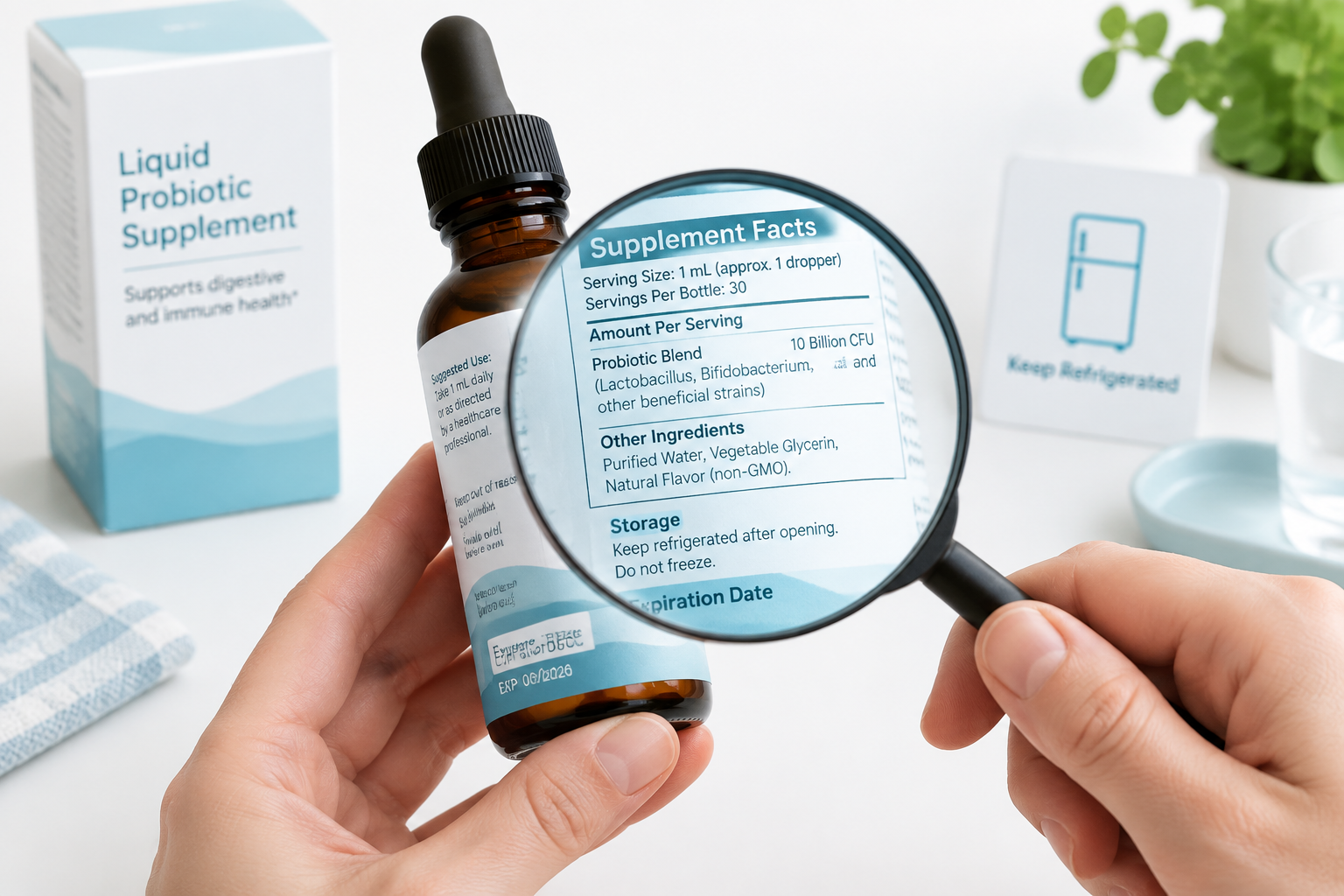
Colony-forming units (CFUs) estimate live microorganisms, but after you identify relevant strain evidence, probiotic bacterial potency matters at the time you use the product. A label that guarantees its CFU count through the expiration or best-by date offers more useful information than one reporting the count only at manufacture. For example, 3 billion CFU at manufacture does not confirm how much remains viable later.
Use the label to check three details:
- Potency guarantee: Prefer language such as “guaranteed through expiration” rather than a count listed only at manufacture.
- Measurement type: Alternative-forming units (AFUs) and CFUs measure viability differently, so 100 million AFU cannot be directly compared with a billion-CFU product. Seed DS-01, for example, guarantees 53.6 billion AFU through expiration.
- Strain-level information: A large total count or long strain list does not show that each strain is present at the dose studied. Seed names 24 strains but does not list an amount for each, so the number reflects breadth rather than strain-specific evidence.
Storage affects whether the stated potency is likely to hold up. Some shelf-stable liquid probiotics can stay at room temperature before opening, while liquid probiotics requiring refrigeration need consistent cold storage from purchase or after opening. Liquids may also have shorter shelf lives and be harder to travel with than capsules. Follow the package instructions, avoid freezing unless the label permits it, and make sure the discard-after-opening period fits your routine.
Liquid format alone does not establish a good match. Bacillus coagulans probiotics contain a spore-forming organism that may be selected for digestive durability, and some oil-based liquids are designed to help organisms withstand gastrointestinal conditions. The more useful comparison is the named strain, dose, and human evidence for your age, symptoms, and circumstances, including recent antibiotic use.
Review the full ingredient panel as closely as the CFU count. Added sugars, sweeteners, flavorings, allergens, and prebiotic fibers may aggravate symptoms in people sensitive to fermentable ingredients. Low FODMAP Certified status, including on Visbiome, can be helpful context but cannot predict personal tolerance.
Digestive symptoms can have many causes, and persistent, severe, or worsening symptoms warrant care from a qualified healthcare professional.
Confirm Expiration-Date CFU or AFU
Shipping and storage can reduce probiotic bacterial potency over a product’s shelf life. Although colony-forming units (CFUs) count living microorganisms, shipping and storage can reduce probiotic bacterial potency over a product’s shelf life.
One USDA Organic probiotic liquid makes this distinction visible. Its label lists 1 billion live bacteria at manufacture, alongside an effective level of 4.5 million through at least the best-by date. Both statements may be accurate, but the expiration-date figure is more relevant to the bottle you buy and finish.
Raw Flora Liquid Probiotic uses a different label approach. It lists 3 billion CFU per 1 mL serving at manufacture without stating potency through expiration. That does not show the product has lost potency. It means the viable count at purchase or near the end of the bottle cannot be confirmed, so the headline number should not be treated as unchanged.
A useful label comparison includes:
- End-date guarantee: Look for wording such as “guaranteed through expiration” or a stated count through the best-by date.
- Measurement system: Some brands use active fluorescent units (AFUs) instead of CFUs. These testing methods are not interchangeable, so their totals cannot be ranked one-for-one.
- Storage requirements: Check for refrigeration before opening, after opening, or both. Some liquids are shelf-stable before opening, while others need refrigeration and may be less convenient to carry.
Seed DS-01, for example, guarantees 53.6 billion AFU through expiration, which is a stronger labeling practice than a manufacture-date count. Its AFU total still cannot be directly compared with a liquid product’s CFU count. Liquid microbes may be suspended rather than freeze-dried, but format alone does not determine survival through stomach acid and bile. An expiration-date guarantee that fits your storage routine offers a more meaningful comparison than the largest number on the front label.
Check Bases, Sugars, and Quality Signals
The full ingredient list, Nutrition Facts panel, and Supplement Facts panel matter more than front-label wellness language. Unflavored liquid probiotics can be taken directly, used as probiotics mixed with water, probiotics mixed with juice, or probiotics in smoothies, and stirred into cool foods. Fermented molasses bases may taste tangy or earthy. One USDA Organic liquid lists water, organic sugarcane molasses, and blueberry, cherry, and pomegranate juice concentrates, which may add sweetness even when probiotics are the product’s focus.
“Sugar-free” does not mean a formula lacks ingredients that could bother your gut. Review the label closely, especially if gas or bloating begins after you start it:
- Sweeteners and flavors: Sugar alcohols, non-nutritive sweeteners, fruit concentrates, and flavorings can affect tolerability.
- Prebiotic ingredients: Fermentable fibers may suit some people but can worsen symptoms during an IBS flare.
- Carriers and oils: The “other ingredients” list may contain oils or other bases. A simpler formula is not automatically a more potent one.
Raw Flora Liquid Probiotic 3 Billion is an unflavored option that may be easier to assess because it can be mixed with cold liquids without flavor masking the ingredient profile.
USDA Organic, vegan, dairy-free, gluten-free, nut-free, and soy-free claims help screen for dietary restrictions, as MaryRuth’s positioning illustrates. USDA Organic reflects certification standards, and vegan excludes animal-derived ingredients. None of these claims establishes digestive benefit or viable probiotic content.
A named genus, species, and strain, such as Lactobacillus rhamnosus GG, gives more useful identity information than an unnamed proprietary blend. Check whether CFUs or AFUs are guaranteed through expiration, since the units are not interchangeable, and confirm the storage directions. Clean Label Project certification may indicate testing for selected contaminants, but it does not verify potency or symptom fit. Food and Drug Administration (FDA) compliance language or medical-food status does not mean FDA approval, and dietary supplements are not FDA-approved before sale. Persistent, severe, or worsening symptoms need evaluation from a qualified healthcare professional.
Choose the Right Format for Your Routine

The best format is the one you can use consistently while matching a named strain and labeled dose to your goal. Liquid delivery may be easier than pills, but a high CFU count, long strain list, or positive reviews do not show whether a product fits your symptoms.
Follow age directions exactly, especially with liquid probiotics for toddlers and liquid probiotics for children. Probiotic droppers help measure small servings for children, older adults, and anyone who struggles to swallow capsules. One product directs 0.75 mL for ages 1 to 3, 1.5 mL for ages 4 to 13, and 3 mL from age 14. Do not reduce an adult serving without label directions or pediatric guidance.
Practical format differences include:
Format | Often fits best when | Main tradeoff |
|---|---|---|
Concentrated drops | You need a low-volume, measured serving | May require refrigeration after opening |
Spoonable tonic | Probiotic dosing with spoons works with a meal routine | Larger servings are less portable |
Capsule | Travel, commuting, or an office drawer matters | May not suit swallowing difficulty |
Powder | You prefer a portable product mixed before use | Requires a drink or cool food |
Fermented drink | A food-like routine and flavor appeal to you | May contain sugar or fermentable ingredients |
Drops and tonics are not interchangeable. A tonic may direct 15 mL for adults and children 12 and older, compared with 5 mL for ages 2 to 12. Choose drops for precise, low-volume dosing, or a spoonable liquid when that routine is easier to maintain.
Unflavored liquids may mix into cool water, juice, smoothies, or cool foods. Avoid hot oatmeal or tea unless the label permits it, since heat can affect live organisms. Fermented molasses-based liquids can taste tangy or earthy, while flavored drinks may add sugar. Check for inulin, chicory root, sweeteners, and other fermentable ingredients if they worsen gas or bloating.
Storage can decide the format. Some liquids are shelf-stable before opening, others need refrigeration, and not every capsule is shelf-stable. Powders mixed immediately before use can offer a portable middle ground.
Choose the strain and dose before choosing the bottle. Lactobacillus rhamnosus GG and Bifidobacterium longum subsp. infantis 35624 should be matched to your goal. Follow timing directions during antibiotic use.
Liquid Probiotics Worth Considering
With routine, strain, and storage needs in view, these liquid probiotics are worked label-reading examples, not rankings or endorsements. The right liquid probiotic supplements for your household depend on your goal, age, ingredient needs, and ability to follow storage directions. Recheck the current bottle label or brand listing before publication or purchase, since formulas and instructions can change.
These examples show how the same label checks apply across products:
- MaryRuth's Organic Liquid Probiotic: This multi-strain product lists 13 strains, including Bacillus coagulans Unique IS-2, and uses an “up to” CFU claim per serving. An “up to” amount is not the same as a CFU count guaranteed through the expiration date. Because the label does not break out amounts by strain, its total CFU figure and long strain list cannot confirm that Unique IS-2 or another researched strain is included at a studied dose.
- MaryRuth's Organic Kids Liquid Probiotic: A children’s liquid is its own formula, not an adult product with a smaller serving. Its age directions, serving size, ingredients, and refrigeration needs should match your child’s situation before you choose it.
- Raw Flora Liquid Probiotic: This contrast case lists 25 strains and 3 billion CFU at manufacture. A manufacture-time count, without an expiration-date guarantee, cannot show how many organisms remain viable at the end of shelf life. Without full strain codes or per-strain amounts, it also cannot verify a researched dose for a particular strain. Recheck the product’s current label or brand listing before publication.
The carrier base matters as much as the strain panel. Sweetened or flavored products may be easier for a busy family to use consistently, but added sugars, allergens, and other ingredients may not fit every dietary need. Despite a pleasant taste, a product may not help with bloating, constipation, or IBS symptoms.
Compare any bottle in the same order:
- Find the full organism name and strain code, rather than relying on a species name or total strain count.
- Check whether the CFU amount is guaranteed through the expiration date instead of stated only at manufacture.
- Review the carrier base, added sugars, and potential allergens.
- Follow the printed refrigeration and handling directions, since storage affects product quality.
A careful label review gives you a stronger basis for comparing multi-strain probiotics than popularity, reviews, or a crowded strain list.
Use Liquid Probiotics Safely

After comparing a product's label details, follow the serving size and frequency on your liquid probiotic's own label. Concentration, dropper design, and age guidance differ by product. For example, age-graded formulas use different volumes for children and adults. Use the supplied measuring device, especially for children.
Begin with the manufacturer's recommended serving and watch for changes during the first several days. Temporary gas, bloating, or changes in bowel habits can occur when starting a probiotic. Taking extra is unlikely to speed results and can make it harder to judge whether the formula agrees with you.
Careful handling and storage help preserve a liquid probiotic supplement's potency:
- Follow shaking directions: Shake the bottle only when its label instructs you to do so.
- Keep the dropper clean: Do not let it touch your mouth, food, or another surface before returning it to the bottle.
- Store it as directed: Some products are shelf-stable before opening, while others need refrigeration after opening or throughout their shelf life.
- Check the expiration date: Do not freeze the bottle unless the manufacturer specifically permits it.
Liquids can be less convenient for travel than capsules, particularly when refrigeration is needed or the opened bottle has a short usable life. Heat exposure, such as leaving a bottle in a car, may affect a product that requires temperature control.
Speak with a qualified healthcare professional or registered dietitian before starting a probiotic if you are pregnant, have a weakened immune system, have a significant health condition, or take prescription medicines. Digestive symptoms, including IBS symptoms, can have many causes, and supplements do not replace diagnosis or prescribed care.
Stop self-managing and seek qualified healthcare advice for severe, persistent, or worsening symptoms. Results vary by person, and any dietary or supplement advice should be individualized.
Liquid Probiotics FAQs
These FAQs cover label details, storage, possible side effects, and safety considerations to help you decide whether a liquid probiotic fits your digestive-health routine.
1. Can Children Take Liquid Probiotics?
Some liquid probiotics for children, including liquid probiotics for toddlers, can be easier to give than capsules, but the format does not make them more effective. Follow the product’s age, serving, storage, and mixing instructions rather than scaling down an adult dose. If the label allows, drops may be added to cold food or drinks, not hot items that can affect live cultures. Ask a pediatrician or registered dietitian before use if your child has a medical condition, a weakened immune system, or persistent, severe, or worsening digestive symptoms.
2. Can Liquid Probiotics Help Diverticulitis?
Liquid probiotics may support digestion, microbiome balance, or regular bowel habits, and some people find them useful for mild, occasional gas or irregularity. They do not treat diverticulitis or prevent flares, and any effect depends on the specific strain rather than the liquid format.
Speak with your healthcare professional before starting one, especially with active symptoms, pregnancy, immune suppression, or another health condition. Results vary by person, and a probiotic cannot replace evaluation or prescribed care. Persistent, severe, or worsening abdominal symptoms need medical attention.
3. Can You Take Liquid Probiotics With Infliximab?
Liquid probiotics do not automatically interact with infliximab, but they are not automatically appropriate. Infliximab modifies immune activity, so speak with the clinician managing your treatment before starting one, especially with a compromised immune system, active infection, illness, or another risk-raising condition.
Liquid delivery is not the deciding factor. A prescriber or registered dietitian can weigh the strain, dose, symptom goal, evidence, age, antibiotic use, and health history. This content is for educational purposes only and is not a substitute for personalized medical advice.
4. Are Liquid Probiotics Different for Men?
No. A liquid probiotic labeled for men is not inherently better for male digestive health. Its possible roles in supporting the intestinal barrier, probiotics for immune function, or the gut-brain axis do not show a male-specific benefit. Choose based on your symptoms, the full strain code and evidence for your goal, CFUs at expiration, added sugars or prebiotics, and storage needs. Age, antibiotic use, medical conditions, and immune status matter more than gender-based marketing. Consult a qualified healthcare professional if safety concerns apply.