


IBS can qualify for disability benefits, but the diagnosis by itself almost never carries a claim. These decisions turn on function: how often symptoms interrupt your work, how long the interruptions last, and whether you could hold a job reliably despite treatment. A well-documented moderate case can succeed where a poorly documented severe one fails.
Social Security has no standalone listing for IBS, which surprises many applicants without disqualifying them. Two routes remain. You can show that your combined findings medically equal a digestive listing, or that your residual functional capacity rules out both your past work and other available jobs. SSDI, SSI, VA compensation, and private long-term disability then each add a different test of their own, so the same medical records can succeed under one program and fail under another.
One rule applies before any of that: your limitations must last, or be expected to last, at least 12 continuous months. Dated records that tie specific symptoms to specific job demands are what move a claim forward. This guide is educational and is not legal advice, and no diagnosis guarantees eligibility.
IBS Disability Benefits Key Takeaways
- IBS has no standalone SSA Blue Book listing.
- Medical equivalence and RFC provide two possible Social Security pathways.
- Disability-related limitations must last or be expected to last at least 12 months.
- SSDI depends mainly on work credits and sustained inability to work.
- SSI also requires meeting income and resource limits.
- VA benefits require service connection, while private claims follow policy terms.
- Dated medical, work, and symptom records should connect IBS to specific job limits.
Can IBS Qualify You For Disability Benefits?

IBS can qualify for disability benefits, but a diagnosis alone usually isn’t enough. The Social Security Administration (SSA) evaluates how your symptoms affect sustained work, not simply the condition’s name. This is why IBS disability benefits depend on medical evidence and documented functional limits.
The SSA Blue Book has no standalone listing for irritable bowel syndrome (IBS). Inflammatory bowel disease appears under Listing 5.06, but the absence of an IBS listing does not automatically disqualify you. Two main pathways may still apply:
- Medical equivalence: SSA may compare the combined severity of your symptoms, clinical findings, treatment history, and related digestive problems with a digestive-system listing. Meeting medical equivalence for Listing 5.06 requires comparable medical severity, not just an IBS diagnosis or a checklist of symptoms.
- Residual functional capacity: Your residual functional capacity (RFC) describes the work activities you can still perform despite your condition. The evidence may show that your limitations prevent past work or make adjustment to other substantial work unrealistic.
Medical equivalence is an individualized decision based on your complete record. Diarrhea or constipation, abdominal pain, bloating, urgency, and fatigue may support your claim, but their significance depends on documented frequency, duration, treatment response, available clinical findings, and a healthcare professional’s explanation of the overall pattern. A symptom that occurs occasionally may carry less weight than one that repeatedly interrupts daily activities despite treatment.
The RFC pathway does not require proof that you cannot perform every type of job. Your records should connect symptoms to specific workplace demands, such as:
- Bathroom access: Unscheduled breaks or limited access may interfere with reliable attendance and workstation time.
- Attendance: Unpredictable flares may cause absences or make a fixed schedule difficult to maintain.
- Pace and task completion: Pain, fatigue, or urgency may slow your work or interrupt tasks.
- Concentration: Discomfort, poor sleep, and fear of an urgent bowel movement may affect focus.
- Workstation tolerance: Symptoms may prevent you from remaining at your workstation for expected periods.
An inability to work due to IBS must last, or be expected to last, at least 12 continuous months, or result in death. A short flare, recent diagnosis, or temporary leave generally will not meet that duration rule. Consistent follow-up can help show whether limitations continue and how they affect work over time.
For IBS Social Security disability questions, rely on verified medical evidence rather than unsupported statistics or estimates. A clear record of IBS in daily life can help translate private symptoms into specific work-related facts.
How Does The SSA Evaluate An IBS Claim?
With work-related IBS limits established by the preceding evidence, the SSA reviews an IBS claim through five steps focused on how your condition affects work. The SSA weighs work capacity, medical evidence, and program rules when deciding an IBS and SSDI claim. This guide is educational only: it is not affiliated with the SSA and does not provide medical, insurance, or legal advice.
The five steps generally follow this order:
- Substantial gainful activity: The SSA first checks whether you're working and earning more than the applicable substantial gainful activity (SGA) limit. Earnings above that limit may end the evaluation at Step 1. Fewer work hours or lower earnings do not automatically establish eligibility for IBS SSDI benefits. The agency still reviews your medical records and work history.
- Severity and duration: The agency considers whether medically documented symptoms significantly limit basic work activities. Relevant symptoms may include pain, diarrhea, constipation, urgency, incontinence, bloating, fatigue, and concentration problems. When reviewing duration, the agency also considers whether the documented limits persist over time. Treatment records are more useful when they show how often symptoms occur, how severe they become, what triggers them, and how they respond to care.
- Listing-level evidence: The SSA compares your medical evidence with its Listing of Impairments, commonly called the SSA Blue Book. IBS has no standalone listing, so an IBS diagnosis usually is not enough by itself. Related findings or another documented condition may affect the analysis. If your condition does not meet or medically equal a listing, the claim continues to an assessment of your actual work capacity.
- Past relevant work: The SSA uses your residual functional capacity, or RFC, to determine what you can still do despite IBS. This assessment may consider sitting, standing, walking, lifting, concentration, attendance, restroom access, unscheduled breaks, and absences during flares. The agency then compares those limits with the essential demands of past relevant work performed during the prior 15 years. This is where an IBS Social Security disability claim must show more than symptoms. Treatment notes should connect those symptoms to specific limits rather than relying on diagnosis codes alone.
- Other available work: If you cannot perform past relevant work, the SSA considers whether you can adjust to another job in the national economy. The analysis includes your RFC, age, education, work experience, and transferable skills. Unpredictable bowel movements, urgency, pain, fatigue, or concentration problems may matter when they prevent reliable performance, even in a job with lighter physical demands.
At a hearing, an Administrative Law Judge may ask a vocational expert about your past work and possible alternatives. The issue is sustained performance across a normal work schedule, not what you can manage on an occasional good day. Records showing your typical pattern across better and worse days can make the difference between a general symptom description and usable evidence.
Digestive symptoms can have many causes. Consult a qualified healthcare professional for persistent, severe, or worsening symptoms. Rules and outcomes vary by claim, and no diagnosis guarantees eligibility.
Which SSDI, SSI, VA, or Private Benefit Fits?

Beyond the SSA's five-step review, the right benefit depends on your work history, finances, military service, and private policy terms. Each program applies a different eligibility test, and each program looks at documented limits such as bathroom urgency, pain, fatigue, concentration problems, missed shifts, reduced pace, lifting difficulty, and access to a restroom.
Program | Main eligibility question | Application route and evidence |
|---|---|---|
Social Security Disability Insurance (SSDI) | Do you have enough recent work credits, and does your condition prevent sustained work? | Social Security application, work history, treatment records, and functional information |
Supplemental Security Income (SSI) | Do your medical limits meet the disability standard while your countable income and resources fit program rules? | Social Security application, medical records, financial details, and household information |
VA disability compensation | Is your IBS connected to military service or an applicable presumptive rule? | VA claim, service history, medical evidence, and connection evidence |
Private long-term disability insurance | Do your symptoms meet the disability definition in your policy? | Insurer forms, policy terms, medical proof, and information about your covered occupation |
SSDI and SSI are separate programs. Social Security Disability Insurance generally requires enough recent work credits from covered employment. Supplemental Security Income is needs-based and considers countable income and resources. A limited work history may make IBS SSI benefits worth investigating, but financial eligibility is reviewed separately from medical eligibility.
Social Security evaluates whether medically documented IBS, alone or combined with other conditions, prevents sustained work. For IBS SSDI benefits, the most useful records connect symptoms to specific job demands:
- Bathroom urgency: Unplanned breaks, limited restroom access, or time away from a workstation.
- Pain and bloating: Difficulty sitting, moving, lifting, or completing physical tasks at the expected pace.
- Diarrhea, constipation, or fatigue: Unpredictable attendance, missed shifts, or trouble maintaining a regular schedule.
- Concentration problems: Missed details, slower completion, or difficulty sustaining pace.
- Anxiety or depression: These conditions may support a claim when healthcare providers explain their connection to IBS and their effect on your functioning. Separate legal standards may still apply.
VA disability compensation asks a different question. Service connection is the central issue, not work credits or household finances. Under 38 C.F.R. § 4.114, Diagnostic Code 7319, the schedular ratings for IBS are 0%, 10%, 20%, and 30%. Eligible Persian Gulf War veterans may also qualify under applicable presumptive rules for certain undiagnosed illnesses or medically unexplained chronic multisymptom illnesses when the service and symptom requirements are met.
Private IBS long-term disability claims depend on the insurance contract. The policy may set an elimination period, benefit duration, exclusions, and a definition of disability. An “own occupation” standard focuses on your specific job, while an “any occupation” standard may later consider whether you can perform other suitable work. Strong long-term disability insurance evidence shows how IBS affects the essential duties of the covered occupation, rather than describing discomfort alone.
Application routes and review times vary. Waiting periods, appeals, offsets, payment interactions, and evidence standards may affect more than one benefit at the same time. Confirm the applicable rules with the agency, insurer, disability attorney, or another qualified representative before relying on an estimate.
Medical documentation can help distinguish digestive symptoms from other possible causes when benefits are under consideration. A healthcare professional’s assessment may clarify the record without promising claim approval.
Which IBS Symptoms Can Limit Your Ability To Work?

Across those benefit programs, IBS can limit your ability to work when symptoms repeatedly affect attendance, pace, concentration, safety, or access to a restroom. For an inability to work due to IBS, the documented effect on your job duties generally matters more than the diagnosis by itself.
Urgency, diarrhea, constipation, incomplete bowel movements, and repeated restroom trips can interrupt customer calls, presentations, meetings, teaching, driving, security work, health care, or any job with limited bathroom access. You may need to leave without warning, arrive late, pause a lesson, or spend recovery time away from your duties. The work impact depends on how often symptoms occur, how predictable they are, and whether your workplace allows flexible breaks. bathroom fear with IBS can also add planning time and make leaving home or reaching work harder.
Abdominal pain, cramping, bloating, and gas can reduce stamina even when you stay at your workstation. Symptoms may make commuting, prolonged sitting, standing, lifting, holding one posture, or using a computer for long periods more difficult. Bloating and gas can add discomfort in close-contact settings, but the key issue is whether symptoms reduce sustained work activity, not whether the diagnosis sounds serious.
Alternating bowel patterns can make schedules unpredictable, especially when a flare lasts two to four days or longer depending on its severity. Repeated flares may lead to missed shifts, shortened workdays, postponed duties, or attendance problems. Occasional discomfort is different from symptoms that disrupt the workweek again and again.
Nighttime bowel movements, pain, or worry about symptoms may interrupt sleep. The resulting IBS-related fatigue can reduce alertness, slow physical work, complicate commuting, and increase risk during safety-sensitive duties. Poor sleep may also intensify the effects of urgency and pain during a full shift.
Pain, fatigue, urgency, and repeated interruptions can create off-task time that a timecard does not show. Work may pause while you find a restroom, monitor bowel sensations, recover after a flare, or regain focus before a complex task. These interruptions can affect accuracy, multitasking, deadlines, production pace, and prolonged attention, although the effect varies by person and job.
Concrete records help connect symptoms with functional limits:
- Restroom use: Record the number, length, urgency, and predictability of interruptions.
- Attendance: Note late arrivals, missed meetings or calls, shortened shifts, absences, and days symptoms keep you from leaving home.
- Work performance: Track slower pace, incomplete or postponed duties, errors, reduced concentration, and recovery time.
- Job demands: Record driving, lifting, fixed postures, prolonged sitting, public contact, safety duties, and limited bathroom access.
This information can support a healthcare discussion about disabling IBS symptoms and clarify how they affect essential work activities. Because similar digestive symptoms can have many causes, persistent, severe, or worsening problems warrant evaluation by a qualified healthcare professional. An IBS flare-up supplies may help with daily planning, but it cannot establish disability or replace medical documentation. Keep the record focused on what happened, how long it lasted, and which work duties were affected.
How Can You Document IBS For A Disability Claim?
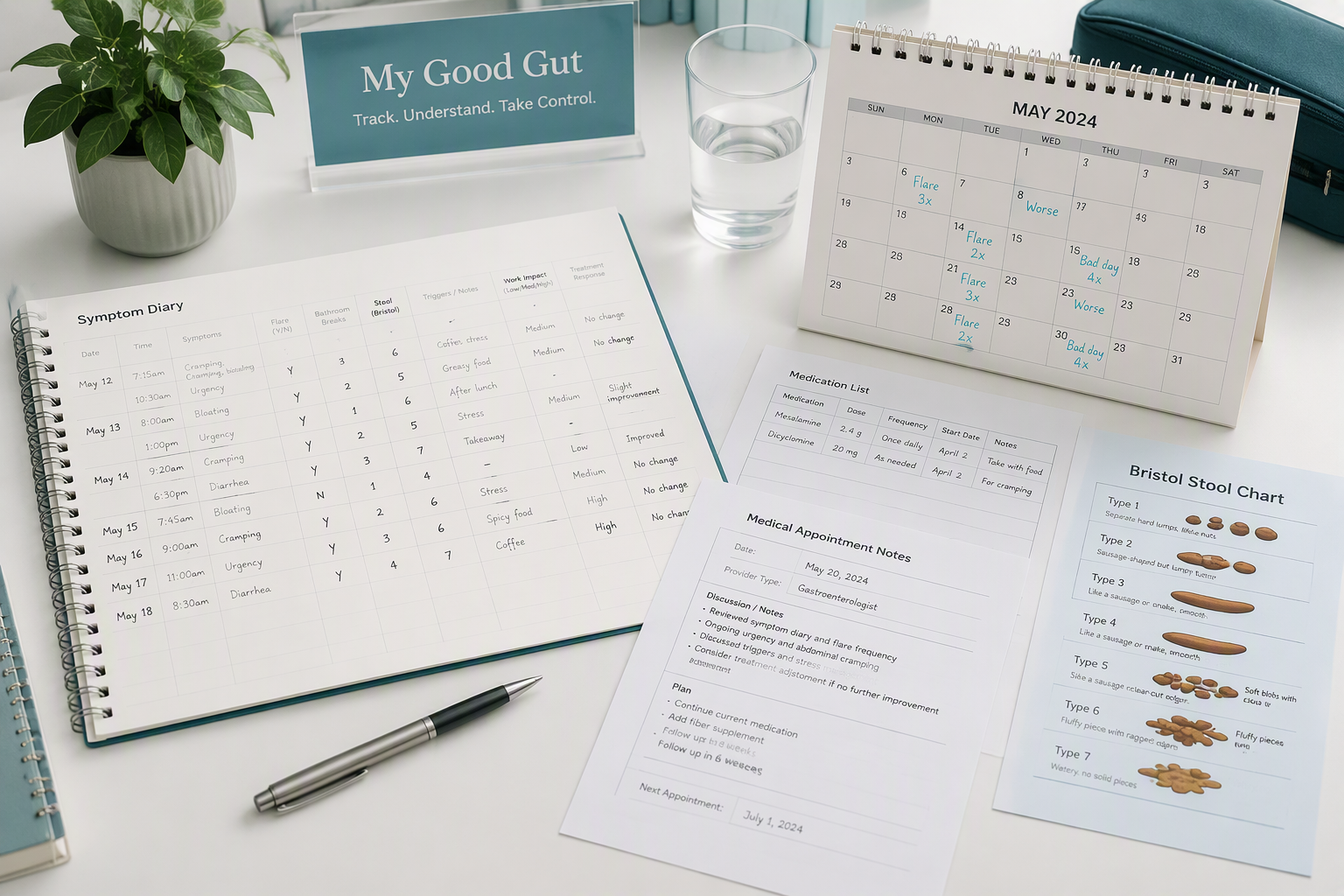
To turn those work-related symptom effects into evidence, a well-supported disability claim connects your IBS diagnosis to specific limits on work and daily life. Medical evidence for disability should show how often symptoms occur, how long they last, and what you cannot reliably do, rather than relying on terms such as "severe IBS" or "debilitating."
Start by building a dated record of diagnosis, treatment, and function. Medical records for disability should include:
- Diagnosis history: Primary-care and gastroenterology notes, the date symptoms began, how IBS was diagnosed, follow-ups, and evaluations for other possible causes.
- Clinical findings: Laboratory or imaging results, treatment plans, and physician statements about your outlook.
- Treatment response: Prescriptions, over-the-counter medicines, dietary changes, therapy, other recommended care, and any symptom recurrence.
This history can serve as proof of IBS diagnosis while showing that persistent symptoms received medical attention. Keep records from both specialists and primary-care clinicians because each may describe different effects on your health and daily function.
A symptom diary adds details that a short office visit may miss, and a contemporaneous dated record generally carries more weight with a reviewer than a recollection assembled later. Paper notes or digital IBS symptom logs can help you follow a consistent documentation routine. A pre-printed log such as a food diary and symptom journal with a Bristol stool chart prompts the same fields every day, which makes gaps and inconsistencies less likely across months of entries. Record each entry with the date and connect symptoms to what happened afterward:
- Flare pattern: Note the duration, bowel pattern, and frequency of each flare. Track constipation and diarrhea separately.
- Symptoms and related effects: Include pain, urgency, bloating, fatigue, sleep disruption, accidents, and trouble concentrating.
- Daily interruptions: Record abandoned or delayed activities, extra time needed, help from others, and whether you had to remain near a restroom.
- Work impact: Estimate unscheduled bathroom breaks, their usual duration, time off task, missed workdays or partial days, late arrivals, and changes in pace or productivity.
Specific observations are stronger than broad labels. For example, "needed four unscheduled restroom breaks lasting about 15 minutes during a six-hour shift" gives a clearer picture than "bathroom urgency was bad." Note whether pain, fatigue, or unpredictable bowel symptoms affected attendance or your ability to finish tasks.
Treatment records should also show what helped, what failed, and whether cost or access barriers limited care. Side effects such as drowsiness, dizziness, constipation, diarrhea, or impaired concentration can create additional work problems. Do not change or stop treatment to strengthen a disability claim.
A treating doctor statement should describe medically supported restrictions, not simply say that you are disabled. Your healthcare professional may address restroom access, unscheduled breaks, time off task, sitting, standing, walking, lifting, attendance, pace, stress tolerance, and concentration. Diary examples can help distinguish usual functioning from occasional better days and difficult flares.
Employment records can support the daily-life picture. Preserve attendance records, leave notices, reduced schedules, performance concerns, and workplace accommodations. Document effects on commuting, childcare, shopping, meals, household tasks, social activities, and sleep, including extra time or help required. Related conditions, such as anxiety, depression, anemia, or another diagnosed digestive problem, should be documented separately rather than automatically attributed to IBS.
This information is educational and does not replace personalized medical advice. Digestive symptoms can have several causes, so the record should identify any relevant evaluations. Keep every entry factual, dated, and tied to function so the record clearly shows how disabling IBS symptoms affect your ability to work and manage daily life.
How Do You Apply Or Appeal After A Denial?
Choose the benefit route that matches your circumstances. Social Security Disability Insurance (SSDI) generally depends on work history and earnings, while Supplemental Security Income (SSI) considers income and resources. Veterans Affairs (VA) disability compensation requires a condition connected to military service. A private long-term disability claim follows the policy's definition of disability, exclusions, deadlines, and proof rules. Some people may pursue more than one route.
A disability claim must show how IBS affects reliable work, not only confirm the diagnosis. Describe the effects on:
- Attendance: Urgency, diarrhea, constipation, pain, or flares that cause absences and unscheduled restroom breaks.
- Workstation access: Time away from your desk, limited restroom access, or difficulty staying in a required location.
- Physical tasks: Problems with sitting, standing, lifting, commuting, or maintaining a normal pace.
- Workday completion: Fatigue, pain, bloating, or concentration problems that interfere with finishing a full shift.
- Other conditions: Anxiety, depression, or another medically documented condition that adds to your work limitations.
For an appeal, treatment notes, testing, medication effects, symptom patterns, flare frequency, restroom needs, and response to care can strengthen the record. Ask healthcare professionals to describe functional limits rather than simply confirming IBS.
A focused application or appeal usually includes these steps:
- Gather records: Collect medical records for disability, employment records, accommodation information, forms, and communications. Keep copies of every submission.
- Check for conflicts: Compare dates, symptom descriptions, treatment details, and work information before filing. Contradictions can raise avoidable questions.
- Describe the full pattern: Include ordinary symptoms and severe flares. A record based only on your worst or best days may not show your typical functioning.
- Read the denial: Social Security may cite symptoms lasting less than 12 months, insufficient severity, adequate control with treatment, the ability to perform past work, or the ability to perform other work.
- Answer the stated reason: Use focused evidence instead of repeating the original application. Explain why limitations continue despite reasonable treatment and why dependable employment remains difficult.
- Meet the review deadline: Request reconsideration or the next review promptly under that program's procedure. Social Security commonly requires reconsideration before an administrative hearing, while VA and private insurers use different forms, deadlines, evidence rules, and review standards.
Failing to meet a specific Social Security listing does not automatically end a claim. A Residual Functional Capacity assessment may consider remaining abilities along with age, education, work experience, and transferable skills.
Professional help can be useful when several conditions, a complex work history, service-connection issues, private-policy restrictions, or repeated denials are involved. A disability attorney or qualified representative can interpret the notice, develop focused arguments, gather relevant records, and track deadlines. Legal guidance does not replace individualized medical care, so continue working with clinicians on symptom documentation and treatment.
This information is educational and does not replace personalized medical or legal advice. Persistent, severe, or worsening digestive symptoms deserve evaluation by a qualified healthcare professional. Program rules control each decision, and no application or appeal guarantees benefits.
IBS Disability Benefits FAQs
These IBS Disability Benefits FAQs cover common questions about eligibility, medical evidence, work limitations, and the application process. They offer a clear starting point while recognizing that decisions vary with your health records, functional limits, and the benefit program involved.
1. Is It Hard To Get Disability For IBS?
IBS disability claims can be difficult because a diagnosis alone doesn’t show that you’re unable to work. If you’re asking, “is IBS a disability,” the answer depends on how symptoms affect your job. Records should connect pain, urgency, diarrhea, constipation, fatigue, or concentration problems with unscheduled bathroom breaks, missed work, interrupted tasks, or an unreliable schedule. Consistent treatment notes, symptom reports, examination findings, and response to care provide stronger proof of IBS diagnosis. Social Security’s Section 5.06 (source) guidance still requires an individualized review.
2. Can IBS Qualify Without A Specific SSA Listing?
Yes, IBS can qualify for disability even without a dedicated SSA listing. Medical equivalence may apply when documented symptoms meet another listing, or an RFC-based medical-vocational allowance may apply when bathroom urgency, pain, fatigue, absences, or poor concentration prevent reliable full-time work.
IBS is a functional disorder, while inflammatory bowel disease involves structural inflammation. Crohn’s disease and ulcerative colitis may follow different evaluation rules. If you ask, “can IBS qualify for disability,” focus on medical records showing how symptoms affect attendance and job performance, rather than relying on general digestive disorders disability claims.
3. Can IBS Qualify For SSI Without Work Credits?
Yes. SSI is needs-based, so you don’t need work credits as you would for IBS and SSDI. You must still meet the Social Security Administration’s disability standard. Your IBS-related limitations must prevent substantial gainful activity and last, or be expected to last, at least 12 months.
SSI also has countable-income and resource limits, so medical eligibility alone doesn’t guarantee IBS SSI benefits. Evidence should explain how urgency, pain, bowel changes, fatigue, and restroom needs affect attendance, concentration, pace, and daily functioning. Rules may change, so confirm current requirements before applying.
4. Can IBS And Another Condition Support Benefits?
Yes. IBS may be evaluated with another documented condition, including anxiety, depression, inflammatory bowel disease, or another digestive disorder. Eligibility depends less on the number of diagnoses than on how their combined effects limit reliable attendance, restroom access, concentration, stress tolerance, pace, and completion of a normal workday.
Describe these interactions in practical terms. Pain and urgency may heighten anxiety, while depression or fatigue can slow tasks and reduce focus. Medical records should connect symptoms with missed days, interrupted work, reduced stamina, and inconsistent activity. Combined conditions do not guarantee eligibility.
5. Can IBS Qualify For Long-Term Disability Insurance?
Yes, IBS long-term disability benefits may be available, but approval depends on your long-term disability insurance policy’s definition of disability. Some policies assess whether IBS prevents you from doing your own occupation, while others consider any suitable work. An elimination period may apply, so a diagnosis alone doesn’t guarantee approval.
A strong long-term disability claim connects symptoms to functional limits through treatment records, a treating doctor statement, documented bathroom-access or attendance problems, and consistent notes about symptom frequency and severity. Check deadlines for notice, proof of claim, and ongoing records. Guidance about working with IBS is educational, not individualized legal or medical advice.