


A low FODMAP protein powder is chosen by checking the entire label, not simply trusting “lactose-free” or “gut-friendly” claims. Whey isolate, egg white, rice, and other simple formulas are often easier starting points for IBS, while inulin, chicory root, polyols, and extra dairy ingredients deserve closer attention.
A short ingredient list can still hide several fermentable carbohydrates, and certification only applies to a stated serving size. Check the protein source, sweeteners, fibers, and serving amount, then test one-quarter of a serving and track symptoms for 24 to 48 hours before increasing gradually. Monash Low FODMAP Certified and FODMAP Friendly marks can narrow your choices, but your current label and personal tolerance remain the deciding factors.
Low FODMAP Protein Powder Key Takeaways
- Check the complete ingredient list instead of relying on front-label claims.
- Whey isolate usually contains less lactose than whey concentrate.
- Avoid inulin, chicory root, and added prebiotic fiber during initial testing.
- Watch for polyols such as sorbitol, mannitol, xylitol, and maltitol.
- Monash and FODMAP Friendly certifications apply to specific serving sizes.
- Start with one-quarter serving and change only one variable at a time.
- Test protein sources individually while tracking bloating, gas, and stool changes.
How Do You Spot High FODMAP Triggers in Protein Powders?
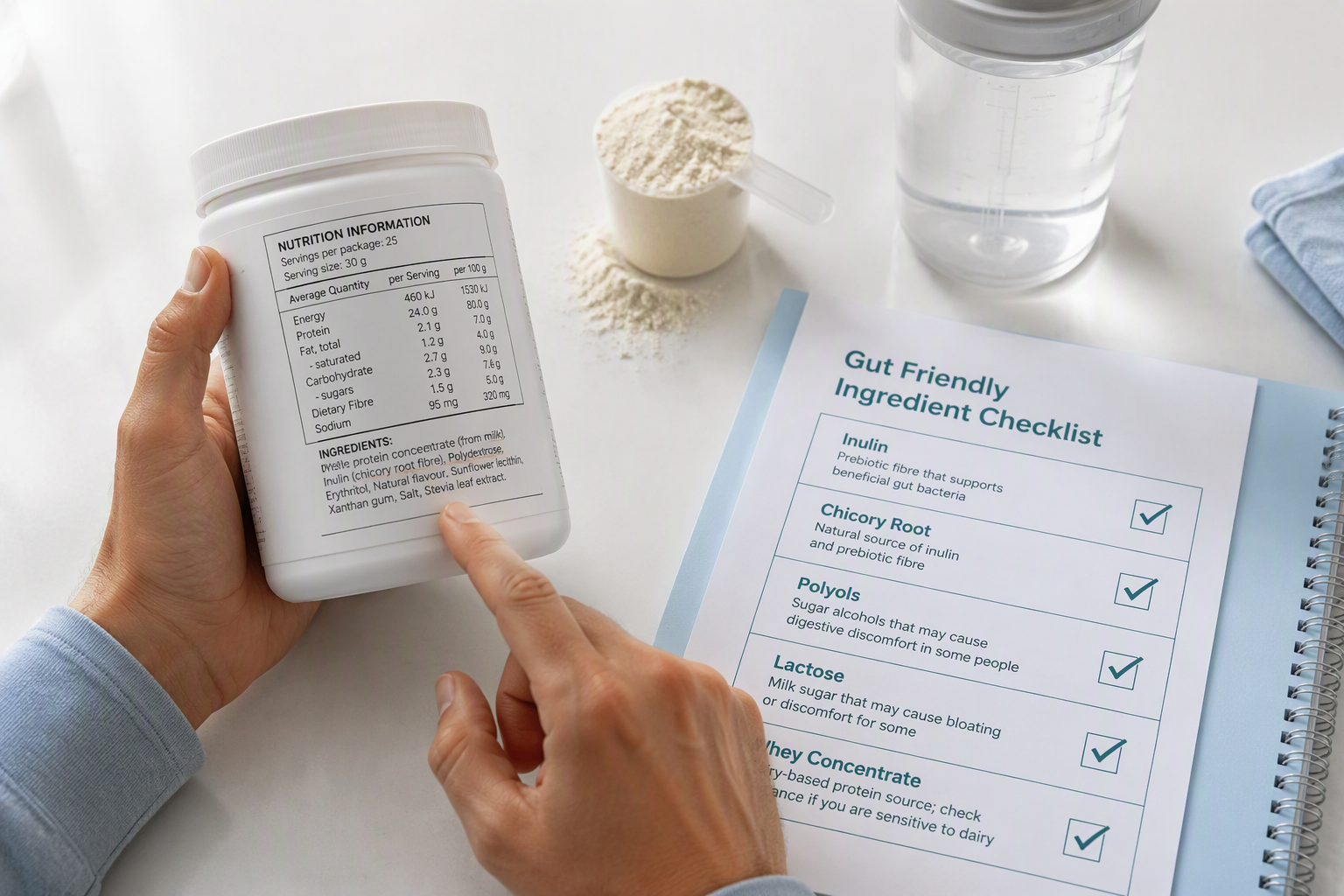
Protein itself usually isn’t the FODMAP problem in a protein powder. Higher risk often comes from what’s added around it, such as sweeteners, binders, milk ingredients, and fiber blends. When choosing a low FODMAP protein powder, label reading means checking the protein source and every extra ingredient together, rather than trusting the word “protein” on the package.
People with irritable bowel syndrome (IBS) may react to fermentable carbohydrates hidden in small-looking additions. Even a short ingredient list can contain several carbohydrate-like ingredients while the Nutrition Facts panel appears clean. Pay close attention to these categories:
- Milk ingredients: Lactose, milk solids, whey concentrate, and other dairy components may cause symptoms with lactose intolerance or individual dairy sensitivities. Whey isolate is often lower in lactose than whey concentrate, but your tolerance still matters.
- Legume-based additions: Pea protein may work for some people, but combining it with other carbohydrate sources can raise the formula’s overall risk. The complete ingredient list matters more than the name of one protein source.
- Starches and syrups: Added starches, glucose-based syrups, and similar ingredients contribute carbohydrates to the formula. Several such additions deserve more caution than one isolated ingredient.
- Prebiotic fibers: Inulin and chicory root are common examples. Jerusalem artichoke can also point to an inulin-rich ingredient. Because these fibers feed gut bacteria, they may contribute to gas, bloating, or urgency for some people with IBS.
“Lactose-free” does not automatically mean a powder fits your low-FODMAP plan. Treat the ingredient list as the more useful check, especially when it includes milk solids, whey concentrate, or another dairy component that has bothered you before. A marketing claim can be accurate while the full formula remains a poor match.
Before buying, circle every likely trigger you find:
- Prebiotic additions: Compare Inulin, chicory root, Jerusalem artichoke, and a broader prebiotic fiber blend by position and amount.
- Dairy ingredients: Lactose, milk solids, whey concentrate, or another dairy ingredient linked to your symptoms.
- Sweeteners and carbohydrates: Sugar alcohols, syrups, or multiple added carbohydrate sources.
Several red flags in one tub make a simpler formula the safer first trial. Keep your trigger list beside you while shopping, and test one serving at a time so you can tell which ingredient your body may be responding to.
How Do You Choose a Low FODMAP Protein Powder?
After identifying likely triggers in the ingredient list, choose a low FODMAP protein powder the same way you approach structured low FODMAP elimination, by reading that list rather than trusting the front label. Start with the serving size you’ll actually use, often 20 to 30 grams, then identify the main protein source. For a lower lactose risk, whey protein isolate is usually a better starting point than concentrate because filtration removes most lactose. The difference in whey protein concentrate vs isolate matters when dairy triggers bloating or gas. If lactose seems to be your main concern, understanding how dairy affects IBS can help you spot the pattern.
A short ingredient list makes a product easier to test. Run this label checklist before buying:
What to look for | Why it matters |
|---|---|
Protein source listed first | The formula starts with the protein you intend to buy. |
“Isolate” or “concentrate” | Whey protein isolate generally contains less lactose than concentrate. |
Prebiotic or added fiber | Inulin, chicory root, and fiber blends may increase fermentation. |
Sugar alcohols | Sorbitol, mannitol, xylitol, maltitol, and isomalt are polyols that may be harder to tolerate. |
Milk powder, milk solids, or condensed milk | Extra dairy ingredients may add lactose beyond the main protein. |
Total ingredient count | A shorter formula is easier to test and troubleshoot. |
Front-of-pack claims can’t tell you whether fermentable carbohydrates were added. “Lactose-free” still leaves the rest of the formula to assess for irritable bowel syndrome (IBS). Check for milk powder, milk solids, or condensed milk below the main protein, even when the package makes a broad digestive-health claim. A product marketed for a low FODMAP diet may still be a poor match for your personal triggers. If meal convenience is the priority, compare the label with the same care you’d use when choosing low FODMAP meal delivery.
Sugar alcohols need a precise read. Sorbitol, mannitol, xylitol, maltitol, and isomalt are polyols worth avoiding while you’re learning your tolerance. Erythritol is the exception. It’s largely absorbed in the small intestine instead of being fermented in the colon, and it’s generally better tolerated at normal serving sizes. Avoiding every ingredient that ends in “-ol” can make your choices unnecessarily narrow.
Added prebiotic fibers are a separate issue from sweeteners. Inulin and chicory root are commonly added to feed gut bacteria, which can increase gas or bloating during an elimination phase. A fiber blend high in the ingredient list raises the product’s risk profile, regardless of the front label. Choosing fiber for IBS explains the wider connection between fiber and symptoms.
Choose the formula closest to single-ingredient protein, then test one serving for 24 to 48 hours while tracking bloating, gas, and stool changes. If symptoms flare, swap formulas rather than repeating the same trial. A low FODMAP product can still cause discomfort because IBS has several drivers. Persistent, severe, or worsening symptoms call for a clinician rather than another product swap, and a low FODMAP diet plan can add structure to the broader process.
How Do You Interpret Certification Claims for a Safe Serving?
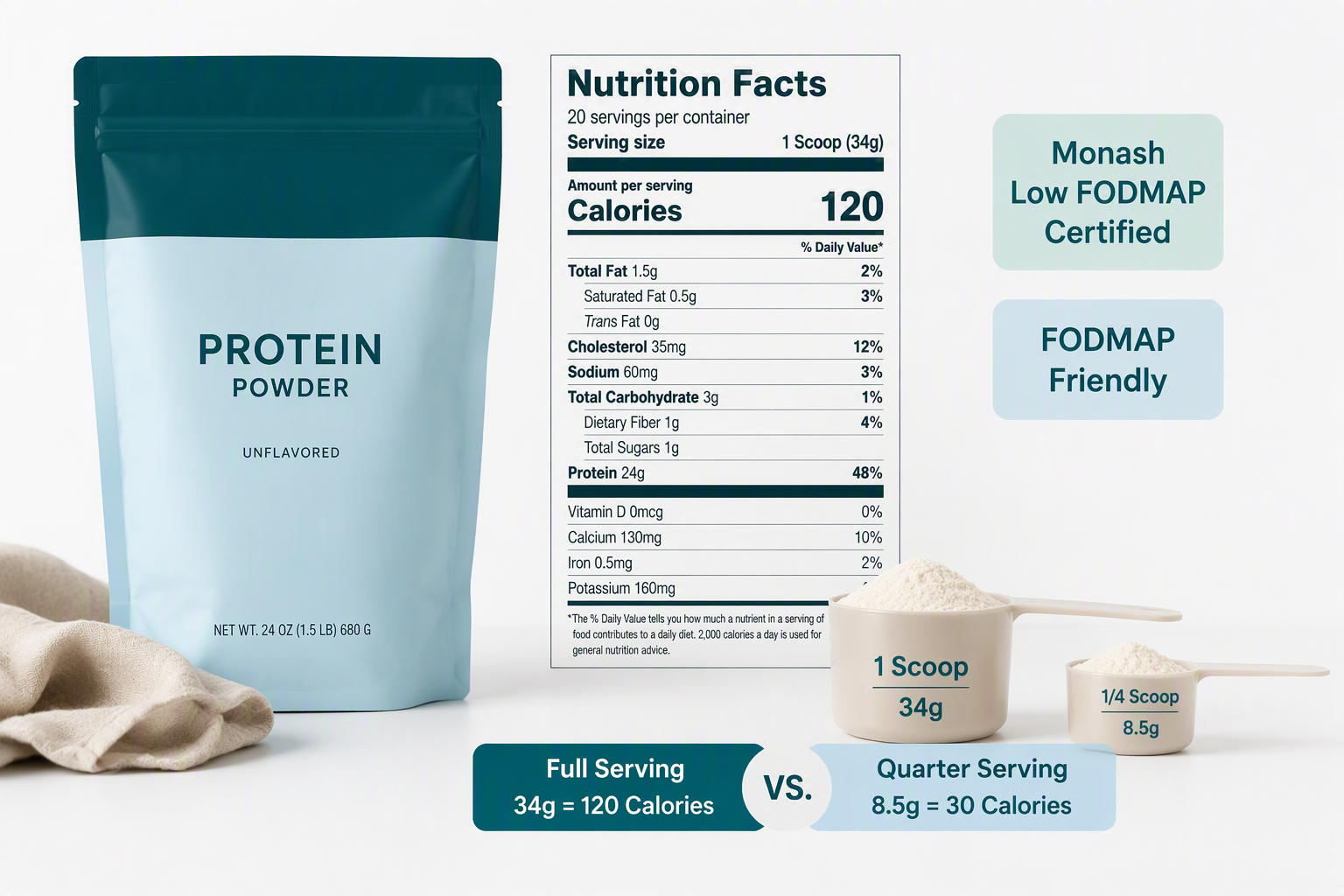
Once you have screened the formula, certification can narrow your choices, but it cannot guarantee that every serving will suit your IBS symptoms. Monash FODMAP and FODMAP Friendly are separate programs, so their logos are not interchangeable. Monash Low FODMAP Certified is run by Monash University, which developed the diet. FODMAP Friendly is an Australian certifier with its own logo and testing process. Monash Low FODMAP Certified and FODMAP Friendly both test products against FODMAP limits at a stated serving size, so they are stronger signals than an unsupported company claim (source).
The label’s meaning varies by the evidence behind it:
What the label says | What it actually means | How much to trust it |
|---|---|---|
A Monash or FODMAP Friendly mark | The product met that program’s limits at a specified serving | Useful, but limited to that serving |
“Low FODMAP” without a certification mark | A company claim without clear independent verification | Treat cautiously |
“Gut-friendly” or similar wording | Marketing language without a defined FODMAP standard | Not useful for FODMAP decisions |
No FODMAP claim | The product might still suit you, but no testing claim is presented | Read the full ingredient list |
Serving size is the catch that can create false confidence. If one scoop was tested, two scoops are not automatically covered. A larger portion may also add more lactose, sweeteners, or added fibers. Start with small servings and increase only if your symptoms remain stable.
Formulas can change with little notice. Flavors may contain different ingredients, and a new tub may not match an online label or a product you tolerated last year, so the package in your hand takes priority over older website information.
Most protein powders have not been tested by either program. Monash has said it cannot answer product-level questions about individual powders without testing each one. Missing certification is therefore weak evidence, not a red flag. Ingredient reading matters more than logo hunting for most low FODMAP protein powder options, although FODMAP Friendly certified products can simplify your shortlist.
Use certification to narrow the field, the current ingredient list to assess risk, and your own tolerance test to confirm fit. A simple log of serving size, ingredients, and symptoms can help you spot a pattern without assuming the logo tells the whole story.
How Do You Run a Tolerance Test at Home?

Because certification applies to a stated serving, a tolerance test works best when you change one variable at a time, start with small servings, and watch your symptoms before increasing the dose. Choose a low-pressure day when you can observe yourself for four to six hours rather than testing a new low FODMAP protein powder during a stressful week.
For the three days before testing, record your usual bloating, gas, stool frequency, urgency, and pain, along with what you eat. This quiet baseline helps separate a powder reaction from symptoms already developing. Keep meals, routines, and other supplements unchanged during the test.
The testing sequence is simple:
- Choose one powder: Test one product and protein source at a time. Avoid introducing a new sweetener, fiber supplement, or other dietary change on the same day.
- Set the timing: Take the first dose at a consistent time when you can monitor symptoms for four to six hours. Keep the rest of the day as routine as possible.
- Begin with a small dose: Use about one-quarter of the label serving, or less if you tend to react easily. Mix it with the same amount of liquid each time.
- Increase gradually: If symptoms stay within your usual baseline during the watch window and don’t continue into the next day, increase the dose. Increase the dose gradually every few days until you reach the serving you plan to use, and slow down if symptoms change.
- Respect the serving size: Low-FODMAP certification and FODMAP thresholds apply to a specific serving. Tolerating a quarter serving does not confirm that the full serving will feel the same.
A brief daily log is more useful than detailed notes you stop completing. One row should take less than a minute:
Day | Dose | Time | Bloating 0-10 | Gas 0-10 | Pain 0-10 | Urgency 0-10 | Stool form and frequency | Anything else new |
|---|---|---|---|---|---|---|---|---|
1 | ||||||||
2 | ||||||||
3 | ||||||||
4 |
Continue while symptoms remain close to your normal baseline through the watch period. If they clearly worsen or continue into the following day, return to the last comfortable dose and retry that level later. A reaction does not automatically mean you must avoid all protein powders.
When a flare occurs, check possible triggers in this order:
- Added prebiotic fibers: Look for inulin, chicory root, or other added fibers.
- Polyols: Check for sugar alcohols such as sorbitol, mannitol, xylitol, or maltitol.
- Protein source: Lactose in some dairy powders, or sensitivity to the protein itself, may be involved.
Stop testing and contact a clinician for bleeding, fever, unintentional weight loss, dehydration, or severe or rapidly worsening symptoms. For personalized medical advice, consult a qualified professional. Results vary by person, and dietary or supplement advice should be individualized.
Which Protein Source Fits IBS Subtypes and Protein Goals?
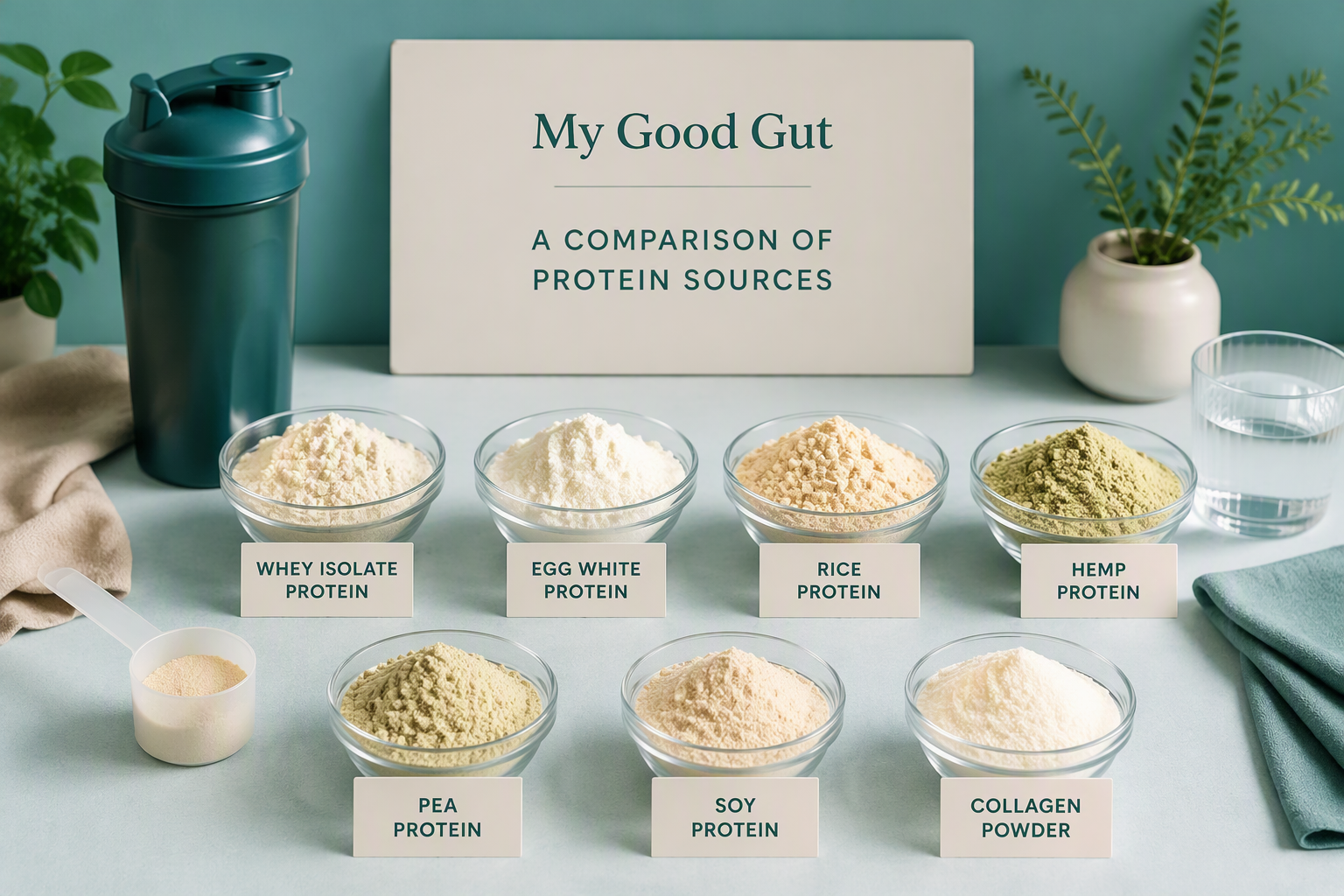
Protein source | FODMAP risk at a typical serving | Complete protein? | Watch out for |
|---|---|---|---|
Whey protein isolate | Usually low | Yes | Lactose, inulin |
Whey concentrate | More variable | Yes | Higher lactose |
Egg white protein | Usually low | Yes | Flavorings, gums |
Rice | Usually low | No | Lower lysine |
Pea isolate | Usually low | No | Fiber blends |
Pea concentrate | Higher risk | No | GOS |
Hemp | Usually low at moderate servings | No | Large servings, blends |
Soy protein | Often higher risk | Yes | GOS, larger servings |
Collagen | Usually low | No | Lacks tryptophan |
For protein powders and IBS, the protein source matters, but the complete ingredient list often matters more. Whey protein isolate has most lactose removed during filtration, so it is usually the simplest dairy option for people with lactose sensitivity. Whey concentrate keeps more lactose and may be harder to tolerate.
Egg white protein is naturally low FODMAP and often makes a sensible first trial. Rice protein is generally low FODMAP because processing removes most fermentable carbohydrates. Hemp is usually low FODMAP at a moderate serving, although larger portions and flavored blends can change its tolerance.
Pea protein requires closer label reading. Pea protein isolate is often tolerated, while pea concentrate retains more galacto-oligosaccharides (GOS), which can increase fermentation and symptoms. Soy protein is commonly higher in FODMAPs because soy-based ingredients may contain GOS, particularly in larger servings. Processing and serving size matter, so plant derived proteins are not one single tolerance category.
Collagen powder is often unflavored and single-ingredient, which can make it a lower-risk option during a product trial. Its drawback is protein quality. Collagen lacks tryptophan and is not a complete protein, so it should supplement a main protein source rather than replace one.
Whey, egg, and soy provide all nine essential amino acids and are complete proteins. Rice is relatively low in lysine, while pea is relatively low in methionine. Combining rice and pea can help fill those gaps. Focusing only on FODMAP risk may leave you short on essential amino acids, especially when powder helps you meet a daily protein goal instead of serving as an occasional addition.
Most powders provide about 20 to 25 grams of protein per serving. That amount may represent a meaningful share of a smaller adult’s daily goal but a modest share for a larger or more active adult. Protein completeness matters more when the powder supplies a regular part of your intake.
IBS subtype alone does not reliably predict which source you’ll tolerate. Added ingredients usually matter more. Prebiotic fibers and polyols often deserve extra caution with diarrhea-predominant symptoms, while serving size and sweetener load may matter more with constipation-predominant symptoms. Subtype-specific context appears in loose stools and IBS-D and IBS constipation, while vetting an IBS supplement covers broader supplement questions.
A useful filter is to choose a single-ingredient powder or isolate, check for inulin, chicory root, fiber blends, and polyols, then pair or vary an incomplete protein across the week. Start with the smallest practical serving because even a low-FODMAP product can cause symptoms when the dose is too large.
Low FODMAP Protein Powder FAQs
These FAQs address common questions about low FODMAP protein powder, including ingredient labels, IBS symptoms, food sensitivities, and everyday convenience. They can help you compare options more clearly before choosing a powder to try.
1. Is whey isolate usually better than whey concentrate?
Whey protein isolate is usually the safer choice for IBS on a low-FODMAP plan because filtering removes most lactose, the milk sugar that may contribute to gas, bloating, or diarrhea. In a whey protein concentrate vs isolate comparison, whey protein concentrate generally contains more lactose and carbohydrates. Look for whey protein isolate as the main protein, check total carbohydrates, and avoid high-FODMAP additions such as milk solids. If protein amounts are similar, favor lower lactose risk over flavor, then test a simple formula gradually because tolerance varies.
2. Can inulin or chicory in protein powders trigger symptoms?
Yes. Inulin, often sourced from chicory root, is a prebiotic fiber and type of fructan that may trigger bloating, gas, or urgency for some people with IBS. It can hide in protein powders labeled with “fiber,” “digestive support,” “prebiotics,” or “gut health,” including ingredients such as chicory root fiber and added prebiotic fibers.
During testing, keep other foods and supplements steady, start with a small serving, and track symptoms and timing across the first one to three doses. If symptoms flare, pause the powder, check the label, and choose a simpler protein without added fibers. This content is for educational purposes only and is not a substitute for personalized medical advice.
3. Does lactose-free protein powder still contain FODMAPs?
Yes. Lactose-free protein powder removes or limits lactose, the milk sugar, but other FODMAPs may remain. Check the ingredient list for inulin, chicory root, sorbitol, xylitol, and added fibers. A lactose-free whey blend can still contain fermentable ingredients, so lactose-free doesn’t automatically mean low FODMAP.
A simpler option, such as a whey isolate low FODMAP protein powder, may be easier to test. Start with a small serving of the specific product, track symptoms, and increase gradually only if tolerated. Protein source, add-ins, serving size, and your individual sensitivity all matter.
4. How do artificial sweeteners affect low FODMAP protein tolerance?
Most non-nutritive sweeteners aren’t FODMAPs, so sucralose, stevia, and monk fruit are generally compatible with a low FODMAP plan. The polyols to watch are sorbitol, mannitol, xylitol, maltitol, and isomalt, which may cause gas, bloating, or diarrhea. Erythritol is usually better tolerated because most is absorbed in the small intestine, so it isn’t equivalent to sorbitol or mannitol. Check the serving size, since tolerance is dose-dependent.
Digestive enzymes target specific carbohydrates. Lactase helps with lactose, while alpha-galactosidase targets galacto-oligosaccharides in some pea and soy proteins. Neither changes a high-FODMAP powder into a low-FODMAP product. A better formula is preferable, and a clinician or dietitian can help you assess enzymes separately.
5. Which protein powders are safest for IBS-C versus IBS-D?
For IBS-D, you’ll often tolerate a low-FODMAP protein powder with few additives, such as whey isolate, egg protein, or a single-ingredient powder. Check for inulin, chicory root fiber, and polyols, including sugar alcohols such as sorbitol and maltitol. These may increase gas or loose stools even when the front label says “low-FODMAP.”
With IBS-C, serving size and sweeteners may matter as much as fiber. Large servings, fiber-heavy formulas, polyols, and soy protein containing GOS or fructans may worsen bloating or urgency. Test a small portion with the same liquid and meal timing, then track stool changes, gas, and bloating for 24 to 72 hours. If symptoms flare, remove inulin or chicory first, then polyols, followed by higher-FODMAP protein sources. Results vary, so persistent or severe symptoms need professional guidance.