


A 10-strain label and gender-focused packaging can make YourBiology and Biotics 8 look meaningfully different. They aren't, at least on the probiotic panel: both list the same 10 Wecare Probiotics strain codes and 20 billion CFUs per daily serving. Formula details, tolerability, evidence, and cost offer more useful grounds for choosing between them.
Four shared strains have published human randomized controlled trials, while six have no identified human trial data and none has been studied in IBS. Biotics 8's inulin and FOS may increase gas or bloating for some people, and neither finished blend has published trial evidence for treating chronic digestive symptoms. Check the current label, price per daily serving, and return terms before buying.
Neither product is a proven treatment for persistent bloating, constipation, diarrhea, or abdominal pain. Severe, worsening, or changing symptoms deserve assessment from a qualified healthcare professional.
YourBiology vs Biotics 8 Key Takeaways
- Both products list the same 10 Wecare Probiotics strain codes.
- Each product advertises 20 billion CFUs per daily serving.
- Gender-focused marketing does not establish a digestive-health advantage.
- Only four shared strains have published human randomized controlled trials.
- None of the disclosed strains has published IBS trial evidence.
- Inulin and FOS may worsen gas or bloating in sensitive people.
- Compare current daily cost, label details, and return terms before purchasing.
How Do YourBiology and Biotics 8 Compare?
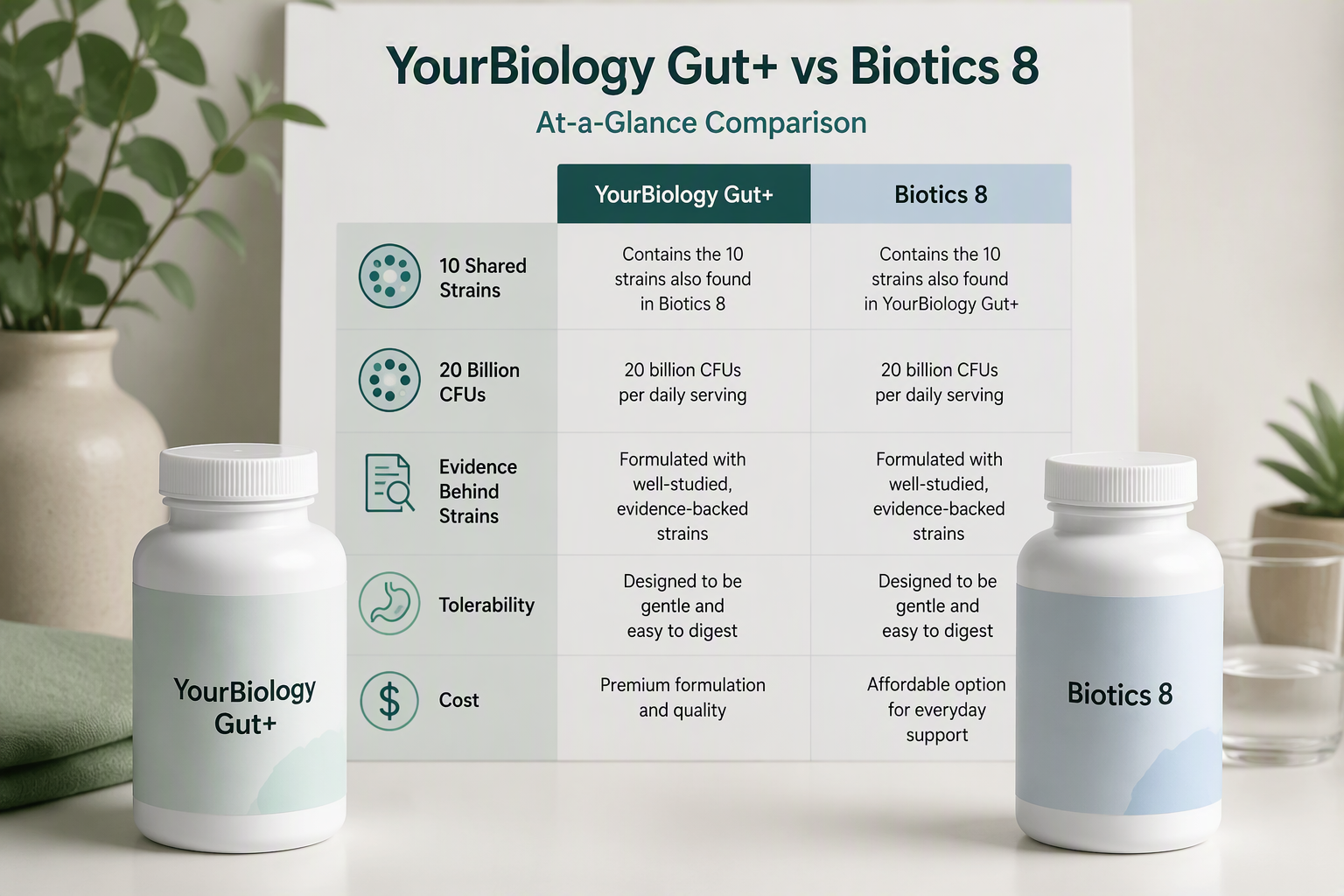
YourBiology vs Biotics 8 comes down less to the probiotic panel than their marketing suggests. Both products are marketed with the same 10-strain Wecare Probiotics panel, so the gendered branding does not by itself prove a digestive-health difference (source). Serving size, secondary ingredients, tolerability, and relative cost are the factors more likely to separate them.
Disclosed organism and strain code | YourBiology Gut+ | Biotics 8 |
|---|---|---|
Lactobacillus acidophilus LA85 | Yes | Yes |
Lactobacillus paracasei LC86 | Yes | Yes |
Lactobacillus rhamnosus LRa05 | Yes | Yes |
Lactobacillus casei LC89 | Yes | Yes |
Lactobacillus fermentum LF61 | Yes | Yes |
Lactobacillus plantarum N13 | Yes | Yes |
Bifidobacterium breve BBr60 | Yes | Yes |
Bifidobacterium bifidum BBi32 | Yes | Yes |
Bifidobacterium longum BL21 | Yes | Yes |
Saccharomyces boulardii SB01 | Yes | Yes |
This is why strain-exact probiotics matter. Organisms sharing a species name are not automatically interchangeable, so a probiotic comparison based only on strain totals or colony-forming unit claims can hide important differences.
Four of these shared strains have published human randomized controlled trials, yet none has been studied in people with irritable bowel syndrome (IBS). Nearly all available research was sponsored or co-authored by Wecare Probiotics, the strain manufacturer. Findings for similarly named strains cannot be applied to LA85, LRa05, or another specific code, and shared formulas do not ensure identical symptom results.
Probiotic supplements weighed on evidence and cost places both alongside other options for gut health. Both are sold directly by their brands: YourBiology Gut+ and Biotics 8. Gender-focused packaging does not show that either product better fits bloating, gas, constipation, diarrhea, or irregularity. Persistent, severe, or changing symptoms warrant guidance from a qualified healthcare professional.
How Do Their Formulas Compare?
Despite their shared 10-strain panel, both products are marketed with 20 billion CFUs per daily serving, but the evidence for each strain needs to be checked one by one before drawing stronger conclusions. This probiotic comparison is therefore less about women's or men's marketing and more about your symptoms, tolerance, and evidence for each exact strain. Neither the strain count nor the CFU total shows which option may suit bloating, gas, constipation, or diarrhea.
The YourBiology ingredients and Biotics 8 ingredients name the same Wecare Probiotics codes:
Organism | Shared strain code |
|---|---|
Lactobacillus acidophilus | LA85 |
L. paracasei | LC86 |
L. rhamnosus | LRa05 |
L. casei | LC89 |
L. fermentum | LF61 |
L. plantarum | N13 |
Bifidobacterium breve | BBr60 |
B. bifidum | BBi32 |
B. longum | BL21 |
Saccharomyces boulardii | SB01 |
Naming probiotic strains is more useful than a generic "10-strain" claim, but it does not establish a benefit for a particular condition. Four of these strains have published human randomized controlled trials, while six have no human data. None has been tested in people with IBS. Research on a related species or differently coded commercial strain cannot be assumed to apply, and most available studies were sponsored or co-authored by Wecare Probiotics.
Biotics 8 also contains the prebiotic fibers inulin and fructooligosaccharides (FOS), plus lipase, amylase, and protease, enzymes that digest fats, carbohydrates, and proteins. These ingredients serve different roles from probiotics. Fermentable fibers may worsen gas or bloating for some people.
Both formulas include vitamin D, which may support general immune regulation and gut-barrier function but does not show relief for a specific digestive condition. The evidence comparison matters more than ingredient presence when deciding what fits your digestive health needs.
What Does YourBiology Gut+ Include?
YourBiology Gut+ lists 10 named Wecare Probiotics codes and advertises 20 billion CFUs per serving. This strain-level detail is more useful than a species-only label because it lets you compare probiotic strains with the exact organisms studied in people, rather than assuming all Lactobacillus or Bifidobacterium strains work the same way.
The YourBiology ingredients label includes:
- Lactobacillus acidophilus LA85: A named Lactobacillus strain.
- Lacticaseibacillus paracasei LC86: A named Lacticaseibacillus strain.
- Lacticaseibacillus rhamnosus LRa05: A named Lacticaseibacillus strain.
- Lacticaseibacillus casei LC89: A named Lacticaseibacillus strain.
- Lactobacillus fermentum LF61: A named Lactobacillus strain.
- Lactiplantibacillus plantarum N13: A strain code for Lactobacillus plantarum.
- Bifidobacterium breve BBr60: A named Bifidobacterium strain.
- Bifidobacterium bifidum BBi32: A named Bifidobacterium strain.
- Bifidobacterium longum BL21: A named Bifidobacterium strain.
- Saccharomyces boulardii SB01: A yeast-based probiotic.
The formula also reports three digestive enzymes, vitamin D, and prebiotics in vegan-friendly capsules. Those additions may affect tolerability and whether the product fits your needs, particularly if prebiotics tend to worsen your gas. They do not establish that the full formula will help a particular symptom.
A strain-specific label supports transparency, but it does not prove the finished blend improves bloating, gas, IBS, constipation, diarrhea, or other digestive concerns at the sold dose. Evidence for an individual code cannot automatically be applied to a 10-strain product with added ingredients. YourBiology Gut+ strain codes and evidence examines that boundary in more detail.
Digestive symptoms can have many causes, so consult a qualified healthcare professional for persistent, severe, or worsening symptoms. Results vary by person.
What Does Biotics 8 Include?
Biotics 8 lists 20 billion CFUs per serving, and that serving is three capsules. This total covers the full blend, not 20 billion CFUs for each strain, and the label does not show how the amount is divided among its 10 strains. That makes capsule count a poor measure of whether it will produce stronger results than YourBiology Gut+. Biotics 8, the men’s version, sets out the complete label.
The disclosed Biotics 8 ingredients include these strain codes:
- L. acidophilus: LA85
- L. paracasei: LC86
- L. rhamnosus: LRa05
- L. casei: LC89
- L. fermentum: LF61
- L. plantarum: N13
- B. breve: BBr60
- B. bifidum: BBi32
- B. longum: BL21
- S. boulardii: SB01
Named strain codes provide more detail than species-only labels, but a 10-strain blend is not proof that it will help every case of bloating, gas, constipation, or diarrhea. The evidence for individual strains still needs separate review.
Biotics 8 is a combination product rather than a probiotic-only formula. Along with probiotics, it contains the prebiotics inulin and FOS, plus lipase, amylase, and protease. These enzymes help break down fats, carbohydrates, and proteins. Their presence does not show that the finished product improves digestive symptoms, and multiple added ingredients can make it harder to identify what affects you.
The label also includes vitamin D3 and describes Biotics 8 as dairy-free, gluten-free, preservative-free, and vegan. Although it is marketed toward men, those features do not make it male-specific or inherently more effective for women. Check the current Supplement Facts panel for the vitamin D3 amount and complete inactive-ingredient list before deciding whether a three-capsule serving suits your needs.
What Does the Evidence Support?
Beyond the matching label details, probiotic evidence is useful only when the genus, species, strain code, colony-forming unit (CFU) dose, and digestive condition match your goal. A finding for one Lactobacillus rhamnosus strain does not apply to every product bearing that species name. The same is true for Lactobacillus plantarum, including claims about IBS symptoms or immune function.
YourBiology Gut+ and Biotics 8 provide strain-level disclosure that supports a product-specific evidence review. Their shared disclosure does not make the finished blends clinically interchangeable, since total and per-strain doses may differ. Strain-specific probiotics should be assessed against research on the exact strain, at a comparable dose, in people with your symptom or diagnosis.
The shared-strain evidence has important limits:
- Four strains have human randomized controlled trials: LRa05, LA85, BBi32, and BL21 have been studied for pediatric acute diarrhea, antibiotic-associated diarrhea, tolerability, or glycemic measures.
- Six strains have no human trial data: LC86, LC89, LF61, N13, BBr60, and SB01 have no published human trials.
- None has been tested for IBS: The disclosed strains do not establish relief for adult bloating, gas, constipation, diarrhea, or diagnosed IBS.
Research on a named ingredient can support biological plausibility, but it cannot show that either 10-strain formula delivers the same result when organisms are combined. Neither product should be described as having published IBS trial evidence unless a direct strain-level review confirms it, and the research base should be checked for sponsor involvement before it is presented as independent support.
For diagnosed IBS, Align, a strain with published IBS trials, offers a more evidence-focused comparison point. Be cautious with manufacturer citations for MIMBb75, Lactobacillus rhamnosus GG, 299v, BB536, Shirota, HA-196, R0175, and B-3. These are separately deposited strains owned by other companies, not strains in either formula, so their results do not transfer to YourBiology Gut+ or Biotics 8.
What Evidence Supports YourBiology Gut+?
YourBiology Gut+ lists 10 strain codes, but published human randomized controlled trials (RCTs) cover only four, and none tests the finished blend. Biotics 8 uses the same codes, so the evidence is limited to strain-specific probiotics rather than proof that either product treats IBS, Crohn’s disease, or broad digestive symptoms. Six listed codes, LC86, LC89, LF61, N13, BBr60, and SB01, have no published human trial evidence.
A full strain code matters more than a species name. Claims about the gut microbiome or immune function do not, on their own, show that a formula will improve digestive symptoms.
The most digestive-relevant result is for Lactobacillus rhamnosus LRa05. In a randomized pediatric acute-diarrhea trial of 111 children, LRa05 reduced average diarrhea duration to 121.4 hours versus 143.9 hours in the comparison group, a difference of about 22.5 hours (source). The paper reports a Wecare Probiotics connection through its authors or funding, and it does not state a completion rate. This result does not establish benefit for adults with bloating, everyday loose stools, or IBS.
The other human-tested codes have narrow evidence:
- LA85: The registered NCT05974657 trial concerns antibiotic-associated diarrhea. It is linked to the Wecare Probiotics strain manufacturer, and its registration entry states no completion rate and no finding for IBS or Crohn’s disease.
- BBi32: A Wecare-affiliated eight-week study enrolled 40 people and assessed safety, tolerability, and gastrointestinal symptom scores. No completion rate was reported, and it was not an IBS treatment study.
- BL21: A Wecare-affiliated 12-week study of 80 participants examined glycemic control. No completion rate was reported, and its design does not test constipation, diarrhea, gas, or bloating relief.
A separate 72-person LRa05 study assessed gastrointestinal symptoms during Helicobacter pylori eradication treatment (source). That narrow treatment setting does not support Gut+ claims for chronic diarrhea, constipation, unexplained gas, bloating, IBS, or Crohn’s disease. Nearly all available research was sponsored or co-authored by Wecare Probiotics, which calls for careful interpretation.
Evidence for Lactobacillus rhamnosus GG, L. plantarum 299v, or B. bifidum MIMBb75 cannot be transferred to similarly named Gut+ strains. Persistent, severe, or worsening symptoms, including diagnosed IBS or Crohn’s disease, need individualized care from a qualified healthcare professional.
What Evidence Supports Biotics 8?
Biotics 8 identifies all 10 Wecare Probiotics strain codes, yet the finished blend has not been tested in a published human trial for IBS, antibiotic-associated diarrhea, or inflammatory bowel disease (IBD). Four listed strains have human randomized controlled trial evidence or trial records in other settings, while six have no identified human data. That transparency is better than species-only labeling, but it does not show that Biotics 8 provides bloating relief, gas relief, or more regular bowel movements.
Its formula includes L. acidophilus LA85, L. paracasei LC86, L. rhamnosus LRa05, L. casei LC89, L. fermentum LF61, L. plantarum N13, B. breve BBr60, B. bifidum BBi32, B. longum BL21, and S. boulardii SB01. Human research has been identified for LRa05, LA85, BBi32, and BL21, but research on an individual strain does not automatically apply to the dose, formula, or users of Biotics 8.
Antibiotic-associated diarrhea shows why strain matching matters. A 2011 Cochrane review of 16 studies involving more than 3,400 patients found that probiotics overall reduced risk, with an approximate number needed to treat of 7. Much of the better-known evidence involved specific products or strains, including S. boulardii and L. rhamnosus GG, not Biotics 8’s SB01 or LRa05 codes. LA85 has a registered antibiotic-associated-diarrhea trial, NCT05974657, but registration is not a published result for Biotics 8.
The evidence limits are especially relevant for IBS and IBD:
- None of Biotics 8’s 10 named strains has a published IBS trial.
- Older IBS findings are short-term and mixed, with possible benefits more often tied to particular Bifidobacterium-containing products than to every probiotic.
- Results for B. bifidum MIMBb75, L. plantarum 299v, and L. rhamnosus GG cannot be transferred to differently coded organisms in Biotics 8.
- No direct clinical evidence supports Biotics 8 for Crohn’s disease or ulcerative colitis, and older guidance found insufficient evidence to routinely recommend probiotics for primary or recurrent Clostridioides difficile-associated diarrhea.
Probiotic safety deserves extra attention if you have IBD, severe diarrhea, blood in stool, fever, weight loss, or worsening symptoms. Seek qualified medical advice rather than using a supplement instead of diagnosis or prescribed treatment.
Ratings and testimonials may describe personal experiences with irregular bowel movements, but they cannot establish effectiveness, safety, or condition-specific suitability. Most available strain research is manufacturer-sponsored or manufacturer-coauthored, making independent replication particularly valuable. Individualized advice remains important.
Before weighing the safety trade-offs, it helps to see what each brand currently states on its own page: YourBiology Gut+ and Biotics 8 both revise their formulas and subscription terms.
Which Is Easier to Use Safely?

Given the evidence limits for both blends, neither product is inherently safer for every digestive concern. YourBiology Gut+ and Biotics 8 name the same 10 Wecare Probiotics strain codes, so gendered marketing does not predict which one you’ll tolerate better. Both formulas also disclose prebiotic ingredients, while YourBiology Gut+ reports digestive enzymes and vitamin D, so the full ingredient panels matter more than the live cultures alone.
Fermentable prebiotics can cause temporary gas, bloating, or abdominal discomfort in some people. Compare the current prebiotic ingredients and amounts on both labels, particularly if fiber supplements or certain carbohydrates have aggravated symptoms before. A tester who reported no Biotics 8 side effects offers one experience, not a forecast of your tolerance, bloating relief, or gas relief.
Everyday details affect probiotic safety and whether you can use a gut health supplement consistently. One hands-on review rated Biotics 8 3 out of 5 for swallowability and 3 out of 5 for taste, despite its relatively small, neutral-tasting capsules. Check each label’s daily capsule count and complete inactive-ingredient panel if sweeteners, additives, or dietary ingredients have caused symptoms for you.
Only four of the 10 disclosed strains have published human randomized controlled trials, and none of those studies enrolled people with IBS. Neither finished formula is a proven treatment for bloating, gas, constipation, diarrhea, or irregular bowel habits, so treat either choice as a personal trial rather than a reliable fix.
Speak with a qualified healthcare professional before using either live-microorganism supplement if you are:
- Immunocompromised: Probiotics may not be appropriate without individualized medical guidance.
- Seriously ill: Your clinician can assess whether a supplement could add risk or complicate care.
- Managing significant digestive disease: Ongoing symptoms may need evaluation before any self-directed trial.
Persistent, severe, or worsening bloating, diarrhea, constipation, or pain needs medical evaluation because supplements cannot identify or treat an underlying condition.
How Do You Take YourBiology Gut+ Safely?
Use the YourBiology Gut+ package you have, not an older retailer listing or a generic probiotic schedule. The current serving size, timing, storage directions, and product-specific warnings should be confirmed from the official label before use, because those details can change and were not independently confirmed for September 2026. Do not exceed the labeled daily serving in hopes of faster relief from bloating, gas, constipation, diarrhea, or irregular bowel movements. A gut health supplement may not provide immediate results.
Mild, temporary shifts in gas, bloating, stool frequency, or abdominal comfort can happen when you start a multi-strain probiotic. Add only one new digestive supplement at a time, especially if you also use prebiotics such as inulin, which can make symptom triggers harder to identify.
A brief symptom note can make tolerance easier to assess:
- Stool pattern: Record frequency, urgency, constipation, or loose stools.
- Abdominal symptoms: Note gas, bloating, cramping, and whether discomfort affects meals, sleep, or work.
- Possible contributors: Include new foods, antibiotics, fiber products, or supplements.
If symptoms worsen, persist, or disrupt daily life, stop self-experimenting and seek individualized advice.
Speak with a qualified healthcare professional before using YourBiology Gut+ if you are pregnant or breastfeeding, immunocompromised, seriously ill, recovering from surgery, or managing conditions or medications that may affect suitability. Seek urgent assessment for severe or worsening abdominal pain, fever, vomiting, blood in the stool, unexplained weight loss, dehydration, or persistent bowel changes.
How Do You Take Biotics 8 Safely?
Biotics 8 lists three capsules as its daily serving, and each container provides 30 servings. If your digestion is sensitive, begin with one capsule daily rather than taking all three at once. Increase only as your body adjusts, and follow the current product label because directions and ingredients can differ by formulation or market.
Biotics 8 contains inulin and FOS, prebiotic fibers that gut bacteria ferment. That process can temporarily increase gas, bloating, cramping, or loose stools, especially if you already experience these symptoms. A slow increase makes it easier to judge whether the full three-capsule serving feels comfortable.
Early digestive discomfort does not mean the supplement is helping, and worsening symptoms are not something to push through. Stop self-experimenting and speak with a qualified healthcare professional if any of the following apply:
- You have persistent, severe, or worsening digestive symptoms.
- You have a diagnosed digestive condition or take medicines.
- You are pregnant, breastfeeding, or have immune-system concerns.
Individualized advice remains important.
Which Should You Choose?
After weighing the shared evidence and safety considerations, neither product is inherently better for women or men. In YourBiology vs Biotics 8, both supplements name the same 10 Wecare Probiotics strain codes, so gendered marketing and a 10-strain count do not create a formula advantage. Choose only if the shared formula fits your budget, tolerance, and reason for trying a probiotic.
The evidence is limited for claims about bloating, regularity, energy, or immune support. Four of the 10 disclosed strains have published human randomized controlled trials, six lack human data, and none has been studied in an IBS trial. Studies of individual strains do not show that either finished product treats a digestive condition, particularly because most available research involves Wecare Probiotics, the strain manufacturer.
Use these checks before buying:
- Confirm the full genus, species, and strain code, not just the species name.
- Check whether that exact code was studied and whether the research examined a strain, blend, or finished supplement.
- Compare the study population and health concern with your own symptoms.
- Treat broad symptom claims cautiously when the evidence does not match your condition or the final formula.
For example, LRa05 has been studied in children with acute diarrhea and alongside Helicobacter pylori treatment. Those findings do not establish benefits for adult gas, constipation, diarrhea, or IBS.
Biotics 8 vs YourBiology is best decided by practical fit. Compare the current cost per daily serving, subscription and return terms, availability, serving directions, and the full ingredient panel. A higher price does not mean stronger evidence. Fermentable prebiotics can worsen gas for some people, and capsules may not suit everyone.
For diagnosed IBS, a strain-specific option may be more relevant than broad best probiotic marketing. Seed, a 24-strain synbiotic without per-strain amounts, sits at the opposite end of that trade-off.
A lower-cost alternative may fit a tighter budget, but it should not be treated as a substitute for individualized care.
Seek individualized medical guidance for concerning symptoms.
If you want to try either one, you can get YourBiology Gut+ here or Biotics 8 here.
YourBiology vs Biotics 8 FAQs
These FAQs cover the details that may shape your choice between YourBiology and Biotics 8, from formula transparency and cost to tolerability, evidence, and when digestive symptoms warrant guidance from a qualified healthcare professional.
1. Which Costs Less Per Daily Serving?
Biotics 8 costs slightly less per labeled daily serving than YourBiology Gut+ in this probiotic price comparison, after accounting for pack size and any subscription discount at checkout. Because both are sold direct and promotions change often, divide the checkout pack price by the number of labeled days it covers, not the capsule count. The small gap matters less than either product’s cost versus a retail probiotic capsule. Since their strain panels match, secondary ingredients, serving size, and tolerance matter more.
2. Can You Buy Both Without Subscriptions?
A subscription is optional only when the checkout offers a one-time purchase. Biotics 8 has been listed at a premium one-time price for 30 servings, though subscription eligibility, discounts, and cancellation terms can differ by country and storefront. Before choosing YourBiology Gut+, confirm that the cart includes a one-time option rather than assuming a recurring plan is required. This check helps prevent a discounted subscription rate from shaping your probiotic user experience or being mistaken for the standard cost.
3. Where Are YourBiology and Biotics 8 Manufactured?
The official product materials reviewed do not name a manufacturing country or facility for either YourBiology Gut+ or Biotics 8. Their shared Wolfson Brands connection does not establish where either supplement is made. Even when a location is disclosed, it does not prove potency through expiration, independent testing, or that the formula fits your symptoms. When comparing probiotic alternatives, weigh transparent strain details and relevant evidence more heavily than manufacturing assumptions alone.
4. Do Both Offer Money-Back Guarantees?
Biotics 8 advertises a 60-day money-back guarantee, though available product-review information does not confirm the return process, exclusions, deductions, or whether opened bottles, one-time orders, and subscriptions qualify. Supplied information also does not confirm YourBiology Gut+’s eligibility window, return authorization or proof-of-purchase requirements, coverage for partially used products, introductory offers, or subscription orders. Treat either guarantee as purchase protection, not proof that the supplement will help, and check the policy shown at checkout because terms may change by country.
5. Are YourBiology and Biotics 8 Available Internationally?
YourBiology has an Australian storefront, but availability elsewhere should be confirmed by entering your delivery country at the official checkout. A product page visible in your region does not guarantee delivery, since stock, permitted destinations, delivery times, and regional listings can change. Neither brand provides a universal international shipping rate. Biotics 8 prices and shipping charges may vary by country and order value, so check the final total, customs terms, duties, taxes, fees, and local supplement restrictions before paying. If shipping is unclear or expensive, consider locally available probiotic alternatives.