


Nausea during a car ride, boat trip, or flight doesn't necessarily mean IBS and motion sickness are directly connected. They are separate conditions, although both can cause queasiness, cramping, bloating, and stomach churning. IBS nausea affects roughly 27-38% of people with IBS, while motion sickness results from mismatched movement signals from the eyes, inner ear, and body.
Timing and accompanying symptoms provide better clues than nausea alone. Dizziness, sweating, pale skin, or extra saliva during movement may fit motion sickness, while bowel changes, familiar food triggers, or symptoms that continue after arrival may suggest an IBS flare. Migraine, vestibular migraine, dehydration, GERD, and POTS can also produce overlapping symptoms, so a brief travel-and-symptom record can help clarify the pattern.
Practical preparation can reduce discomfort without promising that every episode is preventable. Familiar smaller meals, steady fluids, lower-motion seating, reduced screen use, and early response to nausea may help during travel. Persistent, severe, worsening, or non-travel-related symptoms deserve evaluation by a qualified healthcare professional.
IBS and Motion Sickness Key Takeaways
- IBS and motion sickness are separate conditions without a confirmed direct causal link.
- Motion sickness usually begins with movement and may include dizziness, sweating, pallor, or vomiting.
- IBS flares often involve abdominal pain, bowel changes, bloating, gas, or familiar food triggers.
- Migraine, GERD, dehydration, and POTS can resemble IBS or motion sickness.
- Familiar smaller meals and steady hydration may reduce travel-related digestive discomfort.
- Lower-motion seating, horizon viewing, and avoiding screens can help prevent motion sickness.
- Persistent, severe, worsening, or non-travel-related symptoms require professional medical evaluation.
Are IBS And Motion Sickness Directly Connected?
Irritable bowel syndrome (IBS) and motion sickness are separate conditions. Current evidence does not show that IBS directly causes motion sickness or makes it more likely. IBS involves intestinal symptoms and altered gut-brain interactions, while motion sickness occurs when the inner ear, eyes, and body send conflicting movement signals to the brain. Having both does not prove that one caused the other.
Travel can make the overlap feel stronger. Both conditions may involve nausea and queasiness, stomach churning, abdominal pain or cramping, bloating and excess gas. IBS nausea, also described as irritable bowel syndrome nausea, affects roughly 27-38% of people with IBS and is reported more often by women. About 38% of women and 27% of men with IBS report it (source), although nausea is not a core IBS symptom. Motion sickness may also cause dizziness, sweating, pale skin, or clamminess.
A sensitive digestive nervous system can make ordinary gut sensations feel more intense, especially during an IBS flare. Vehicle movement, unfamiliar food, strong odors, poor sleep, schedule changes, and concern about restroom access can add distress. These factors may explain why motion sickness and IBS seem connected without showing a direct cause-and-effect relationship.
Timing and context provide better clues than nausea alone:
Pattern | May fit better with |
|---|---|
Symptoms start after a car, boat, or plane begins moving, especially with dizziness or sweating | Motion sickness |
Symptoms follow a familiar food trigger or a change in bowel habits | An IBS flare |
Abdominal pain, bloating, or bowel symptoms occur during and outside travel | IBS or another digestive condition |
Record the type of travel, movement, meals, hydration, stress, sleep, bowel changes, and when nausea began. Comparing an episode against the IBS symptoms you already know is more useful than judging nausea alone, but one episode cannot establish a diagnosis.
Persistent, severe, worsening, or disruptive nausea, vomiting, dizziness, abdominal pain, or bowel changes warrant evaluation by a qualified healthcare professional, especially when symptoms are new or occur away from travel.
How Can You Tell Motion Sickness From An IBS Flare?

Motion sickness and an IBS flare can feel alike, but IBS and motion sickness are not the same condition. The strongest clues are the timing, the trigger, the symptom pattern, and what happens after travel stops.
Both can cause nausea, cramping, bloating, gas, and stomach churning. Motion-triggered nausea is more likely during a winding car ride, boat trip, turbulence, or reading while moving. Sensory conflict and motion sickness occur when the eyes and inner ear send mismatched movement signals to the brain.
Pattern | Motion sickness | IBS flare |
|---|---|---|
Trigger and timing | Starts during or soon after movement or visual exposure | May start before travel, on non-travel days, or after a food, stress, or hydration trigger |
Key symptoms | Nausea with dizziness during travel, sweating, pale skin, extra saliva, reduced appetite, or vomiting | Abdominal pain, bloating, gas, and IBS nausea, with or without nausea as a main symptom |
Bowel changes | Usually not the main feature | IBS bowel changes can include diarrhea, constipation, mucus, incomplete bowel movements, or alternating patterns |
Recovery | Often improves after movement ends, although settling may take time | May continue after arrival, especially after a meal or bowel trigger |
Nausea alone does not identify the cause. IBS may be diarrhea-predominant, constipation-predominant, or mixed-type, and IBS nausea can occur during a flare without being a defining symptom. An active flare, particularly one involving diarrhea, may also make travel-related queasiness feel stronger. That means both problems can occur together.
A short decision path can help you sort the pattern:
- Did symptoms begin with movement, turbulence, a winding road, or reading while traveling? If so, motion sickness is more likely.
- Are sweating, pallor, extra saliva, vomiting, or dizziness during travel present? These autonomic symptoms support motion sickness but do not confirm it.
- Do cramping, diarrhea, constipation, incomplete bowel movements, or sudden urgency to go match your usual pattern? If so, an IBS flare may be contributing. Motion sickness rarely drives that kind of bowel change on its own.
- Do symptoms continue after the vehicle, boat, or plane stops? Ongoing symptoms fit an IBS trigger or another cause more than isolated motion sickness.
Car travel nausea that begins before boarding may reflect an existing flare that motion is intensifying, a detail worth noting in the travel diary covered later in this guide.
What Other Conditions Can Cause Similar Symptoms?
IBS and motion sickness can cause similar nausea, but the pattern matters. IBS usually includes recurring abdominal pain with diarrhea, constipation, or both. Motion sickness follows travel or visual movement and may bring nausea, sweating, and dizziness. Episodes between trips, symptoms without travel, or a pattern that keeps changing call for broader assessment.
Upper digestive symptoms can point to conditions that overlap with IBS:
- Functional dyspepsia: Upper-middle abdominal discomfort, bloating, early fullness, or feeling full after a small meal may fit this condition. A sour stomach can describe upper digestive discomfort, but it does not identify the cause.
- GERD: Heartburn, burning that rises toward the chest, or indigestion is more typical of gastroesophageal reflux disease (GERD) than motion sickness.
- Gastroparesis: Delayed stomach emptying may cause fullness that lasts, nausea, and vomiting after meals. IBS can coexist with GERD or gastroparesis, so one diagnosis does not rule out another.
- Migraine-related illness: Headache, light or sound sensitivity, visual changes, or a personal or family history of migraine can add an important clue. Vestibular migraine may cause vertigo, imbalance, or motion sensitivity with little or no headache. IBS, migraine, and motion sensitivity can overlap, and people with migraine may be more prone to motion sickness.
- Dehydration and circulation problems: Vomiting, diarrhea, heat exposure, or low fluid intake can cause dizziness. Low blood pressure, anemia, heavy menstrual bleeding, loperamide, stomach infection, and food poisoning may also resemble an IBS flare.
- Autonomic disorders: Symptoms brought on by standing, heat, prolonged sitting, or movement, especially with palpitations, faintness, unusual fatigue, or chronic digestive distress, may warrant evaluation for postural orthostatic tachycardia syndrome (POTS). POTS can involve gravity or motion intolerance and IBS-like symptoms. Tiredness that lingers between trips is worth separating from this picture too, since IBS and low energy often travel together for reasons that have nothing to do with movement.
This list is not a way to diagnose yourself. It shows why a symptom that keeps returning, or one that appears after eating or while resting rather than during travel, deserves a closer look than a travel strategy can give it.
Seek prompt medical evaluation for:
- Severe nausea or persistent vomiting.
- Nausea that occurs without travel.
- Significant unintentional weight loss.
- Blood in the stool or difficulty swallowing.
- Symptoms that remain persistent, severe, or worsening.
How Does The Gut-Brain Axis Influence Travel Symptoms?
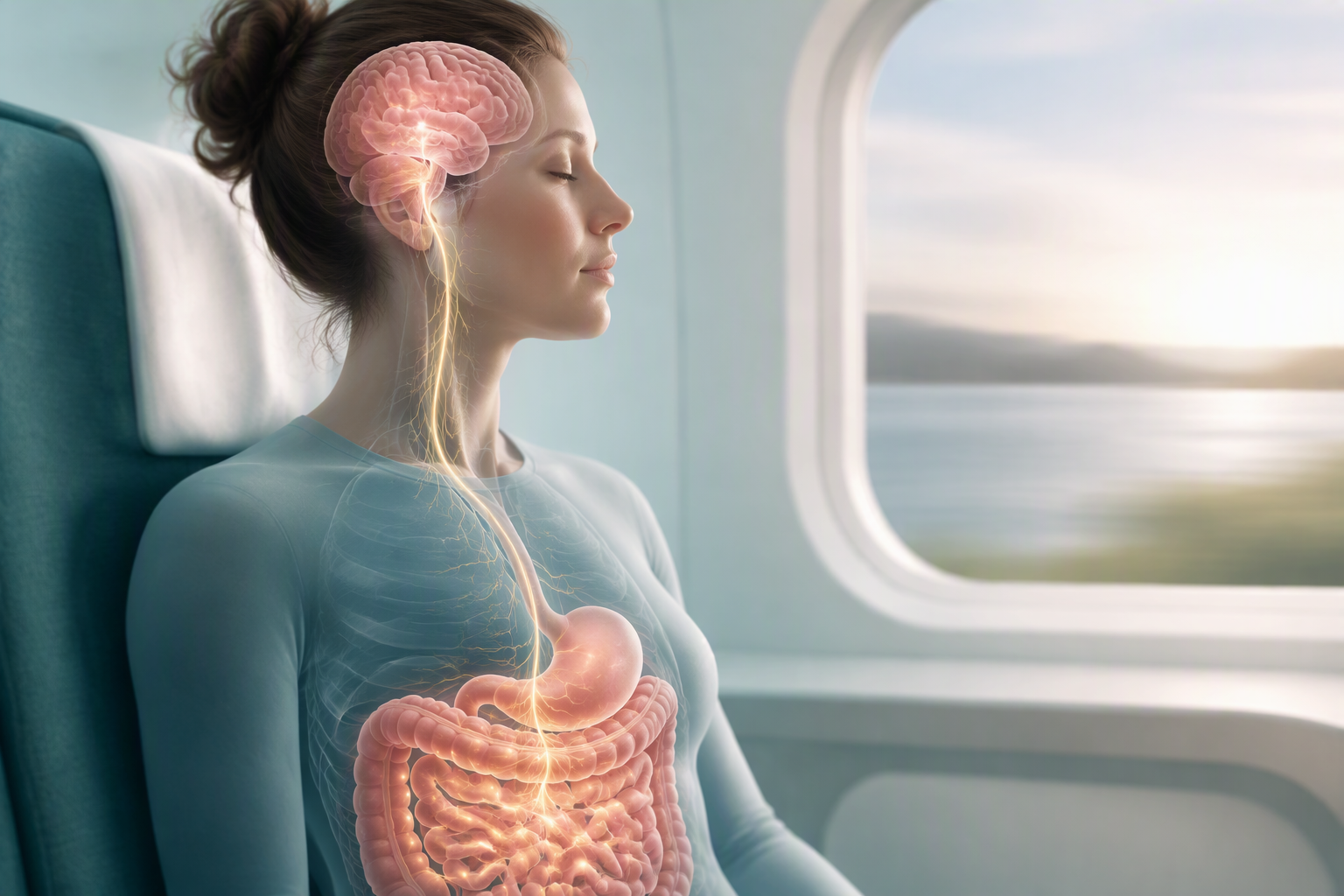
The IBS gut-brain axis helps explain why travel may intensify nausea, bloating, urgency, abdominal pain, or dizziness without showing that IBS directly causes motion sickness. This gut-brain connection involves the vagus nerve, serotonin and other neurotransmitters, and the autonomic nervous system, which regulates digestion, heart rate, and stress responses.
With heightened gut nerves, normal stretching, gas, intestinal movement, or bloating may feel painful or nauseating. This sensitive digestive nervous system may also alter gastrointestinal motility, meaning the timing or strength of digestive contractions changes. Travel adds a separate balance challenge. Sensory conflict and motion sickness can develop when the eyes and inner ears send mismatched movement signals.
Stress can affect symptoms before departure. Anticipatory anxiety may activate the autonomic nervous system, tighten abdominal muscles, increase gut activity, and make physical sensations harder to ignore. That response can amplify digestive and vestibular symptoms together, but stress does not create the visual-inner-ear mismatch that underlies motion sickness.
Migraine creates another possible overlap. People with migraine are more likely to experience motion sickness, and migraine is also more common among people with IBS. These clues may suggest migraine or vestibular migraine rather than an IBS flare alone:
- Headache
- Light or sound sensitivity
- Spinning or a history of migraine
Balance problems show up in this conversation for a reason: dizziness, vertigo, and disequilibrium are frequently reported alongside IBS, and one published paper proposes gravity handling as a possible shared thread (source). That paper is explicitly a hypothesis, not a demonstrated mechanism, and it does not show that IBS causes motion sickness.
What the evidence shows and where it stops: Established mechanisms include gut-brain signaling, autonomic responses, and increased digestive sensitivity in IBS. Plausible overlap exists among IBS, motion sensitivity, migraine, and vestibular migraine. Whether IBS itself raises motion-sickness risk remains unconfirmed. Direct studies of motion sickness and treatment outcomes in people with IBS are limited, with little detail by IBS-D, IBS-C, IBS-M, migraine status, vestibular migraine, or POTS.
During travel, note whether symptoms follow vehicle movement, meals, bowel changes, dehydration, stress, or a predictable time pattern. These details can help a qualified healthcare professional distinguish motion sickness from an IBS flare or another condition.
How Can You Prevent IBS And Motion Sickness During Travel?

Preventing symptoms starts with managing your known triggers instead of eliminating every food. IBS does not appear to directly cause motion sickness, but both can produce nausea and stomach discomfort during travel. These IBS travel tips focus on practical steps you can take before and during a trip.
- Plan familiar meals: Eat a smaller portion at a regular time. Traveling soon after a large meal, or on an empty stomach when that worsens nausea, can make symptoms harder to interpret. Avoid trying unfamiliar foods on travel day. Limit fatty, greasy, spicy, highly processed, or high-FODMAP foods when they trigger your symptoms. FODMAPs are fermentable carbohydrates that affect some people, not everyone.
- Pack for your usual symptoms: Bring tolerated snacks, cool water, tissues, hand sanitizer, and spare clothing. Leave out caffeine, artificial sweeteners, or other known triggers that contribute to IBS stomach upset during travel. Check restroom locations before departure, especially when traveling with IBS in an unfamiliar place.
- Choose a lower-motion position: For car travel nausea, the front passenger seat may help when sitting there is safe and legal. On an airplane, a seat over the wings usually moves less. For boat travel nausea, stay near the middle and as low as practical. Face forward, support your head, and look at the horizon or a fixed distant point. How you sit matters after the trip too, and sitting posture and gut comfort can matter as much at a desk or on a long flight home.
- Act at the first warning sign: Stop reading and put away your phone when motion-triggered nausea begins. Focus on a stable distant object and breathe slowly, with a relaxed exhale. Fresh air from a safely opened window or a brief stop, when possible, may keep symptoms from building.
- Sip fluids gradually: Take small sips of cool water rather than drinking a large amount quickly, since dehydration can worsen nausea and sugary or carbonated drinks may add to bloating (source). IBS-related diarrhea and vomiting from motion sickness can both cause fluid loss. During prolonged travel or significant losses, an appropriate electrolyte drink may help replace fluids, but avoid beverages that reliably worsen your symptoms.
Use medicines only if you have discussed them with a qualified healthcare professional, particularly if you take regular prescriptions.
None of this makes every trip comfortable, and worrying about restrooms, odors, or needing to explain yourself can be as tiring as the symptoms. Planning the parts you can control, such as the meal, the seat, the water, and the timing, tends to shrink how much of the trip you spend bracing for what might happen.
Which Medicines May Help Motion Sickness With IBS?
Motion-sickness medicine may help when nausea begins during travel, but IBS does not automatically increase your risk of motion sickness. Compare the timing and pattern with your usual symptoms, then ask a pharmacist or clinician whether treatment fits your health history and other medicines.
Early treatment may keep nausea from adding to abdominal discomfort, urgency, or bowel changes. Non-drowsy measures can be a better choice when you need to drive, work, supervise children, or stay alert.
Option | How it’s used | Main cautions |
|---|---|---|
Stable seating and horizon viewing | Sit near the middle of a boat, face forward, and look toward the horizon | Helps some travelers but is not reliable for everyone |
Ginger or wrist acupressure | Consider before or during travel | Results vary, and ginger may interact with some medicines |
Dimenhydrinate | Often taken 30-60 minutes before travel, according to the label or professional advice (source) | Drowsiness, dry mouth, constipation, blurred vision, urinary difficulty, and interactions. Check first in pregnancy |
Meclizine | May help prevent motion sickness when used as directed | Similar sedating and anticholinergic effects, including constipation. Check first in pregnancy |
Scopolamine patch | A prescription option for predictable or longer trips | Requires screening for eye conditions, urinary retention, certain heart or neurologic conditions, interactions, and anticholinergic sensitivity. Check first in pregnancy |
Avoid driving, alcohol, or combining sedating medicines unless a healthcare professional confirms it is safe. Meclizine, dimenhydrinate, and scopolamine may worsen constipation, which can make IBS-C more uncomfortable. With diarrhea, dehydration and other medicines need review before treatment.
Pregnancy and breastfeeding require individualized advice. Motion-sickness medicines and herbal remedies are not automatically safe, so check with a pharmacist or clinician and read each product label before use.
Peppermint and some probiotic strains may ease certain IBS symptoms, but they have not been shown to prevent motion sickness. Treat them as possible gut-comfort options rather than motion-sickness treatments. A simple record of movement, meals, fluids, and symptoms can show whether nausea follows travel motion, a meal, or your usual IBS pattern. The next section covers exactly what to track.
What Should You Track Before Speaking With A Clinician?

A two-week travel-and-symptom diary can help you and a clinician distinguish motion-related symptoms from IBS bowel changes, food triggers, stress, or another pattern (source). Record each episode while traveling with IBS, then bring a concise pattern summary instead of pages of raw notes.
Copy or print this template and fill in one row for each episode, keeping the same fields every day:
What to record | Details |
|---|---|
Travel and movement | Car, boat, or plane, route, duration, winding roads, turbulence, rough water, and seat position |
Visual exposure | Reading or screen use, horizon viewing, resting, fresh air, or leaving the vehicle |
Meals and drinks | Timing, portion size, caffeine, alcohol, dairy, and suspected fermentable oligosaccharides, disaccharides, monosaccharides, and polyols (FODMAP) foods |
Bowel pattern | Constipation, diarrhea, urgency, alternating habits, incomplete evacuation, pain, bloating, frequency, and timing |
Fluids | Amount tolerated, vomiting, diarrhea, slow sipping, electrolyte replacement, and signs that fluids would not stay down |
Episode details | Start time, severity from 0 to 10, duration, recovery time, nausea, dizziness, vertigo, headache, light sensitivity, sweating, abdominal pain, or vomiting |
Other factors | Stress, poor sleep, migraine symptoms, medicines or supplements, dose, timing, benefit, and side effects |
IBS may be diarrhea-predominant (IBS-D), constipation-predominant (IBS-C), or mixed-type (IBS-M). Note your usual pattern so a clinician can compare it with travel-related changes.
Before the appointment, highlight:
- Symptoms that also occur away from travel.
- Repeated meal, FODMAP, or motion associations.
- The time between eating and symptom onset.
- Changes after stopping motion, resting, or reducing visual strain.
A consistent diary beats a perfect one. Two weeks of short, honest entries usually shows a pattern that memory alone cannot.
When Should You Seek Medical Care For Nausea Or Dizziness?
Seek medical care when nausea or dizziness is severe, persistent, occurs outside travel, or differs from your usual IBS pattern. IBS and motion sickness can overlap, but neither should automatically explain symptoms that continue after a trip or appear when you aren’t traveling.
Contact a qualified healthcare professional for any of these concerns:
- Severe or persistent symptoms: Severe nausea, repeated vomiting, symptoms lasting beyond a brief travel episode, or nausea that occurs when you are not traveling.
- Possible dehydration: Very dark or infrequent urine, intense thirst, dry mouth, weakness, fainting, confusion, or dizziness that worsens when standing.
- Red-flag changes: Significant unintentional weight loss, blood in the stool, black stools, difficulty swallowing, or symptoms that steadily worsen.
- An unusual dizziness pattern: Dizziness during travel that also occurs at home, near-fainting, motion or gravity intolerance, or chronic digestive symptoms.
Vomiting from motion sickness and diarrhea during an IBS flare can cause rapid fluid loss. Take small, frequent sips instead of drinking a large amount at once. An oral rehydration drink may help replace fluids and electrolytes after substantial losses. Inability to keep fluids down requires prompt medical attention.
Recurrent dizziness can relate to dehydration, low blood pressure, anemia, medication effects, infection, or food poisoning. POTS, an autonomic disorder involving heart rate and blood flow changes with position, can also cause motion intolerance, dizziness, and ongoing gastrointestinal symptoms. Fainting, confusion, severe worsening, or continued vomiting calls for urgent care.
Bring the diary from the previous section to your appointment, and flag anything new: bleeding, weight loss, swallowing problems, or symptoms that show up away from travel. A clinician may review your history, perform an examination, and order blood or stool tests. Endoscopy or colonoscopy may sometimes be needed to check for conditions that resemble IBS.
This content is for educational purposes only and is not a substitute for personalized medical advice.
IBS And Motion Sickness FAQs
These IBS and motion sickness FAQs address common questions about nausea, dizziness, digestive symptoms, travel triggers, and overlapping symptom patterns. They provide clear context for understanding these concerns and recognizing when professional guidance may be appropriate.
1. Can Motion Sickness Trigger IBS Diarrhea?
Motion sickness isn’t proven to directly cause IBS diarrhea, but the symptoms can overlap, including nausea, abdominal discomfort, and sudden urgency. An active flare may heighten body sensitivity, making motion-related queasiness feel worse. Stress or travel anxiety can also affect the gut-brain connection and IBS gut-brain axis, potentially worsening diarrhea while motion sickness causes nausea or vomiting. Sip water slowly and often, and consider electrolytes if fluid loss continues. Seek medical advice for persistent, severe, or worsening symptoms.
2. Can Vomiting Worsen IBS Symptoms?
Vomiting can briefly intensify IBS symptoms by straining abdominal muscles and triggering more cramping, bloating, gas, or stomach churning. IBS and motion sickness may both cause nausea and abdominal discomfort, but motion sickness can also bring dizziness, sweating, pale skin, extra saliva, and vomiting.
Repeated vomiting can cause fluid loss, interrupt meals, and increase nervous-system stress, which may disrupt bowel habits. Persistent or severe vomiting, vomiting without travel, unintentional weight loss, blood in the stool, or difficulty swallowing isn’t typical of IBS. Speak with a qualified healthcare professional if these symptoms occur.
3. Can Dehydration Aggravate IBS During Travel?
Yes. Dehydration can aggravate IBS during travel. For IBS-C, losing fluids can harden stool and worsen constipation or stomach cramps. With IBS-D, diarrhea may compound fluid loss, fatigue, dizziness, and nausea, making motion-related queasiness feel stronger. After significant diarrhea or vomiting, electrolytes may help replace losses.
Drink water during the hours before departure, then carry a refillable bottle and fill it after airport security. Sugary or carbonated drinks may increase bloating, while caffeine and alcohol can worsen fluid loss.
4. Which Travel Foods May Trigger IBS Symptoms?
Large meals, fatty or greasy foods, spicy dishes, highly processed snacks, and caffeine may worsen IBS symptoms or motion-related nausea, especially shortly before departure. Choose a smaller, familiar meal instead of trying a new airport, station, or in-flight dish, and avoid foods that have caused problems before. FODMAP-containing foods, including fermentable carbohydrates, lactose, and some artificial sweeteners, are personal triggers, not automatic restrictions. Eat slowly and follow your own symptom history rather than treating every FODMAP food as off-limits.