


A probiotic with the highest CFU count or longest strain list isn't automatically the right choice. To choose a probiotic, start with one digestive goal, then look for the exact strain, dose, and schedule studied for that concern.
Front-label claims often group together bloating, constipation, IBS, and general digestive support, even though research for one use does not transfer to another. Lactobacillus rhamnosus GG and Saccharomyces boulardii are among the better-studied options for antibiotic-associated diarrhea, while Bifidobacterium longum subsp. infantis 35624 has separate IBS research. Seven evidence-aware steps cover label details, CFUs, expiration dates, storage, product quality, and safety checks.
A four- to eight-week trial of one product at a time makes it easier to tell whether symptoms such as pain, urgency, or irregular stools have meaningfully changed. Persistent abdominal pain, ongoing diarrhea, blood in the stool, or unexplained bowel changes need medical evaluation rather than supplement self-treatment alone.
Choosing a Probiotic Key Takeaways
- Start with one digestive goal instead of trying to treat every symptom at once.
- Match your goal to human research on the exact probiotic strain and dose.
- Check the Supplement Facts panel for genus, species, and strain code.
- More CFUs do not automatically mean a probiotic will work better.
- Confirm potency through expiration and follow the product's storage instructions.
- Choose transparent products and check added ingredients, allergens, and independent verification.
- Test one product for four to eight weeks and stop if symptoms worsen.
Step 1 — Define Your Digestive Health Goal
Start with one digestive goal instead of trying to fix every gut symptom at once. That focus is the foundation of how to choose a probiotic without being distracted by a high colony-forming units (CFUs) number or a long ingredient list. If you are still weighing whether to take one at all, start with how probiotic supplements work. Pick the concern that affects your daily life most, whether that is antibiotic-associated diarrhea, constipation, bloating, irritable bowel syndrome (IBS)-related pain, vaginal health, immune support, or general digestive maintenance.
A clear goal might be one of the following:
- Antibiotic-associated diarrhea: Diarrhea that occurs during or soon after a prescribed antibiotic course.
- Constipation: Infrequent stools or stools that are hard or difficult to pass.
- Bloating or gas: Symptoms that disrupt meals, work, sleep, or comfort.
- IBS symptoms: IBS-related pain, diarrhea, constipation, or mixed bowel habits.
- General maintenance: Broad digestive support when you do not have a specific symptom to address.
These goals are not interchangeable. A strain researched for antibiotic-associated diarrhea may not help constipation, bloating, or immune support. Likewise, research involving one IBS symptom pattern or bowel-habit subtype may not apply to another. Products marketed for broad digestive health offer less useful guidance than specific health goals paired with human research.
An effective probiotic depends on the exact strain, dose, schedule, and condition studied, not just the genus or species on the label. For example, evidence for Bifidobacterium longum 35624 does not automatically apply to another B. longum product that lacks the 35624 strain code. The same rule applies to Lactiplantibacillus plantarum 299v and Bifidobacterium bifidum MIMBb75, since similar bacterial names do not mean the products have the same evidence.
Dose and timing matter, too. Clinical findings apply to the amount and schedule tested, so more CFUs are not automatically better. Even a product containing the same strain may not match study results if its dose differs.
Before comparing labels, write a simple selection statement: you are considering a probiotic for one goal over a reasonable trial period and will look for evidence on the same strain and dose. Set a practical sign of improvement, such as less pain, fewer urgent bowel movements, or more regular stools. If symptoms worsen or do not improve, reassess rather than taking the supplement indefinitely.
Persistent abdominal pain, ongoing diarrhea, marked constipation, or unexplained bowel changes need medical evaluation rather than supplement self-treatment alone.
Step 2 — Match Your Goal To Studied Strains

With your digestive goal defined, start with the outcome you want to support, then match the product’s full strain name and code with human research. Clinically studied probiotic strains are identified more precisely than by a species name, ingredient list, or Colony Forming Unit (CFU) count. More CFUs or more bacterial probiotic strains do not automatically make a product a better choice, because strain-specific probiotic benefits apply only when the exact strain, or the exact combination, was studied for your specific health goals.
A strain code is like a full street address, while a species name is only the city. Use that detail when comparing products:
- Antibiotic-associated diarrhea: Antibiotic-associated diarrhea probiotics may be relevant if you are taking antibiotics or finished them within the past two months. Diarrhea can begin during treatment or after the medication ends. Lactobacillus rhamnosus GG and Saccharomyces boulardii for antibiotic diarrhea are among the most researched options. Research suggests an overall protective effect, with about seven people needing treatment to prevent one case, but prevention is not guaranteed. Seek medical care for persistent, severe, or worsening diarrhea.
- Irritable bowel syndrome (IBS): Match the strain to your main symptoms instead of choosing a generic digestive blend. Bifidobacterium longum subsp. infantis 35624 and Lactiplantibacillus plantarum 299v, also called DSM 9843, have been studied for abdominal pain and bloating. Product labels may use either the older Lactobacillus plantarum name or Lactiplantibacillus plantarum, so the 299v code is the more reliable detail to compare.
A small placebo-controlled study found that abdominal pain resolved in all 20 participants taking 299v, compared with 11 of 20 taking placebo (source). That result is encouraging, but it does not mean the strain will help every person or every IBS symptom. Research also differs in the products tested, IBS subtypes, symptom measures, and study length.
Bifidobacterium bifidum MIMBb75 has its own randomized trial for IBS symptom relief and quality of life. Its results do not carry over to another B. bifidum product with a different code. A probiotic is best viewed as a time-limited personal trial rather than a guaranteed answer.
- General digestive maintenance: Lactobacillus acidophilus and Bifidobacterium animalis appear often in everyday digestive supplements, but their presence alone does not show they will help constipation, gas, or bloating. Lactobacillus rhamnosus GG and Bifidobacterium lactis may have digestive or immune evidence tied to particular strains. Species-level labeling cannot transfer those findings from one product to another.
- Ulcerative colitis: Probiotics may have a limited role alongside standard treatment for mild-to-moderate ulcerative colitis. Escherichia coli Nissle 1917 and the original De Simone formulation sold under the VSL#3 name showed modest potential. Studies published before 2016 do not describe the formula sold as VSL#3 afterward, and this evidence does not broadly support probiotics for Crohn’s disease or replace prescribed treatment.
The exact strain code and your symptom goal matter more than a broad “digestive health” claim on the front label.
Step 3 — Read The Full Probiotic Label

To verify the strain matches you found, a genus species strain probiotic label gives you the organism’s full identity, which is the only reliable way to compare a product with research. The three-part probiotic name includes the genus, species, and strain. In Lactobacillus rhamnosus GG, Lactobacillus is the genus, rhamnosus is the species, and GG is the strain identifier.
The strain code is especially important. A label listing only Lactobacillus is too broad to match with a study, and names such as Bifidobacterium infantis or Lactobacillus plantarum without a code still leave out key information. Codes such as 35624, 299v, MIMBb75, and GG should sit beside the relevant organism, because probiotic strains within the same species can have different effects.
Use this label audit when comparing products:
- Genus and species: Record the complete organism name, such as Lactobacillus rhamnosus.
- Subspecies: Note this detail when it appears, as in Bifidobacterium longum subsp. infantis 35624.
- Strain code: Look for an identifier tied directly to the organism, such as GG, 299v, or MIMBb75.
- Label location: Check the Supplement Facts panel, not just front-label marketing.
- Missing details: Treat a strain count or species-only claim as incomplete information, not evidence of clinically studied probiotic strains.
Ten fully identified organisms, such as L. acidophilus LA85 and L. rhamnosus LRa05, give you details you can investigate. Ten unnamed strains do not. A scan of roughly 30 top-selling products for IBS and digestive complaints found that almost none listed a clinical strain code, so this information can be hard to find.
Taxonomy can add confusion because familiar genus names sometimes change. For example, a label may use Lactobacillus plantarum or Lactiplantibacillus plantarum. When matching a product to research, prioritize the stable species and strain identifier, such as 299v, rather than assuming the updated genus name signals a different organism.
Complete labeling does not guarantee strain-specific probiotic benefits for your symptoms. Research on Bifidobacterium longum subsp. infantis 35624, 299v, and Bifidobacterium bifidum MIMBb75 applies only to those exact strains and the populations and symptoms studied. If a code is missing, contact the manufacturer before treating a broad species name as evidence.
Step 4 — Evaluate CFUs, Expiration, And Storage
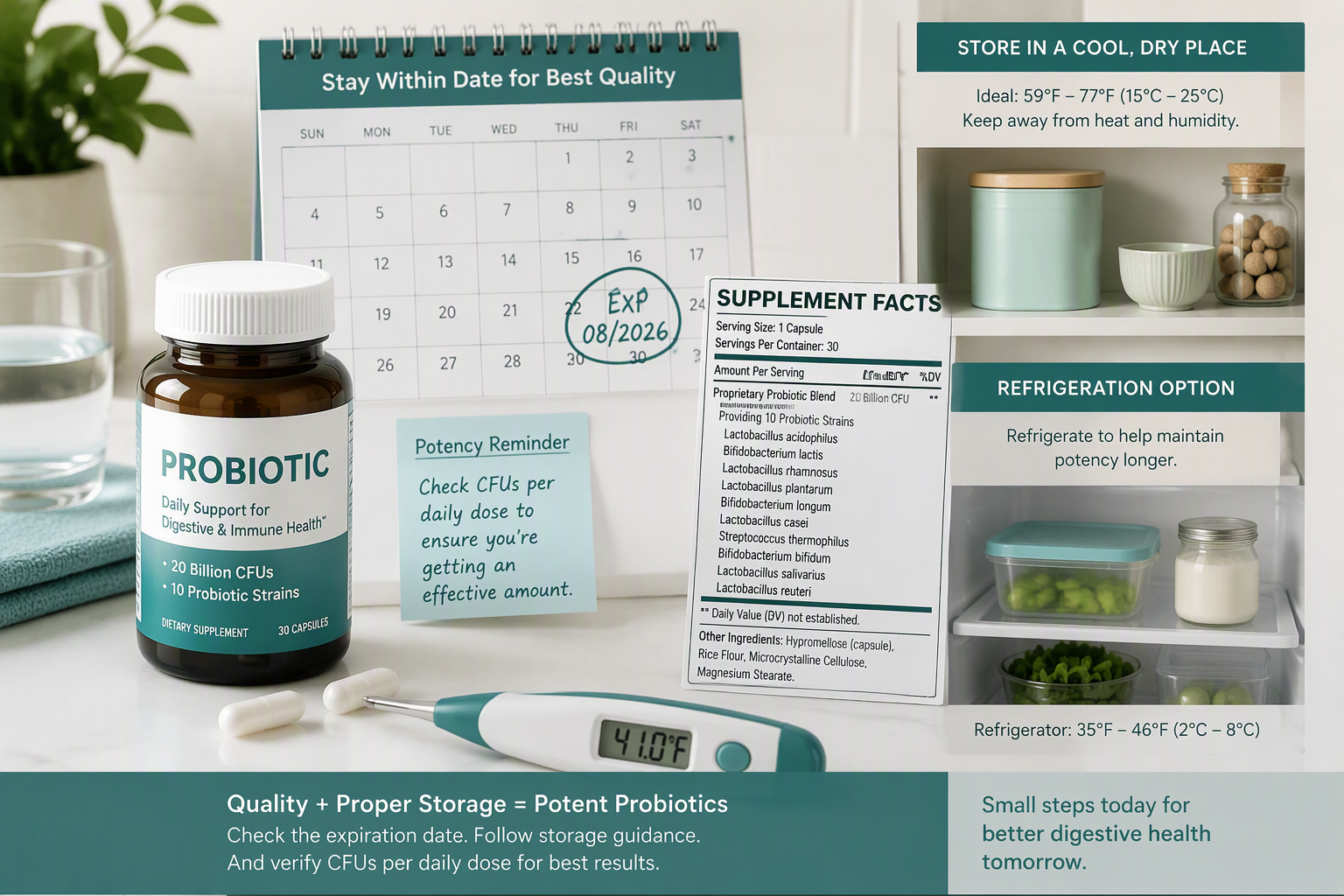
Colony forming units (CFUs) tell you how many viable microorganisms a probiotic provides in one stated dose. They do not show the total organisms in the bottle, and a larger number does not automatically make a product a better fit for your symptoms.
Check whether the CFU count in probiotics is listed per capsule, per serving, or per daily dose. If one capsule contains 5 billion CFUs and the directions call for two capsules, your daily dose is 10 billion CFUs. This small calculation helps prevent a common label-reading mistake.
There is no universal minimum probiotic CFU, because the right amount depends on the strain, your goal, and the research behind it. Trials span a wide range of doses, and the number alone does not tell you whether the product has been studied for your concern.
A probiotic marketed with 60 billion CFUs is not necessarily more useful than one with 10 billion. For IBS, a clearly identified strain code and human research related to IBS matter more than a high count or a long species list. A guide to how much to take and when can help you match serving directions to the amount you plan to take.
The potency statement and probiotic expiration date matter as much as the dose. Look for language confirming that CFUs are guaranteed through shelf life, expiration, or a use-by date. A label that reports the count only at manufacture describes the product when it left the factory, not necessarily the potency remaining when you take it.
Probiotic storage instructions help protect those live organisms:
- Keep the container tightly closed: Moisture and oxygen can reduce potency after repeated opening.
- Follow the label’s storage directions: Some refrigerated probiotics need steady refrigeration, while others are intended for a cool, dry cabinet.
- Avoid heat and humidity: Hot cars, sunny windowsills, and steamy bathrooms can expose the product to damaging temperature swings.
- Plan for travel: Bring only what you can store as directed, or choose a product labeled for room-temperature storage.
Refrigerated probiotics are not automatically better, and shelf-stable products are not automatically weaker. The practical choice is one with a studied strain, an appropriate dose, a clear expiration guarantee, and storage conditions that fit your routine.
Step 5 — Check Product Quality And Ingredients
Beyond CFUs, expiration, and storage, quality checks help you avoid products with unclear contents or misleading claims. Probiotics are dietary supplements, not medications, so the FDA does not assess their safety or health claims the way it evaluates drugs. Choose a reputable probiotic brand, and view vague blends, exaggerated promises, or “FDA-approved probiotic” language as warning signs. An effective probiotic gives you enough detail to connect the product with your health goal.
Use this checklist before you buy:
- Independent verification: Programs such as NSF International, U.S. Pharmacopeia (USP), ConsumerLab, and Informed-Choice may review label accuracy, strain identity, CFU amounts, or contamination controls. A seal does not mean every quality measure was tested, so confirm what that certification covers.
- Strain identification: A genus species strain probiotic label names all three levels, such as Lactobacillus plantarum 299v. A species name alone does not show that it is the strain studied for a specific outcome. Align, for example, identifies Bifidobacterium longum subsp. infantis 35624.
- CFU and expiration details: Compare the Supplement Facts panel with the package and product website. Look for CFUs guaranteed through shelf life rather than only at manufacture, then check the probiotic expiration date and storage instructions.
- Blend transparency: Lactobacillus and Bifidobacterium blends may suit some goals, but more strains do not automatically mean better symptom support. Each listed strain needs evidence of its own, especially if you have IBS.
- Other ingredients: Check for milk or dairy, soy, wheat or gluten, corn, sweeteners, coatings, capsule materials, and other carriers. If you follow a vegan or vegetarian diet, confirm that the finished capsule contains no animal-derived ingredients. A gluten-free or dairy-free claim applies to the completed product, not automatically to the microorganisms.
A cited review found that 5 of 19 products had fewer bacteria than claimed, and some included unintended species. A short ingredient list can make a reaction easier to trace, but it does not prove purity, safety, or effectiveness. Products with many added ingredients deserve extra scrutiny for unwanted microbes, heavy metals, allergens, and other contamination.
Strain listings can help you distinguish similar-sounding products. Probiotic supplement reviews can also help you compare label details beyond front-package marketing.
Step 6 — Compare Supplements With Fermented Foods

Fermented foods and probiotic supplements can both support your gut health, but they are not interchangeable. Evidence consistency matters more than whether a product is labeled “fermented.” A supplement may name a strain, state a dose, and connect research to that exact organism. Kefir, sauerkraut, kimchi, and miso can add nutrients, flavor, and live microorganisms to meals, but their microbial content can shift with the recipe, batch, processing, and storage. A guide to which foods actually contain live cultures covers how to read those labels.
These categories offer different levels of detail:
- Probiotic supplements: May list a strain code, colony forming units (CFUs), and a viable-count guarantee through the expiration date.
- Functional foods: Have added probiotic organisms, though labels may provide less strain and dose information than supplements.
- Traditional fermented foods: Usually identify ingredients and cultures rather than clinically studied strains for a specific digestive concern.
A label that lists only Lactobacillus or Bifidobacterium gives you less useful information than one with a full strain designation. The same is true of Lactobacillus and Bifidobacterium blends that name several organisms but not their strain codes. Research on one strain does not carry over automatically to another strain in the same species, and fermented foods rarely offer that level of identification.
A CFU count on probiotics can help you track a supplement dose, especially when it is guaranteed through expiration. More CFUs are not automatically better, however. Fermented foods may contain live organisms without a verified count when you eat them, so you cannot precisely compare their dose with a supplement. That does not lessen their nutritional value. It means they serve a different purpose.
Microorganisms also need to survive stomach acid and reach the intestines alive. Delayed release probiotic capsules may offer extra protection, while Bacillus coagulans and yeast probiotic strains such as Saccharomyces boulardii may better tolerate harsh conditions. Refrigerated products and freeze-dried, shelf-stable options can both be appropriate when you follow the probiotic storage instructions.
Choose a supplement when you need a named strain and consistent, trackable intake. Fermented foods fit well when they work with your meals and preferences. For probiotics for general digestion, either approach may have a place, but IBS requires condition-specific evidence rather than broad digestive claims. How the supplement categories differ can help frame that decision.
Digestive symptoms can have many causes, so persistent, severe, or worsening symptoms need evaluation from a qualified healthcare professional.
Step 7 — Check Safety And Track Your Trial

Whichever probiotic or fermented-food approach you choose, a safe probiotic starts with a safety check and a clear way to judge your own response. Healthy adults generally tolerate probiotics, but they may carry greater risks for people who are seriously ill, immunocompromised, have a compromised gut barrier, or have another significant health condition. Speak with a qualified healthcare professional before use if any of these apply to you.
Storage affects whether live microorganisms remain viable through the expiration date. Refrigerated probiotics need steady cold storage, while room-temperature probiotics are often freeze-dried and made to stay stable on the shelf. Follow the package directions, seal the container tightly, and protect it from heat and moisture. A bottle kept in a hot car or steamy bathroom may lose potency early.
The delivery format may help organisms survive stomach acid and reach the intestines alive, but it cannot promise symptom relief. Delayed-release or enteric-coated capsules can add protection, while spore-forming organisms such as Bacillus coagulans and yeasts such as Saccharomyces boulardii may also tolerate harsh conditions. That information can help when deciding how to choose a probiotic, but strain-specific research for your particular symptoms still matters.
Test one product at a time for a planned four- to eight-week period rather than changing several supplements, meals, or digestive treatments at once. Keep major changes to fiber intake, new medications, and other gut-health routines as steady as practical. A paper journal or free printable can make tracking easier during a busy workweek or family schedule.
Record a short baseline before you begin, then track the same details throughout the trial:
- Bloating and pain: Note when symptoms happen and whether they disrupt meals, errands, or concentration.
- Bowel habits: Record stool frequency, consistency, urgency, constipation, and diarrhea separately.
- Daily impact: Include poor sleep, missed work, skipped activities, and time spent looking for a restroom.
- Possible side effects: Keep new or worsening gas, bloating, abdominal discomfort, nausea, constipation, or diarrhea separate from your usual symptoms.
A higher-dose probiotic can cause mild digestive upset at first, but discomfort does not mean the supplement is helping. Stop the trial if symptoms repeatedly worsen or if there is no meaningful benefit by your planned endpoint. Bring your dated record to a clinician, since a contemporaneous log is more useful than trying to remember several weeks of symptoms.
Stop the probiotic and seek prompt medical guidance for these warning signs:
- Severe or rapidly worsening abdominal pain.
- Repeated vomiting or signs of dehydration.
- Blood in the stool or black stools.
- Fever, fainting, breathing difficulty, facial swelling, or rapid overall decline.
Digestive symptoms can have many causes, and supplements do not replace diagnosis or prescribed treatment. Consult a qualified healthcare professional for persistent, severe, or worsening symptoms. Results vary by person, and any dietary or supplement advice should be individualized.
How To Choose A Probiotic FAQs
These FAQs address common questions about choosing a probiotic, from reading labels and weighing evidence to considering safety and your digestive goals. They can help you prepare for a conversation with a healthcare professional.
1. Should You Choose A Probiotic With Prebiotics?
Prebiotics are fermentable fibers that feed gut microbes, while probiotics are specific live strains, so you do not need both for a probiotic to be useful. Added inulin or FOS may support regularity but can increase gas and bloating in sensitive digestion. Match the product to your goal: antibiotic-associated diarrhea probiotics, including Saccharomyces boulardii for antibiotic diarrhea and Lactobacillus rhamnosus GG, may not help IBS, constipation, or bloating. Introduce one new ingredient at a time, and seek medical advice for persistent or worsening symptoms.
2. Which Probiotic Features Matter During Antibiotic Treatment?
During or soon after antibiotic treatment, choose a probiotic that lists the complete strain designation, not only the species. Saccharomyces boulardii and Lactobacillus rhamnosus GG are among the most studied options for helping prevent or reduce antibiotic-associated diarrhea, but results from one strain do not carry over to similarly named products. Check the expiration date, storage needs, and timing instructions. Bacterial probiotics may need to be taken separately from antibiotics. S. boulardii is a yeast, but ask a clinician before use if you are immunocompromised, seriously ill, have a central line, or develop severe or worsening symptoms.
3. Should Pregnant Adults Choose Probiotics Differently?
Pregnancy calls for a more careful approach to choosing a safe probiotic. Review the exact strain with your obstetric clinician or pharmacist, not only the species name. Lactobacillus rhamnosus GR-1, Lactobacillus reuteri RC-14, and Lactobacillus crispatus are linked with vaginal or urinary tract health, while some L. reuteri strains may support immune health. Findings for one strain do not carry over to every probiotic or pregnancy concern.
Check the full Supplement Facts panel for prebiotics, herbs, sweeteners, allergens, and other active ingredients. Storage, expiration dates, strain disclosure, and quality testing also matter, especially when symptoms, infections, medications, breastfeeding, or medical history affect whether a product is appropriate.
4. When Should You Ask A Doctor Before Choosing Probiotics?
Ask a doctor before choosing a probiotic if you have a weakened immune system, serious illness, a severe underlying condition, or a compromised gut barrier. Sick infants should only use probiotics with guidance from a qualified healthcare professional. Healthy adults usually tolerate them well, but high doses may cause temporary gas, bloating, or digestive upset when started.
Persistent diarrhea, blood in the stool, unexplained weight loss, fever, or worsening abdominal pain need medical evaluation because they can signal inflammatory bowel disease or another condition. A symptom diary can reveal patterns, but it cannot replace diagnosis, prescribed treatment, or follow-up.