


Physician's Choice Probiotic may be worth trying for general digestive support if convenience and price matter more than condition-specific evidence. Its 60 billion CFUs, 10-species blend, and shelf-stable once-daily capsule do not reliably predict relief from bloating, constipation, diarrhea, or IBS.
The label names bacterial species but not the strain codes needed to match a probiotic to clinical research. No published trial appears to test the finished Physician's Choice 60 Billion formula, and its roughly 50-milligram prebiotic blend may also cause early gas or bloating in some people.
A lower-cost trial can be reasonable for mild, occasional symptoms when you change only one supplement at a time and reassess it after a defined period. Persistent, severe, or worsening bowel changes need evaluation from a qualified healthcare professional rather than continued self-treatment.
Physician's Choice Probiotic Key Takeaways
- Physician's Choice provides 60 billion CFUs across 10 probiotic species in one daily capsule.
- The formula does not disclose strain codes, limiting comparisons with clinical probiotic research.
- No published clinical trial appears to test the finished Physician's Choice 60 Billion formula.
- High CFU totals do not prove relief for bloating, constipation, diarrhea, or IBS.
- Shelf-stable storage and delayed-release capsules support convenience, not proven symptom improvement.
- Temporary gas, bloating, or digestive discomfort can occur when starting a high-count probiotic.
- Seek medical evaluation for severe, persistent, worsening, or unexplained digestive symptoms.
What Is Physician’s Choice 60 Billion Probiotic?

Physician’s Choice Probiotic 60 Billion is an over-the-counter, once-daily supplement intended for general digestive health support, not treatment for a diagnosed condition. Each capsule contains 60 billion colony-forming units (CFUs) from 10 bacterial species. A 60 billion CFU probiotic may sound potent, but the number alone cannot predict relief for bloating, constipation, diarrhea, irregular bowel habits, or irritable bowel syndrome (IBS)-like symptoms.
The labeled Physician’s Choice ingredients are:
- Lactobacillus species: Lactobacillus casei, L. acidophilus, L. paracasei, L. salivarius, L. plantarum, and L. bulgaricus.
- Bifidobacterium species: Bifidobacterium lactis, B. bifidum, B. longum, and B. breve.
The label lists species but not strain codes, which identify a particular genetic version of a bacterium. That gap matters because evidence for a named strain, such as B. longum subsp. infantis 35624 or B. bifidum MIMBb75, does not transfer to every product containing the same species. What separates probiotic labels on disclosure matters more than CFU totals or customer ratings.
Physician’s Choice says its delayed-release capsule helps organisms survive stomach acid and reach the intestines. That is a delivery claim, not proof of symptom relief. The prebiotic component and capsule design may matter, but results still depend on the exact strains, dose, your digestive condition, and your individual response.
The finished formula does not appear to have published clinical trials, so broader probiotic research cannot confirm its effectiveness or side-effect profile. Manufacturer-reported figures of more than 250,000 five-star reviews and 31.68 million bottles sold show marketplace reach, not clinical evidence. The listing is described as a category best seller with roughly 4.6 stars from more than 143,800 ratings, though ratings and rank can change.
You can buy Physician’s Choice 60 Billion Probiotic directly. Take one capsule daily as directed and treat it as a routine to assess over time, not fast relief.
Digestive symptoms can have many causes, so persistent, severe, or worsening symptoms need evaluation from a qualified healthcare professional.
What Features Does Physician’s Choice Offer?
Physician’s Choice 60 Billion offers a convenient once-daily format, but its 60 billion colony-forming units and 10 probiotic strains do not establish that the formula will help IBS. One vegetarian capsule combines the probiotic blend with prebiotics, which may fit a busy workday, family routine, or travel schedule better than multi-capsule probiotic supplements. Convenience does not mean one product can address every cause of bloating, constipation, diarrhea, or irregular bowel habits.
As a shelf-stable probiotic, it does not require refrigeration. That can make cabinet storage and travel simpler when you follow package directions and check the expiration date. The delayed-release capsule is intended to protect its contents from stomach acid, but that feature does not show the organisms reach the gut alive in clinically meaningful amounts or relieve IBS-like symptoms.
The manufacturer markets the product as free from:
- Dairy, soy, gluten, wheat, major nuts, eggs, fish, and shellfish.
- Genetically modified organisms (GMOS), artificial sweeteners, preservatives, and color additives.
These claims can make ingredient screening easier, especially when you avoid particular allergens or additives. Still, check the current package label rather than relying on a retailer listing, and speak with a qualified healthcare professional if you have an allergy or strong sensitivity.
Physician’s Choice says it is among third-party tested probiotics, with testing for purity and potency, and the company also states that the product is made in United States facilities certified for current Good Manufacturing Practice (cGMP), using domestic and imported ingredients. These are useful manufacturing and label-quality safeguards, not proof that the formula works for a particular digestive condition.
The larger evidence gap is strain identification. Although the label advertises 10 strains, it does not provide clinical strain codes on the front label. Evidence for one strain cannot be assumed to apply to another member of the same species or to a multi-strain blend. For example, naming Lactobacillus rhamnosus is not the same as identifying L. rhamnosus LRa05. For diagnosed IBS, strain identity matters more than an impressive colony-forming unit count.
Like other dietary supplements, Physician’s Choice carries the Food and Drug Administration (FDA) disclaimer that its claims have not been evaluated by the FDA and that it is not intended to diagnose, treat, cure, or prevent disease. Persistent, severe, or worsening bloating and bowel changes need medical assessment rather than a supplement-only approach.
How Transparent Is the 10-Strain Formula?
Despite the broader label-quality safeguards, Physician’s Choice ingredients identify the 10 species in this formula, which is more useful than a label that only says “probiotic blend.” Still, this 10 strain probiotic does not disclose enough detail to connect the capsule to specific probiotic clinical trials:
- Lactobacillus acidophilus
- Lactobacillus casei
- Lactobacillus paracasei
- Lactobacillus plantarum
- Lactobacillus rhamnosus
- Lactobacillus salivarius
- Lactobacillus bulgaricus
- Bifidobacterium breve
- Bifidobacterium lactis
- Bifidobacterium longum
This list helps you compare the Lactobacillus and Bifidobacterium species in different formulas or avoid an organism you do not tolerate well. Its main limit is the absence of probiotic strains, the letter-and-number codes that identify a specific organism within a species and allow it to be matched to a study.
One species can contain many strains that act differently. Findings involving Lactobacillus casei or a particular Bifidobacterium lactis strain may provide background, but they cannot show that the unnamed version in this capsule has the same effect. Species-level research also cannot confirm benefits for bloating, bowel regularity, or irritable bowel syndrome (IBS).
Without strain codes, it is difficult to tell whether the organisms and doses match research in people with symptoms like yours or how this product compares with strain-specific alternatives. The label also offers limited help in assessing whether prebiotic ingredients are present, which matters if added fibers tend to worsen your gas or bloating.
A 10-species formula offers variety, but variety is not the same as traceable evidence for named organisms at studied doses. Physician’s Choice is clear about the species it includes, yet not transparent enough to tie the formula confidently to strain-specific findings. As of September 2026, the finished Physician’s Choice 60 Billion product does not appear to have its own clinical trial evidence, so benefits and tolerability should be treated as uncertain rather than assumed from the ingredient list. Biotics 8, a fully strain-disclosed option, shows what a traceable label looks like at a similar strain count.
Do 60 Billion CFUs Show Effectiveness?
Given the missing strain codes, a 60 billion CFU probiotic carries a high labeled dose, but the total alone cannot show whether it will help bloating, constipation, diarrhea, or IBS-like symptoms. Colony-forming units estimate the number of live microorganisms able to grow under laboratory conditions. Physician’s Choice lists 60 billion CFUs per serving across 10 strains, but it does not disclose how much of each organism the formula contains.
That gap matters because a 10 strain probiotic can post a large total while supplying unknown or very small amounts of individual probiotic strains. Effects depend on the exact strain, the dose studied for that strain, and the person taking it. Federal health guidance notes that probiotic effects are strain-specific, and a higher CFU total does not reliably predict better results (source)).
Species names also cannot reliably connect a formula to probiotic clinical trials. For example, Bifidobacterium lactis includes many distinct strains. HN019 and BB-12 have research on gut transit time and bowel-movement frequency in general adult populations, not demonstrated IBS benefit. Without a strain code, there is no way to tell whether either strain appears in this blend (source)).
Physician’s Choice says its CFU count is tested for accuracy through the expiration date, rather than only when the product is made. That is more useful than a manufacture-date count because probiotics can lose viability in storage, shipping, and at home. Still, the available product information does not provide batch-specific viability results or explain how survival is tested under normal storage and shipping conditions.
The company also advertises 15-times greater survival than a standard probiotic. Its acid-resistant capsule and delayed-release design may help organisms withstand stomach acid, but no supporting study, comparator product, or testing method is published. This remains a manufacturer claim about capsule performance, not evidence of digestive symptom relief.
A more meaningful assessment looks for three separate details:
- Strain identification: Clinical strain codes, rather than species names alone, allow comparison with published research.
- Verified viability: The labeled dose should remain viable through expiration, ideally with evidence beyond a general label statement.
- Product-specific evidence: Randomized controlled trials should test the complete formula in people with symptoms like yours.
Third-party tested probiotics can offer reassurance about purity, potency, and certain safety concerns. Those quality checks do not establish that the full Physician’s Choice formula helps a particular digestive symptom.
For this product, 60 billion CFUs are best viewed as a potency claim, not reliable proof of effectiveness. Digestive symptoms can have many causes, so persistent, severe, or worsening symptoms warrant guidance from a qualified healthcare professional.
Do Prebiotics and Delayed Release Help?
Beyond the CFU total, the prebiotic blend and delayed-release design are reasonable formula features, but neither shows that this probiotic will improve IBS-like symptoms. The more important question is whether its named strains have evidence for the symptoms you want to address.
The product’s organic prebiotics include Jerusalem artichoke root, gum arabic, and chicory-root-derived Fibergum Bio. These prebiotic ingredients are fermentable fibers that may serve as food for certain beneficial bacteria. Still, the full blend supplies only about 50 milligrams per daily capsule, making it a minor part of the formula.
That amount is unlikely to produce the fiber-like effect many people expect from a prebiotic, such as dependable changes in bloating or bowel regularity. Physician’s Choice has not supplied clinical research showing that its approximately 50-milligram blend improves digestive symptoms for people using this specific formula.
The delayed-release capsule has a sensible purpose, but its benefit remains unproven:
- Acid-resistant capsule: The capsule is designed to help more live organisms pass through stomach acid and reach the intestines.
- Plausible delivery goal: Bacteria need to remain viable to have a possible effect, so protecting them during digestion makes practical sense.
- Evidence limit: Better survival in a capsule or laboratory test does not show that pain, constipation, diarrhea, or bloating will improve in real-world use.
Physician’s Choice states that its capsule provides “15-times greater survival than a standard probiotic.” The available product information does not identify the study, comparison product, testing method, or source behind that figure. Without those details, “standard” has no clear meaning, and the claim cannot show whether the capsule improves digestive outcomes for people taking it.
Treat the organic prebiotics and acid-resistant capsule as possible conveniences, not proof of better symptom relief. For persistent bloating, constipation, diarrhea, or IBS-like symptoms, strain-specific evidence matters more than capsule technology or a small prebiotic add-on.
How Much Does Physician’s Choice Cost?
Despite the formula’s evidence limits, Physician’s Choice is a lower-cost way to try a high-CFU daily probiotic, although the amount shown at checkout matters more than any price captured in a review. A 30-capsule bottle may cost a fraction of practitioner-channel, single-strain products or direct-sold subscription formulas when compared by daily use.
That price difference can matter when you are fitting a supplement into a household budget. A probiotic trial is more useful when you can take the same formula consistently long enough to notice whether bloating, bowel habits, or other symptoms change. For many shoppers, Physician’s Choice is a more practical starting point than a premium formula.
The advertised price may not match your final total because several checkout details can change it:
- One-time versus recurring purchase: Subscription options can reduce the displayed total, but they also create repeat shipments unless you cancel or change the order.
- Selectable coupons: Some offers must be selected before checkout. Confirm that the discount appears in the final total rather than assuming the headline offer applies.
- Seller and shipping terms: Delivery charges, free-shipping thresholds, and return eligibility may differ between the brand’s direct store and third-party retailers.
Retail prices, coupon offers, stock, and subscription terms can change without notice. Compare the one-time and recurring totals on the actual checkout page, especially if a low introductory offer could turn into an order you do not want to continue.
The brand advertises a money-back guarantee, but that protection is separate from a retailer’s own return policy. If you buy through a marketplace or another seller, check that seller’s shipping terms, return window, refund process, and subscription rules before ordering. A direct-brand guarantee may not extend to a third-party purchase.
Physician’s Choice is a reasonable best affordable probiotic option if you want a high-CFU, multi-species formula without premium pricing. Affordability is its strongest argument because a lower-cost trial is easier for more people to complete. It does not address the formula’s limited strain-code transparency or establish that the product has evidence for your specific IBS-like symptoms.
Current pricing, count, and the full species list are on the Physician’s Choice 60 Billion listing, which is worth a look before you compare it with anything else here.
What Are Physician’s Choice’s Pros and Cons?
Physician’s Choice is convenient if you want one high-count, shelf-stable probiotic capsule, but its formula does not offer enough strain-level detail to predict relief for a specific symptom or IBS. This physician's choice probiotic review finds it most suitable for busy shoppers who accept that uncertainty rather than expect targeted results.
The main advantages and drawbacks are easy to weigh:
- All-in-one convenience: Each serving provides 60 billion colony-forming units (CFUs) across 10 probiotic species in a delayed-release, shelf-stable capsule. That can be simpler than refrigerating or taking several supplements, especially during a packed workday or family routine.
- Simple inactive ingredients: An independent ingredient review found no additives identified as unhealthy in the relatively short inactive-ingredient list. The delayed-release capsule may also be practical for regular use. Neither feature shows that the product will relieve bloating, constipation, diarrhea, or IBS-like symptoms.
- Limited strain transparency: The label identifies probiotic species but not clinical strain codes. Probiotic effects are strain-specific, meaning research on a Lactobacillus or Bifidobacterium strain cannot be assumed to apply to a different strain in this blend.
That missing detail matters more than the CFU count. A named strain, such as B. longum subsp. infantis 35624 or L. acidophilus DDS-1, can be matched with its own research. Without matching codes and a study of the complete Physician’s Choice formula, broad digestive-health marketing claims go further than the available product-specific evidence supports.
Physician’s Choice side effects are another practical trade-off. A higher-count probiotic can temporarily increase gas, bloating, or digestive discomfort, particularly if you already have a sensitive gut or active symptoms. When bloating is your main concern, starting with this product may be less straightforward than choosing an option with strain-specific evidence.
Probiotic customer reviews can indicate satisfaction with convenience, but they are not clinical evidence. Amazon lists a 4.6 out of 5 average from 144,213 global ratings, including 77 percent five-star, 12 percent four-star, 6 percent three-star, 2 percent two-star, and 3 percent one-star ratings. Those results cannot predict your response or establish effectiveness for diagnosed IBS.
Physician’s Choice may fit shoppers who value a widely purchased, multi-species capsule and can tolerate some early uncertainty. Its main limitations are missing strain-level information, possible digestive discomfort, and marketing language that may sound more definite than the research allows. Digestive symptoms can have many causes, so persistent, severe, or worsening symptoms should be assessed by a qualified healthcare professional.
Is Physician’s Choice Worth It?
Physician’s Choice may be worth trying if you are an otherwise healthy adult who want a shelf-stable, one-capsule daily probiotic rather than condition-specific evidence. Its 10-species, 60-billion colony-forming unit (CFU) blend, prebiotic ingredient, and delayed-release capsule offer variety and convenience. Those features do not show that it will relieve bloating, constipation, diarrhea, or IBS.
The main limitation in this physician's choice probiotic review is the lack of strain-level detail. No clinical trial appears to test the finished Physician’s Choice 60 Billion formula, so its likely benefits and side effects cannot be predicted for this product specifically. A review of roughly 30 popular IBS and digestive probiotic supplements found that few named clinical strain codes, which makes transparent labeling an important comparison point.
Evidence has a clear order of usefulness:
- Strongest evidence: A study of the exact finished formula.
- More targeted evidence: A study of the exact named strain in a similar group of people.
- Limited evidence: Species-level research and probiotic customer reviews, neither of which can confirm how a multi-strain blend will affect you.
A species name alone cannot connect a supplement to a clinical trial. Results for Bifidobacterium longum subsp. infantis 35624 or Lactiplantibacillus plantarum 299v do not apply to a label that does not name either strain code. A high CFU count and 10 species signal breadth, not proven symptom relief.
Research-backed probiotics fit best when the strain matches the health question you are trying to address. UltraFlora, a single-strain practitioner formula, may suit a more targeted choice.
The brand reports more than 250,000 five-star reviews, a 4.8 average rating, and over 31.68 million bottles sold. Amazon lists 4.6 stars from about 143,800 reviews and roughly 50,000 monthly purchases. These figures may reflect satisfaction with ordering and routine use, but they are not controlled evidence of digestive relief. The 60-day guarantee and the subscription discount can reduce financial risk, not uncertainty about whether the formula will help you.
If you are asking, “is Physician’s Choice probiotic healthy,” the more useful question is whether it fits your symptoms, budget, and tolerance. Consider a short, consistent personal trial for mild symptoms, and avoid changing several supplements at once. Free shipping or subscription savings should not keep you taking a product that is not helping.
For diagnosed IBS, persistent symptoms, or another digestive condition, clinical guidance or a strain-specific option is a safer choice. Align contains B. longum subsp. infantis 35624, a strain studied in diagnosed IBS, unlike Physician’s Choice’s unlabeled blend.
Digestive symptoms can have many causes, so consult a qualified healthcare professional for severe, worsening, or ongoing symptoms. Results vary by person, and supplement decisions should be individualized.
Who Should Use Physician’s Choice?
Physician’s Choice 60 Billion can be a reasonable short personal trial if you are generally healthy and want support for mild, occasional gas and bloating, irregularity, constipation, or diarrhea. The 10-strain, 60 billion colony-forming unit formula may appeal to shoppers focused on gut health, but those label details cannot predict your response or establish product-specific benefits for IBS.
The manufacturer says the capsules exclude the following ingredients:
- Dairy, soy, gluten, wheat, major nuts, eggs, fish, and shellfish.
- Genetically modified organisms, artificial sweeteners, preservatives, and color additives.
These exclusions may make the product easier to consider if you avoid particular ingredients, but they do not guarantee tolerance for every sensitive digestive system. A product marketed for constipation or for diarrhea is not automatically the right choice for your symptoms.
Shelf-stable capsules do not need refrigeration, which can suit workdays, travel, and inconsistent routines. Customer reviews commonly describe them as relatively small and easy to swallow. That convenience is separate from effectiveness, so follow package directions and stop use if troublesome new symptoms develop.
Physician’s Choice is a weaker fit when diagnosed IBS or frequent, disruptive IBS-like symptoms are the main concern. Although it lists 10 strains, the label does not prominently provide clinical strain codes, the letter-and-number identifiers used to match a product with research. That makes it difficult to compare its formula with IBS-studied strains such as Bifidobacterium longum 35624 or Lactiplantibacillus plantarum 299v.
For a comparison at a similar strain count, Garden of Life’s shelf-stable blend at least names its organisms. If you are asking is Physician’s Choice probiotic healthy, the practical answer depends on your symptoms, ingredient needs, and health history.
Seek medical evaluation rather than self-treating if you have:
- Blood in stool, fever, significant pain, or unintentional weight loss.
- Persistent, severe, worsening, or unexplained constipation or diarrhea.
- Symptoms that wake you from sleep.
- A weakened immune system, serious underlying illness, recent hospitalization, or a complex medication plan.
Probiotic safety also deserves extra attention if you take antibiotics. Customer reports do not establish safe timing, benefit, or suitability alongside a particular medication. Digestive symptoms can have many causes, and results vary by person.
How Does Physician's Choice Compare With Align?
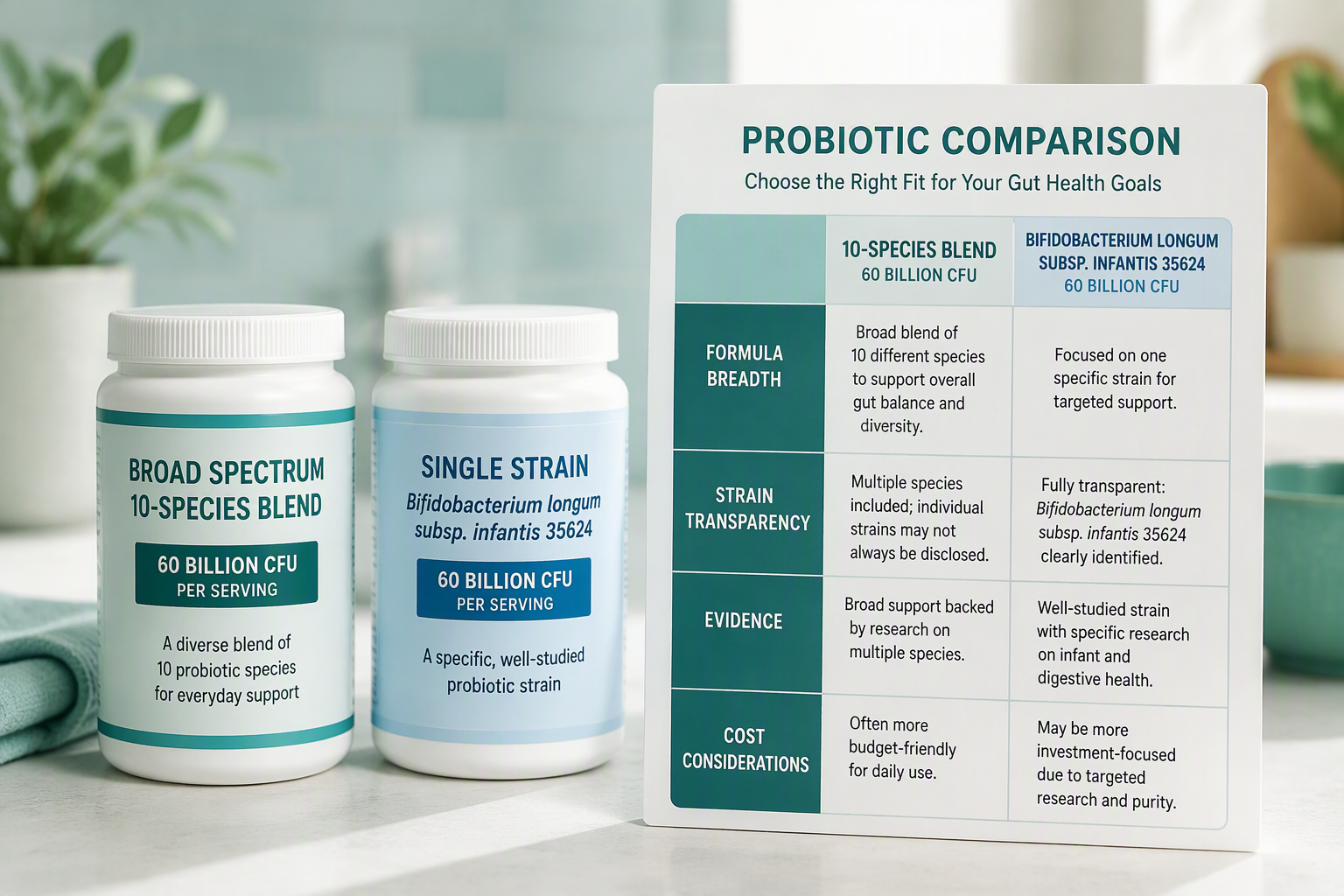
Align’s single strain with IBS trials is the sharper contrast, since Physician's Choice takes a broader daily-support approach. The Physician's Choice 60 Billion product reviewed here, Amazon ASIN B09GLGC9DG, contains 10 named organisms and 60 billion colony-forming units (CFUs). Align contains Bifidobacterium longum subsp. infantis 35624. More CFUs do not automatically make a probiotic a better match for bloating, irregular bowel habits, or diagnosed IBS.
The key difference is label transparency. Physician's Choice names 10 species, including Lactobacillus acidophilus, Lactobacillus plantarum, Bifidobacterium lactis, Bifidobacterium longum, Bifidobacterium bifidum, and Bifidobacterium breve, but does not provide strain codes. Align’s 35624 code lets you match the product with research on that exact organism. Research on one strain cannot be assumed to apply to an unnamed strain from the same species, especially within a multi-strain blend.
Feature | Physician's Choice | Align |
|---|---|---|
Formula | 10 named organisms, 60 billion CFUs, prebiotics, and a delayed-release capsule | One identified probiotic strain |
IBS evidence fit | No strain codes to connect the formula directly to IBS trials | Contains 35624, which has been studied in diagnosed IBS |
Trial approach | Broad routine with several ingredients that may affect symptoms | One-variable trial that is easier to interpret |
Likely value | Markedly lower cost per day | Higher cost, with clearer strain-specific relevance |
In a placebo-controlled IBS study, 35624 outperformed placebo for every measured symptom except bowel-movement frequency and stool consistency. That finding belongs to 35624, not to all B. longum products or to Physician's Choice. It also does not mean Align will relieve symptoms for every person with IBS.
Physician's Choice may be the best affordable probiotic if you want a convenient, broad formula and understand its evidence limits. Lower daily cost can make it easier to complete a reasonable trial, but affordability and a high CFU count do not establish IBS relevance. Its prebiotics and multiple organisms can also make it harder to tell whether new gas, bloating, diarrhea, constipation, or stool changes came from one ingredient.
Align is the clearer choice for a focused trial of research-backed probiotics when you have diagnosed IBS and want a product with a traceable strain. Physician's Choice is better suited to general digestive support when cost and a broad formula matter more than condition-specific evidence.
Persistent, severe, or worsening digestive symptoms warrant evaluation by a qualified healthcare professional rather than another supplement.
If you want to try Physician’s Choice 60 Billion, you can get it here.
Physician’s Choice 60 Billion Probiotic FAQs
These four FAQs address side effects, refrigeration, antibiotic timing, and expected results for Physician’s Choice 60 Billion Probiotic, helping you weigh practical use before buying.
1. What Side Effects Can Physician’s Choice Cause?
Physician’s Choice side effects may include temporary gas and bloating or digestive discomfort when you begin the 60 Billion Probiotic, particularly if you have a sensitive gut or IBS-like symptoms. Its 10-strain, high-dose formula may alter fermentation, but discomfort is neither expected for everyone nor proof it is working. For probiotic safety, stop taking it and contact a qualified healthcare professional for severe, persistent, worsening, or concerning symptoms. These include intense abdominal pain, ongoing diarrhea or constipation, vomiting, fever, blood in your stool, or signs of an allergic reaction. A probiotic for diarrhea should not replace medical assessment.
2. Should You Refrigerate Physician’s Choice Probiotic?
Physician’s Choice 60 Billion Probiotic is marketed as a shelf-stable probiotic, so refrigeration is usually unnecessary. The once-daily vegetarian capsule can stay in a cupboard and travel with you. Check the storage directions on the bottle you purchase, since packaging may change, and keep it tightly sealed and away from heat, humidity, and direct sunlight. Refrigeration cannot compensate for improper storage.
3. Can You Take Physician’s Choice With Antibiotics?
Walmart customers have described taking Physician’s Choice 60 Billion with antibiotics to support gut flora or immunity, but those experiences do not show that it prevents antibiotic-associated symptoms or improves infection treatment. Because its 10 strains lack clinical strain codes, evidence for other probiotic formulas cannot be applied automatically.
Ask a clinician or pharmacist whether it suits your antibiotic, health history, other medicines, symptoms, and dosing schedule. Follow your prescribed antibiotic directions, since this supplement does not replace medical care.
4. How Long Until Physician’s Choice Works?
Some customers report less bloating or more regular bowel movements within days to a week, but these individual experiences are not clinical evidence. Because Physician’s Choice 60 Billion has not been tested in clinical trials, there is no dependable timeline, and a high CFU count does not make it the best probiotic for constipation. Response may vary with your symptoms, diet, other treatments, and strain fit.
Reassess after a defined trial rather than continuing indefinitely. Persistent, worsening, or disruptive symptoms deserve discussion with a qualified healthcare professional, since a probiotic cannot replace diagnosis or prescribed care.