


Before paying a premium price for Metagenics UltraFlora Intensive Care, make sure the bottle contains the U.S. single-strain LP299V® formula. The available 299v evidence supports a cautious trial for mild, recurring abdominal discomfort, not dependable treatment for IBS or every bowel symptom.
A similarly named UltraFlora product may list three organisms, including LGG, S. boulardii, and BB-12, which is a different formula with different evidence. The reviewed version provides 20 billion CFU of Lactobacillus plantarum 299v in two capsules, while its key study included only 40 people with IBS and measured abdominal-pain resolution.
The premium cost is easier to justify when you specifically want the verified 299v strain and can follow the label's storage directions. New, severe, or worsening symptoms, blood in the stool, unexplained weight loss, fever, or persistent diarrhea need medical assessment rather than repeated supplement trials.
UltraFlora Intensive Care Key Takeaways
- Verify that the U.S. bottle lists LP299V® as its only probiotic strain.
- Two capsules provide 20 billion CFU and 170 milligrams of 299v.
- A 40-person IBS trial found possible abdominal-pain benefit, but evidence remains limited.
- Research on 299v does not prove the finished Metagenics product treats IBS.
- The formula contains soy, so check the current package label before purchasing.
- Compare final daily costs because the 60-capsule bottle lasts 30 days at labeled dosing.
- Persistent, severe, or worsening digestive symptoms require qualified medical guidance.
What Is Metagenics UltraFlora Intensive Care?
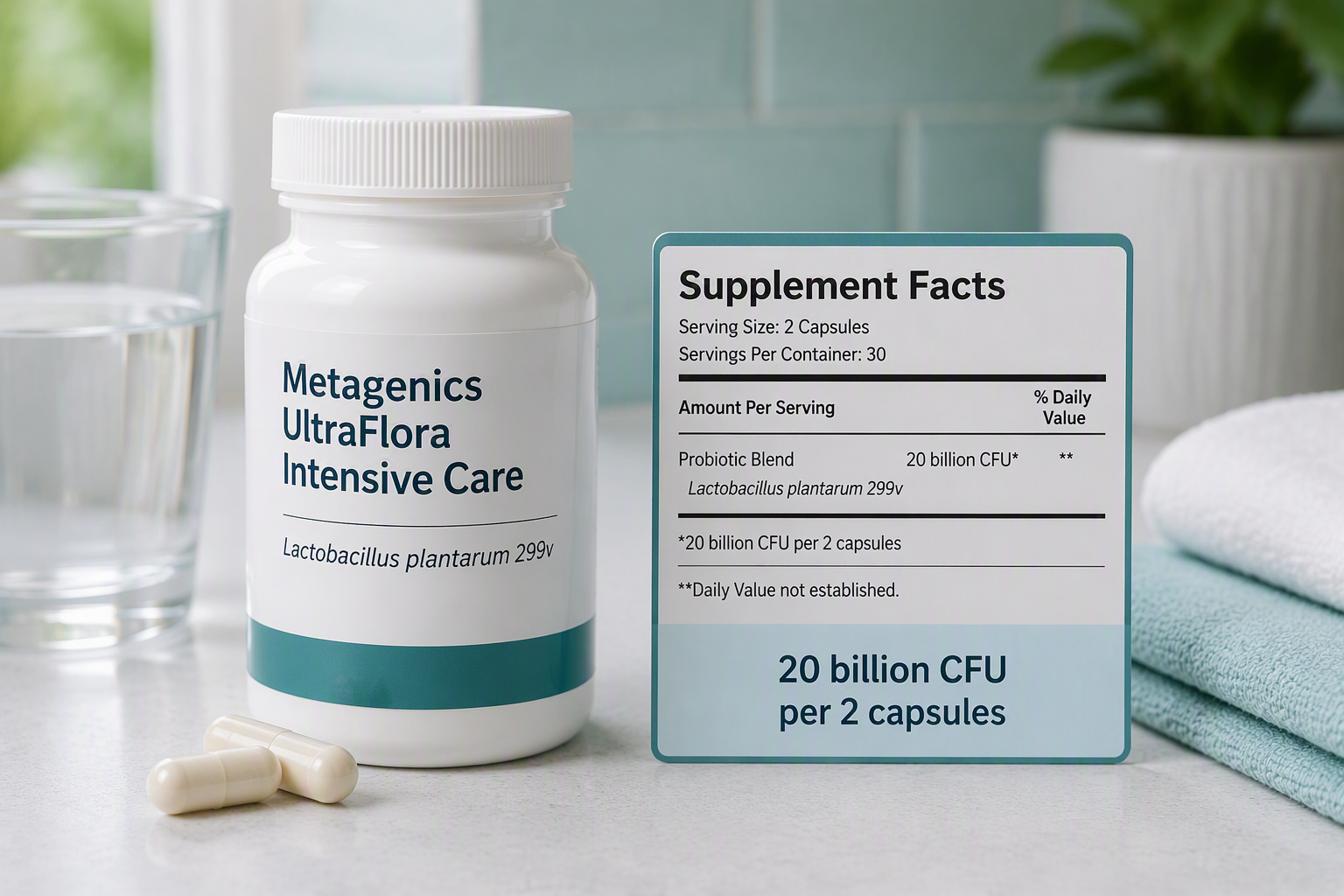
Metagenics UltraFlora Intensive Care Probiotic is the U.S. product assessed here: a single-strain Metagenics probiotic containing Lactobacillus plantarum 299v, labeled LP299V®. That strain-level name matters. Research on another Lactobacillus species, a different strain, or a multi-strain product cannot be assumed to apply to this formula.
The Supplement Facts panel lists a daily serving of two capsules with 20 billion colony-forming units (CFU), meaning viable microorganisms counted at manufacture, and 170 milligrams of LP299V®. The 60-capsule bottle supplies 30 servings, which means each capsule provides 10 billion CFU and 85 milligrams. This is important when judging whether a 20 billion CFU probiotic listing reflects the full daily serving or only one capsule.
Metagenics markets this product for intestinal distress and bowel discomfort. It may appeal if bloating, abdominal discomfort, constipation, diarrhea, or irregular bowel habits interfere with work or family life. Those are manufacturer claims, not a promise of relief, and a single strain will not fit every symptom pattern or case of irritable bowel syndrome (IBS).
Evidence for 299v is strain-specific, not evidence for probiotics as a whole. In a small placebo-controlled trial of 40 people, all 20 participants who received 299v reported that abdominal pain resolved, compared with 11 of 20 receiving placebo. The result supports more study of the named strain, but it cannot predict your response to the finished product.
Product naming can create real confusion. Some similarly named Ultra Flora Intensive Care listings describe a three-organism formula containing Lactobacillus rhamnosus LGG, Saccharomyces cerevisiae boulardii, and Bifidobacterium animalis subsp. lactis BB-12. That is not the same as the U.S. LP299V®-only formula, so its ingredients and evidence should not be treated as interchangeable.
The package details that identify the reviewed formula are:
- Strain: LP299V® is the only probiotic organism listed.
- Serving: Two capsules provide 20 billion CFU and 170 milligrams.
- Bottle size: 60 capsules provide 30 servings.
Listings with multiple organisms or another serving size may reflect an older formula, a different market version, or an inaccurate retailer page. Single-strain and multi-strain probiotics compared places this option in context.
The UltraFlora Intensive Care Amazon listing should resolve to ASIN B00O9S6K0I and show LP299V® at 20 billion CFU per two-capsule serving. Confirm those label details before purchasing, since later safety, storage, value, and evidence discussions apply only to the verified U.S. formula.
What Features Does UltraFlora Intensive Care Offer?
With the reviewed formula identified, UltraFlora Intensive Care Probiotic centers on the named Lactobacillus plantarum 299v strain. A two-capsule daily serving supplies 20 billion colony-forming units (CFU), with 10 billion CFU in each capsule. The 299v code matters because studies of Lactobacillus plantarum without that exact identifier do not necessarily apply to this formula.
For a single-strain digestive health probiotic, this is a comparatively high dose. Still, choosing a 20 billion CFU probiotic based on potency alone can be misleading. Strain identity, product quality, and your own response are more relevant to symptom relief than a larger CFU number.
The formula has a relatively short inactive-ingredient list:
- Capsule: Vegetarian hydroxypropylmethylcellulose.
- Other ingredients: Potato starch and vegetable magnesium stearate.
- Dietary positioning: Vegetarian, gluten-free, and non-genetically modified organism (non-GMO).
Those attributes may fit some diets, but this gut health supplement is not free of all common allergens. UltraFlora Intensive Care contains soy, so avoid relying on abbreviated retailer descriptions if you have a soy allergy or sensitivity. Check the package label before purchasing, since ingredients and formulations can change.
Metagenics and retailer listings state that the product receives third-party testing for purity and potency and is made in a facility certified for current Good Manufacturing Practices (cGMP). These practices support quality assessment, which matters for products containing live microorganisms. They do not establish that the supplement will work for a particular digestive condition or confirm that every seller stocks the same formulation.
Metagenics markets the product for digestive health, bowel regularity, colon comfort, immune health, microbiome support, gastrointestinal barrier support, and occasional intestinal irritation. These are structure/function claims, meaning they describe general intended support rather than evidence that the product treats irritable bowel syndrome (IBS), chronic constipation, persistent diarrhea, or another diagnosed condition.
If digestive symptoms disrupt meals, work, sleep, or travel, the research on the specific 299v strain deserves separate consideration from the manufacturer’s finished-product claims. Persistent, severe, or worsening symptoms warrant guidance from a qualified healthcare professional.
Verify Your Formula and Market Label
Use the physical bottle or Metagenics’ official market label as the deciding reference, not a retailer title, photo, or copied description. Retail listings can stay live after packaging or formulas change, so “UltraFlora Intensive Care 60 capsules” does not, by itself, confirm what is in the bottle. Match the product name, capsule count, and Supplement Facts panel to the version you plan to buy.
The strain identity should read Lactobacillus plantarum 299v, including the 299v designation. A product labeled only as L. plantarum is not necessarily the same organism studied under that specific strain name. If the full identity is missing or conflicts with the official label for your market, the evidence discussed for 299v does not automatically apply.
The reference formula contains 299v at 20 billion CFU. That amount must match the stated serving size and indicate whether potency is guaranteed through expiration. A retailer description listing LGG, S. boulardii, and BB-12 at 22.5 billion CFU signals a different, three-organism formula rather than a small wording difference.
Before purchasing, check the full label for the details that affect fit and handling:
- UltraFlora probiotic dosage: Confirm the suggested daily use and CFU amount per serving.
- Other ingredients: Review inactive ingredients, capsule materials, and allergen statements, especially if additives or dietary restrictions affect you.
- Probiotic storage: Follow the directions printed on the exact bottle. Some retailer information describes refrigeration with room-temperature stability for seven days, but instructions can differ by market version.
Do not assume cold shipping not required unless the handling information for your exact product supports it. Careful label matching helps you avoid comparing research, dosing, or storage guidance for the wrong formula.
What Does 299v Evidence Actually Show?
Beyond verifying the label, UltraFlora Intensive Care names the specific Lactiplantibacillus plantarum 299v strain, also labeled Lactobacillus plantarum 299v or DSM 9843. That is more informative than a species-only label because probiotic effects can vary by strain. Still, research on 299v does not automatically show that the finished Metagenics capsule will produce the same results for you.
The key evidence is a small randomized, placebo-controlled 2001 study by Niedzielin, Kordecki, and Birkenfeld. It included 40 people with IBS, with 20 taking 299v and 20 taking a placebo. All 20 participants receiving 299v had abdominal-pain resolution, compared with 11 of 20 in the placebo group (source)).
That finding supports a possible strain-specific effect on abdominal pain in the IBS group studied. It does not establish equal benefit for bloating, constipation, diarrhea, stool frequency, or long-term symptom control. With only 40 participants, the result is less certain than one from a larger, independently replicated trial and may be more affected by chance, participant differences, and how outcomes were reported.
The study tested 299v, not UltraFlora Intensive Care as a branded, finished product. Metagenics markets this LP299V probiotic as providing 20 billion CFU of 299v per serving. However, the CFU label amount alone cannot confirm that the retail capsule matched the trial’s dose, delivery conditions, participant group, duration, or outcomes.
Several factors can affect whether strain research applies to a store-bought supplement:
- Live bacteria at use: Storage conditions and time on the shelf can affect how many organisms remain viable.
- Capsule formulation: Delivery through the digestive tract and any added ingredients may differ from the research intervention.
- Symptoms measured: Someone seeking help for constipation or diarrhea is not necessarily seeking the abdominal-pain outcome measured in the 2001 trial.
- Length of use: A short study cannot show whether any benefit continues with longer-term use.
A named strain remains a meaningful advantage over an unspecified L. plantarum product. By comparison, Align, with the strongest IBS trial record, uses Bifidobacterium longum subsp. infantis 35624, which has a substantially larger multicenter trial behind it. Both are identifiable strains, but their evidence bases are not the same size. Culturelle’s LGG and its diarrhea evidence is a third named strain whose research sits in a different setting again.
UltraFlora Intensive Care may be worth discussing if you specifically want Lactobacillus plantarum 299v rather than an unnamed L. plantarum product. Results vary by person, and digestive symptoms can have many causes. Persistent, severe, or worsening symptoms need assessment from a qualified healthcare professional rather than self-treatment alone.
How Do Dosage, Storage, and Safety Work?
UltraFlora Intensive Care is typically labeled as two capsules daily, or as directed by a healthcare practitioner. Some retailer listings give an UltraFlora probiotic dosage range of one to two capsules per day. That is the total daily amount, not a reason to follow a customer’s morning-and-evening routine unless your clinician has recommended that timing.
A 60-count bottle is marketed as a 30-day supply at two capsules daily. If you and a healthcare professional choose the lower end of the range, the bottle could last up to 60 days. This changes the product’s effective monthly cost, since probiotic capsules can become expensive when taken at the higher daily amount.
Follow the package directions for probiotic storage and check the expiration date before use. The manufacturer states that the labeled colony-forming unit CFU count is maintained through expiration when storage instructions are followed. Cold shipping not required does not mean heat exposure is harmless, so do not rely on the date alone if the bottle was left in a hot car, near a heat source, or in other unfavorable conditions.
Review the current package label before buying, particularly if you avoid soy. The stated formula contains Lactobacillus plantarum 299v and soy, along with potato starch, hydroxypropyl methylcellulose capsule material, and vegetable magnesium stearate. Retailer descriptions and product versions can change, so an older listing may not reflect the bottle you receive.
A cautious approach matters when digestive symptoms are active or unpredictable:
- New or worsening symptoms: Increased bloating, bowel discomfort, diarrhea, constipation, or other changes call for attention rather than a higher dose.
- Medicines and health conditions: If you take prescription or over-the-counter medicines, are pregnant or breastfeeding, are immunocompromised, or manage a significant medical illness, speak with a qualified healthcare professional or pharmacist before starting.
- Underlying digestive concerns: A probiotic may support your gut health, but it does not replace evaluation or treatment for a digestive condition.
Digestive symptoms can have many causes, and persistent, severe, or worsening symptoms need medical assessment.
How Much Does UltraFlora Intensive Care Cost?
After considering dosing, storage, and safety, the Metagenics probiotic price falls at the premium end of single-strain products. It may cost more per day than many mainstream probiotic capsules or broad multi-strain formulas (source).
According to Metagenics, UltraFlora Intensive Care contains the named strain Lactobacillus plantarum 299v and provides 20 billion CFU in its standard two-capsule daily serving. That CFU serving size is the relevant basis for comparing prices. The manufacturer also states that the product is third-party tested and that potency is declared through expiration. That premium reflects quality control and traceability, not a guaranteed improvement in bloating, bowel changes, or other symptoms.
The 60-capsule probiotic bottle lasts 30 days at the labeled two-capsule serving. If a clinician suggests a lower daily dose, the same bottle lasts longer, which may affect your monthly spending more than a discount. Reducing the dose only to save money can also make it harder to judge whether the labeled regimen suits you.
The delivered cost can change for several practical reasons:
- Retailer pricing: Metagenics sells its probiotic directly and through retailers, with different prices and promotions.
- Shipping: A lower bottle price may be less favorable once shipping charges or minimum-order requirements apply.
- Probiotic subscription terms: Savings, delivery schedules, renewal policies, and cancellation conditions vary by seller.
Compare the final cost per daily serving before committing to a recurring order. If price is your main concern, Physician’s Choice, the best-selling budget pick, may be a more practical starting point. Biotics 8, a disclosed multi-strain option, may also fit if a named 299v strain is not essential to your decision.
UltraFlora Intensive Care earns its premium only if you specifically want 299v for a symptom studied with that strain. If any L. plantarum product would do, this Metagenics probiotic is unlikely to offer enough added value.
Confirm that the bottle you are looking at still names 299v, and check the current serving size and count, on the UltraFlora Intensive Care listing.
What Are UltraFlora Intensive Care's Pros and Cons?
The main advantage in this Metagenics UltraFlora Intensive Care review is clear strain disclosure. The formula identifies Lactiplantibacillus plantarum 299v, or 299v, rather than naming only a species. That lets you compare the product with research on the exact strain, although a disclosed strain cannot predict relief from bloating, pain, constipation, or diarrhea.
Its strongest points include:
- Traceable strain: Few high-selling digestive products name a clinical strain code. In a small 40-person IBS study, 299v showed a possible abdominal-pain benefit. That result is promising, but the study is too small to show that this product will help everyone with IBS-like symptoms.
- Labeled potency: Metagenics says extensive testing supports 20 billion colony-forming units (CFU) through the expiration date when the package storage directions are followed. That CFU count makes the labeled potency easier to compare across products.
- Simple formula and quality claims: A single strain can make it easier to judge how you tolerate a trial. Retailers describe the product as vegetarian, gluten-free, non-genetically modified, third-party tested for purity and potency, and made in a cGMP-certified facility. These are manufacturer or retailer claims, not proof of better symptom outcomes.
The tradeoffs matter just as much:
- Limited fit and evidence: Research on 299v does not make it a dependable answer for every digestive symptom or its underlying cause. A single-strain product may also be less appealing if you prefer a multi-strain formula or a lower-cost trial. Probiotic reviews and retailer anecdotes add context, but they cannot predict your response or replace clinical evidence.
- Soy and storage uncertainty: Some listings call the formula soy-protein-free, while other product information identifies soy-derived material. That does not necessarily mean it is soy-free. If you have a soy allergy or medically important sensitivity, verify the exact US bottle label with a pharmacist or clinician and follow the storage instructions.
- Premium price: Ratings are encouraging but methodologically thin, with 4.8 out of 5 from 64 clients on one listing and 4.4 out of 5 from 62 global ratings on another. The cost may suit you if disclosed 299v and labeled potency are priorities, but it is harder to justify when symptoms may have several causes.
Persistent, severe, or worsening digestive symptoms deserve guidance from a qualified healthcare professional.
Is UltraFlora Intensive Care Worth It?
Weighing those tradeoffs, UltraFlora Intensive Care may be a reasonable premium option for mild, recurring abdominal discomfort if the bottle confirms the single Lactiplantibacillus plantarum 299v strain. This Metagenics UltraFlora Intensive Care review found no evidence that the finished product treats IBS, SIBO, Candida, food intolerance, or suspected intestinal permeability.
The case for 299v comes from strain-specific research, not proof for every product carrying that name. In the small randomized trial by Niedzielin, Kordecki, and Birkenfeld, 299v showed a possible abdominal-pain benefit. Although that finding supports a cautious personal trial, a 40-person study cannot show that every 299v formula, dose, or batch will deliver the same result.
Label accuracy is a key part of the value decision. The U.S. Metagenics listing identifies one 299v strain and 20 billion colony-forming units (CFUs) per two-capsule serving. By contrast, vital.ly lists a similarly named product with three organisms, a different dose, and different refrigeration instructions. Check the country, strain list, dose, directions, and storage guidance on the bottle in hand before comparing products or prices.
A higher Metagenics probiotic price is easier to justify when these conditions apply:
- Confirmed 299v formula: A strain-specific probiotic for bowel discomfort has a clearer rationale than a broad gut health supplement built around vague microbiome claims.
- Sustainable cost: Compare the per-bottle and per-day cost with what you can reasonably maintain beyond a short trial.
- Realistic expectations: Metagenics describes support for occasional bowel discomfort, gastrointestinal barrier integrity, and immune support. These are manufacturer structure/function claims, not evidence of disease treatment or guaranteed relief.
Verified iHerb probiotic reviews may help you assess shipping, capsule quality, and tolerability. They cannot establish that the product treats SIBO, Candida, post-antibiotic symptoms, food intolerance, or suspected intestinal permeability. The same limit applies when considering a probiotic while taking antibiotics, since customer experiences cannot replace individualized clinical advice.
A time-limited trial can make sense when the formula is verified, symptoms are mild and recurring, and the cost fits your routine. It is less compelling if you want a SIBO probiotic or expect condition-specific treatment from an unverified product. Persistent, severe, or worsening digestive symptoms need qualified medical guidance, and supplements do not replace diagnosis or prescribed care.
Results vary by person, and any dietary or supplement advice should be individualized.
Who Should Use UltraFlora Intensive Care?
UltraFlora Intensive Care may be worth discussing with a healthcare professional if you have recurring, non-urgent bloating, abdominal discomfort, constipation, diarrhea, or bowel-pattern changes that have already been assessed as IBS or another functional digestive concern. A time-limited trial lets you judge the specific Lactiplantibacillus plantarum 299v strain, also labeled 299v, without expecting one digestive health probiotic to solve every digestive complaint.
Evidence for 299v is limited but relevant. In a small 2001 randomized, placebo-controlled IBS trial, 299v showed a possible abdominal-pain benefit, though that small sample calls for caution and the result does not mean UltraFlora Intensive Care will treat IBS for everyone.
Verified shoppers mention smoother digestion, general gut-health support, and use during antibiotics, but customer experiences cannot prove treatment of a medical condition. This matters if you are considering a SIBO probiotic for suspected SIBO, Candida overgrowth, food intolerance, or “leaky gut.” Those symptoms can overlap with other conditions and may need clinical history, testing, and tailored care. During antibiotic treatment, ask your prescriber or pharmacist whether a probiotic fits your situation and how doses should be spaced.
Pause and seek medical advice before starting if you are:
- Pregnant or breastfeeding.
- Immunocompromised, seriously ill, or using a central venous catheter.
- Recovering from major surgery or hospitalization.
- Taking prescription medicines with uncertain compatibility.
Medical evaluation is more appropriate than a supplement trial if you have:
- Blood in your stool, unexplained weight loss, fever, or anemia.
- Persistent vomiting, dehydration, or severe or worsening pain.
- New bowel symptoms later in adulthood.
- Diarrhea that persists or wakes you at night.
Digestive symptoms have many possible causes, and results vary from person to person. This review offers general education, not personalized medical advice, so persistent, severe, or worsening symptoms deserve professional care.
If you want to try UltraFlora Intensive Care, you can get it here.
Metagenics UltraFlora Intensive Care FAQs
These FAQs cover Metagenics UltraFlora Intensive Care's formula, IBS-related evidence, possible side effects, pricing, and when healthcare guidance may be appropriate. They can help you weigh manufacturer claims, research limits, and your own digestive symptoms.
1. Is UltraFlora Intensive Care Third-Party Tested?
Retailer information says UltraFlora Intensive Care is third-party tested for purity and potency and made in a current Good Manufacturing Practice CGMP-certified facility. That is encouraging, but it does not independently confirm testing for every bottle or batch.
Stronger verification would include a named outside laboratory or certification program, a public Certificate of Analysis (COA), and batch-specific identity, potency, and contaminant results. Available product information does not provide these details, so view the claim as reassuring but not fully transparent.
2. Can You Take UltraFlora Intensive Care With Antibiotics?
UltraFlora Intensive Care is marketed to help restore gut bacteria after antibiotics, but that does not mean it suits every antibiotic course or every person. Customer reports of using a probiotic while taking antibiotics are personal experiences, not clinically verified guidance or a reliable timing plan.
Ask your prescriber or pharmacist whether Lactobacillus plantarum 299v is appropriate for your antibiotic, symptoms, health conditions, and other medicines, including whether to continue after treatment ends. Supplements should not replace prescribed treatment.
3. Is UltraFlora Intensive Care Gluten-Free?
Retailer listings describe UltraFlora Intensive Care as gluten-free. Its inactive ingredients, including potato starch, hydroxypropyl methylcellulose, and vegetable magnesium stearate, do not suggest a gluten-containing grain. Formulas and allergen statements can differ by market and may change over time.
With celiac disease, a wheat allergy, or high gluten sensitivity, rely on the package label for the product you are buying. Review the full excipient list and any manufacturing or cross-contact information. One U.S. listing identifies soy, while an Australian listing states that it is free from soy protein.
4. Is UltraFlora Intensive Care HSA Eligible?
UltraFlora Intensive Care is not automatically an HSA/FSA eligible probiotic because it is sold by a healthcare-focused brand. Eligibility depends on your plan administrator and applicable IRS rules. Before purchasing, confirm whether reimbursement requires a letter of medical necessity or prescription. Keep an itemized receipt and any supporting documents, since you may need to pay full retail cost out of pocket if the purchase is not approved.