


Frequent snacks do not damage your gut, but they can delay the migrating motor complex from returning to its between-meal fasting pattern. The MMC is a repeating series of electrical signals and muscle contractions that moves leftover material through the stomach and small intestine after caloric intake stops. It is one small part of how digestion runs on a schedule.
After eating, a separate response can prompt an urge to use the bathroom, which is the colon reacting to a full stomach rather than the MMC. During fasting, motilin helps coordinate the MMC's strongest contraction phase. Altered MMC activity is associated with SIBO, but it cannot explain bloating, constipation, or discomfort by itself, and questions about transit time often overlap.
Rather than forcing long gaps without food, notice whether a regular meal rhythm reduces automatic grazing while still meeting hunger, medication, and schedule needs. Eating close to bedtime and skipping meals are separate habits, and neither should become a test of willpower.
Migrating Motor Complex Key Takeaways
- The MMC coordinates fasting contractions in the stomach and small intestine.
- It moves leftover food particles, fluids, shed cells, and other material toward the colon.
- Eating shifts digestion into a fed pattern and pauses fasting MMC activity.
- Frequent caloric snacks and drinks can shorten uninterrupted fasting periods.
- Motilin helps coordinate the MMC's strongest, most regular contraction phase.
- Reduced MMC activity is associated with SIBO but does not diagnose it.
- Symptoms alone cannot show whether MMC activity is normal.
What Is the Migrating Motor Complex?
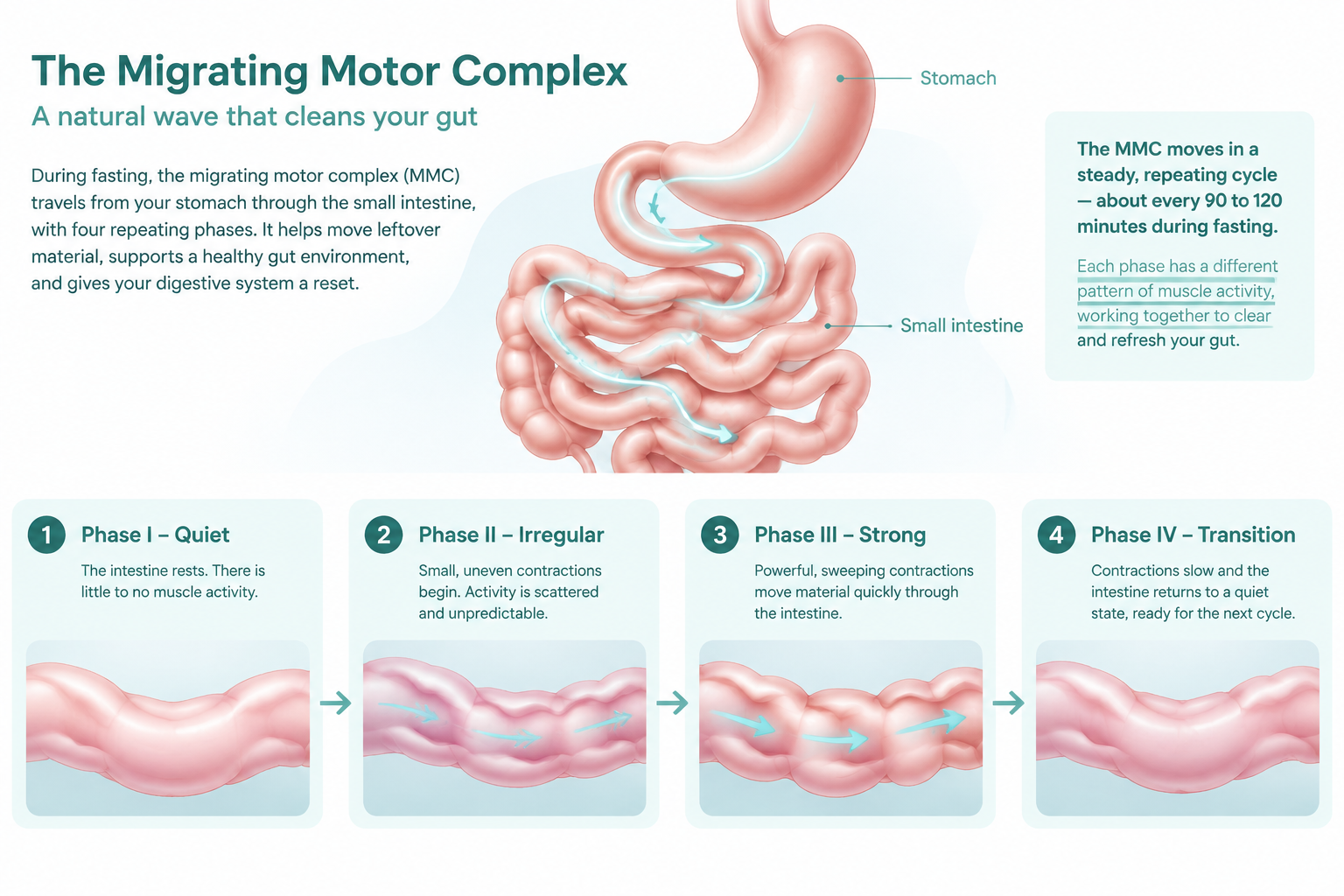
The migrating motor complex (MMC) is a repeating pattern of electrical signals and coordinated smooth-muscle contractions that moves through the stomach and small intestine between meals. If you are wondering what is the migrating motor complex, “migrating” means this activity travels along the upper digestive tract rather than staying in one spot. Researchers named it after observing these waves move along the bowel (Nat Rev Gastroenterol Hepatol 2012 review of the migrating motor complex).
A key migrating motor complex function is its role as the housekeeper of the gut. During fasting, it helps move leftover food particles, digestive fluids, shed cells, and other material toward the colon, helping prepare the stomach and small intestine for the next meal. This is normal digestive housekeeping, not a cleanse, cure, or sensation you should expect to feel.
Migrating motor complex fasting activity differs from the contractions that follow a meal. After eating, the stomach and small intestine mainly mix food with digestive juices and move it forward for digestion, but once caloric intake has stopped, the MMC becomes more relevant. A digestive system overview can help place this between-meal pattern in the larger process of digestion.
Cycles often recur every 90 to 120 minutes during sustained fasting, although this is not a personal timer. Timing can differ from person to person and from one cycle to another (J Smooth Muscle Res 2013 review of the migrating motor complex). The migrating motor complex phases follow a four-part pattern:
- Phase I: A relatively quiet period with little contraction.
- Phase II: Irregular contractions begin and gradually become stronger.
- Phase III: A brief wave of strong, regular contractions does much of the sweeping.
- Phase IV: A short transition returns the gut to Phase I.
These phases help explain how the MMC works between meals. Normal fasting motility may also help limit bacterial buildup by moving residual material and excess bacteria onward. Still, altered MMC activity is only one association with small intestinal bacterial overgrowth (SIBO), small intestinal fungal overgrowth (SIFO), gastroparesis, irritable bowel syndrome (IBS), and functional dyspepsia. Gastroparesis can involve delayed stomach emptying from disrupted stomach contractions, but the MMC does not by itself explain an individual’s bloating, constipation, or discomfort. Persistent symptoms deserve medical evaluation.
How Does the MMC Work Between Meals?
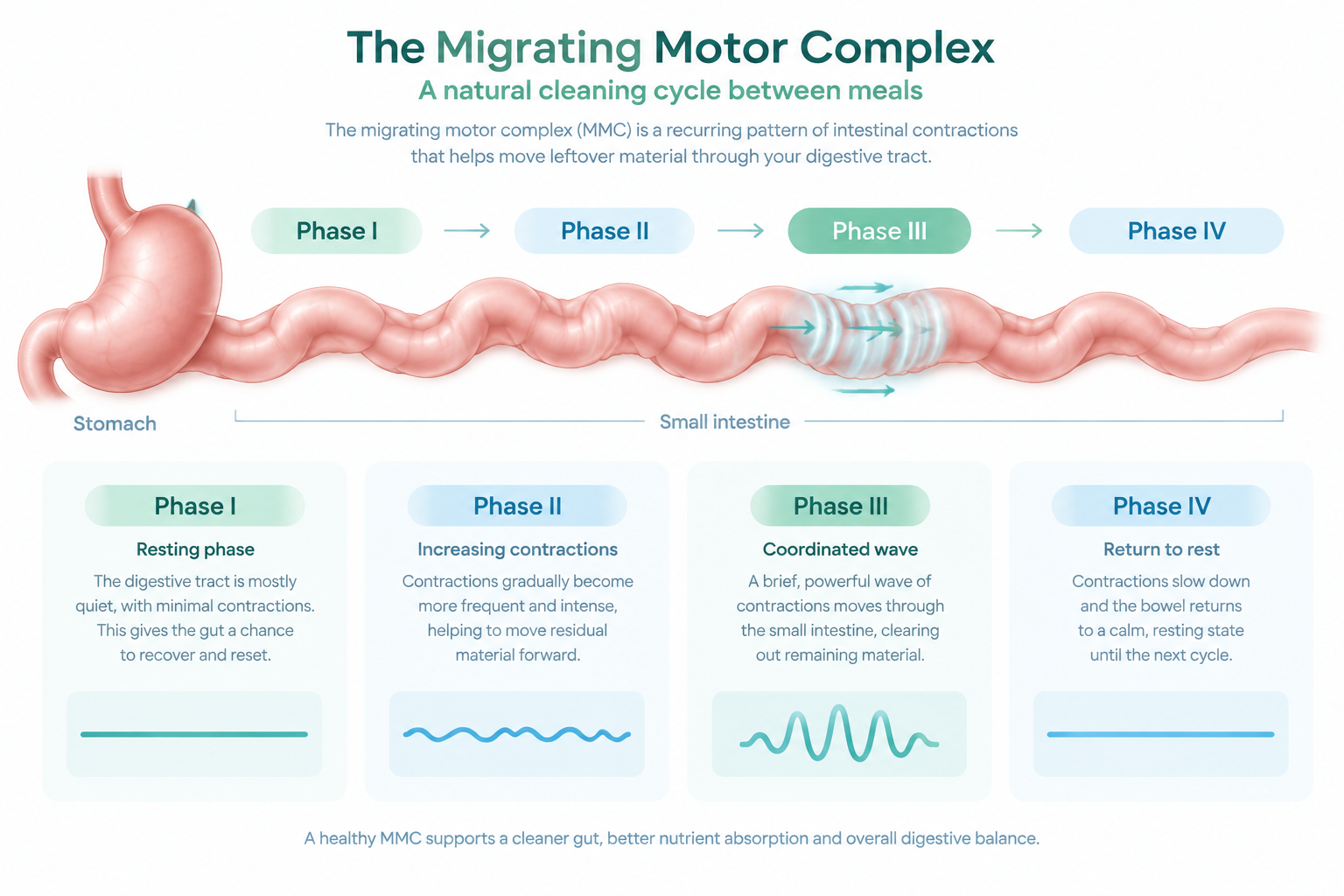
In that between-meal role, the MMC is a repeating fasting rhythm, not a nonstop gut-cleaning system. After digestion settles, the stomach and small intestine cycle through four migrating motor complex phases before the pattern begins again. This interdigestive motility, paced by the interstitial cells of Cajal and coordinated through the myenteric plexus and the vagus nerve, varies with recent food intake, sleep, stress, illness, and individual physiology, so it does not run on a personal meal-timing stopwatch.
The cycle follows a general pattern:
- Phase I resting MMC: Smooth muscle is mostly quiet, with rare contractions and little electrical spike activity. This long, calm stretch is normal during fasting, not a sign that your digestive tract has stopped working.
- Phase II: Irregular contractions gradually become stronger and more frequent. They can start moving leftover fluid and gas, although the movement is less coordinated than in the next phase and often goes unnoticed.
- Phase III active phase: Rapid, evenly spaced, high-amplitude contractions move in a coordinated wave from the stomach through the small intestine. When the pylorus, the opening between the stomach and small intestine, is open, this wave moves residual contents downward. Phase III lasts only minutes. It does not clear out everything or guarantee that bloating, constipation, or discomfort will not occur.
- Phase IV: This brief transition shifts the gut from Phase III’s organized contractions back to the quietness of Phase I.
The stronger contractions of Phase III can produce borborygmi, the audible rumbling often linked with hunger. A noisy stomach after a longer break between meals can be normal and does not, on its own, point to poor motility or SIBO.
Motilin, a hormone released from the duodenum and upper small intestine during fasting, rises before Phase III and helps coordinate its contractions. Ghrelin, vagal signaling, and the enteric nervous system, the nerve network within the gut, also help shape the pattern.
What Happens to the MMC When You Eat?
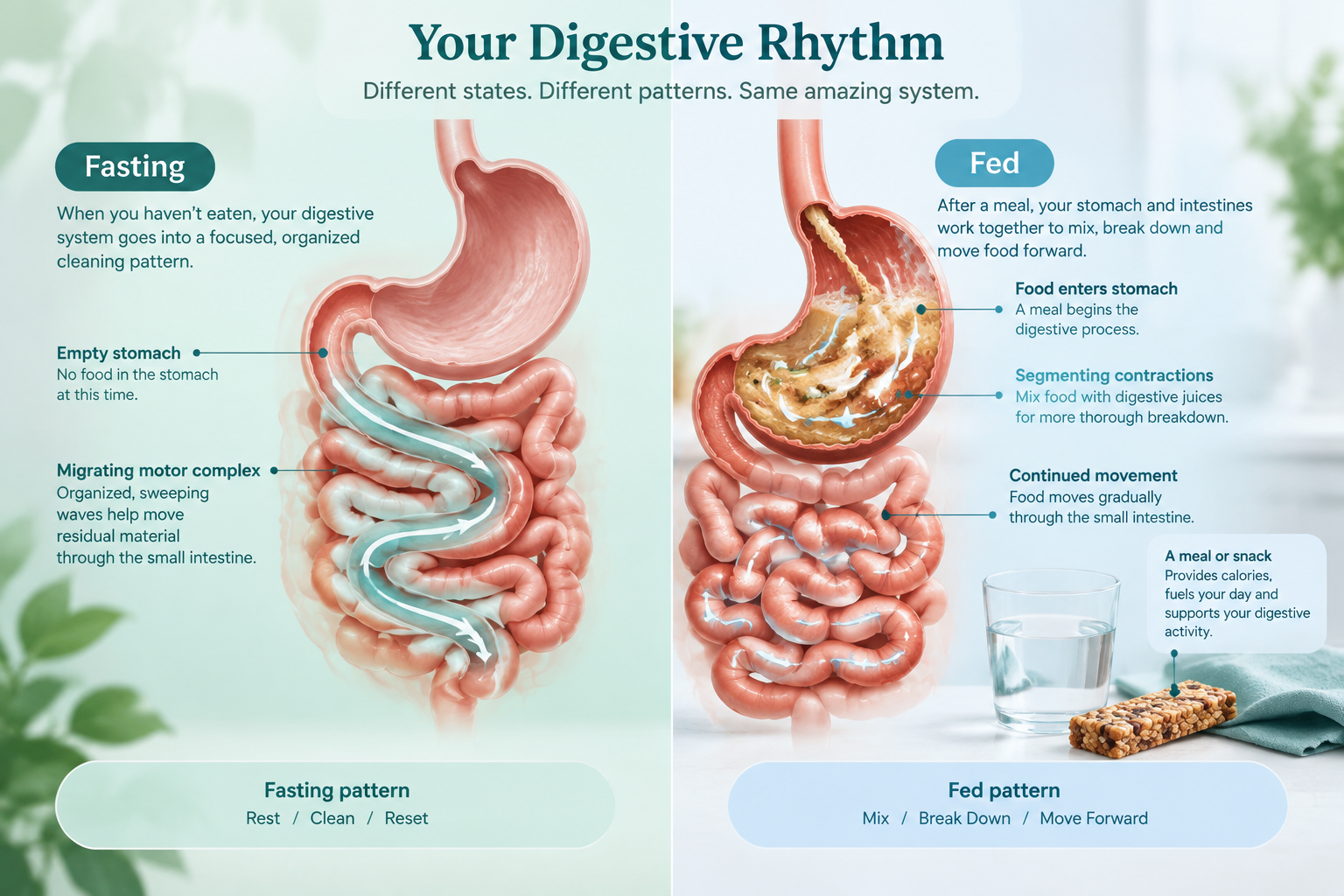
That fasting rhythm changes when eating, including most caloric drinks, shifts your digestive tract from its fasting cleanup pattern to a fed pattern within minutes. The MMC pauses while gastric emptying gets under way, and slower segmenting contractions take over. These contractions mix food with digestive enzymes to support digestion and absorption instead of sweeping material onward. This is the key difference in the fed state vs fasting state described in a Journal of Smooth Muscle Research review.
The fed pattern continues while your stomach and small intestine are processing a meal. That helps explain why grazing interrupts the MMC: each snack or calorie-containing drink can restart fed-mode activity before a longer fasting interval begins. Eating something every hour may therefore leave little uninterrupted time for the MMC to return.
This can be relevant during packed workdays when coffee with add-ins, a snack bar, and small bites replace more distinct meals. Snacks may still be appropriate when hunger, medical needs, or your schedule call for them, but recognizing the pattern can help you notice whether frequent eating lines up with discomfort or bloating.
Food also affects the large intestine through a separate response. Stomach stretching after a meal contributes to how eating triggers the colon, which may help explain the urge to have a bowel movement after eating.
Meal spacing is only one part of digestive comfort, yet it can make day-to-day symptom patterns easier to interpret.
How Can You Space Meals Realistically?

Given that each meal starts normal fed-state digestion, meal spacing works within normal fed-state digestion. Nerve signals and hormones, including gastrin and cholecystokinin, coordinate food processing. Meal spacing and digestion are not about avoiding food, but simply leave uninterrupted time for fasting-pattern small intestine motility to return after food clears.
Grazing and digestion can affect that timing. Frequent snacks, caloric drinks, or repeated small bites can reduce the longer breaks that support meal spacing. A single snack does not harm digestion, and there is no universal calorie cutoff. The overall pattern matters more than tracking every bite.
A three-to-five-hour gap between meals can be a flexible starting point, not a prescription. MMC cycles vary, and fasting-pattern activity takes time to resume. Build a rhythm around hunger, work shifts, family meals, exercise, medications, and enough nourishment. Realistic options include:
- Regular meals: Breakfast, lunch, and dinner with fewer unplanned snacks can naturally create daytime breaks.
- A planned snack: An afternoon snack may better support a long workday, exercise, or genuine hunger than trying to push through it.
- An evening routine: Eating close to bedtime may be worth reconsidering when a bedtime snack is habitual rather than hunger-driven.
An overnight food-free window is optional, not a test of willpower. Finishing dinner earlier or skipping an automatic bedtime snack may allow several fasting cycles to occur, and water generally fits that break. A strict overnight fast of a set length is unnecessary for many people. Pregnancy, recovery, certain medical conditions, medications, and a history of disordered eating can make fasting inappropriate. Skipped meals and digestion are different from intentional meal spacing.
Ghrelin, a hormone linked with hunger, may help coordinate fasting motility and hunger sensations. Still, meal timing is not a proven treatment for SIBO, IBS, or other digestive diseases, and symptoms cannot reliably show how well your MMC is working. Persistent symptoms warrant care.
Conditions that slow gut motility, including diabetes, hypothyroidism, and Parkinson's disease, can weaken the MMC, sometimes called interdigestive dysmotility, and MMC dysfunction is one proposed reason bacteria accumulate in SIBO. Meal spacing supports the pattern but does not treat those conditions.
Migrating Motor Complex FAQs
These FAQs explain the migrating motor complex, the factors that may influence it, and why meal timing can come up when you have digestive symptoms. They also distinguish established digestive physiology from questions worth discussing with a healthcare professional.
1. What Triggers the Migrating Motor Complex?
Fasting is the main trigger for the migrating motor complex. Once your stomach and small intestine have finished processing a meal, motilin released by cells lining the upper small intestine rises, peaking before the Phase III active phase and helping prompt its strong sweeping contractions. Eating, especially fat or glucose, lowers motilin. Ghrelin, a hunger-linked hormone, may also support between-meal activity in the upper digestive tract, but hunger alone does not show whether your motility pattern is normal.
2. How Long Does the MMC Last?
The MMC usually repeats during fasting about every 90 to 120 minutes, as the J Smooth Muscle Res 2013 review notes, though its timing can vary substantially, even for the same person on different days. Phase III is only the brief sweeping portion of that larger cycle, with the strongest coordinated contractions moving through the stomach and small intestine for minutes. This difference helps put meal spacing and digestion into perspective.
3. Does Drinking Water Interrupt the MMC?
Plain, still water generally does not interrupt the fasting MMC because it has no calories. Meals shift small intestine motility into a fed pattern through signals such as gastrin and cholecystokinin. Drinks containing milk, sugar, fat, protein, sweeteners, caffeine, or carbonation may affect symptoms differently. The enteric nervous system and gut-brain axis also influence gut transit time, including in people concerned about small intestinal bacterial overgrowth. Follow any fasting instructions from your clinician.
4. What Can Disrupt the Migrating Motor Complex?
The gut-brain axis, metabolic conditions, a recent gastrointestinal infection, and digestive diseases that affect nerves or muscles can alter MMC activity. When Phase III activity is reduced or absent, food residue, waste, and microbes may remain longer in the small intestine, where fermentation can add gas and discomfort. Still, the connection between the migrating motor complex and SIBO does not identify the cause of your symptoms.
Bloating, nausea, abdominal pain, early fullness, constipation, diarrhea, and mixed bowel habits can also occur with IBS, functional dyspepsia, gastroparesis, and SIFO. If symptoms persist or interfere with eating, clinical context matters more than trying to determine how to support the migrating motor complex on your own.
5. Can You Improve Your Migrating Motor Complex?
Regular meal gaps may allow interdigestive motility and migrating motor complex function, but self-care cannot repair it. To support the migrating motor complex, choose timing that fits hunger, work, medicines, nutrition, and disordered-eating history while avoiding prolonged fasting or rigid rules that worsen symptoms or anxiety.
Migrating motor complex and SIBO are not a diagnosis: reduced clearing may be associated with small intestinal bacterial overgrowth, but symptoms overlap with IBS, gastroparesis, and functional dyspepsia. For diagnosed conditions, clinicians may use prokinetics such as low-dose erythromycin based on condition, medicines, and risks. Ginger, artichoke leaf extract, naltrexone, and lifestyle changes have limited condition-specific evidence and cannot independently treat suspected SIBO, gastroparesis, IBS, or functional dyspepsia.