


A heating pad is usually the first thing people reach for during an IBS flare, and it does help. What most advice skips is that the pad you’ll find at the top of every best-seller list is 12 by 24 inches and designed for backs and shoulders. Over a lower abdomen it overhangs your hips, slides off unless you’re lying down, and heats a lot of skin that doesn’t need it.
So this guide starts with fit rather than popularity. Belted wraps, cordless abdominal belts, adhesive patches, microwaveable packs and large plug-in pads each suit a different moment, and the one that matters most for a workday or a classroom is the one no roundup mentions.
It also covers the safety limits properly. Fifteen to twenty minutes, a barrier between the pad and your skin, and never falling asleep with an electric one on. There’s a specific reason for those rules that most articles leave out: repeated exposure to heat that never feels hot enough to burn can still mark your skin permanently, and because it’s painless, people don’t notice it happening.
The rest is a short flare routine you can actually repeat, and the symptoms that mean you should stop reaching for heat and call someone instead.
Heating Pads for IBS Key Takeaways
- Heating pads may temporarily ease familiar IBS cramps, bloating pressure, and abdominal discomfort.
- Use the lowest comfortable setting with a towel or clothing barrier.
- Limit each heating session to about 15 to 20 minutes.
- Choose belted or cordless formats for upright use and large pads for resting.
- Never sleep with an electric heating pad turned on.
- Stop when skin becomes red, painful, numb, itchy, or blistered.
- Seek medical care for severe, worsening, unfamiliar, or persistent abdominal pain.
Can Heating Pads Ease IBS Cramps?
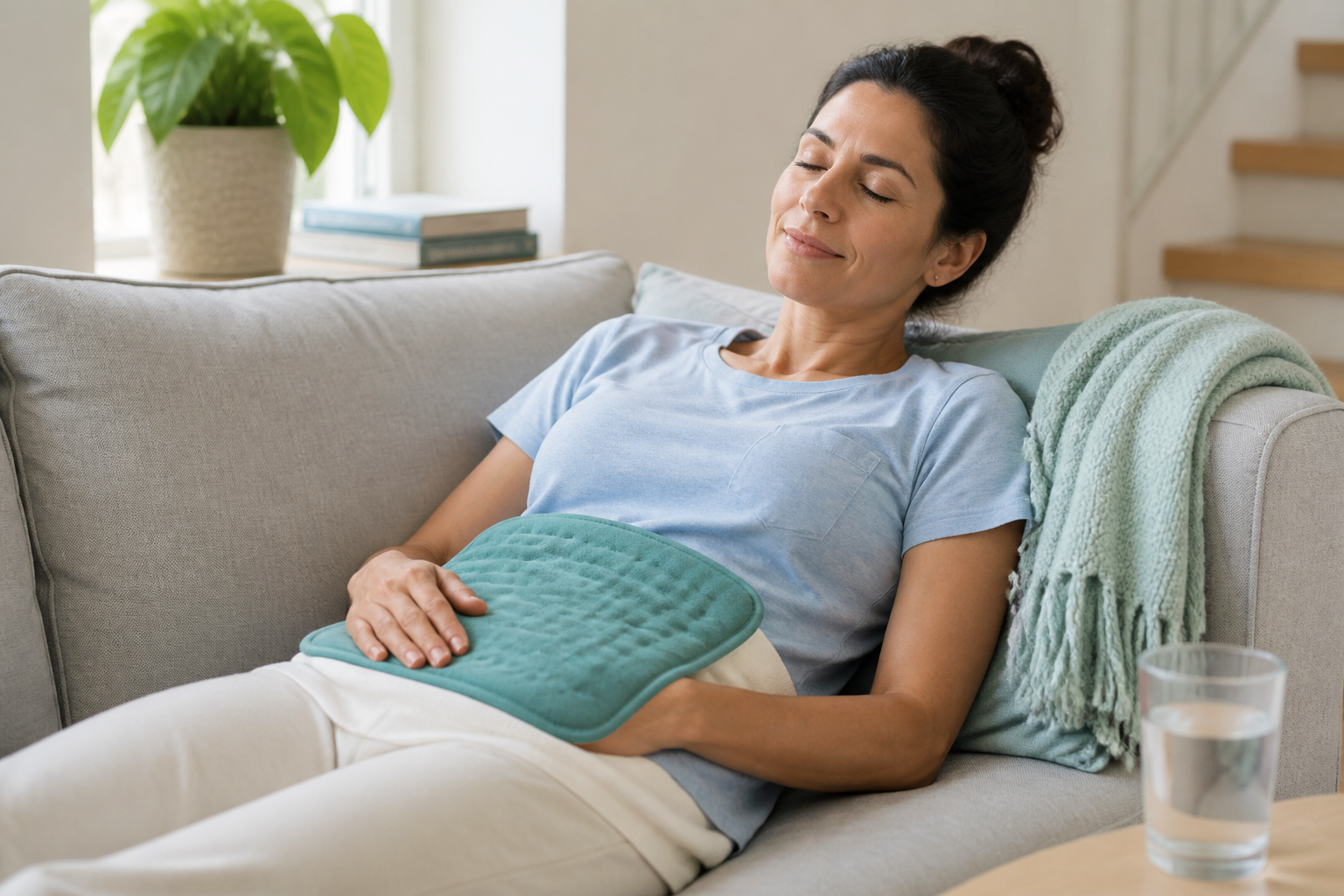
Yes. A heating pad can provide immediate, temporary, drug-free comfort during an irritable bowel syndrome (IBS) flare. Warmth may ease abdominal pain, cramping, and pressure related to bloating, helping you continue work, rest, or daily plans with less disruption. It is not a cure. Results vary, relief usually lasts during use and briefly afterward, and heat won’t prevent future flares.
Heat may relax tight or spasming abdominal muscles. Steady warmth can also offer a calming sensory distraction when your abdomen feels clenched. It may reduce discomfort without addressing the cause of bloating, constipation, diarrhea, or other digestive symptoms. A broader plan for managing IBS symptoms may include several types of care.
During an active flare, use the lowest effective heat and keep each session brief:
- Choose the lowest setting that feels comfortably warm.
- Place a towel or clothing layer between your skin and the heating pad or hot-water bottle.
- Limit use to about 15 to 20 minutes, then check your skin before another session.
Heating pads and hot water bottles work well at home, while a discreet pad may fit better into a workplace or classroom routine. Heat can support comfort during a flare, but it shouldn’t replace care for ongoing symptoms.
Safety note: Stop if your skin becomes red, painful, numb, or blistered. Seek medical advice for persistent, severe, or worsening symptoms.
Which Heat Format Fits Your Day?
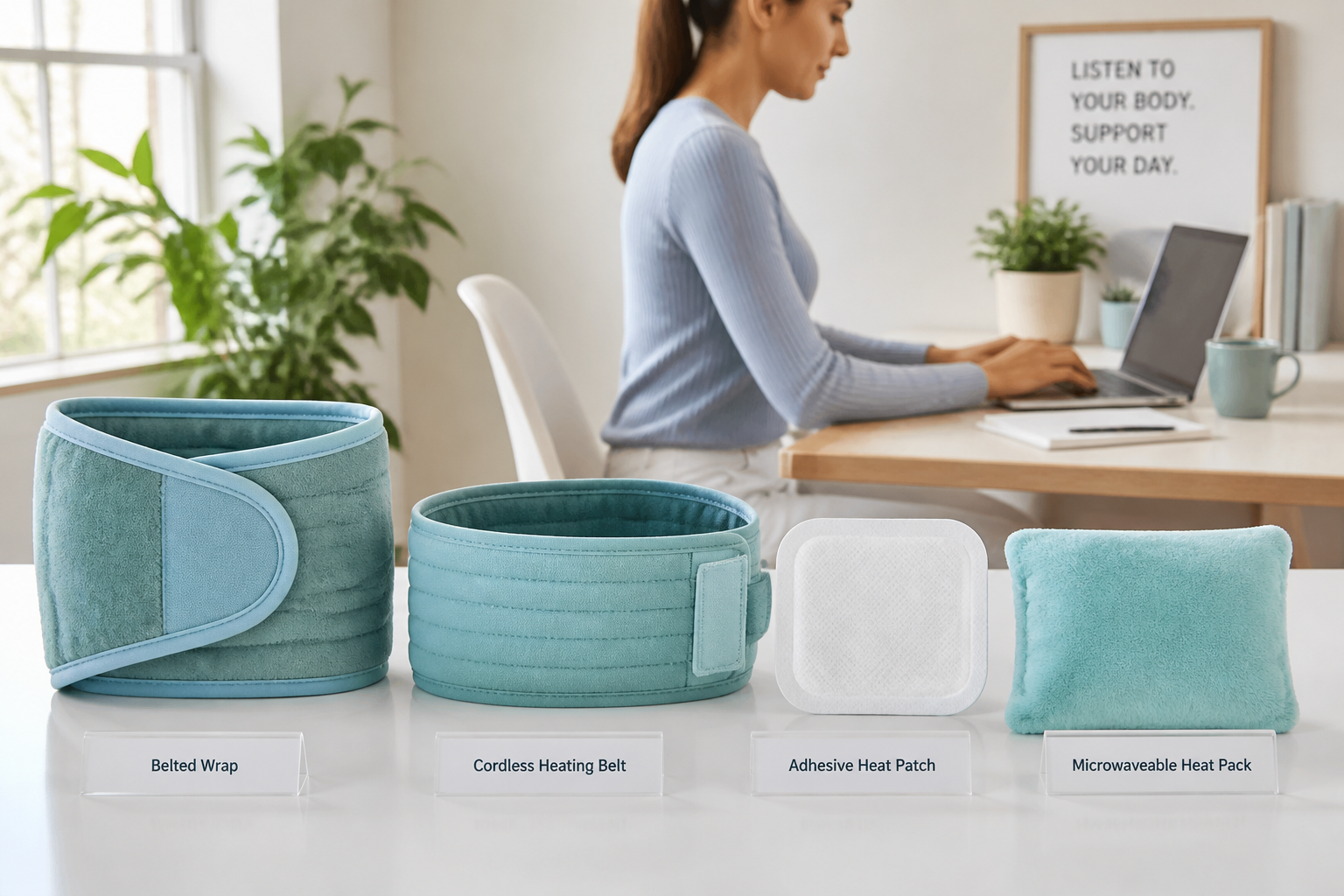
The right format depends on where you need warmth and how much you plan to move. Many popular electric heating pads are 12 by 24 inches or larger, with shapes made for backs and shoulders. Over your lower abdomen, that size may hang over your hips, shift unless you lie down, and heat skin beyond the cramping area. For IBS cramps, a belted wrap, abdominal belt, or adhesive patch often fits better than a larger pad.
Format | Best for | Trade-off |
|---|---|---|
Wrap-around belted pad | Working or resting while sitting upright | Hands-free and held against the abdomen, but it still needs an outlet |
Cordless rechargeable belt | Commuting, errands, and work | Portable and discreet, but usually less intense than plug-in heat and requires charging |
Adhesive single-use wrap | Discreet wear under clothing | Slim and cord-free, but single use creates a recurring cost |
Microwaveable flaxseed or rice pack | Bedtime or places without power | Molds to the abdomen, but warmth fades and requires reheating |
Large plug-in pad | Resting at home while lying down | Consistent, adjustable heat, but the shape suits backs more than abdomens |
Hot water bottle | Resting with traditional, adjustable warmth | Needs hot water, may leak if damaged, and is less practical while moving |
Here are specific options in each category, ordered by how well they fit abdominal cramps rather than by popularity:
Product | Format | Rating | Why it fits |
|---|---|---|---|
Belted wrap | 4.8 stars, ~101 reviews | Six heat levels, four timers, auto shut-off. The belt holds warmth against your abdomen while you sit upright | |
Belted wrap | 4.6 stars, 500+ reviews | Same belted design with a longer track record | |
Cordless belt | 4.4 stars, 4,400+ reviews | Shaped for the belly and the most-reviewed cordless option | |
Cordless belt | 4.2 stars | Covers belly and back, and is listed as FSA and HSA eligible | |
Adhesive wrap | 4.4 stars, 4,500+ reviews | Up to eight hours under clothing with no cord, battery, or bulk | |
Microwaveable | 4.6 stars, 5,700+ reviews | Unscented, molds to the abdomen, and carries no electrical risk | |
Large plug-in | 4.3 stars, 69,600+ reviews | Best-selling option, useful if you also want heat for back or neck | |
Large plug-in | 4.1 stars, 18,900+ reviews | Same 12 by 24 inch size, longer-established brand |
A few notes on that list. The belt is the feature that matters most for cramps, because a flat pad slides away when you work, read, or rest upright. FSA and HSA eligibility is worth checking, since most people don’t realize heat therapy can qualify. The microwaveable pack is the only format that isn’t a hazard if you fall asleep with it. And both large plug-in pads are good products that are simply bigger than this job needs.
Choose a belted or cordless format when warmth needs to stay put while you’re upright, adhesive heat when discretion matters, a microwaveable pack when there’s no outlet or you’re winding down, and a large plug-in pad when you’re resting at home. Heat can help manage cramps, but results vary by person, and the same skin protection, timing, and stop-use rules apply to every format.
How Can You Use Heat Safely?
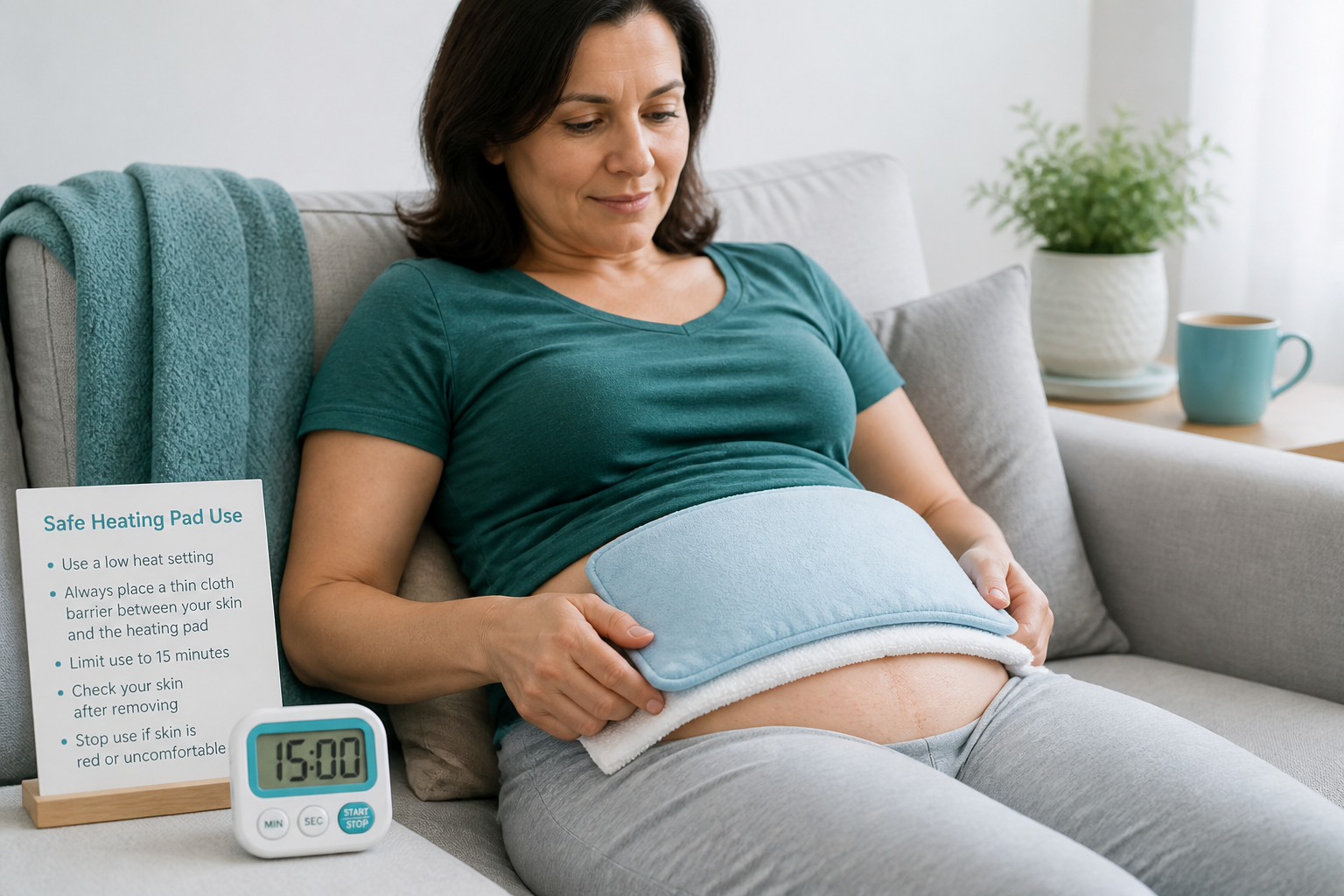
Heat may temporarily ease familiar IBS cramps, but it cannot explain new pain or replace medical care. Begin with a low setting, a short session, and a barrier between your skin and the heat source.
Use this safety-first routine:
- Create a barrier: Place a thin towel or clothing layer between your skin and a heating pad or hot-water bottle, and choose the lowest setting that feels comfortable.
- Place it gently: Rest the heat source over the lower abdomen where cramping occurs. Don’t press it tightly into your stomach or lie on top of it. Remove or reposition it if nausea, bloating, or discomfort increases.
- Set a time limit: Start with 15 to 20 minutes, then remove the heat and let your skin cool before trying another session. Several short periods are safer during a flare than continuous heat.
- Check your skin: Stop if the area becomes red, sore, itchy, or unusually warm. Irritation and low-temperature burns can develop before the heat itself feels dangerous, which is why you check rather than wait.
- Stay awake: Never sleep with a heating pad turned on, even if it has an automatic shut-off feature. While asleep, you may not notice overheating, shifted placement, or skin irritation.
Equipment choice affects safety as well:
Format | Practical safety point |
|---|---|
Electric heating pads | Choose a dry, undamaged pad with an automatic shut-off feature, and inspect the cord before each use. |
Microwaveable heat packs | These remove electrical risk if falling asleep is a concern, but they still require a barrier, skin checks, and time limits. |
Repeated, prolonged exposure creates another risk called erythema ab igne, also known as toasted skin syndrome. Warm temperatures below the usual burn threshold, roughly 43 to 47 degrees Celsius, may cause blotchy pink patches that develop into a brown, net-like pattern. Heating pads and hot-water bottles are common sources, along with heated car seats and laptops (source). StatPearls describes the same condition as a result of repeated heat exposure (source).
This skin change is often painless, so waiting for discomfort isn’t reliable. A published case involved hot-water bags used for severe abdominal pain. Mottled, darkened skin spread across the patient’s abdomen, and although the pigmentation decreased after heat was stopped, visible changes remained years later (source). Another report linked the condition to heating-pad use for chronic pain (source). The risk comes from repeated exposure rather than one session, and it is avoidable with a barrier and time limits. Some clinicians advise sessions of no more than 30 minutes, which supports the 15-to-20-minute starting point (source).
Skip heat for abdominal pain during pregnancy or over areas with reduced sensation, open wounds, rashes, or swelling. Diabetes and neuropathy can make it harder to feel a burn developing, so skin checks matter even when the heat seems mild. Persistent, severe, or worsening symptoms need evaluation by a qualified healthcare professional.
How Do You Build a Flare Routine?
A flare routine is a short, repeatable comfort sequence that may provide temporary relief, but it does not cure IBS. Painful spasms in intestinal smooth muscle can cause cramps. Localized warmth may help by relaxing those muscles, increasing blood flow, and dampening some pain signals from the skin and abdominal wall.
Begin with heat applied to the specific area that aches rather than covering a broad stretch of your abdomen. Place a heating pad, heat pack, or hot-water bottle over that spot, use a thin cloth barrier, and select the lowest comfortable setting.
A calm routine can follow these steps:
- Use short sessions: Apply heat for 15 to 20 minutes. Short exposures lower the risk of skin irritation and low-temperature burns, and more heat is not necessarily more helpful.
- Reassess between sessions: Remove the heat and check for lasting redness, tenderness, or worsening discomfort. Note whether the cramp is improving, unchanged, or worsening. If severe cramps return, take a break and use another short session rather than one prolonged one. Never sleep with an active electric heating pad.
- Choose movement or rest: A slow walk or easy stretch may relax tight muscles in the gastrointestinal tract and ease body tension when movement feels comfortable. Rest instead if pain, nausea, or dizziness increases.
- Add a soothing pause: Sip a non-caffeinated tea you already tolerate, such as peppermint, ginger, fennel, or chamomile, while breathing slowly and steadily. Skip any tea that triggers reflux, bloating, or another symptom. These options sit alongside other non-drug approaches for IBS.
- Track the flare: Record pain location and severity, bowel changes, recent foods or drinks, sleep, stress, and which comfort steps helped. Patterns make future conversations with a clinician more useful.
Stop heat immediately if it feels too hot, changes your skin, or worsens discomfort, and seek medical care for severe, persistent, or worsening abdominal pain.
Keep the routine simple enough for a busy morning, workday, or classroom break. Each session should be a gentle check-in with your body, not a test of endurance.
When to Use Heat for IBS Cramps
Heat is one of the few IBS comfort measures where individual routines differ more than the evidence does. The mechanism is simple and the same for everyone – what varies is when and where people actually reach for a heating pad.
Two patterns come up most often. The first is nighttime, when cramps make it hard to settle, and a low setting for a short period before bed becomes part of a wind-down routine. The second is the workday, where the problem isn’t only pain but visibility: a cord and a bulky pad aren’t practical in a meeting or a classroom, which is why the adhesive and cordless formats above exist.
Neither pattern makes heat more effective. Both change whether you’ll actually use it. A pad that only works when you’re lying down at home is no help during the hours when a flare is most disruptive, and that practical gap matters more than a heat setting.
Whatever routine you settle into, the limits stay the same. Keep a layer of fabric between the heat source and your skin, hold sessions to about 15 to 20 minutes, and check the skin afterward rather than waiting for it to hurt.
Stop if your skin becomes painful, numb, or unusually red. Seek medical care for severe or worsening pain, repeated vomiting, blood in your stool, fever, fainting, or symptoms that feel different from your usual IBS pattern. Temporary comfort is useful, but unfamiliar or persistent symptoms need evaluation.
When Should Abdominal Pain Get Medical Care?
Heat can be a reasonable comfort measure during a familiar, mild-to-moderate IBS flare, especially when abdominal pain improves after a bowel movement. A heating pad may ease cramps, bloating, and discomfort related to constipation or diarrhea, but it doesn’t treat the underlying cause or eliminate IBS pain.
Try heat briefly and pay attention to how your body responds. Urgent assessment matters more than comfort measures when you have:
- Sudden or severe pain: Pain that is steadily worsening or sharply focused in one area.
- Major abdominal changes: A rigid or markedly swollen abdomen.
- Whole-body warning signs: Fainting, confusion, or trouble breathing.
A previous IBS diagnosis doesn’t make every new symptom IBS. Don’t let a heating pad delay urgent care when symptoms are severe, unfamiliar, or rapidly changing.
Prompt medical advice is also appropriate for:
- Fever, repeated vomiting, or an inability to keep fluids down
- Blood in vomit or stool, or black, tarry stools
- Yellowing of the skin or eyes
- Unexplained weight loss
- A major new change in bowel habits
Use the “different from usual” rule for symptoms that don’t fit your normal flare pattern. Contact a qualified healthcare professional if pain persists, wakes you from sleep, becomes more frequent or disruptive, or remains unchanged after a cautious 15-to-20-minute heat session. A comparison of IBS medicines may help you discuss additional options with a clinician.
Familiar, mild symptoms may support a short heat session. Severe or unusual symptoms need professional evaluation first.
Heating Pads for IBS Cramps FAQs
These FAQs cover common questions about heating pads for IBS cramps, including comfort, safe use, timing, and how heat may fit into your personal flare-care routine.
1. Can Heat Help IBS-Related Lower Back Pain?
Yes. Heat may offer temporary comfort when an IBS flare causes lower back aching, muscle tightness, or abdominal cramps. Warmth can increase local blood flow and relax stiff muscles, which may ease discomfort around your low back and abdomen, while a heating pad can be a soothing option for mild, familiar pain, especially when back tension worsens with cramping. It does not treat the underlying cause of IBS. New, severe, persistent, or worsening back pain needs evaluation by a qualified healthcare professional rather than being assumed to come from IBS.
2. Can Heating Pads Worsen IBS Bloating?
Using a heating pad for IBS bloating typically doesn’t worsen bloating itself. Gentle warmth may increase blood flow around your abdomen and relax tight muscles, easing spasms and making pressure or trapped gas more manageable. Heat can lessen the sensation of bloating, but it won’t remove gas or address the cause of a flare.
Stop relying on heat alone if your abdomen becomes more swollen, fullness worsens, or pain differs from your usual IBS symptoms. Seek guidance for persistent, severe, or worsening symptoms.
3. Can You Use Heat During an IBS Migraine?
Yes, you can use heat therapy for IBS cramps during a migraine-like episode to ease abdominal discomfort temporarily, but it won’t treat the migraine. Place a cloth barrier between your skin and the heating pad, use a low or moderate setting for a limited session, and check for redness or burning. Stop if heat worsens nausea, dizziness, or overall discomfort. Never fall asleep with an electric heating pad switched on, even when migraine fatigue makes rest tempting.
4. Can Heating Pads Help IBS Constipation Cramps?
A heating pad may offer temporary comfort for IBS cramps when constipation causes abdominal tightness, bloating, trapped gas, or spasm-like pain. Gentle warmth can increase local blood flow and relax tense abdominal and digestive tract muscles, but it won’t treat constipation or promise a bowel movement.
Sip fluids and take a short, easy walk if you feel able. Use comfortable heat with a cloth barrier, and stop if irritation or worse discomfort develops.
This content is for educational purposes only and is not a substitute for personalized medical advice. Digestive symptoms can have many causes, and results vary by person. Consult a qualified healthcare professional for persistent, severe, or worsening symptoms, and before using heat if you are pregnant or have reduced skin sensation.