


Your prescription is half finished and your stomach has started to protest. Taking a probiotic alongside antibiotics turns out to be the one use with genuinely solid evidence behind it. Across 17 randomized trials in outpatients, diarrhea showed up in 8.0% of people taking a probiotic compared with 17.7% of those who weren't.
Three separate questions get tangled together here. Preventing diarrhea during the course, easing symptoms once you've finished, and rebuilding your gut bacteria are distinct claims with distinct evidence, and only the first is well supported. No product has been shown to restore the microbial community an antibiotic disrupted.
Timing matters more than most labels admit. Bacterial strains need at least two hours of distance from each antibiotic dose, while Saccharomyces boulardii is a yeast and generally doesn't.
Key Takeaways
- Preventing diarrhea during antibiotics is the best-supported use of probiotics.
- Lactobacillus rhamnosus GG and Saccharomyces boulardii have the most consistent findings.
- Easing symptoms afterward and restoring the microbiome are separate, weaker claims.
- No probiotic has been shown to rebuild your pre-antibiotic microbial community.
- Keep bacterial probiotics at least two hours away from each antibiotic dose.
- Saccharomyces boulardii is a yeast, so that spacing generally does not apply.
- Watery diarrhea with fever or cramping may signal C. difficile and needs testing.
How Do Antibiotics Affect Your Gut?
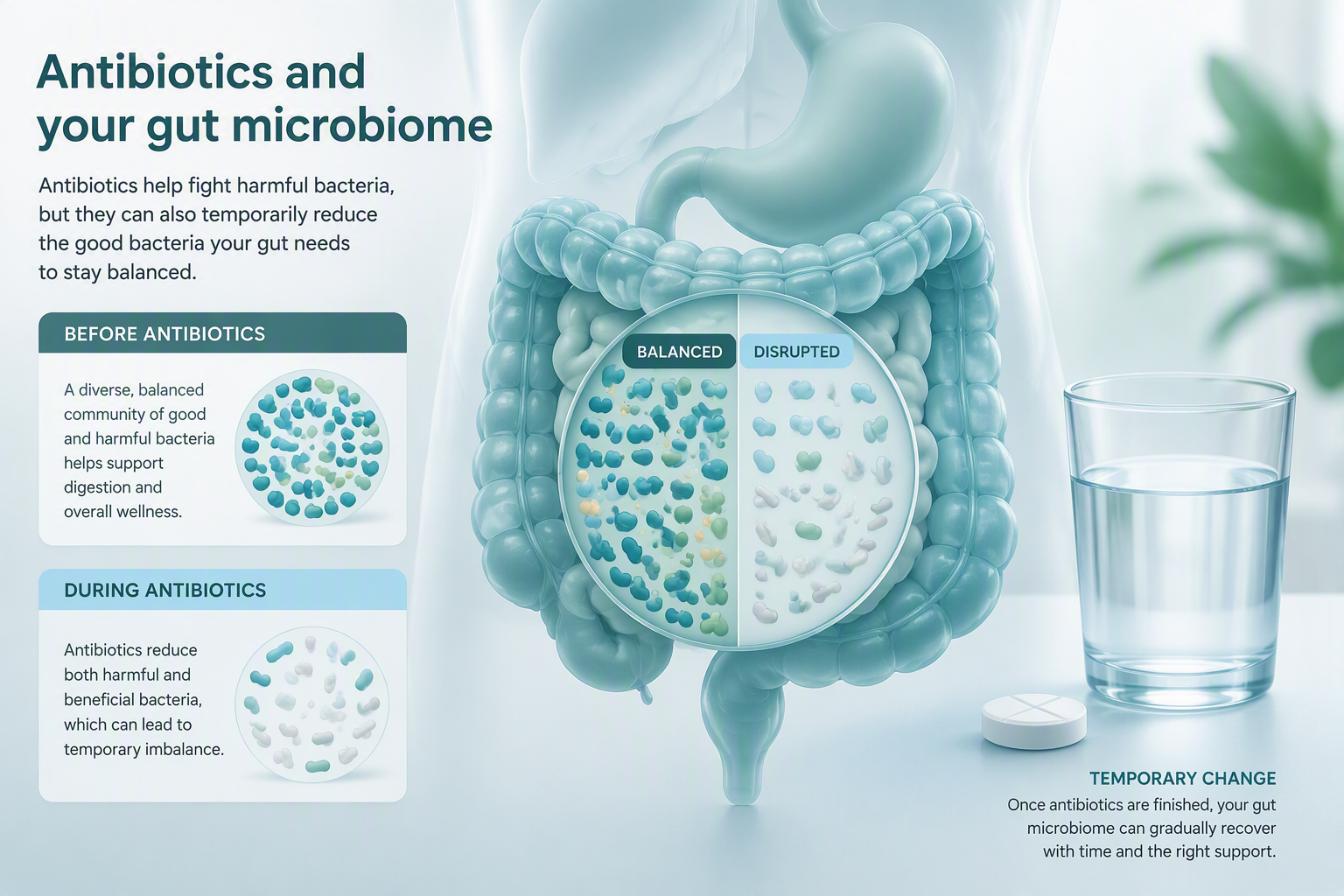
Antibiotics treat bacterial infections, but they cannot fully tell harmful germs apart from the beneficial gut bacteria that live in your digestive tract. As a result, they can temporarily alter the gut microbiome, including commensal bacteria that help with digestion, nutrient processing, and immune signaling.
This temporary imbalance is known as antibiotic-associated dysbiosis. Broad-spectrum antibiotics, higher doses, and longer courses may cause more noticeable changes, though your response also depends on your health history and prior antibiotic use. Do not stop a prescribed antibiotic because of digestive symptoms without speaking with the clinician who prescribed it.
Common antibiotic side effects may include:
- Looser stools or sudden urgency to use the bathroom.
- Bloating, gas, cramping, or nausea.
- Constipation or a bowel pattern that differs from your usual routine.
These symptoms can be disruptive at work, at home, or while caring for family. They are often temporary and do not automatically mean permanent gut damage. When protective microbes are reduced, organisms that are usually kept under control may have more opportunity to multiply.
Antibiotic-associated diarrhea is a common side effect, and how often it happens varies with the antibiotic used and the population treated. It is often mild and settles after treatment ends or soon afterward. A more serious concern is infection with Clostridioides difficile, also called C. difficile, which can develop when protective bacteria are lost.
Contact a healthcare professional promptly for warning signs such as:
- Frequent or severe watery diarrhea.
- Significant abdominal pain or fever.
- Signs of dehydration, including dizziness, very dark urine, or trouble keeping fluids down.
- Diarrhea that persists, worsens, or occurs during or soon after antibiotic treatment.
The gut microbiome often starts rebalancing after treatment, but recovery has no fixed timeline. Antibiotic type, course length, diet, overall health, and repeated exposure all matter. No single food or supplement can restore every changed microbe.
Questions about probiotics for gut problems are understandable, but the right choice depends on your symptoms and health history.
Which Probiotic Goal Fits Your Situation?
Probiotics after antibiotics can serve three very different purposes, and each calls for different evidence. The key question is whether a named strain has human evidence for your specific goal, not whether a bottle lists a high colony-forming unit (CFU) count or many bacteria.
Those goals include:
- Reducing diarrhea risk during treatment: Probiotics and antibiotics may be used together to lower the chance of antibiotic-associated diarrhea while you take the medication. Probiotics for antibiotic-associated diarrhea are not intended to rebuild your usual gut community. The next section covers the probiotic strains with the most consistent findings for this narrow purpose.
- Supporting symptoms after treatment: Persistent diarrhea, constipation, gas, or bloating deserve a symptom-based approach. Probiotic supplements may be part of a conversation with a healthcare professional, but the appropriate next step depends on the symptom, its severity, and your medical history rather than the antibiotic course alone.
- Returning to your prior microbial community: Gut microbiota reconstitution refers to the return of the bacteria and other microbes that were present before antibiotics. That process is more complicated than adding bacteria from a capsule. A 2018 human study found that supplementation delayed, rather than sped up, the return of the native community in some participants.
This does not mean probiotics are harmful or never useful. It does mean that “restoring the gut” is too broad a promise, especially because introduced organisms can persist differently from one person to another. A strain that may help one outcome cannot be assumed to help another.
For every goal, look for the full genus, species, and strain code, along with human evidence for that exact use. A genus name, the number of strains in a blend, or a headline CFU number cannot show whether a product fits your situation.
Can Probiotics Prevent Diarrhea During Treatment?
Probiotics may lower the chance of antibiotic-associated diarrhea (AAD) for some people during an antibiotic course, but they are not needed or effective for everyone. AAD affects roughly 2% to 15% of people taking antibiotics, with risk shaped by the medication, dose, and individual health factors. Many people will not develop diarrhea without a supplement.
The goal matters when considering probiotics for antibiotic-associated diarrhea. Fewer diarrhea episodes during treatment does not mean a product will ease later bloating, constipation, or IBS-like symptoms. It also does not show that your original gut microbiome has been restored. Do probiotics help diarrhea addresses diarrhea support beyond antibiotic use.
Among probiotics with antibiotics, Lactobacillus rhamnosus GG and Saccharomyces boulardii have the most consistently favorable findings for AAD prevention in guidance and research reviews. The complete strain identity matters. A label listing only “Lactobacillus,” “L. rhamnosus,” or “Saccharomyces” does not confirm it contains the studied strain, so evidence for Lactobacillus rhamnosus GG or Saccharomyces boulardii does not carry over to another species or strain (source).
Trials of L. rhamnosus and S. boulardii have generally used doses at or above 5 billion CFU daily, the threshold above which the pediatric evidence showed a stronger effect. That is context, not a universal dose. If you are taking probiotics during antibiotics, assess the label with these points in mind:
- Full strain identity: Look for the genus, species, and strain code, not just a broad bacterial or yeast category.
- Relevant human research: Evidence should address AAD prevention rather than general digestion or microbiome support.
- Shopping claims: A higher CFU count, more strains, strong ratings, or a lower price does not show that a supplement matches the preparation studied.
Children need added caution. In a Cochrane review of pediatric trials covering 7,019 participants, antibiotic-associated diarrhea occurred in 8% of children given a probiotic against 19% of controls, and the effect was stronger at doses of 5 billion CFU or more per day (8% against 23%) than below that threshold (8% against 13%) (source). Those figures do not identify the right option for every child because age, health history, antibiotic type, and the exact preparation all matter. A qualified clinician or pharmacist can help parents consider a specific product during treatment.
Can Probiotics Support Symptoms After Treatment?
Probiotics after antibiotics may help some people manage short-term digestive symptoms, but easing a symptom is different from rebuilding the microbial community affected by an antibiotic course. A supplement might reduce diarrhea for one person without returning the microbiome to its earlier state. Neither result is automatic.
Human evidence for probiotics after treatment is mixed and less certain than evidence for preventing antibiotic-associated diarrhea during an antibiotic course. Strains studied to keep diarrhea from starting have not necessarily been tested for bloating, constipation, gas, or irregular bowel movements that continue weeks later. Products marketed for post-antibiotic recovery may not have been studied for the symptom bothering you.
A useful check before choosing a probiotic includes:
- Identify the symptom: Diarrhea, constipation, bloating, and lactose-related discomfort can have different causes and may call for different approaches.
- Match the exact strain: Look for a human study of the same genus, species, and strain code on the label, not simply a similar bacteria type or a high CFU count.
- Check the study goal: Prevention during antibiotic treatment does not establish that a strain relieves IBS-like symptoms afterward or restores your usual microbiome.
The same strain-specific caution applies to probiotics for gas and bloating. It also matters when considering whether probiotics help lactose intolerance.
When symptoms are mild and improving, time, fluids, and a gradual return to your usual fiber intake may be enough. Persistent, severe, or worsening symptoms warrant a conversation with a qualified healthcare professional rather than automatic supplementation.
Can Probiotics Restore Your Native Microbiome?
No probiotic has been shown to rebuild your personal, pre-antibiotic gut microbiome. Preventing antibiotic-associated diarrhea during treatment or easing symptoms soon afterward differs from gut microbiota reconstitution, meaning a return to the microbial community you had before antibiotics.
This distinction matters when you are dealing with antibiotic-associated dysbiosis, or a shift in the usual balance of intestinal microbes. A probiotic may be studied for diarrhea prevention without evidence that it can restore gut bacteria or lead to lasting gut microbiota recovery. Long-term post-antibiotic microbiome recovery has not been established for any individual probiotic strain in humans.
The full genus, species, and strain code matter because closely related organisms do not share evidence automatically:
- Lactobacillus acidophilus LA85: Has a registered human study for antibiotic-associated diarrhea, NCT05974657. Registration alone does not show that LA85 works for that outcome, and it does not demonstrate restoration of a native microbiome.
- Lactobacillus rhamnosus LRa05: Has been studied in other human settings. Those findings do not apply to LA85, other Lactobacillus products, or restoration of your gut microbiome.
- Lactobacillus casei LC89 and Bifidobacterium strains: Broad labels such as Lactobacillus, Bifidobacterium, or “10-strain blend” do not tell you whether the exact strain has human research for the outcome you want.
Saccharomyces boulardii needs the same careful reading. It is a yeast, not a Lactobacillus or Bifidobacterium bacterium. Saccharomyces boulardii and some Lactobacillus strains have evidence for reducing antibiotic-associated diarrhea risk, but that prevention research does not show lasting microbiome recovery.
Symptoms after antibiotics can also overlap with other conditions. Ongoing bloating, pain, diarrhea, or constipation may call for a closer look at probiotics and SIBO rather than assuming a supplement is the answer.
No shelf product has demonstrated that it can restore a microbiome. The useful label-screening question is whether a fully named strain has human evidence for a specific antibiotic-related outcome, since high CFU counts and familiar bacterial names cannot answer it.
When Should You Take Probiotics?
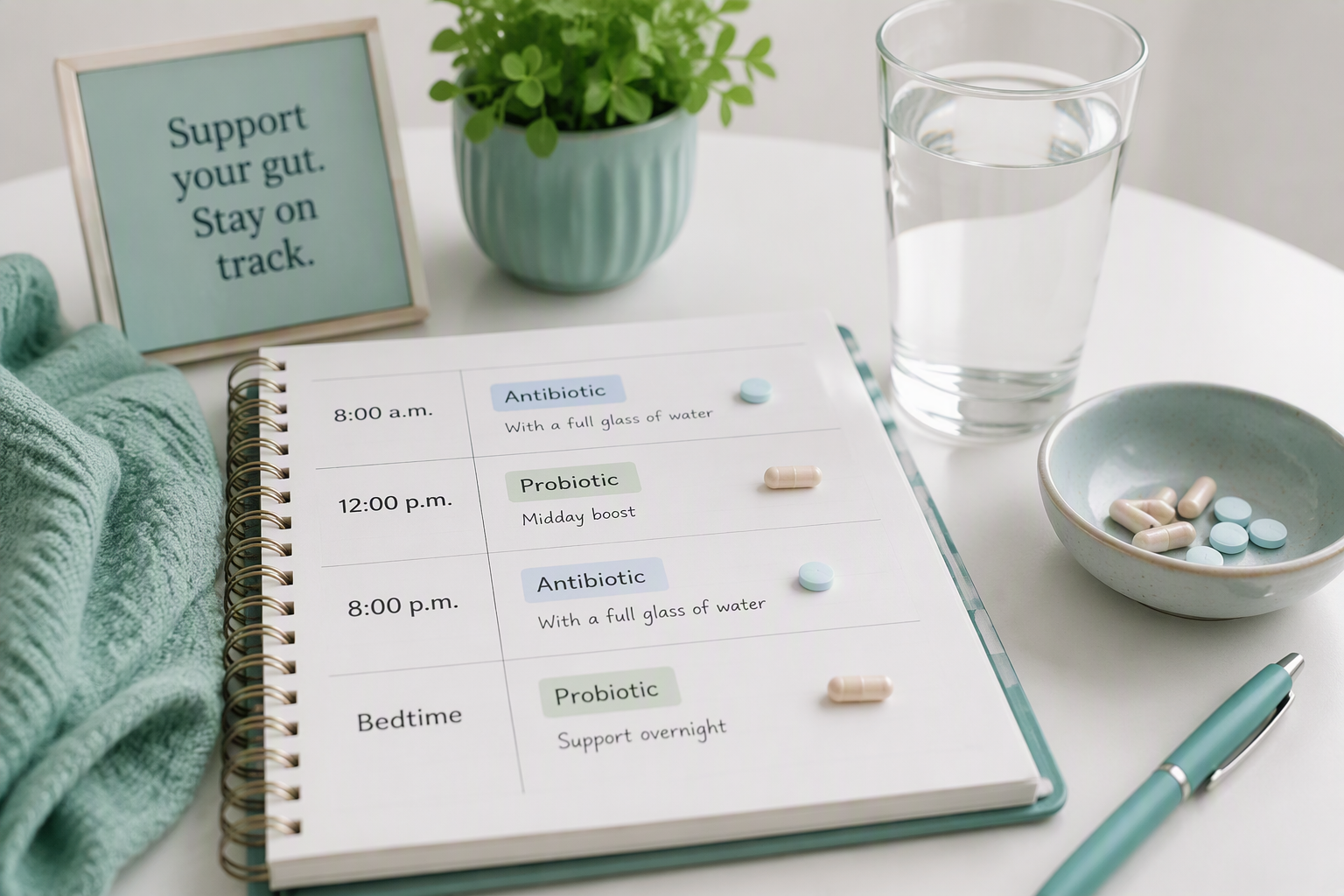
For most bacterial probiotics, leave at least two hours between the probiotic and each antibiotic dose. A two- to three-hour gap is a practical probiotic timing target when your routine allows. Take the antibiotic exactly as prescribed and place the probiotic in the available gaps rather than changing an antibiotic dose.
Taking a bacterial probiotic at the same time as an antibiotic may inactivate some organisms before they reach the gut. This spacing is a sensible precaution, not a proven requirement for every person or product.
A twice-daily antibiotic schedule could look like this:
- 8 a.m.: Take the prescribed antibiotic.
- Midday: Take a bacterial probiotic according to its label.
- 8 p.m.: Take the prescribed antibiotic.
- Bedtime: Take the probiotic if the label allows and at least two hours have passed.
Taking probiotics during antibiotics can be difficult when medication is due three or four times a day. In that case, meaningful separation may not be possible, and a pharmacist can help you review the medication and product. Do not skip or delay an antibiotic to create more room.
Saccharomyces boulardii is an exception. Because it is a yeast rather than a bacterium, antibacterial antibiotics generally do not affect it in the same way, so it usually does not need the same spacing. Follow the product label either way, since advice about probiotics with antibiotics is not one-size-fits-all.
If you choose to use a probiotic, it is commonly started with the antibiotic course and continued for one to two weeks afterward if well tolerated. Evidence for continuing use is limited, and not everyone needs a supplement to recover. Probiotics and antibiotics should serve a specific goal rather than become an automatic pairing.
A probiotic should never delay prescribed treatment or evaluation of persistent, severe, or worsening symptoms. Get individual advice before self-directing timing if you are pregnant, immunosuppressed, seriously ill, or managing an ongoing digestive condition.
Which Label Details Matter When You Are on Antibiotics?

For antibiotic-related use, a probiotic label should match the goal of lowering the risk of antibiotic-associated diarrhea, rather than make broad digestive-health promises. Among probiotic supplements, look for Lactobacillus rhamnosus GG or Saccharomyces boulardii with a clear strain code. These probiotic strains have the most consistent findings for this purpose. If neither is named, the product is not a close match for preventing antibiotic-associated diarrhea, regardless of its strain count or reviews.
A quick shelf-side check can narrow the options:
- Daily dose: Compare the amount with the 5 billion CFU per day threshold discussed for these strains. A dose far below that may be too low for this use, while a much higher amount is not automatically better supported.
- Routine fit: Consider capsules or sachets per day, refrigeration needs, and whether probiotic timing works around your antibiotic schedule at work, school, or while traveling. A product that cannot be stored or spaced reliably is harder to take consistently.
- Added ingredients: Inulin, fructooligosaccharides (FOS), sugar alcohols, flavorings, and mixed digestive blends may add gas or bloating when antibiotics have already unsettled digestion. A simpler formula also makes a short trial easier to interpret.
- Marketing claims: Star ratings, long organism lists, and “clinically studied” claims do not show that the tested strain is in the bottle. Match the exact organism and strain instead of relying on a headline CFU number.
How Can You Support Gut Recovery Naturally?

Post-antibiotic microbiome recovery usually benefits more from steady routines than from a dramatic reset. Regular fluids, tolerated meals, and a slow return to food variety can support gut microbiota recovery while digestion settles.
After repeated diarrhea, take frequent small sips of water and consider an oral rehydration solution to replace fluids and electrolytes. Water remains helpful, but it may not replace what frequent loose stools take away. Get medical care promptly if you cannot keep fluids down or symptoms are severe.
Fiber acts as food for beneficial gut bacteria, yet a sudden increase can make gas, cramping, or bloating worse. Begin with small portions of familiar, tolerated choices such as oats, cooked vegetables, fruit, or beans. Bran cereal, raw vegetables, and large bean servings may be harder to handle early on, so increase fiber only as comfort allows.
Fermented foods are optional, food-first choices that may add live microbes to your diet, but they do not reliably restore gut bacteria or guarantee symptom relief. Probiotic foods are best introduced one at a time, in small servings:
- Yogurt with live cultures or kefir: Dairy may worsen symptoms if lactose is difficult for you to digest.
- Kimchi or sauerkraut: Spicy, acidic, or heavily seasoned versions can aggravate bloating or reflux.
- Miso or tempeh: These may be gentler fermented foods to try in a simple meal.
Artificial sweeteners and sugar alcohols, including xylitol and sorbitol, can also trigger discomfort. Simplifying meals for a few days can make food patterns easier to notice. Many people’s gut microbiota moves closer to its earlier baseline within two to eight weeks, though recovery and symptoms vary.
When Should You Seek Medical Advice?
Probiotics are not a substitute for medical care when diarrhea is severe, worsening, or still present about 48 hours after antibiotics. Contact a healthcare professional promptly if frequent loose stools disrupt eating, drinking, sleep, work, or daily life. Vomiting that prevents you from keeping fluids down also needs assessment, since antibiotic side effects, infection, and other concerns can initially look alike.
Prompt medical attention is needed if any of these warning signs appear:
- Blood or black stools: These may signal bleeding and should not be managed with a probiotic or home treatment alone.
- Severe or escalating abdominal pain: A noticeably swollen, hard, or rigid abdomen needs urgent evaluation.
- Fever, confusion, fainting, or unusual weakness: These symptoms may point to infection, dehydration, or another serious illness.
- Dehydration signs: Very little or very dark urine, intense thirst, dry mouth, dizziness, or trouble staying alert require quick care.
Persistent watery diarrhea during antibiotic treatment or soon afterward can be a sign of Clostridioides difficile, also called C. difficile. Fever, cramping, and dehydration add to the concern. An estimated 20% to 30% of antibiotic-associated diarrhea cases may be linked to C. difficile, which needs testing and targeted treatment rather than a probiotic dose change or self-treatment.
Individual medical guidance is especially important if you have significant immune compromise, serious illness, a recent hospital stay, a central venous catheter, or a prior C. difficile infection. Infants, young children, frail older adults, and people who receive frequent medical treatment can become dehydrated quickly or show less obvious signs of complications.
Probiotic safety and usefulness vary by person. Persistent, severe, or worsening symptoms deserve care from a qualified healthcare professional.