


A "prenatal" label doesn't make a probiotic automatically safe or useful. For most healthy pregnancies, probiotics are generally well tolerated, but safety depends on the exact strain, product quality, and your health history.
In a review of 11 randomized trials involving 1,505 pregnant participants, Lactobacillus and Bifidobacterium products were not linked to changes in birth weight, gestational age, or cesarean delivery. Yet miscarriage data were not reported, and findings for one named strain cannot be applied to every probiotic on a shelf.
Pasteurized yogurt or kefir may be a practical food option, while supplements need closer label review for strain codes, CFU guaranteed through expiration, ingredients, and storage instructions. New, severe, persistent, or worsening digestive symptoms need prenatal medical advice rather than self-treatment with a probiotic.
Pregnancy Probiotics Key Takeaways
- Probiotics are generally well tolerated in healthy pregnancies, but safety varies by strain, product, and health history.
- A review of 1,505 participants found no changes in birth weight, gestational age, or cesarean delivery.
- The same safety review did not report miscarriage outcomes.
- Probiotics may support constipation, but evidence for bloating and other benefits is less consistent.
- Choose pasteurized yogurt, kefir, and fermented foods during pregnancy to reduce foodborne illness risk.
- Check for a full strain code and CFU guaranteed through the expiration date.
- Contact your prenatal team for severe, persistent, worsening, or new digestive or vaginal symptoms.
Are Probiotics Safe During Pregnancy?

For most healthy pregnant people, probiotics during pregnancy are generally well tolerated, but they are not risk-free or interchangeable. If you are asking, are probiotics safe during pregnancy, the practical answer depends on the exact strain, product quality and storage, and your health and pregnancy history. Pregnancy probiotics safety also cannot be inferred from research in nonpregnant people with irritable bowel syndrome (IBS).
A 2009 systematic review and meta-analysis by Dugoua and colleagues combined 11 randomized trials involving 1,505 pregnant participants who used Lactobacillus and Bifidobacterium probiotics. These are among the most studied probiotic genera, but a finding for one strain does not automatically apply to every product in the same genus or species. The pooled results showed no effect on cesarean delivery, birth weight, or gestational age in the probiotic groups, and no malformations were reported (source).
That evidence is reassuring but incomplete. The review did not report miscarriage data, so it cannot answer whether probiotics affect miscarriage risk. It also does not establish probiotics fetal safety for every supplement, dose, strain, or pregnancy situation.
Systemic absorption of probiotics is rare in healthy people, so fetal exposure through the bloodstream is thought to be unlikely (source), though temporary gas, bloating, constipation, diarrhea, or bowel-habit changes can still occur. A probiotic safety guide can help you recognize common effects and signs that merit medical advice.
General findings need more caution when any of these apply:
- Weakened immune system: Live-microbe supplements may pose different risks when immune defenses are reduced.
- Serious illness or recent major surgery: Personal medical factors can matter more than broad pregnancy research.
- Central venous catheter: Rare bloodstream infections are a particular concern with these devices.
- High-risk or complicated pregnancy: An obstetrician, midwife, pharmacist, or prenatal clinician can weigh potential benefits and risks for your situation.
A large colony-forming unit (CFU) number or popular brand name does not identify safe probiotic strains during pregnancy. Because some labels list only a genus and species while evidence may apply only to a named strain code, storage also matters because a product may not contain its stated organisms through its expiration date.
Use the label to prepare for a prenatal-care conversation:
- Check the full organism name: Look for the genus, species, and strain code rather than "Lactobacillus" or "Bifidobacterium" alone.
- Confirm the CFU statement: The amount should be guaranteed through expiration, not only at manufacture.
- Match the evidence to pregnancy: Research in IBS does not establish safety or benefit in pregnancy.
- Bring the relevant details: Share the food or supplement name, symptoms, medications, health conditions, and pregnancy history.
What Benefits Are Supported by Evidence?

Beyond the safety questions above, probiotic benefits during pregnancy depend on the specific product, strain, and health outcome studied. These live bacteria or yeasts may support microbial balance in the gut and vagina, but findings vary widely. No single probiotic is best for pregnancy, and results from one strain or population do not automatically apply to another.
For probiotics for maternal digestion, the clearest possible benefit is support for regular bowel movements. Some preparations may help manage pregnancy-related constipation, so probiotics for constipation during pregnancy may be worth discussing with your prenatal care professional. Evidence for bloating is less consistent, and a product that changes stool frequency may not ease gas or abdominal pressure.
Diarrhea needs more caution than routine constipation. Mild, short-lived diarrhea may improve with fluids, food adjustments, and medical guidance. Persistent, severe, or bloody diarrhea needs prompt clinical assessment rather than self-treatment with a supplement. Seek care for symptoms that are severe, persistent, or worsening.
A useful label gives enough detail to connect the product to actual research:
- Check for the full genus and species, such as Lactobacillus acidophilus or Bifidobacterium lactis.
- Find the strain code, such as HN019, instead of relying on a broad digestive-support promise.
- Review the colony-forming units (CFUs) against the amount used in relevant research.
- Match the study population to your goal. Prioritize studies involving pregnant participants.
Strain codes matter because closely related organisms can act differently. Lactobacillus probiotics include many distinct strains, and a finding for Bifidobacterium lactis HN019 cannot be assumed for another Bifidobacterium strain or for Lactobacillus acidophilus. Look for a fully named strain with research relevant to pregnancy and your specific concern.
Probiotics and vaginal microbiome research is mixed. Certain Lactobacillus rhamnosus and Lactobacillus reuteri strains have been studied for supporting an acidic vaginal environment and possibly lowering the risk of bacterial vaginosis or yeast infections. Oral and vaginal products are not interchangeable. Probiotics for vaginal microbiome balance do not replace testing or prescribed treatment for odor, itching, unusual discharge, burning, or pelvic pain.
Although glucose-related findings are still emerging, some trials using specific strains later in pregnancy report modest changes in blood glucose or insulin resistance, but this does not show that probiotics prevent gestational diabetes. Prenatal screening, individualized nutrition support, monitoring, and treatment remain the foundation of care.
Studies of infant eczema and allergy prevention also conflict, partly because strains, timing, and postpartum use differ. If allergic disease runs in your family, individualized guidance from your prenatal care team or pediatric clinician is more useful than choosing probiotics for gut health during pregnancy mainly for allergy prevention.
How Do Foods, Prebiotics, and Supplements Compare?
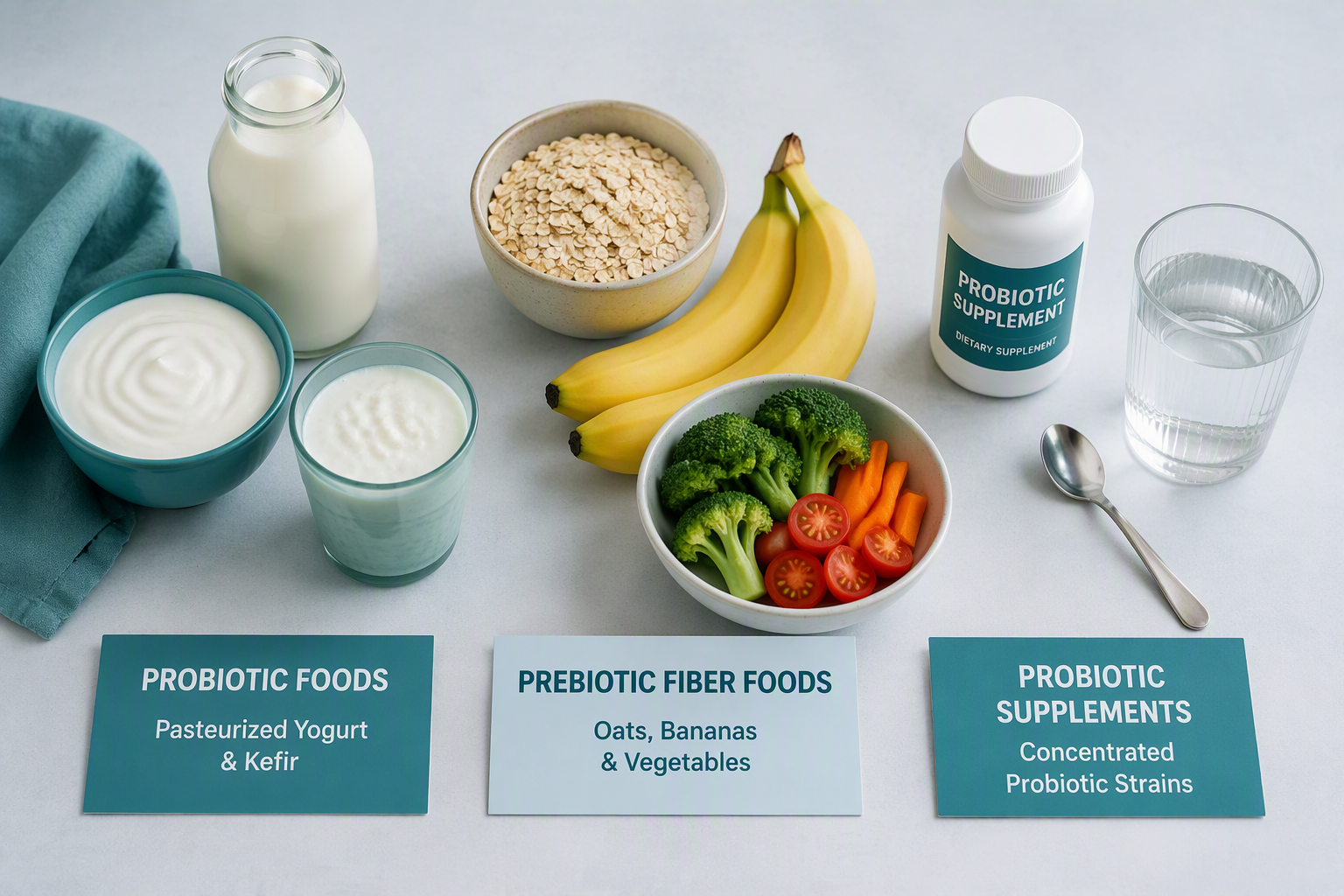
Because benefits vary by outcome and strain, probiotic foods, prebiotic fibers, and supplements serve different purposes, so there is no single best option for every pregnancy or digestive concern. Probiotics are not routinely recommended as a general pregnancy supplement. Whether one fits depends on your symptoms, health history, the identified strain, product quality, and reason for use. Your prenatal care team can help you weigh those details.
Here is how these options differ:
Option | What it provides | Pregnancy consideration |
|---|---|---|
Probiotic foods | Live microorganisms plus food nutrients | Choose pasteurized products and treat them as foods, not remedies |
Prebiotics | Fibers that feed certain gut microbes | Add slowly because fermentable fibers can cause gas or bloating |
Supplements | Selected live microorganisms in a capsule, powder, or liquid | Strain and product details matter more than a large number on the label |
Synbiotics | A probiotic combined with a prebiotic | More ingredients do not automatically mean a better or safer fit |
For people who tolerate dairy, probiotic foods during pregnancy can include yogurt labeled with live, active cultures and kefir. Live-cultured yogurt during pregnancy provides protein and calcium, while kefir during pregnancy offers similar nutrients in a drinkable form. Sauerkraut during pregnancy and kimchi during pregnancy may contain live cultures, but fermented vegetables are not guaranteed to ease constipation, bloating, or pregnancy complications.
Food safety matters more than marketing claims:
- Cultured dairy: Choose milk, yogurt, kefir, and other cultured dairy products made with pasteurized milk.
- Fermented vegetables: Select pasteurized sauerkraut and kimchi instead of raw or unpasteurized versions.
- Kombucha: Raw or unpasteurized kombucha is generally discouraged because of foodborne-illness concerns. Pasteurized products vary, so discuss kombucha with your prenatal clinician before adding it.
Prebiotics offer a food-first option, while probiotics require strain-specific evaluation. Prebiotic-rich foods and fiber supplements may support bowel regularity, but increasing fermentable fiber too quickly can worsen gas or bloating. Check ingredient labels so you can tell a prebiotic fiber from a probiotic ingredient.
Synbiotics require the same ingredient-by-ingredient review. A prenatal capsule might list 30 billion colony-forming units CFU, 17 probiotic strains, acacia fiber, and Jerusalem artichoke root. Neither a higher CFU total nor a longer strain list shows that a formula fits your symptoms or pregnancy.
How Do You Read a Pregnancy Probiotic Label?
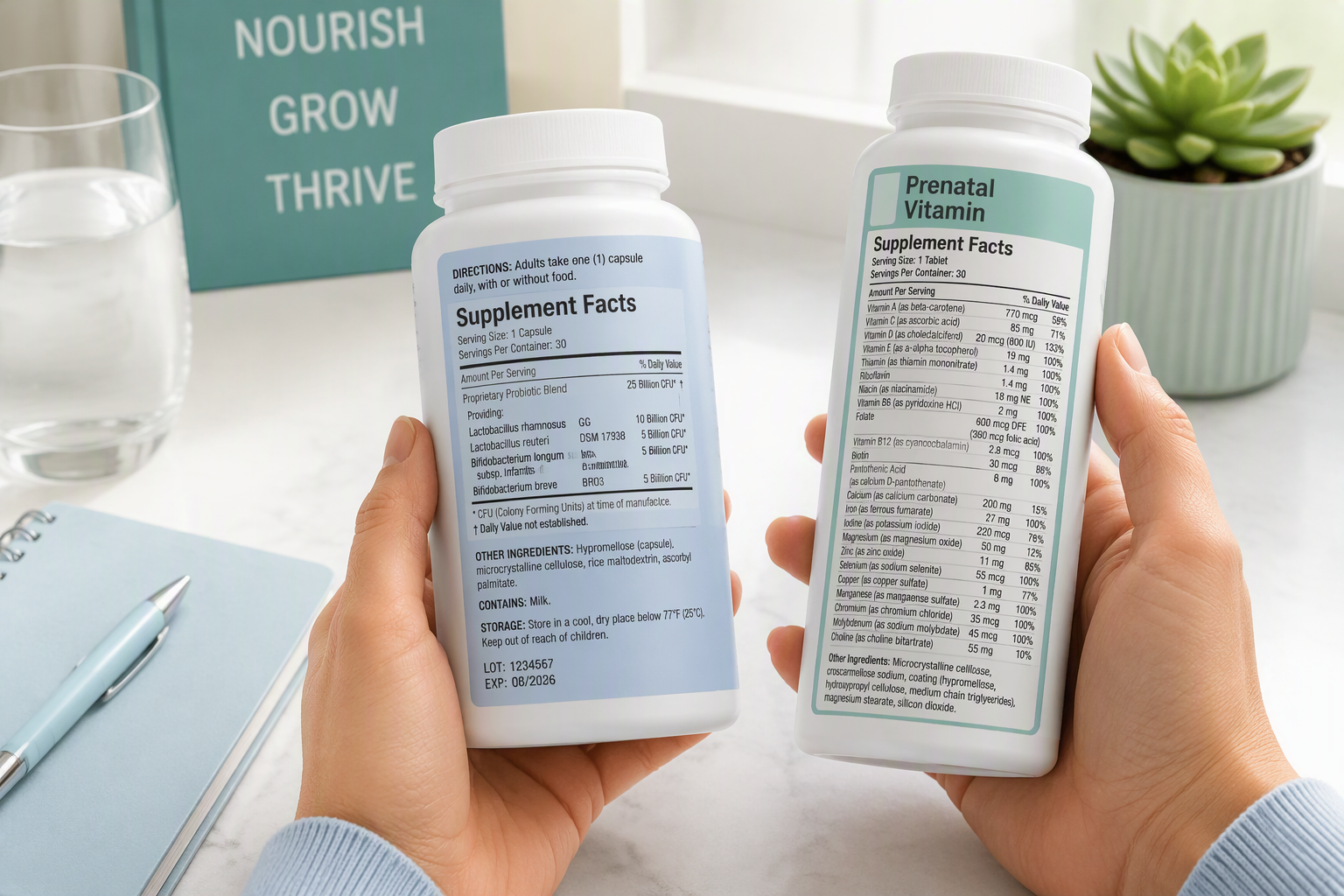
To compare the food and supplement options appropriately, a pregnancy probiotic label should show what is in the bottle, how long it stays potent, and whether the research applies to pregnancy. Safe probiotic strains during pregnancy cannot be identified from front-label terms such as "prenatal" or "digestive support."
Use this sequence before considering probiotics for gut health during pregnancy:
- Match the full organism name: Look for the genus, species, and strain code, such as Lactobacillus rhamnosus GG, rather than only Lactobacillus or L. rhamnosus. Strains in the same species can have different effects, so research on one does not transfer to a similar-sounding product. A strain studied in nonpregnant adults is not automatically appropriate during pregnancy.
- Read the CFU statement: Colony-forming units (CFUs) estimate the number of live microorganisms. They are not a quality grade or a measure of pregnancy suitability. Choose a label that guarantees CFUs through the expiration date, not only at manufacture. A higher count does not automatically mean better probiotics for constipation during pregnancy or probiotics for bloating during pregnancy.
- Check the study match: Claims about bowel regularity, IBS, vaginal health, glucose, or infant eczema should identify the outcome studied, the participants, and the stage of pregnancy. Evidence from general adult or IBS studies does not establish pregnancy benefits. A possible supportive benefit is also different from preventing or treating a pregnancy condition.
- Review product details: Check the Supplement Facts panel, inactive ingredients, allergens, storage instructions, expiration date, and lot number. Third-party testing can offer added reassurance about identity, purity, and label potency, but it does not prove that a probiotic is safe or effective in pregnancy (source). A current good manufacturing practice (cGMP) facility or independent-testing claim reflects manufacturing attention, but does not show that a product will help a pregnancy symptom.
- Treat marketing as a starting point: "Women's health" and "prenatal" do not replace strain-specific evidence. In the United States, supplements are not reviewed as strictly as prescription medicines and are not Food and Drug Administration (FDA)-approved simply because they are marketed to pregnant people.
Bring a label photo to your obstetrician, midwife, or pharmacist, including strain codes, expiration-date CFUs, ingredients, and testing details. Include every prescription and over-the-counter product you take, including your prenatal vitamin, so the conversation can cover probiotics and medication safety.
Seek prenatal care for new, severe, persistent, or worsening symptoms.
How Do Symptoms Guide Your Next Step?
Even with a carefully reviewed label, mild, familiar constipation, gas, and bloating are common during pregnancy because hormones and pressure from the growing uterus can slow digestion. New, persistent, severe, or worsening symptoms deserve a call to your prenatal care team before you try to self-treat, since similar symptoms can have many causes.
A symptom pattern can help determine what to discuss:
- Mild constipation, gas, or bloating: Food, fluids, movement, and daily routines may be appropriate topics for your prenatal clinician. Probiotic benefits during pregnancy remain uncertain, including the benefits of probiotics for maternal digestion, so a supplement is not a guaranteed fix.
- Symptoms that began after a probiotic: Gas, bloating, constipation, loose stools, diarrhea, or nausea can occur early after starting a product. Do probiotics cause gas explains one possible reason. Discomfort does not show that a product is helping, so avoid increasing the dose to push through symptoms.
- New diarrhea, severe abdominal pain, repeated vomiting, or worsening symptoms: Contact your obstetrician or midwife promptly. Supplements cannot replace an evaluation, diagnosis, or prescribed treatment.
If symptoms began after a supplement, bring the container or a clear photo of its label to your appointment. Your clinician can consider the genus, species, named strain code, colony-forming unit (CFU) count, ingredients, timing, and symptom pattern. A high CFU count does not by itself make a product relevant in pregnancy, and evidence for an irritable bowel syndrome (IBS) strain does not establish pregnancy safety or effectiveness.
Vaginal symptoms need a different response from digestive discomfort. Pregnancy-related hormonal shifts can affect vaginal pH and microbial balance, raising susceptibility to bacterial vaginosis and yeast infections. Itching, burning, irritation, unusual discharge, or odor needs diagnosis rather than a probiotic trial. Evidence that probiotics prevent related complications, including preterm birth, remains mixed.
Small preliminary studies have examined probiotics for nausea, vomiting, blood glucose, and insulin resistance, but they do not establish treatment for gestational diabetes or a dependable anti-nausea option. Bring glucose records, meal patterns, medications, symptom timing, and the full product label to your obstetrician, midwife, or diabetes-care clinician.
Some maternal probiotic studies began supplementation at 32 to 36 weeks and continued until delivery, with findings suggesting lower rates of infant atopic conditions such as eczema. This emerging evidence remains mixed and does not identify one proven product or prevention strategy. Family allergy history and the timing of any supplement are useful details for your prenatal team.
When Should You Call Your Prenatal Team?
Probiotics require an individualized decision during pregnancy. Before you start or continue one, ask your OB/GYN, midwife, or prenatal team whether the specific strain and product fit your symptoms, health history, and reason for using it. They can help you decide whether probiotic foods during pregnancy, including pasteurized yogurt or kefir during pregnancy, are a better fit than a supplement or whether another approach is needed.
Contact your prenatal team before using probiotics if you have a weakened immune system, a serious underlying condition, or a high-risk pregnancy. Pregnancy probiotics safety findings from studies of healthy participants do not answer individual questions about infection risk or a closely tailored care plan. The same caution applies to probiotics for immune health during pregnancy, since supplements do not replace medical care.
Call your prenatal team for digestive symptoms that are new, severe, ongoing, or worsening, including:
- Severe or ongoing diarrhea.
- Repeated vomiting or an inability to keep fluids down.
- Severe abdominal pain.
- Signs of dehydration, such as very dark urine, dizziness, or much less urination.
Mild gas or a short-term change in bowel habits can occur after starting probiotics, but do not assume those symptoms explain an illness that needs assessment. Bring the label for any third-party tested probiotic supplements you are considering, along with a brief record of your symptoms, foods, and medications.
Prompt pregnancy or infection warning signs include:
- Fever, painful urination, or unusual vaginal discharge or odor.
- Vaginal bleeding or fluid leakage.
- Regular painful contractions.
- Noticeably reduced fetal movement later in pregnancy.
A probiotic cannot diagnose or treat an infection, and general advice of that kind does not replace personalized prenatal care. Pooled trial data provide limited reassurance for the specific outcomes studied, but the review also left preterm-birth questions unresolved. Product quality, dose, strain, and your individual pregnancy still matter.
Probiotics During Pregnancy FAQs
These FAQs address common questions about probiotic foods, supplements, safety, and label reading during pregnancy. They can help you prepare for an informed conversation with your prenatal care professional.
1. Can I Take Probiotics With Prenatals?
Probiotics are not routinely recommended during pregnancy, but you may be able to take one with a prenatal vitamin if your prenatal clinician considers both products appropriate. The choice should reflect your symptoms, health history, reason for use, and the product’s specific strains and ingredients, not a “pregnancy probiotic” label alone.
Bring both labels to your OB-GYN, midwife, or other prenatal clinician, especially if the probiotic contains prebiotics, herbs, added vitamins, or other active ingredients. Separating doses may be more comfortable if either product worsens nausea, bloating, constipation, or diarrhea. Persistent or worsening digestive symptoms need medical guidance.
2. When Should I Start Pregnancy Probiotics?
No single week of pregnancy is right for everyone. The timing should reflect why you’re considering a probiotic, whether the specific strain has been studied for constipation, digestive or vaginal symptoms, or another pregnancy-related outcome, and your health history. A “pregnancy probiotic” label or high colony-forming units (CFUs) alone cannot guide that choice.
Most participants in one safety review started probiotics between 32 and 36 weeks and continued until delivery, so early-pregnancy use is less studied. Review the strain, your gestational stage, symptoms, medicines, and prenatal care guidance before starting.
3. Are Vaginal Probiotics Safe During Pregnancy?
Vaginal probiotics should not replace prenatal evaluation or prescribed treatment for bacterial vaginosis, yeast infection, or symptoms such as unusual discharge, odor, itching, burning, or pain. Pregnancy can shift vaginal pH and the vaginal microbiome. Although Lactobacillus probiotics, including L. rhamnosus and L. reuteri, have been studied for probiotics for vaginal microbiome balance, benefits remain unproven. A 2021 Nutrients systematic review found one trial reporting more vaginal discharge and stool-consistency changes with these strains, with a relative risk of 3.67 (95% confidence interval 1.04 to 13.0). Discuss vaginal versus oral probiotics and vaginal microbiome products, plus the exact strain, with your prenatal clinician when considering whether probiotics are safe during pregnancy.
4. Can Probiotics Trigger Contractions?
Routine probiotic research has not shown that probiotics trigger contractions or labor. In pooled trials, birth weight, gestational age, and cesarean-section rates were similar, and no malformations were reported. Because those trials did not report miscarriage outcomes, they cannot answer that question or confirm safety for every strain, dose, or individual pregnancy.
Evidence that probiotics improve the vaginal microbiome or prevent preterm birth is mixed, so they should not be used to prevent labor. Contact your prenatal team immediately for new or regular contractions, bleeding, fluid leakage, severe abdominal pain, or reduced fetal movement.