


Most people don't need one. A probiotic earns its place when it's matched to a specific problem, and taking one daily as a general precaution against bloating or irregularity isn't supported by what the trials show.
The clearest exception is a course of antibiotics. Across 17 randomized trials, diarrhea affected 8.0% of people taking a probiotic against 17.7% of controls, a real effect with named strains behind it. For IBS the picture blurs, because evidence attached to Bifidobacterium longum 35624 or Lactiplantibacillus plantarum 299v says nothing about a product sharing only a species name.
Food is often the sensible place to start when you tolerate it. Yogurt and kefir cost less than a supplement and carry live cultures, which makes them a reasonable test before committing to capsules.
Probiotics, Foods, and Safety Key Takeaways
- Probiotics are not necessary for everyone, and daily use is not a general fix.
- Taking one alongside antibiotics has the clearest supporting evidence.
- IBS findings belong to named strains and don't transfer between products.
- Fermented foods are often a practical first step when tolerated.
- A label needs a full strain code and potency guaranteed through expiration.
- Temporary gas or bloating can occur when starting a probiotic.
- Immunocompromise, serious illness, or a central line means asking a clinician first.
Should You Take Probiotics Every Day?
Daily probiotics are not necessary for everyone. If you’re asking should you take probiotics, start with a defined goal and discuss ongoing irritable bowel syndrome (IBS)-like symptoms with a qualified healthcare professional. Probiotics do not replace medical evaluation, prescribed treatment, regular meals, or a varied diet, and the full range of probiotic benefits depends on the strain and your situation.
For generally healthy adults, fermented foods with live cultures can be a practical way to include probiotics in meals if you tolerate them. Yogurt, kefir, kimchi, and similar foods also add nutrients to your overall eating pattern. A daily probiotic supplement provides a defined microorganism or blend, which is useful only when the label names the complete strain code studied in people.
For IBS symptoms, a high colony-forming unit (CFU) count or familiar species name does not predict results. Evidence for Bifidobacterium longum 35624 or Lactiplantibacillus plantarum 299v does not apply to another product with a similar name. The strain number is the key detail, even when older and newer genus names differ.
When comparing supplements, look for:
- Full strain code: The exact letters and numbers used in human research.
- Dose through expiration: A stated organism count at the end of shelf life, not only at manufacture.
- Storage instructions: Clear handling guidance, since heat and storage conditions can affect viability.
In the United States, dietary supplement regulation does not require the Food and Drug Administration (FDA) to review probiotic safety or effectiveness before a product reaches the market. An FDA probiotic warning is not a substitute for checking the label, and marketing claims about probiotics and weight deserve the same careful review.
Healthy adults often tolerate probiotics, but temporary gas, bloating, or bowel-habit changes can occur. Get medical guidance before daily use if you are immunocompromised, seriously ill, recently hospitalized, or have a central venous catheter.
Which Digestive Problems May Probiotics Help?

After considering daily use, probiotic benefits are tied to specific conditions, not broad relief for unpredictable digestion. Whether are probiotics effective for you depends on the diagnosed problem, the studied strain and dose, and your own response. A high colony-forming unit (CFU) count or long ingredient list does not predict symptom relief. Do probiotics help digestion depends on both the symptom and evidence for the exact product.
Antibiotic-associated diarrhea has the clearest evidence of potential benefit. A 2017 review of 17 randomized trials with 3,631 nonhospitalized participants found diarrhea in 8.0% of people taking probiotics, compared with 17.7% of controls, or roughly half the likelihood during antibiotic use. This is moderate-quality evidence of reduced risk for some people, not a treatment for every cause of diarrhea (source).
Evidence for irritable bowel syndrome (IBS) is less consistent. A 2018 review of 53 randomized trials involving 5,545 patients found possible improvement in overall symptoms and abdominal pain, but no species, strain, or combination worked reliably for everyone (source). With irritable bowel syndrome probiotics, findings from one strain do not apply to every product in the same species.
Other common concerns need realistic expectations:
- Constipation: Constipation probiotics, including some containing Bifidobacterium lactis, may support bowel-movement regularity in adults. They are not a dependable remedy, and findings in children are inconsistent. Diet, medications, fluid intake, and health conditions can also affect bowel habits.
- Gas and bloating: Some people notice more gas or bloating when first starting a probiotic. Research has not established who benefits, and these symptoms can have many triggers.
Probiotics and immune health involve different questions from condition-specific digestive uses. Persistent, severe, or worsening bowel-habit changes need guidance from a qualified healthcare professional.
How Do You Choose an IBS Probiotic Strain?
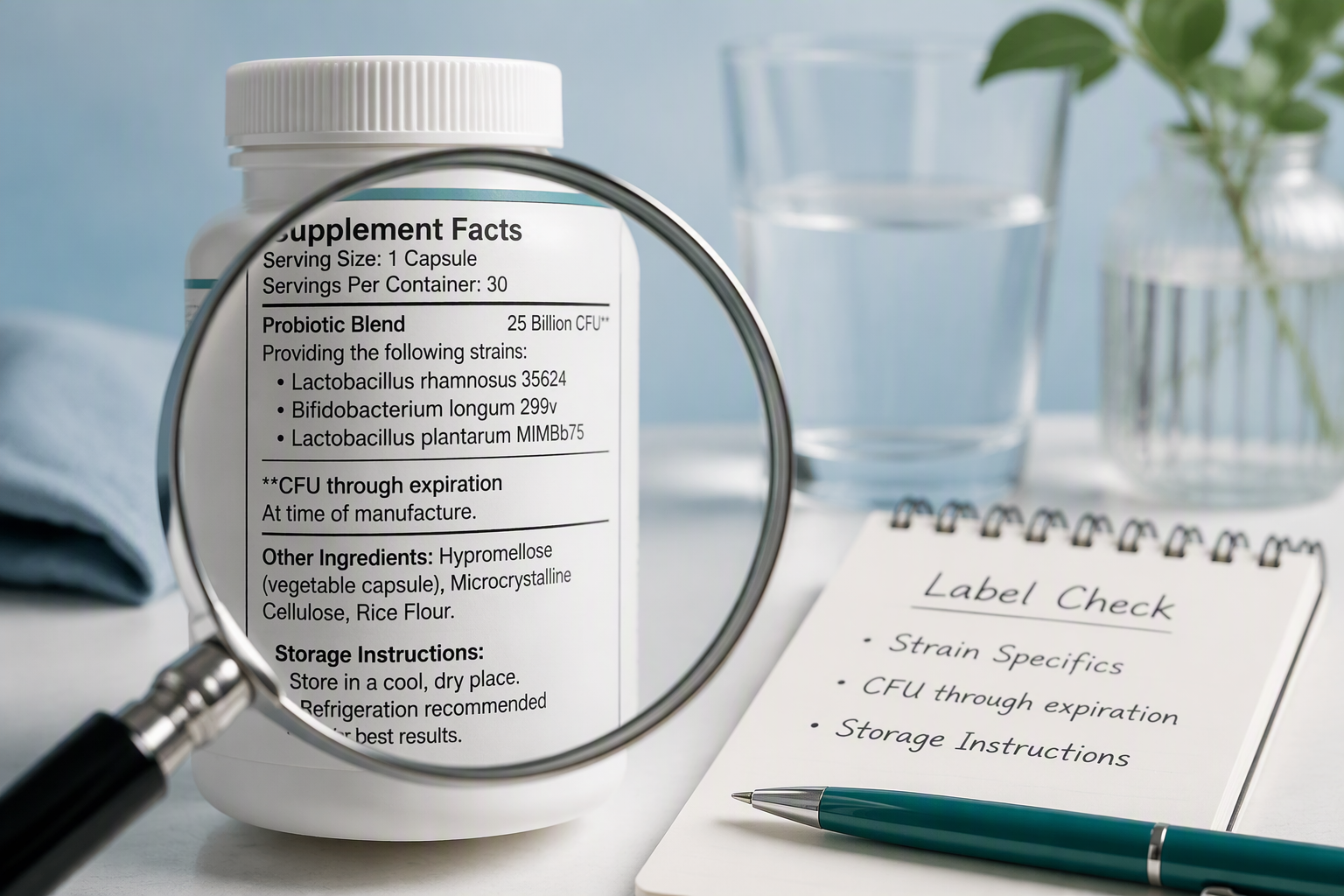
For IBS specifically, choose irritable bowel syndrome probiotics by matching a named strain with the IBS symptom studied, rather than choosing the highest colony-forming unit count or a broad digestive-support claim. Start with the outcome that matters most to you, such as abdominal pain, bloating, overall symptom relief, or quality of life.
A clinical strain includes the full organism name and a letter-and-number code. Many IBS probiotic studies use exact strain codes, so a species-only label is not enough to match a product to the research (source).
A useful label check includes:
- Exact strain code: Check the Supplement Facts panel or manufacturer information for the complete designation, such as 35624, 299v, or MIMBb75.
- Studied outcome: Look for research on the named strain and symptoms that match your IBS experience.
- Dose through expiration: Prefer products that state the amount available through the expiration date, not only when the product was made.
- Added ingredients: Consider whether prebiotics, sweeteners, or other additions have previously worsened your symptoms.
Several probiotic strains have IBS-specific research, but none works for every person. Bifidobacterium longum subsp. infantis 35624, sometimes labeled with the older name Bifidobacterium infantis, showed better results than placebo for most measured symptoms in an earlier IBS trial (source). Lactiplantibacillus plantarum 299v was studied in 40 people, with abdominal pain resolving in 20 of 20 participants taking 299v compared with 11 of 20 taking placebo. Its small sample means the finding cannot predict your result.
Taxonomy changes can make matching a label harder than it needs to be. Although Lactobacillus plantarum 299v may appear under its newer name, Lactiplantibacillus plantarum, or as DSM 9843, the strain number is the dependable match. Bifidobacterium bifidum MIMBb75 also has a randomized, double-blind, placebo-controlled IBS trial, but its findings apply to MIMBb75 only, not to every B. bifidum product.
If you are asking, are probiotics effective for IBS, a published study of the exact strain is a more informed starting point than a front-label promise. It is not a guarantee of relief or a substitute for diagnosis.
Match a Strain Code to Your Symptom
For IBS, the strain code matters more than the genus name. Probiotic strains from the same species do not necessarily produce the same results, so a label listing only Bifidobacterium, Lactobacillus, Lactiplantibacillus, or B. bifidum cannot be matched to a specific study. Taxonomy can change, but codes such as 35624 and 299v remain the most useful identifiers.
The evidence is symptom-specific:
- Bifidobacterium longum subsp. infantis 35624: This strain has been studied for broad IBS symptom improvement rather than one bowel-habit concern. An earlier placebo-controlled study found benefits for every measured symptom except bowel-movement frequency and stool consistency. A later multicenter, randomized, double-blind, placebo-controlled dose-ranging trial included 362 women with IBS in primary care, across all bowel-pattern subtypes (source). The published report lists Procter & Gamble as the funding source, but does not state a trial completion date. Align Probiotic has been associated with 35624, although the product label should display the full code before you connect it with this evidence.
- Lactiplantibacillus plantarum 299v: Labels may instead use Lactobacillus plantarum 299v or DSM 9843. Its clearest IBS finding involves abdominal pain, not every IBS symptom. In a randomized trial of 40 people, pain resolved for all 20 participants taking 299v and 11 of 20 taking placebo (source). That small study supports considering a code-matched product for pain, not assuming that any L. plantarum supplement will work.
- Bifidobacterium bifidum MIMBb75: A randomized, double-blind, placebo-controlled trial linked MIMBb75 with overall IBS symptom relief and better quality of life (source). Those results belong to MIMBb75 alone, not to every product labeled B. bifidum.
A review of roughly 30 leading IBS and digestive products found that almost none named a clinical strain code. A species-only label is not enough to match a product with these trial results, especially when symptoms are unpredictable or severe.
Do Not Rely on CFUs Alone
Colony-forming units (CFUs) show how many live organisms a serving is expected to contain. They do not show whether those organisms are the strains studied for your IBS symptoms. A high-CFU claim cannot confirm benefit for pain, bloating, constipation, or diarrhea, or prove that the organisms remain viable through storage and use. Check CFUs after confirming the strain identity and relevant human evidence.
The full strain code matters more than the genus or species name. For example, 35624 identifies a specific organism more clearly than Bifidobacterium infantis, while 299v is more useful than Lactobacillus plantarum alone. Labels may use either Lactobacillus or Lactiplantibacillus for 299v, but the code is the consistent identifier. Research on one strain does not automatically apply to another strain in the same species.
That gap makes high-CFU marketing difficult to evaluate. Even a supplement promoted as having 60 billion CFUs and 10 strains may not let you determine whether its organisms were studied in people with IBS. Without a code, you cannot confidently connect the product to strain-specific research.
A meaningful label review includes these details:
- Exact strain code: Match the complete code with human research for the symptom you want to address. A broad digestive-support claim is not IBS evidence.
- Expiration-date potency: Look for a CFU amount guaranteed through the expiration date, not only when the product was made.
- Storage and product identity: Follow refrigeration or room-temperature directions, and use the exact formulation studied.
A species-only label, reformulated brand, or similar-looking product is not interchangeable with the researched strain. Supplement labels may not reliably confirm organism identity, potency, or survival to the gut.
Should You Choose Probiotic Foods or Supplements?

After checking strain-specific labels, probiotic foods are usually a sensible first choice when you tolerate them. Greek yogurt and kefir offer convenient dairy options along with protein, fatty acids, and amino acids. Other fermented foods, such as refrigerated sauerkraut, kimchi, miso, kombucha, fermented fruits and vegetables, and pickles, can bring variety to meals. They may support gut health, but they work best within an overall balanced diet.
Not every fermented product still contains live probiotics. Heating and other processing steps can reduce or remove the microbes formed during fermentation. For yogurt and kefir, check labels for “live and active cultures,” and read refrigerated products carefully. Shelf-stable or pasteurized sauerkraut, kimchi, miso, pickles, and kombucha may contain few or no live cultures.
Prebiotics are nondigestible fibers that feed some members of the gut microbiome. Food sources include:
- Beans, oats, and whole grains
- Onions and garlic
- Bananas and other fiber-rich plant foods
If bloating is part of your symptoms, make one dietary change at a time. Adding kefir, beans, and a fiber supplement in the same week can make it difficult to know whether one is helping or causing extra gas.
Probiotic supplements can be a reasonable targeted option for a specific symptom, limited access to fermented foods, or a short-term convenience trial. A capsule is not automatically more effective than food. Look for the complete strain code, not just a familiar species name or a high colony-forming-unit count. Evidence for Bifidobacterium longum subsp. infantis 35624, for example, does not apply to every product labeled Bifidobacterium infantis.
Professional guidance matters before self-treating in these situations:
- Persistent, severe, or worsening digestive symptoms
- Immune-suppressing treatment or a weakened immune system
- Symptoms that may need testing rather than a supplement trial
A qualified healthcare professional or registered dietitian can help determine whether probiotics fit your situation without delaying needed care.
How Can You Try a Probiotic Safely?
Whether you choose foods or supplements, a safe probiotic trial involves changing one thing at a time. Choose a product with a clearly listed organism and strain code that matches your symptom goal, rather than picking one based on a high CFU count or a familiar species name. Keep meals, fiber intake, and your usual routine steady. Avoid adding prebiotic blends, digestive enzymes, or other major changes during the trial.
For IBS, a daily probiotic supplement may help some people, but effects are gradual, symptom-specific, and personal. Follow the label directions for several weeks, then stop if there is no meaningful benefit instead of moving from product to product. Research on one strain does not apply to another strain with a similar name.
A careful label check supports probiotic safety:
- Identity: Look for the genus, species, and strain code, such as 35624 or 299v. Genus names may change, but the strain number remains the key identifier.
- Potency: Confirm that the stated amount is guaranteed through the expiration date, not only when the product was made.
- Storage: Follow refrigeration or room-temperature instructions, since heat and moisture can damage live organisms.
- Simplicity: For a first trial, avoid over-the-counter probiotics that also contain prebiotics, enzymes, or several unfamiliar ingredients.
Dietary supplement regulation differs from drug regulation. Probiotics are regulated as foods rather than medicines and do not undergo the same premarket testing as prescription drugs. There is no blanket FDA probiotic warning that confirms every product is either safe or effective, so a transparent label and strain code matter more than front-label promises.
Mild gas or bloating can be probiotics side effects, especially at the start. Stop the product if symptoms worsen or do not settle. Seek prompt medical care for:
- Allergic-reaction signs: Swelling, hives, or trouble breathing.
- Severe symptoms: Severe abdominal pain, persistent vomiting, bloody stools, fever, or dehydration.
Extra caution is needed if your immune system is weakened. Consult a qualified healthcare professional before trying a probiotic if you are immunocompromised, seriously ill, pregnant, have a central venous catheter, take immune-affecting medicines, or are receiving cancer treatment. Probiotic foods are generally well tolerated by healthy adults, but persistent digestive symptoms need medical evaluation beyond self-treatment.
Track Symptoms Before and During Your Trial
Start with several days of baseline notes before adding a probiotic. Record the time, frequency, and consistency of each bowel movement, plus any sense of incomplete emptying. The Bristol Stool Chart can help you describe stool consistency. Rate abdominal pain, bloating, gas, and urgency from 0 to 10 to capture your usual pattern rather than an unusually good or difficult day.
Keep the same dated log during a four- to eight-week trial. A paper diary, notes app, or printable tracker can all work, and consistency matters more than the format. Include effects on daily life, not only bathroom frequency:
- Urgency and accidents: Note bathroom rushes or accidents, if relevant.
- Sleep and activities: Record disrupted sleep, missed plans, and time away from work.
- Potential confounders: Include major food changes, alcohol, travel, illness, stress, menstrual-cycle timing, and new or changed medicines, laxatives, fiber products, or supplements.
Avoid starting multiple digestive products at once. Adding a prebiotic, enzyme, or fiber supplement alongside a probiotic makes it difficult to tell what caused a change.
Track possible adverse effects separately from your usual IBS symptoms, especially:
- Digestive changes: New or clearly worse gas, bloating, cramping, diarrhea, constipation, or nausea.
- Skin reactions: Rash or other new symptoms.
Note when each symptom began relative to the product. Persistent, severe, or worsening symptoms need evaluation from a qualified healthcare professional. At the end, compare the full baseline with the full trial, not only your best day.
Know When to Ask a Clinician First
Ask a clinician before using a probiotic if illness or medicines have weakened your immune system. Healthy adults often tolerate these live microorganisms well, but probiotic safety changes when your body has a reduced ability to fight infection. A clinician can weigh the possible benefit against the potential risk in your situation.
Individual advice is especially important before trying over-the-counter probiotics in these circumstances:
- Serious illness or hospitalization: Medical instability, intensive care, major surgery recovery, or a recent hospital stay calls for guidance rather than self-starting a supplement.
- Cancer treatment: Chemotherapy, radiation, some targeted treatments, and transplant-related care can affect immunity and the digestive tract. Your oncology team may advise against a probiotic or suggest an approach that fits your treatment plan. Supplements may also affect the existing microbial balance and could influence treatment response.
- Complex digestive conditions: Inflammatory bowel disease, short bowel syndrome, severe pancreatitis, or unexplained ongoing symptoms need medical assessment before a probiotic trial.
- Several medicines: A clinician or pharmacist can consider your full medication list, diagnosis, and symptom pattern before adding a supplement.
Do not use a probiotic to put off care for ongoing or worsening bloating, diarrhea, constipation, abdominal pain, unplanned weight loss, rectal bleeding, fever, or a major change in bowel habits. Those symptoms may need evaluation instead of a supplement trial.
Supplements do not replace diagnosis, prescribed treatment, or follow-up care. Asking first is a practical safety step, not a sign that you have done anything wrong.
Should You Take Probiotics FAQs
These FAQs cover common concerns about whether probiotics fit your digestive symptoms, daily routine, and safety needs, helping you prepare for a conversation with a qualified healthcare professional.
1. What Signs Suggest You Need Probiotics?
No symptom proves that you need a probiotic. If you’re asking should you take probiotics for recurring gas, bloating, constipation, or diarrhea, focus on one non-urgent concern and consider a strain matched to it, rather than treating an “unhealthy microbiome” as a diagnosis.
Persistent, severe, worsening, unexplained, or life-disrupting symptoms need medical care, especially with weight loss, blood in the stool, fever, severe pain, or ongoing vomiting. Probiotics do not replace diagnosis or prescribed treatment.
2. Should You Take Probiotics With Gastroparesis?
Probiotics are not a standard treatment for gastroparesis, and evidence does not show that they improve delayed stomach emptying or help everyone safely. Some people develop gas, bloating, or increased fullness, which can worsen symptoms that are already hard to manage. Discuss probiotic foods or supplements with your gastroenterologist before trying them. Gastroparesis care should address the underlying cause, nutrition needs, and symptom control, while persistent, severe, or worsening symptoms need medical evaluation.
3. Can Probiotics Cause Temporary Side Effects?
Some people have temporary probiotics side effects, including gas, bloating, mild abdominal discomfort, or an upset stomach. These symptoms can reflect an adjustment to a new supplement or food, but they do not show that the product is helping or mean you should keep taking it if you feel worse.
Stop the product and seek medical advice if symptoms are severe, worsening, persistent, or occur with vomiting, fever, blood in the stool, dehydration, or an allergic reaction. Digestive symptoms have many possible causes and need evaluation when they do not settle.
4. Can You Take More Than One Probiotic at a Time?
You can, but it undoes the point of a trial. Evidence attaches to a named strain at a studied dose, so running two products at once means no result can be traced back to either one.
Start with one clearly identified product, give it a defined period, and only add or switch once you have decided about the first. A multi-strain blend carries the same limitation: what was studied, if anything was, is the blend as sold rather than each organism in it.