


Bloating shifts with meals, stress, and hormones, which makes it one of the hardest symptoms to test a supplement against. A good week can easily look like a working product. Two strains carry most of the usable evidence, and both were studied in people with IBS rather than in bloating on its own.
In a trial that recruited 214 people, 78% of those taking Lactiplantibacillus plantarum 299v rated the effect as good or excellent against 8% on placebo. Bifidobacterium longum subsp. infantis 35624 has its own separate trial record. Neither result means bloating stops, and reviews haven't found a strain or dose that works for everyone.
Matching an exact strain code to your symptom does more for you than the CFU number printed on the front of the box. Both of those strains also appear under older and newer genus names, so match on the number rather than the words around it.
Key Takeaways
- Bloating evidence centers on two strains, B. longum subsp. infantis 35624 and L. plantarum 299v.
- A strain code, not a genus name or CFU count, links a product to that research.
- The same strain appears under old and new genus names, so match the number.
- Where trials show a benefit, it is modest rather than the end of bloating.
- Track severity, visible distension, and timing around meals, not just how you feel.
- Mild early bloating often settles, but bloating that worsens is a reason to stop.
- If a well-matched strain does nothing over eight weeks, suspect another cause.
Can Probiotics Help With Bloating?

Probiotics may modestly reduce bloating for some people with irritable bowel syndrome (IBS), but they do not help manage every case or work reliably for everyone. Recurring bloating can disrupt meals, work, and social plans. For otherwise healthy adults with bloating not linked to IBS, research on probiotics and bloating is mixed, and any improvement tends to be mild.
Choosing probiotics for bloating is difficult because a species name alone does not identify the organism studied. A scan of roughly 30 popular IBS and digestive probiotic products found that almost none displayed a clinical strain code. Evidence for one strain does not carry over automatically to another strain in the same species.
The research does not point to one effective product or dose. Reviews of the bloating and distension literature have not identified a universally effective strain or dose, and expert consensus places the evidence for selected probiotics in IBS at moderate rather than strong (source).
A 2018 review of 15 IBS studies reported significant probiotic benefits, including less bloating, in eight studies. That finding is encouraging, but it does not mean every blend, dose, or person will respond the same way.
Several factors can shape your experience:
- Strain code: A complete code identifies the specific microorganism tested, while a genus and species label does not.
- Formula and dose: Multi-strain products and added fibers may affect tolerance, making it harder to tell what changed your symptoms.
- Symptom pattern: Constipation, lactose intolerance, dietary changes, stress, and other digestive conditions can all contribute to bloating.
- Trial length: Studies use different time frames, so judging a product too quickly can be misleading.
The answer to what conditions do probiotics treat depends on the condition and the exact strain, not a broad probiotic label. The same strain-specific caution applies to whether probiotics are safe with small intestinal bacterial overgrowth (SIBO) and to probiotics with antibiotics.
So, can probiotics help with bloating? Focus on products that name a strain with relevant IBS evidence, then assess symptoms during a trackable eight-week trial rather than chasing a one-size-fits-all supplement.
Persistent, severe, or worsening symptoms need evaluation from a qualified healthcare professional.
Two other causes are worth ruling in or out early, because they change the answer entirely: do probiotics help constipation covers stool retention as a source of distension, and probiotics and dairy digestion covers lactose.
Which Strains Have Evidence for IBS Bloating?
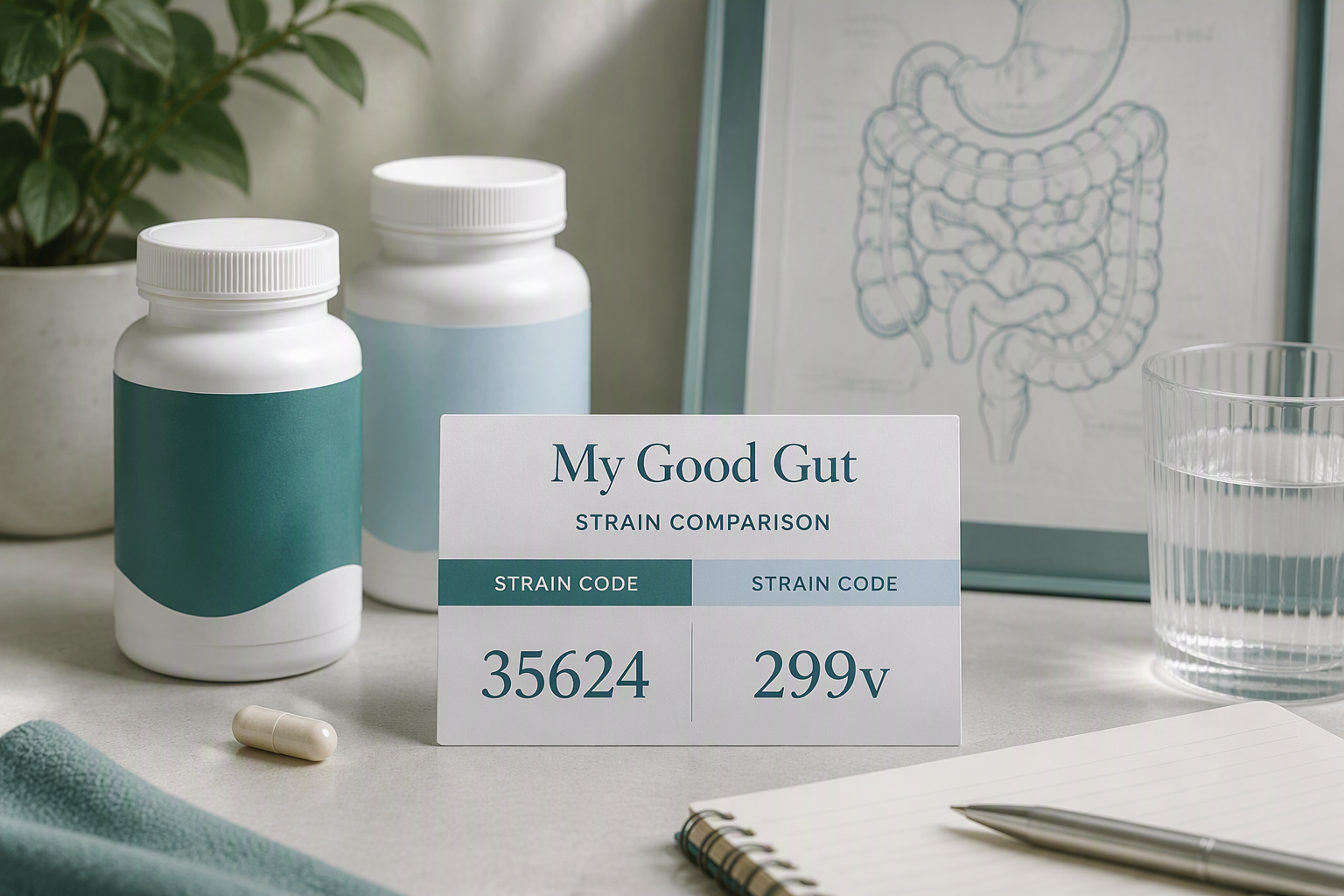
No probiotic works for everyone with IBS bloating. A review of randomized placebo-controlled trials found five single probiotic strains with evidence for selected IBS symptoms, but improvement in overall symptoms does not mean a product will ease bloating for every person (source).
The strains with the most relevant IBS research include:
- Bifidobacterium longum 35624: Formerly labeled Bifidobacterium infantis 35624, this is the most established option for people with diagnosed IBS. Its research includes bloating and other symptoms across constipation-, diarrhea-, and mixed-pattern IBS. It has meaningful evidence, but it is not a guaranteed anti-bloating remedy.
- Lactiplantibacillus plantarum 299v: Also called DSM 9843 and sometimes listed under its former Lactobacillus name, 299v has human IBS research for abdominal symptoms. In one small trial, abdominal pain resolved in 20 of 20 participants taking 299v, compared with 11 of 20 taking placebo. That limited result should not be treated as definitive evidence for bloating relief (source).
- Lactobacillus rhamnosus GG: This strain has trial evidence for selected IBS outcomes, not a promise to reduce bloating by itself.
- Saccharomyces cerevisiae CNCM I-3856: This specific supplement yeast has IBS trial evidence. It is different from Saccharomyces boulardii, so findings for one yeast do not apply to the other.
- Bacillus coagulans Unique IS2: Also identified as MTCC 5260, this strain has been studied for particular IBS symptoms but is not a guaranteed option for bloating.
The best probiotics for bloating are not identified by a genus or species name alone. Look for the complete strain code, especially 35624 or 299v. Taxonomy changes mean either old or new genus names may appear on a label, but the number is what connects a product to the research.
Evidence does not transfer to generic Bifidobacterium infantis, Bifidobacterium lactis, Lactobacillus acidophilus, or un-coded multi-strain blends. A product also needs to match the studied dose and formulation, contain viable organisms through its expiration date, and survive digestion. Those details matter more than a long list of specific probiotics on the front of the bottle.
How Does Bifidobacterium Infantis 35624 Perform?
Bifidobacterium longum subsp. infantis 35624, often labeled Bifidobacterium infantis 35624, is a strain studied for IBS rather than a general option for occasional bloating from any cause. Research included people with constipation-predominant, diarrhea-predominant, and mixed-pattern IBS, so it is most relevant when bloating occurs alongside recurring IBS symptoms.
In a multicenter study of 362 primary-care patients with IBS, randomized placebo-controlled trials found that the effective dose of 35624 outperformed placebo for overall IBS symptoms, abdominal discomfort, and bloating. The trial was randomized, double-blind, placebo-controlled, and dose-ranging, which reduces certain sources of bias. Still, its findings describe average results in a group, not dependable relief for every person who tries the strain (source).
The symptom pattern helps set realistic expectations:
- Global IBS symptoms and abdominal pain: Evidence is strongest for the overall symptom picture and abdominal pain.
- Bloating: Some participants experienced less bloating, although findings are more moderate than those for global symptoms and pain.
- Bowel movements and stool consistency: Earlier placebo-controlled research found no advantage over placebo for bowel-movement frequency or stool form.
This difference matters if constipation, diarrhea, or unpredictable stool consistency is your main concern. Less abdominal fullness or pain may occur without a meaningful change in how often you have bowel movements or what your stools look like.
The strain code 35624 is the key detail on a label. A product that lists only Bifidobacterium infantis, B. longum, or another related Bifidobacterium species does not confirm that it contains the organism evaluated in IBS research. Likewise, findings for 35624 do not transfer automatically to a multi-strain formula that includes a similar species.
For IBS-related bloating and pain, 35624 is among the more thoroughly studied single strains. Trials do not show that it cures IBS or consistently corrects bowel frequency and stool consistency.
What Do Studies Show for Plantarum 299v?
Lactiplantibacillus plantarum 299v is a strain-specific probiotic with some research in IBS, but it will not help everyone with bloating. Labels may use its former name, Lactobacillus plantarum 299v, or DSM 9843. Match 299v or DSM 9843 when comparing a product with the research, since a label that only says L. plantarum may refer to a different strain.
The trial above used a single daily capsule for four weeks, which is a reasonable benchmark for a trial length. That is the timeframe studied, not a personal prescription or a promise of quick relief. Symptoms can also change with meals, stress, travel, and menstrual cycles, which can make a few days of use hard to judge.
In a randomized, double-blind, placebo-controlled trial that recruited 214 people, 78% of participants taking 299v rated the overall effect as good or excellent, compared with 8% taking placebo. The tested preparation was used for four weeks, and the published report was sponsored by Probi AB, a company connected with the strain. This overall-response finding does not show that 78% of people will have bloating relief, nor does it identify which symptoms improved for each participant (source).
A smaller placebo-controlled study provides useful context. Among 40 people with IBS, all 20 participants receiving 299v had resolution of abdominal pain, compared with 11 of 20 receiving placebo. Its small sample limits confidence, and the finding does not establish benefits for every IBS symptom, including stool frequency or consistency (source).
When you compare a product label with these studies, focus on:
- Strain code: Match 299v or DSM 9843, rather than the genus and species name alone.
- Timeframe: Four weeks is the period used in much of the research, so a few days is usually too soon to spot a meaningful pattern.
- Symptom focus: The evidence is more relevant to bloating, discomfort, abdominal pain, and overall symptom ratings than to every bowel-habit concern.
299v is among the individual strains with evidence for key IBS symptoms, but its studies are limited in size, length, and measured outcomes. Results from Lactiplantibacillus plantarum 299v do not transfer to other L. plantarum products with different strain codes.
Which Strain Codes Should You Look For on a Label?
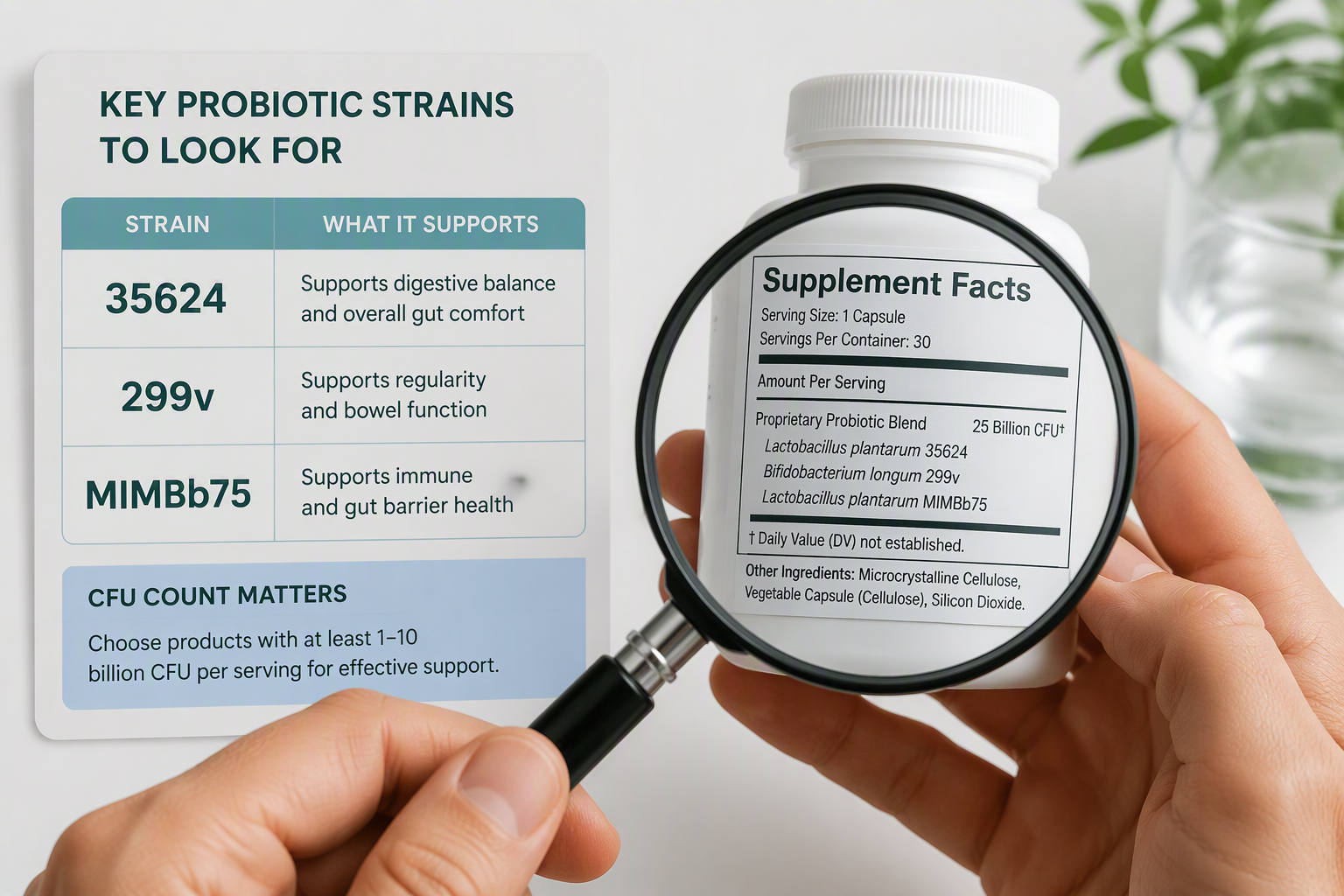
For bloating-related IBS evidence, the full strain code matters more than the genus or species name. The findings for 35624 and 299v apply only to those exact probiotic strains. A bottle labeled only “Bifidobacterium” or “B. infantis” cannot be reliably matched with that research.
Taxonomy changes can make matching harder. Strain 35624 has appeared as Bifidobacterium infantis, Bifidobacterium longum subsp. infantis, and B. longum 35624. Lactiplantibacillus plantarum 299v may appear under its former name, Lactobacillus plantarum, or as DSM 9843. The genus name may change, but the number is the consistent identifier.
The codes that matter for this evidence include:
- 35624: Align contains B. longum subsp. infantis 35624. Earlier IBS research found benefits over placebo for measured symptoms except bowel-movement frequency and stool consistency.
- 299v: Look for this code whether the label says Lactobacillus plantarum or Lactiplantibacillus plantarum 299v. A small trial found abdominal pain resolved in all 20 participants taking 299v, compared with 11 of 20 taking placebo. That result is encouraging, but a small study cannot predict your response.
- MIMBb75: Bifidobacterium bifidum MIMBb75 has been studied in a randomized, double-blind, placebo-controlled IBS trial with symptom and quality-of-life benefits. Those findings belong to MIMBb75 alone, not to every B. bifidum product.
Bifidobacterium lactis is another reason species-only shopping can mislead. Evidence associated with B. lactis does not substitute for evidence on 35624, 299v, or MIMBb75. Specific probiotics need a complete strain name and code.
Before trying a product, check that the CFU dosage, or colony-forming units, is assigned to the named strain rather than listed only as a blend total. If a product does not disclose its probiotic strains, it cannot be matched to this bloating evidence.
How Would You Know a Probiotic Is Working for Bloating?

A probiotic may be helping when bloating days occur less often, feel less intense, or both. Any benefit is usually gradual, modest, and tied to a specific strain, rather than a complete disappearance of bloating.
Bloating can mean pressure, fullness, visible swelling, or a mix of these sensations. A daily record needs more than a severity score to show a useful pattern:
- Severity: Rate the sensation from 0 to 10 and note whether it disrupts meals, work, sleep, or plans.
- Visible distension: Record whether your abdomen looks swollen as well as whether it feels uncomfortable.
- Meal timing: Note whether symptoms appear after particular meals, snacks, or drinks.
- Overnight change: Mark whether bloating eases by morning or remains through the next day.
- Bowel movements: Include constipation, diarrhea, or changes in regularity, since stool buildup can contribute to bloating.
For example, a rating of 6 after a dairy-heavy lunch points to a different pattern than a 6 that begins before breakfast and lasts all day.
Four weeks is a fair first check-in, while eight weeks is a reasonable decision point. Mild extra gas or bloating in the first few days may settle. Stop the probiotic if bloating clearly keeps worsening or occurs with pain rather than trying to push through it.
No meaningful change after eight weeks with a well-matched strain may mean that gut bacteria are not the main driver. Constipation and lactose are the two drivers worth reconsidering at that point.
When Should You Skip Probiotics or Seek Care?
Bloating is common and often manageable, but probiotic safety includes knowing when a supplement trial is not the right next step. Probiotics cannot identify the cause of your symptoms or replace medical care, especially when a new pattern feels noticeably different from your usual lower gastrointestinal symptoms.
Seek prompt medical evaluation if bloating occurs with any of the following:
- Unintentional weight loss: Losing weight without trying can signal a condition that needs assessment.
- Blood in the stool or black stools: These can be signs of bleeding in the digestive tract.
- Fever, persistent vomiting, jaundice, anemia, or fainting: These symptoms should not be self-treated with a probiotic.
- Severe or escalating abdominal pain: Intense, constant, or worsening pain needs timely care.
- Rapidly worsening abdominal distension: A quickly swollen or enlarged abdomen deserves medical attention, particularly when it is painful or paired with vomiting.
A possible bowel obstruction needs urgent care. Severe cramping or constant pain, marked abdominal distension, repeated vomiting, and an inability to pass stool or gas can point to a blockage. Do not add probiotics, fiber, or foods intended to support digestion in this situation, since self-treatment may delay the care you need.
It is also time to stop switching supplements when symptoms are frequent, persistent, disruptive to meals, sleep, work, or family life, or unlike your usual pattern. Recurrent bloating with constipation, diarrhea, pain, or a change in bowel habits can occur with functional gastrointestinal disorders such as IBS. It can also relate to lactose intolerance, food triggers, pelvic floor dysfunction, or another condition that needs a different assessment.
Celiac disease and SIBO can resemble IBS or food intolerance, but testing and treatment differ. Celiac testing is most informative before you start a gluten-free diet because removing gluten first can affect test results. A probiotic may ease symptoms for some people, but it cannot determine whether celiac disease, SIBO, or another cause is behind them.
Inflammatory bowel disease (IBD), including Crohn’s disease and ulcerative colitis, needs condition-specific care. Contact your care team about new, worsening, or persistent bloating, especially with diarrhea, rectal bleeding, fever, weight loss, or substantial pain. Treating these symptoms as routine IBS can miss a flare or complication.
Persistent bloating is not always digestive. Increasing abdominal size, early fullness, pelvic or lower-abdominal pain, urinary urgency or frequency, or symptoms that first appear after midlife merit timely clinical or gynecologic evaluation.
Consult a qualified healthcare professional for persistent, severe, or worsening symptoms, and remember that results vary by person.
What Else Can Reduce Bloating?

Bloating often improves when you address the most likely contributor instead of removing every possible trigger at once. Hard, infrequent, or difficult-to-pass stools can trap stool and gas, leaving your abdomen feeling tight or full. Regular meals, enough fluids, gentle movement, and a gradual fiber increase may support more comfortable bowel habits. Persistent constipation is worth discussing with a qualified healthcare professional.
Fiber can help with constipation-predominant IBS, but increasing it too fast may worsen gas and visible distension. Psyllium forms a gel that can soften stool, and an unflavored product makes an IBS trial easier to interpret because sweeteners and flavorings can add their own symptoms. A gradual approach is usually easier on your digestive system:
- Start small: Use a low amount of psyllium and give your body time to respond.
- Increase slowly: Raise the amount only while symptoms stay manageable, and keep your fluid intake steady.
- Change course if needed: Methylcellulose does not ferment, and partially hydrolyzed guar gum may be worth considering if psyllium repeatedly causes gas.
Food timing can also reveal lactose intolerance. Bloating, gas, or loose stools after milk, ice cream, or other lactose-containing foods may call for a short trial of lactose-free dairy or smaller portions with meals. Reintroducing the food afterward can help confirm the pattern. Yogurt and aged cheeses may be easier to tolerate, so eliminating all dairy without testing your response can be more restrictive than necessary.
When bloating consistently follows onions, garlic, beans, wheat-based foods, or certain fruits, a brief low-FODMAP diet trial can help identify fermentable carbohydrates that do not sit well with you. Gut microbiota can ferment these carbohydrates, producing gas in people who are sensitive to them. The trial is temporary, not a long-term restrictive diet:
- Reduce likely high-FODMAP foods for a limited period.
- Reintroduce one food group at a time in planned portions.
- Keep foods you tolerate and limit only the triggers you identify.
A registered dietitian can help protect nutritional adequacy, especially if your usual diet is already limited.
Fermented foods are another one-at-a-time experiment, not a universal bloating treatment. Live-culture yogurt, kefir, kimchi, sauerkraut, miso, and kombucha affect people differently. Lactose, fiber, carbonation, spice, and fermentable carbohydrates can aggravate symptoms, and processing may destroy live cultures. Check labels and introduce only one new fermented food at a time.
Regular eating, sufficient sleep, physical activity, and stress-reduction practices can affect the brain-gut connection, bowel habits, pain, and bloating. If targeted changes do not help or symptoms disrupt work, meals, or daily plans, a clinician- or dietitian-guided IBS plan is more useful than adding restrictions or supplements.
Probiotics for Bloating FAQs
These FAQs cover common questions about probiotics for bloating, including what product labels mean, what the evidence can and cannot show, and when symptoms may need more attention.
1. Can Probiotics Cause Temporary Bloating?
Yes. Probiotics for gas may cause temporary fullness, gas, or bloating as your digestive system adjusts to a new strain, but this does not show that the product is helping. Responses vary, and some probiotics can make bloating worse. Stop the supplement if discomfort persists, becomes more intense, or clearly worsens after you start it. Seek prompt medical care for severe symptoms, and consult a qualified healthcare professional about ongoing or worsening digestive concerns.
2. Do Probiotics Help With Smelly Gas?
Probiotics are not a reliable treatment for smelly gas. Reviews of probiotics in IBS have not shown a reliable reduction in flatus. The panel reached 75% agreement, but the GRADE evidence was low, so this does not rule out an individual response. Some strains may modestly ease bloating, which is different from reducing frequent, foul-smelling gas. Seek medical evaluation if symptoms persist or occur with pain, diarrhea, constipation, weight loss, or changed bowel habits.
3. Can Prebiotics Worsen Probiotic Bloating?
Prebiotics are nondigestible fibers that gut microbiota ferment, which can increase gas and bloating in some people. Inulin and fructooligosaccharides may be harder to tolerate when added alongside a probiotic, though prebiotics are not harmful and tolerance varies by product and amount.
Try the probiotic by itself first. If you later add a prebiotic fiber or combination product, introduce it gradually so you can better identify the source of any new symptoms.
4. Should You Take Probiotics With Food?
No single timing rule works for every probiotic. Taking it consistently, following the label, and choosing a time you can remember usually matter more than finding a perfect schedule. Bacterial probiotics are often taken shortly before food or several hours after a meal to reduce stomach-acid exposure, but product instructions can differ.
Saccharomyces boulardii is a yeast that is more resistant to stomach acid, so its timing with meals is usually less important. Use a regular routine unless your label or healthcare professional suggests otherwise.