


You don't need to stop a probiotic every time you take medicine. Most healthy people have few established, clinically meaningful probiotic drug interactions, but timing and safety checks depend on the exact strain, your medications, and your health history.
Antibiotics may reduce the activity of susceptible bacterial probiotics, while antifungals can affect yeast-based Saccharomyces boulardii. A 1- to 2-hour gap is often practical for bacterial products and antibiotics, but the label and pharmacist's advice take priority. The Supplement Facts panel should list the organism and strain code, such as Lactobacillus rhamnosus GG or Saccharomyces boulardii CNCM I-745.
Warfarin, immune-lowering medicines, central venous catheters, and serious illness call for added caution. In those situations, bring a photo of the probiotic label and your full medication list to a pharmacist or clinician before starting a live product.
Probiotic Drug Interactions Key Takeaways
- Most healthy adults have few established, clinically meaningful probiotic medication interactions.
- Antibiotics can reduce bacterial probiotic activity without weakening the antibiotic.
- Separate bacterial probiotics from antibiotics by 1 to 2 hours when label directions support it.
- Antifungals may reduce Saccharomyces boulardii activity, and spacing may not solve the concern.
- Check genus, species, strain code, and added ingredients on the Supplement Facts panel.
- Warfarin users should discuss new probiotics with their anticoagulant clinician and consider closer INR monitoring.
- Seek approval before live probiotics with weakened immunity, central venous catheters, serious illness, or recent major surgery.
Do Probiotics Interact With Medications?
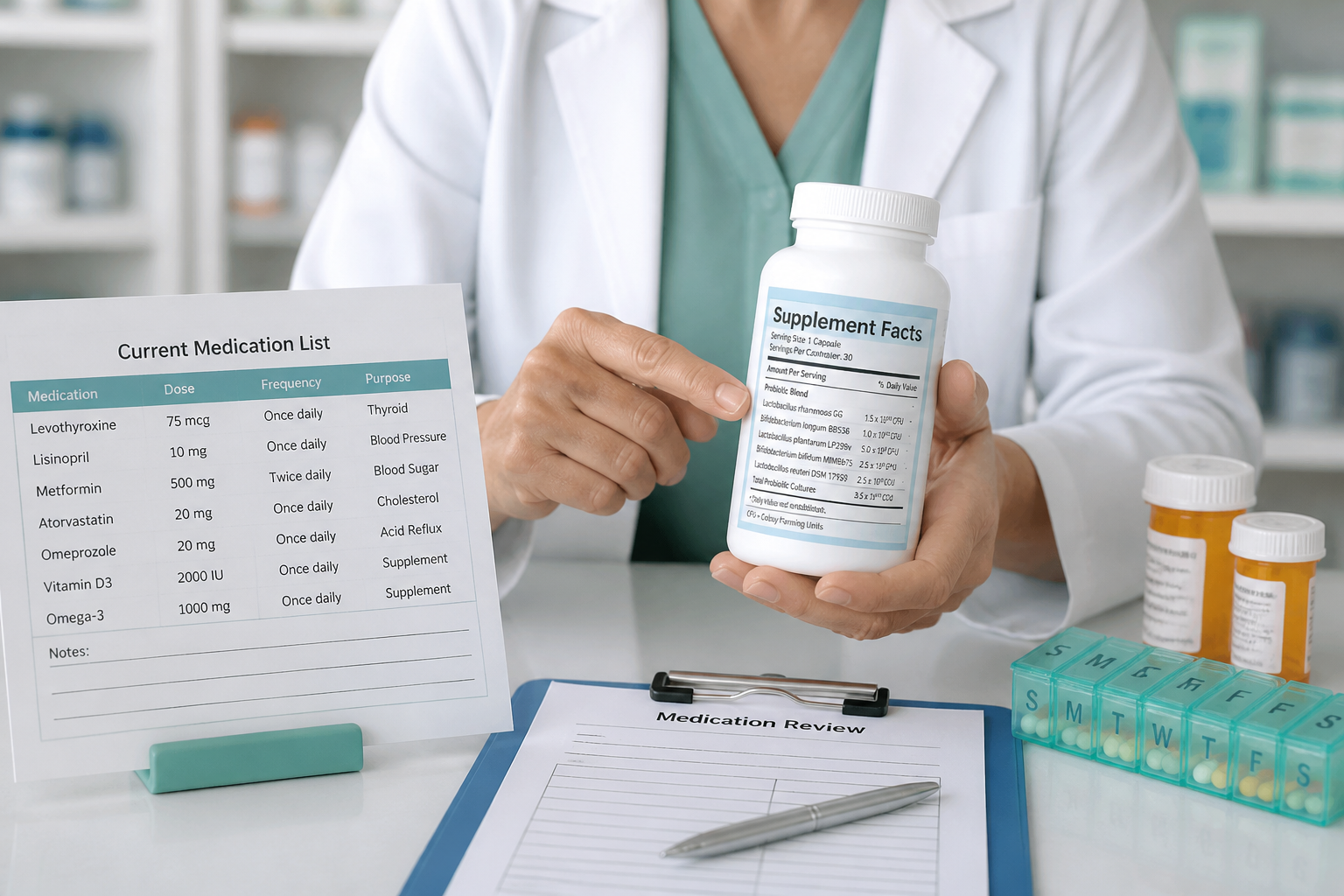
Most healthy people have few well-established, clinically important probiotic medication interactions. Still, probiotic safety is not guaranteed for everyone. A useful review considers the exact product and strain, your prescription and over-the-counter medicines, and health conditions that can raise the risks of taking live organisms. Alcohol comes up for the same reason people ask about medicines, though alcohol and probiotic timing turns out to rest on much thinner evidence than the popular advice suggests.
The label matters more than the word “probiotic.” These products contain live bacteria and may also contain the beneficial yeast Saccharomyces boulardii. Look for a full strain code, not just a species name, because findings for one strain, blend, or brand do not automatically apply to another. Many digestive products do not provide clinical strain codes, which makes their expected effects harder to judge.
For example, research on Bifidobacterium longum subsp. infantis 35624 applies to that strain, not every product labeled Bifidobacterium longum. The same limitation applies to strains such as Bifidobacterium bifidum MIMBb75, Lactobacillus rhamnosus LRa05, and Lactobacillus acidophilus LA85. A colony-forming unit (CFU) count tells you how many organisms are listed, but not whether the product contains the organism studied.
The key distinction is between established probiotic drug interactions and possible biological effects. Changes in the gut microbiota could theoretically affect stomach acidity, intestinal transit, mucus barriers, drug transporters, microbial drug metabolism, or how a medicine is absorbed and processed. That possibility does not establish that probiotics and medication interactions will change your treatment response in a meaningful way.
More often, medication reduces probiotic activity rather than the probiotic causing a dangerous interaction. Antibiotics can suppress susceptible bacterial strains, while antifungal medicines may reduce the activity of yeast-based products such as S. boulardii. The medication and the labeled organism determine whether timing may matter, so a universal spacing rule is not reliable.
Warfarin warrants particular care. Gut bacteria contribute to vitamin K production, so a major shift in gut flora could theoretically affect warfarin response and the international normalized ratio (INR), a blood-clotting test. This uncertainty does not show that every probiotic changes INR, but product-specific guidance from a pharmacist or clinician is appropriate.
Before starting a probiotic, take these practical steps:
- Photograph the complete label: Include strain codes, the ingredient list, and the CFU count.
- Gather everything you take: Bring prescriptions, over-the-counter medicines, vitamins, herbs, and supplements when asking about medications that interact with probiotics.
- Consider higher-risk circumstances: Weakened immunity, serious illness, a central venous catheter, recent major surgery, or immune-lowering medicines can make live probiotics unsuitable, even when an interaction checker shows no warning. Who should avoid probiotics offers more detail about these risks.
A listed interaction, or no listing, is not conclusive because formulations and strain disclosure vary. Bring the label and medication list to a pharmacist or clinician if your health needs are complex or new symptoms occur.
How Should You Time Probiotics With Antibiotics?
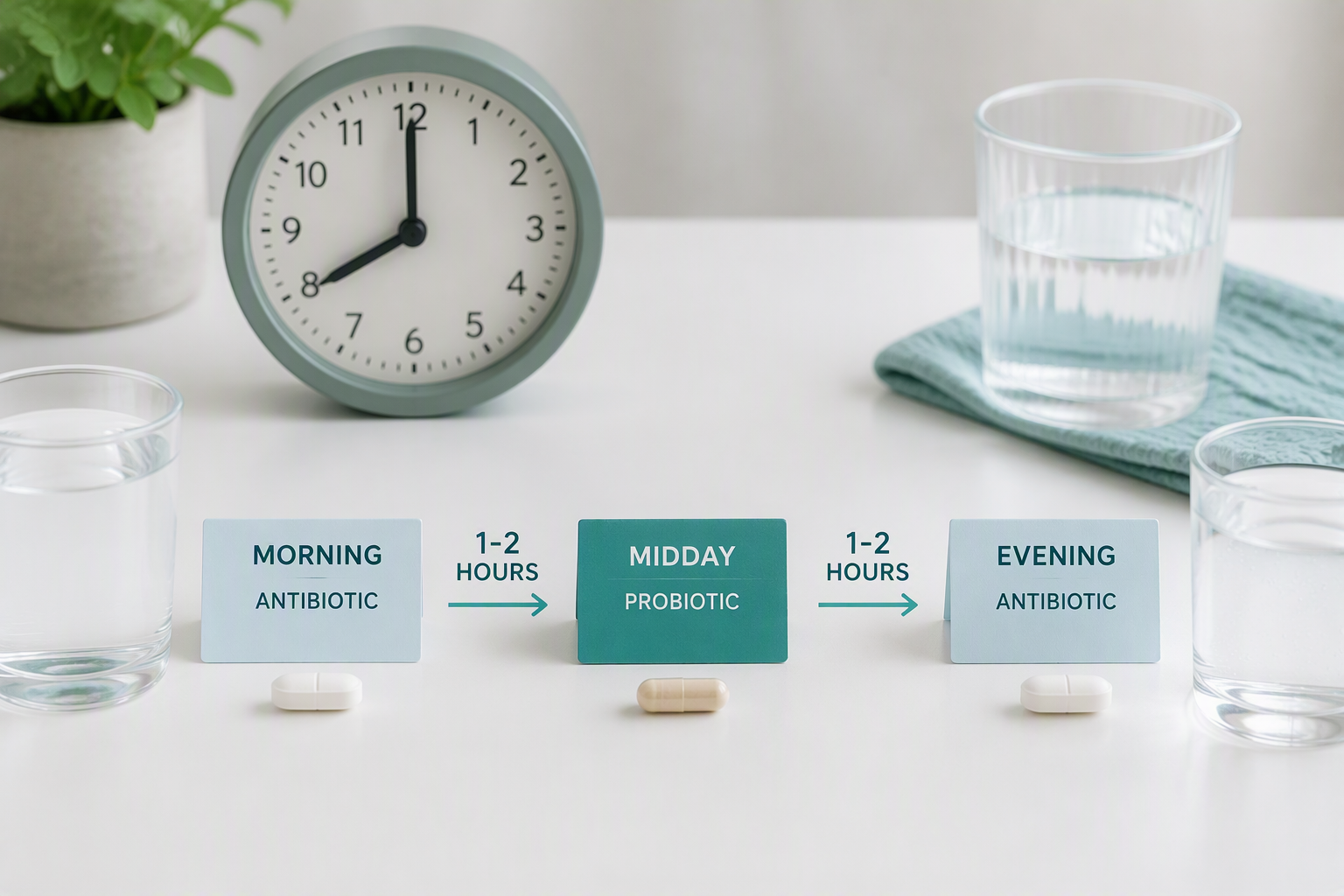
Antibiotics can reduce the activity of susceptible live bacterial probiotics when both are taken together. This concern is about antibiotics killing probiotic bacteria, not probiotics weakening the antibiotic. Keep taking your antibiotic exactly as prescribed, and do not delay, skip, or stop treatment because you also use a probiotic.
For most bacterial products, a practical answer to how long to separate probiotics from antibiotics is at least 1 to 2 hours from each antibiotic dose (source). A longer interval may be needed when the product label or your pharmacist recommends it. If you take an antibiotic in the morning and evening, a probiotic at midday or bedtime may fit your routine, as long as the recommended gap remains intact.
Taking probiotics with antibiotics does not follow one rule for every product. Some formulations may be taken at the same time, while others need more separation. Product directions and pharmacist advice take priority over a general schedule, especially if you take several medicines or have a complicated dosing routine.
A simple label and medication review can help:
- Set the antibiotic schedule first: Take each dose at the prescribed time. The probiotic should fit around the antibiotic, not make an antibiotic dose easier to miss.
- Check the full probiotic identity: Look for the organism’s name and strain code, not broad wording such as “Lactobacillus blend” or “10 strains.” Evidence for one strain does not automatically apply to another product.
- Confirm the timing advice: Compare the probiotic label with your prescription instructions. A pharmacist can help you choose a schedule that accounts for every medication and health condition.
The best-supported strains for reducing the risk of antibiotic-associated diarrhea are Lactobacillus rhamnosus GG and Saccharomyces boulardii CNCM I-745 (source). That evidence is strain-specific, meaning it does not show that every probiotic prevents diarrhea or provides the same benefit. Results can also differ based on the antibiotic, probiotic formulation, and the people studied.
Bacterial probiotics are usually the products most likely to benefit from spacing. In contrast, Saccharomyces boulardii is a yeast-based probiotic, so antibiotics do not target it in the same way they target bacteria. Even so, check the label rather than assuming all probiotics with antibiotics can be timed alike.
A common practice is to continue a probiotic for 7 to 10 days after the antibiotic course ends. This may be reasonable for some products, but it is not a guarantee against antibiotic-associated diarrhea, and spacing also cannot treat severe diarrhea or replace medical care.
Contact a pharmacist or clinician before using a probiotic if you have weakened immunity, take multiple medicines, or cannot identify the product’s organism and strain. Seek prompt medical care for severe diarrhea, bloody stools, fever, signs of dehydration, or worsening abdominal pain.
Is Your Probiotic Bacterial or Yeast-Based?
The Supplement Facts panel, not the front-label word “probiotic,” tells you whether a product contains live bacteria, beneficial yeast, or both. Common bacterial names include Lactobacillus and Bifidobacterium, while Saccharomyces boulardii is a yeast. That distinction matters for probiotics and antibiotics because antibiotics can reduce susceptible bacteria, but S. boulardii is naturally resistant to most antibacterial medicines.
Match the full organism name before relying on general timing advice. Bifidobacterium longum subsp. infantis 35624 is more specific than “B. infantis,” and Lactobacillus rhamnosus GG and Lactiplantibacillus plantarum 299v are distinct bacterial strains. Genus names may change, but the strain’s letters and numbers are usually the most dependable identifier. Strain-specific evidence for one strain does not automatically apply to another strain in the same species.
A complete label review gives a pharmacist or clinician the details needed for individualized guidance:
- Identify each live organism: Look for its genus, species, and strain code, rather than a broad species name alone.
- Check for a single strain or blend: A formula containing bacteria and Saccharomyces boulardii needs different consideration than a single-yeast product.
- Note the full formulation: Record the dose in colony-forming units (CFUs), capsule or powder form, added active ingredients, storage directions, and instructions about meals or medicines.
- Follow antibiotic directions: With a bacterial probiotic, follow the label and consider spacing it from the antibiotic to help preserve the live bacterial dose. This does not mean the probiotic weakens antibiotic treatment.
How long to separate probiotics from antibiotics depends on the bacterial strain and product instructions. Saccharomyces boulardii may not need separation in the same way, though spacing probiotics with antibiotics may still support a simpler routine or follow product-specific directions. A mixed formula should not be treated like a yeast-only product.
Bring the exact label, your complete medication list, and relevant health conditions to a pharmacist or clinician. Extra caution is appropriate with antifungal medicines, immune-lowering treatment, or conditions that raise infection risk. Antifungals may affect yeast-based products, while serious concerns with live probiotics are safety issues rather than conventional drug interactions. Missing strain codes make product-specific guidance less certain.
Can Antifungals Affect Yeast Probiotics?
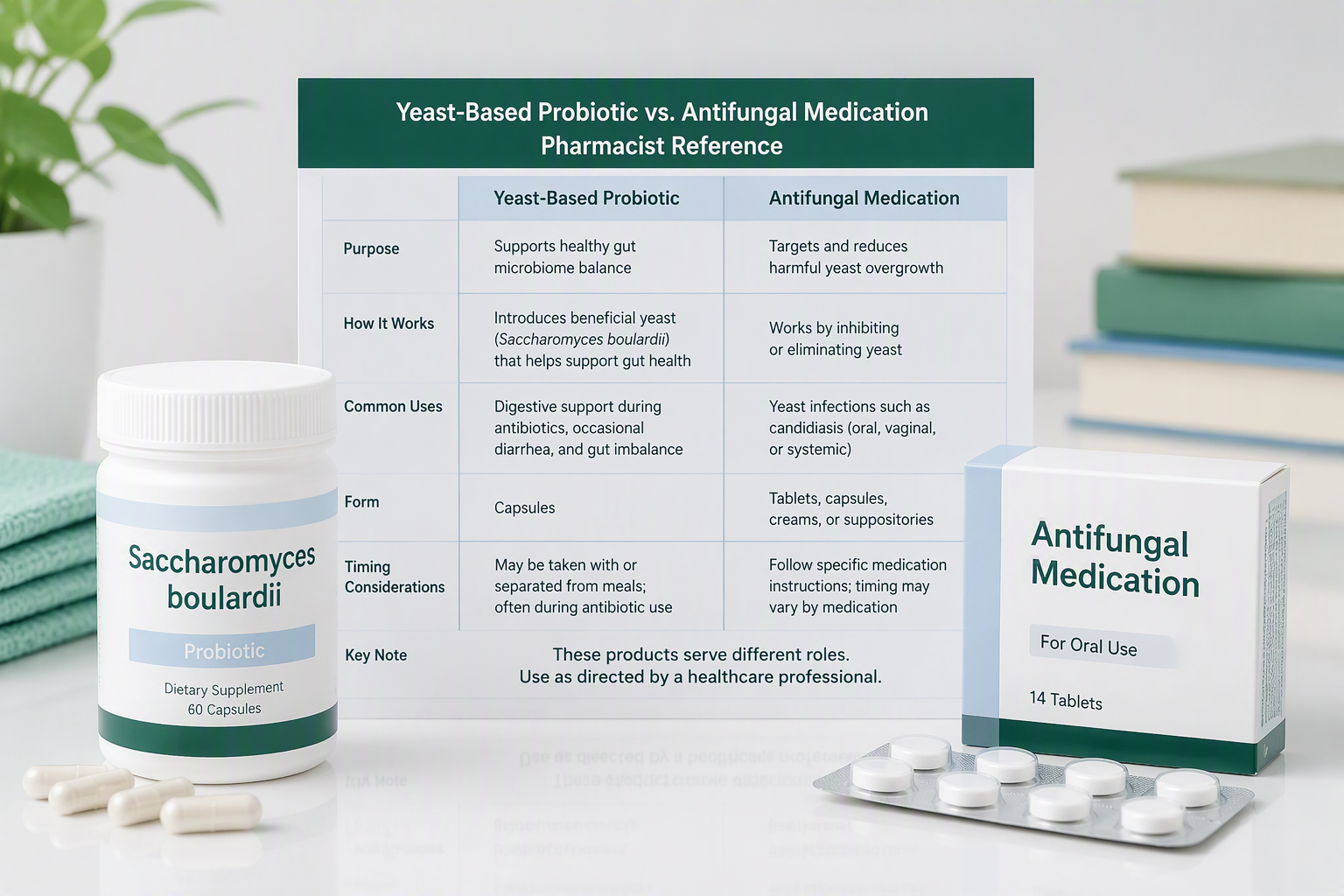
While antibiotics mainly affect bacterial probiotics, antifungal medicines can reduce or neutralize a live yeast probiotic, so the main concern is usually reduced probiotic benefit rather than an automatic harmful interaction for every otherwise healthy adult. Still, probiotics and antifungal medications deserve a closer look when the supplement contains live yeast.
Check the Supplement Facts label instead of assuming that every probiotic is bacterial. Saccharomyces boulardii is a live yeast, and antifungal drugs and probiotics can interact differently from bacterial probiotic strains. The exact strain and full ingredient list matter, particularly in products that combine several microorganisms.
Antifungals worth reviewing before using a yeast probiotic include:
- Clotrimazole: The form of treatment and where it is used can affect whether it is relevant to your probiotic plan.
- Ketoconazole: An oral product may act against the live yeast in a Saccharomyces boulardii supplement.
- Nystatin: Because it targets fungi and yeasts, it calls for individualized guidance when you use a yeast probiotic.
The cautious default is not to take Saccharomyces boulardii at the same time as a prescription antifungal unless your prescriber, pharmacist, or another qualified clinician specifically recommends it. Separating doses by a few hours may be suggested, but timing alone may not keep an oral antifungal from acting on the live yeast during treatment.
Antibiotics are different. Saccharomyces boulardii is naturally resistant to most antibiotics, so it is not directly suppressed in the way many bacterial probiotics are. That distinction does not make it compatible with antifungals. Spacing doses may still make your routine easier or limit stomach upset, but it does not remove the antifungal concern.
A medication review should account for:
- Your probiotic: The exact strain, ingredients, and whether it contains live yeast.
- Your medicines: Prescription, over-the-counter, and antifungal products.
- Your health factors: Weakened immunity and other conditions that can change probiotic safety.
Evidence for many probiotic and medication combinations remains limited. A pharmacist can help you decide whether pausing the yeast probiotic, choosing a non-yeast option, or using a personalized plan makes the most sense for your medications and health history.
Ordinary startup gas is a separate issue from a medicine conflict. Probiotic gas and bloating can help you sort out that possibility while you seek medication-specific advice.
Who Should Avoid Live Probiotics Without Approval?
Beyond medication-specific concerns, live probiotics are usually well tolerated by healthy adults, but people with weakened immunity, central venous catheters, severe illness, or other major health problems should get medical approval first (source). Probiotic safety for immunocompromised people is a precaution, not evidence that these supplements are broadly dangerous. Pregnancy is a separate question, and the evidence on whether probiotics are safe during pregnancy should be considered on its own.
Talk with your pharmacist, doctor, or treating specialist before starting a live bacterial or yeast probiotic if any of these apply:
- Immune-lowering treatment: This includes immunosuppressants such as cyclosporine, tacrolimus, or azathioprine, as well as cancer chemotherapy and high-dose corticosteroids, including prednisone.
- Reduced immunity: Cancer, an organ transplant, autoimmune disease, or another serious condition can make it harder for your body to contain organisms that are normally harmless.
- Severe illness or intensive treatment: Intensive care, hospitalization, or intensive medical treatment calls for product-specific guidance before using a live probiotic.
- A central venous catheter or line: A catheter can give organisms a route into the bloodstream, changing the safety considerations.
- Damaged heart valves: Heart-valve disease can raise the consequences if an infection occurs, even though the initial risk remains rare.
- Serious digestive disease or injury: Short bowel syndrome, severe pancreatitis, gastrointestinal bleeding, recent major abdominal surgery, and open surgical wounds may weaken the intestinal barrier. Black, tarry stools or new severe digestive symptoms need prompt medical evaluation, not self-treatment with a supplement.
The risks of live bacteria and yeast probiotics are uncommon but important in these higher-risk situations. Rare bloodstream bacterial infections and yeast infections have been reported in highly vulnerable patients, and severe illness, poor nutrition, and a damaged intestinal barrier may further increase concern because live organisms can move beyond the gut more easily.
This is not a typical medication interaction. Probiotics and immunosuppressive drugs do not necessarily react chemically, nor do these medicines simply make a probiotic less effective. The concern is that immune suppression may, in rare cases, make it harder to control a live organism that enters the bloodstream or another area where it does not belong.
A careful review of probiotic contraindications and probiotic precautions should consider:
- Your medicines: Include prescriptions, over-the-counter products, injections, recent chemotherapy, and steroid treatment.
- The exact product: Check whether it contains live bacteria, live yeast, or both. Bring the label, strain code, and formulation rather than relying on the word "probiotic."
- Relevant health factors: Mention catheter use, heart-valve disease, recent surgery, serious gastrointestinal illness, immune conditions, and hospitalization.
- Professional guidance: A clinician or pharmacist can weigh the strain, product form, medication list, and health history before advising on use.
A live yeast product can raise different concerns from a bacterial one, and a multi-strain capsule is not interchangeable with a single-strain product. If you are medically stable but unsure, pause before starting and ask a pharmacist or clinician for guidance.
Can Probiotics Affect Warfarin or INR?

For people taking warfarin, typical over-the-counter probiotics have not been shown in strong human studies to routinely cause clinically meaningful interactions with warfarin. Still, warfarin has a narrow safety margin, so caution is sensible. The concern is biologically plausible, but it is not proven or predictable for every product or person.
Gut bacteria can contribute to vitamin K production, which supports clotting-factor production. Warfarin reduces vitamin K-dependent clotting activity, and the International Normalized Ratio (INR) blood test monitors its effect. A major microbiome change could theoretically affect warfarin response or INR, although a probiotic may not meaningfully change vitamin K exposure.
Proposed effects on drug absorption, metabolism, excretion, intestinal enzymes, permeability, transporters, and inflammation also remain largely theoretical. Do not change your warfarin dose, stop taking warfarin, or separate doses from a probiotic to prevent an interaction that has not been established.
Strain-specific evidence is more useful than the broad term “probiotic.” Because products may combine several organisms with prebiotics, vitamins, or other added ingredients, a species name and colony-forming unit (CFU) count provides less useful information than full strain codes.
Before starting a probiotic or changing one, review the following with the clinician managing your anticoagulant:
- Every medicine: Include warfarin, other anticoagulants, prescription medicines, and over-the-counter products.
- The exact label: Share the bottle or a photo of the Supplement Facts panel, including strain codes, dose, and added ingredients.
- Your health history: Probiotic safety for immunocompromised people needs extra care because the risks of live bacteria and yeast probiotics can be higher in certain medical situations.
- Whether INR checks are needed: A clinician may suggest closer monitoring after a new probiotic, brand, strain, or substantial dose change, especially if your INR has been difficult to keep in range.
These probiotic precautions also matter when considering probiotics and immunosuppressive drugs or probiotics and antifungal medications. Individual probiotic safety depends on the exact product and strain, every medicine you take, and relevant health conditions.
Keep your vitamin K intake and usual warfarin routine consistent unless your prescriber advises otherwise. That consistency makes an INR change easier to interpret.
Prompt medical advice is important for these warning signs:
- Unusual or prolonged bleeding
- Frequent nosebleeds
- Severe or unexplained bruising
- Blood in urine or stool, or black stools
- Coughing or vomiting blood
- Symptoms that may suggest a clot
Use a Strain-First Safety Check
To put these medication and safety considerations into practice, a probiotic label is the starting point for assessing probiotic medication interactions because the word "probiotic" does not identify the actual organism. Look for the genus, species, and full strain code, whether the product contains live bacteria or yeast, and any added prebiotics or active ingredients. Bifidobacterium longum subsp. infantis 35624 and Lactobacillus rhamnosus GG identify specific organisms, while a species-only label or a high CFU count does not provide the same detail.
A strain-first review also avoids broad assumptions about probiotic drug interactions. Strains within the same species can have different research records, and evidence for one strain does not automatically apply to another. Taxonomy can change on labels, too, so the strain number or code is often the most reliable detail to match.
Use this sequence before taking a probiotic with a medicine:
- Read the full Supplement Facts panel: Take a clear photo showing every strain code, dose, capsule or powder form, and added ingredients. Inulin, fructooligosaccharides, and other prebiotics are not probiotic organisms, but they can still affect digestive symptoms.
- Check bacterial probiotics against antibiotics: Antibiotics may kill susceptible bacterial strains when both are taken at the same time. This usually reduces the probiotic's likely activity rather than weakening the prescription. Separating doses of a bacterial probiotic and an antibiotic may reduce immediate exposure, but the best timing depends on the product and the prescription label (source). Follow the antibiotic label and your prescriber's instructions, since spacing is not needed for every product.
- Review yeast probiotics separately: Saccharomyces boulardii is not targeted by antibacterial antibiotics in the same way as bacterial probiotics. Antifungal medicines may reduce or eliminate its activity, however. Saccharomyces boulardii CNCM I-745 is a specific strain, not a substitute for every Saccharomyces product. Each organism in a mixed formula needs its own review.
- Consider medicines with little room for dosing changes: Probiotics could theoretically influence intestinal pH, transit time, permeability, microbial enzymes, transporters, or drug bioaccumulation. Those changes could affect absorption, metabolism, clearance, peak concentration, or total drug exposure. Strong human evidence that typical over-the-counter probiotics meaningfully change prescription-drug levels remains limited, but added caution makes sense with narrow-therapeutic-index medicines, including some immunosuppressants and antiseizure drugs.
The main concern in higher-risk situations is usually rare infection rather than a routine medication interaction. Live organisms can, in uncommon cases, enter the bloodstream and cause bacterial or fungal infections. Get specialist approval before starting a live probiotic in these situations:
- Immune suppression: After an organ or stem-cell transplant, during chemotherapy or high-dose prednisone treatment, or while taking cyclosporine, tacrolimus, or azathioprine.
- Serious illness or medical devices: During critical illness or when you have a central venous catheter.
- Major digestive or surgical risk: With severe gastrointestinal disease, short bowel syndrome, or recent major surgery.
Most healthy people have few clinically important interactions, but the right advice depends on the exact product, your medicines, and your health history. Bring the product or label photo and a complete prescription and over-the-counter medication list to a pharmacist or clinician, and ask whether timing, an antifungal medicine, immune status, or a narrow-therapeutic-index drug changes the recommendation.
Probiotic Drug Interactions FAQs
These FAQs cover common probiotic drug interaction concerns, including how medicines and probiotic labels can affect your choices and when a pharmacist or clinician can offer personalized guidance.
1. Can Probiotics Interact With Blood Pressure Medicines?
Clinically important interactions between common probiotics and blood pressure medicines have not generally been established. For most healthy adults, the risk appears low, though limited evidence cannot rule out uncommon or product-specific concerns. Your probiotic strain, full ingredient list, medication regimen, and health history all matter. If you take several medicines, have a complex condition, or feel unsure about a supplement, ask a pharmacist to check the exact product with your prescriptions before you start it.
2. Do Probiotics Interact With Diabetes Medications?
Typical probiotics have little direct evidence of changing how diabetes medicines are absorbed, broken down, or measured in your blood. Meaningful interactions seem uncommon for otherwise healthy adults, but the specific strain or brand, your health conditions, and your full medication list can affect safety.
Unlike supplements that lower blood glucose, probiotics are not known to routinely add to insulin or other glucose-lowering medicines. Check your readings more closely after starting or changing a product, and contact your pharmacist or prescriber about low-glucose symptoms or label concerns.
3. Can Probiotics Affect Birth Control Pills?
A routine direct interaction between probiotics and birth control pills has not been established. For most healthy people, probiotics have few clinically important medication interactions, although the strain or brand, your other medicines, and health conditions still matter. Unlike St. John’s wort, probiotics are not known to speed drug metabolism or reduce pill effectiveness. Severe vomiting or diarrhea can affect oral-pill absorption, and progestin-only pills follow different rules. Check your leaflet and ask a pharmacist about supplements or medication-specific concerns.
4. Do Probiotics Interact With Proton Pump Inhibitors?
No established major interaction is generally recognized between common probiotics and PPIs such as omeprazole. Lower stomach acid may affect a probiotic’s survival or performance, but it does not mean the probiotic makes omeprazole unsafe or less effective. Probiotics and medication interactions vary by strain, formulation, your other medicines, and health conditions. Because medications that interact with probiotics differ by product and person, review the label and your full medication list with a pharmacist, especially if you have a higher infection risk.
5. Can Probiotics Interact With Infliximab?
Probiotics are not known to have a typical drug interaction with infliximab, but here safety matters more than medication effectiveness. Infliximab suppresses parts of your immune system, so the live microorganisms in a probiotic supplement can rarely cause infection when immune defenses are lowered. Do not start, stop, or change a probiotic without guidance from the clinician who prescribes your infliximab, and bring the label or a photo showing the strain, dose, and delivery format.
The right answer depends on your condition, infection history, other medicines, and the specific product. Contact that clinician promptly if digestive illness starts or worsens after a probiotic, and seek urgent care for fever, chills, or other signs of infection. A probiotic does not replace infliximab or individualized treatment.