


You’re trying to decide whether Align Probiotic is worth the recurring cost for bloating, gas, or IBS. It may be worth a 30-day trial when broader IBS symptoms are the concern, but it is less likely to provide predictable changes in constipation, diarrhea, or stool consistency.
Its value rests on Bifidobacterium longum subsp. infantis 35624, a named strain studied in IBS, rather than on its CFU count. In a placebo-controlled trial involving 362 women with IBS, the strain improved several overall symptoms, including pain and bloating, but research did not show the same benefit for bowel-movement frequency or stool consistency.
Finished Align products have not themselves been clinically tested, and ingredients matter alongside the strain evidence. It contains milk protein, so it is not suitable for a milk allergy, while temporary gas or bloating can occur when starting a probiotic. A worthwhile trial means a tolerable, meaningful change in the symptoms that most disrupt your day.
Align Probiotic Key Takeaways
- Align contains the named IBS research strain B. longum subsp. infantis 35624.
- Evidence is stronger for overall IBS symptoms, pain, and bloating than stool frequency or consistency.
- Published trials studied strain 35624, not necessarily the finished Align formulas sold today.
- Align contains milk protein and is unsuitable for people with a milk allergy.
- Temporary gas, bloating, or mild digestive discomfort can occur when starting Align.
- Align is shelf-stable, taken once daily, and should be stored below 77°F.
- A 30-day trial can help determine whether symptom improvement justifies the ongoing cost.
What Is Align Probiotic?
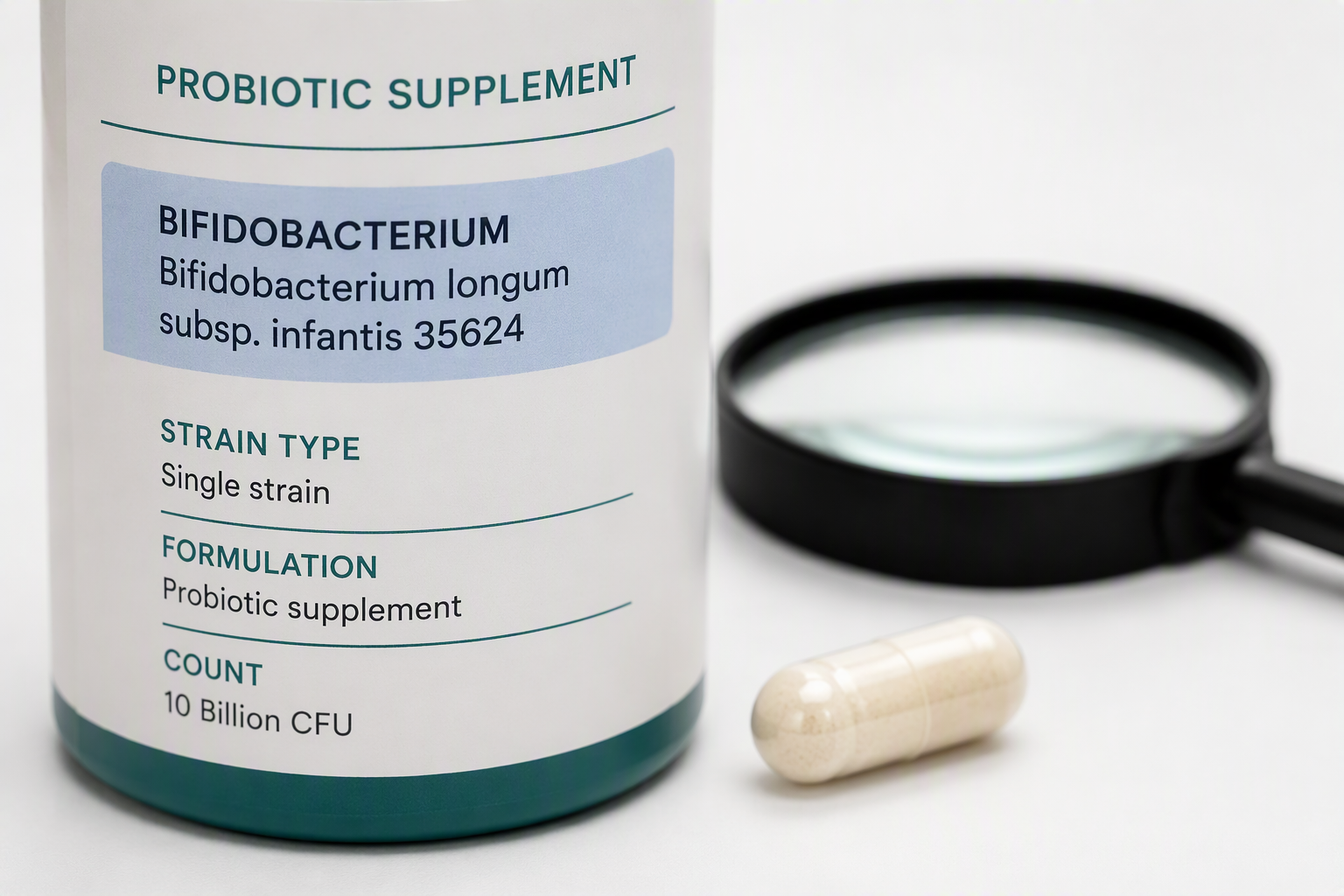
Align Probiotic is a daily, single-strain supplement for digestive support, not a blend of multiple probiotics. Its label identifies Bifidobacterium longum subsp. infantis 35624, which may also appear as Bifidobacterium longum 35624 or Bifidobacterium infantis 35624. The number 35624 matters because probiotic findings apply to a specific strain, not to every Bifidobacterium product or probiotics for gut health in general.
Align digestive support is marketed for bloating, gas, and changes in bowel habits. It is a dietary supplement, not an approved treatment for irritable bowel syndrome (IBS), and it cannot replace a diagnosis or medical care. A daily trial may help some people, but it is not a cure and cannot promise symptom relief.
Published IBS research evaluated Bifidobacterium 35624 rather than the finished Align formulation sold in stores. In a placebo-controlled trial, the strain performed better than placebo for most measured IBS symptoms, but not for bowel-movement frequency or stool consistency. That limitation matters when constipation or diarrhea is your main concern. Align’s finished product has not itself been clinically tested, so strain findings may not apply equally to every format or person.
Clear strain labeling makes Align easier to assess than many multi-strain supplements that list species without clinical strain codes. Align says 35624 has more than 20 years of research and that gastroenterologists recommend the brand nearly twice as often as other brands. The brand does not explain how that recommendation comparison was measured.
A clinically tested probiotic is best judged by details that match your needs:
- Strain identity: The label should name the exact strain studied in people.
- Symptom fit: Research should address the symptoms you hope to manage.
- Formula tolerance: Ingredients should suit your dietary needs and sensitivities.
If you decide to try it, you can buy Align Probiotic directly. Probiotic supplements compared on strain evidence can help place its transparency in context.
Persistent, severe, or worsening digestive symptoms warrant guidance from a qualified healthcare professional.
What Features Does Align Probiotic Offer?
Align Probiotic is designed for a low-effort routine: one capsule or chewable tablet daily. Label directions allow a dose with or without food and at any time, which may suit a packed workday, school pickup, or travel schedule. Convenience can help you take it consistently, but it does not guarantee relief from bloating, gas, irregular bowel habits, or IBS.
Its freeze-dried bacteria do not need refrigeration, so the package can travel more easily than a refrigerated probiotic. Follow the package storage directions and best-by date, since heat, moisture, and extended storage can reduce the number of live bacteria.
The label reports colony-forming units (CFU), which measure viable bacteria. Align states that it contains 1 billion live bacteria at manufacture and at least 10 million CFU through the best-by date, a figure that reflects survival in the package rather than how well it may help your symptoms, so a higher CFU count is not automatically a better choice.
A key feature of Align digestive support is its named strain, Bifidobacterium longum subsp. infantis 35624. Many digestive probiotics list several species but no clinical strain code. When comparing products for diagnosed IBS, research on the exact strain matters more than the CFU number alone.
The practical advantages and limits include:
- Advantages: One daily dose, no refrigeration, and a choice of capsule or chewable tablet.
- Evidence context: A named strain makes comparison easier, but research on strain 35624 does not equal direct testing of every finished Align format.
- Personal fit: Align ingredients, allergens, cost, possible side effects, and your symptom pattern all affect whether it makes sense to try.
A probiotic cannot replace diagnosis or medical care.
What Does 35624 Evidence Show for IBS?
Bifidobacterium 35624 has unusually relevant IBS evidence, but it may help manage symptoms rather than cure IBS or work the same way for everyone. When weighing an Align IBS probiotic, the strain code is the key detail because scientific names have changed. Older studies use Bifidobacterium infantis 35624, while newer labels may list Bifidobacterium longum subsp. infantis 35624 or Bifidobacterium longum 35624.
Whorwell and colleagues studied an encapsulated 35624 preparation in a multicenter, randomized, double-blind, placebo-controlled, dose-ranging trial of 362 women with IBS in primary care. The participants included people with constipation-predominant, diarrhea-predominant, and mixed IBS, so this was evidence for the tested 35624 product rather than for probiotics as a whole (source).
At the best-performing dose, the trial found improvement in the overall symptom picture, including abdominal pain or discomfort, bloating or visible distension, and difficulty with bowel movements. That may be meaningful when pain and bloating disrupt meals, work, or sleep. Still, Align for IBS should not be expected to bring immediate relief or produce the same result for every person.
An earlier placebo-controlled study by O’Mahony and colleagues found that Bifidobacterium 35624 performed better than placebo on the IBS symptoms measured, except bowel-movement frequency and stool consistency (source02155-9/fulltext)). The evidence is therefore stronger for overall symptom relief, pain, and bloating than for making stools reliably firmer, looser, more frequent, or less frequent.
For IBS, compare the trial population and exact formula with your own situation: The details that matter most include:
- The strain code: The full 35624 identifier ties the product to the IBS research. A genus or species name alone does not.
- The study population: Trials in people diagnosed with IBS are more relevant than general digestive-health marketing claims.
- The exact formula: The label should name the studied strain, while the other ingredients should fit your dietary needs and symptom pattern.
Positive placebo-controlled research carries more weight than marketing language, but one trial cannot establish equal benefit across every IBS subtype, severity level, or symptom pattern. Before treating the findings as definitive, review the primary publication for participant completion and author or product affiliations.
Strain-specific evidence also does not automatically validate every retail formula. Research on Bifidobacterium infantis 35624 applies only when a product identifies and supplies that exact strain, not necessarily every Align dose, capsule ingredient list, allergen profile, or manufacturing batch. Match the label to 35624, then weigh cost, ingredients, allergens, and daily-use fit before deciding whether this irritable bowel syndrome probiotic belongs in your routine. UltraFlora, the 299v single-strain alternative, is the other retail strain with its own IBS trial, on a much smaller scale.
Which Ingredients and Allergens Matter?
Because that evidence applies to the strain rather than every formula detail, Align’s active ingredient is Bifidobacterium longum subsp. infantis 35624, the strain evaluated in IBS research. The remaining Align ingredients are capsule excipients, not added probiotic strains. They can still matter if you avoid certain allergens, follow a vegetarian or gluten-free diet, or find that particular additives affect your digestive health.
The reported inactive ingredients are:
- Microcrystalline cellulose: Capsule filler.
- Hypromellose: Plant-based capsule material.
- Sugar: Includes sucrose.
- Magnesium stearate: Manufacturing aid.
- Milk protein: The clearest documented allergen concern.
- Titanium dioxide: Whitening color additive.
- Propyl gallate: Antioxidant preservative.
- FD&C Blue No. 1: Artificial color.
- Sodium citrate dihydrate: Stabilizing ingredient.
- Riboflavin: Colorant and vitamin.
Align is marketed as vegetarian and gluten-free, but it contains milk protein. Because it contains milk protein, Align is not appropriate if you have a milk allergy, and gluten-free labeling also does not make a supplement suitable for every food sensitivity. If an allergy is severe or an ingredient restriction is medically necessary, confirm the current package label with the manufacturer or a pharmacist before use.
Formulas can change, and online retailer listings may not match the package in your hand. Checking the box matters most when you are avoiding an ingredient for medical reasons.
Added sugar and FD&C Blue No. 1 may lead you to prefer a simpler formula, especially if you limit artificial colors. Their presence alone does not show that they cause bloating, IBS symptoms, or other digestive problems.
Titanium dioxide in supplements needs measured context. European regulators have raised potential genotoxicity concerns, meaning possible DNA damage, but that does not establish a dose-specific risk from the small amount in Align. The same caution applies to propyl gallate, magnesium stearate, colorants, and sucrose. Product-specific clinical evidence does not support broad claims that these ingredients are inherently toxic or cause digestive symptoms.
A past reaction to an additive is more useful than alarming product reviews when choosing a probiotic. Results vary by person, and persistent, severe, or worsening symptoms warrant guidance from a qualified healthcare professional.
How Easy Are Daily Use and Storage?
Align is straightforward to take if a once-daily probiotic suits your routine and you can keep it away from heat. According to the product directions, the capsule and chewable tablet are each taken once daily, with or without food, at any time of day. That flexibility can fit busy mornings, irregular meals, commutes, or travel.
Format preference is the main practical difference:
- Capsules: Offer a quick, neutral option if you’re comfortable swallowing pills.
- Chewables: May be more manageable if swallowing pills is difficult, though checking the ingredient panel matters if you’re sensitive to added ingredients.
Align is shelf-stable and does not require refrigeration, which removes a common obstacle for commuters and travelers. Keep each capsule or chewable in its original blister packaging until use, and store the package below 77°F (25°C).
The separated blister pack travels well in a purse, desk drawer, or carry-on, but it does not protect against high temperatures. Do not leave Align in a hot car, near a heat source, or anywhere that exceeds the label guidance, because proper storage is intended to protect potency through the product’s shelf life, not guarantee symptom relief.
For busy adults with gas and bloating, this format has few routine barriers. Convenience can help you take it consistently, but it does not determine whether Align will help your IBS or irregular bowel habits. Watch for probiotic side effects, such as new or worsening digestive discomfort.
What Side Effects and Safety Warnings Apply?
Align is generally well tolerated by many adults, yet temporary gas, bloating, or mild digestive discomfort can happen when you begin a probiotic. That can be particularly frustrating if IBS already causes similar symptoms. A brief adjustment is different from symptoms that are severe, do not ease, or clearly get worse after you start taking Align.
A 2023 review of 81 randomized controlled trials (RCTs), including 9,253 participants, reported adverse events in 11.62% of probiotic users and 10.61% of placebo users. Serious adverse events were uncommon, reported in 0.15% and 0.22% of participants, respectively (source). These are raw pooled reports, not a formal safety comparison, because many trials did not assess whether the probiotic caused an event and some recorded usual IBS symptoms as adverse events.
Colony-forming units measure the number of live microorganisms in a probiotic. They do not indicate whether a product is safe for you or likely to suit your symptoms, because the strain, ingredients, and your health history matter more than a high CFU count alone.
Stop taking Align and seek urgent medical care if you develop possible signs of an allergic reaction:
- Rash or hives: These may signal an allergic response, particularly if they begin after a dose.
- Trouble breathing: Breathing problems need emergency evaluation.
- Swelling of the face, lips, tongue, or throat: This can indicate a severe reaction and should not be monitored at home.
Align is not suitable if you have a milk allergy. Lactose intolerance and milk allergy are different conditions, and digestive upset alone is not the same as anaphylaxis.
Individual clinical advice is important before trying Align in these situations:
- A weakened immune system: Reduced immune defenses can change the safety considerations for probiotics.
- Long-term corticosteroid use: These medicines may affect immune function.
- Pregnancy, planned pregnancy, or breastfeeding: A clinician should guide probiotic use during these stages, since this review cannot determine whether Align fits your pregnancy, medication regimen, or health condition.
Align should not replace medical assessment or prescribed treatment. Speak with a qualified healthcare professional about persistent, severe, or worsening bloating, pain, bowel changes, fever, vomiting, bleeding, unexplained weight loss, or any new concerning symptom.
How Much Does Align Probiotic Cost?
After weighing safety and tolerability, treat Align as a once-daily expense rather than judging it by the bottle price alone. Divide the shelf price by the number of capsules to estimate your daily cost. A 28-capsule bottle lasts about four weeks, while a larger size only saves money if the lower per-capsule cost outweighs the upfront spend and you can use it before the best-by date.
A retailer comparison is only meaningful when the Align formulation and capsule count are identical. Check the final daily cost after:
- Shipping and taxes: These can erase a lower displayed price.
- Coupons and Subscribe & Save discounts: Confirm whether a discount requires repeat deliveries or other conditions.
- Membership requirements: A member-only offer may not be the lowest cost for you.
Amazon marketplace prices and promotions can change quickly, so the checkout total matters more than the advertised deal.
Bottle size also affects how much financial risk you take:
- Smaller bottle: This is a sensible starting point while you learn whether Align fits your symptoms, routine, and budget.
- Multi-month supply: This may suit you after you have decided to take it consistently and checked the best-by date.
- Amazon ratings: A 4.7 out of 5 rating from 10,709 global ratings reflects customer sentiment, not your likely symptom relief or the product’s value.
In an Align probiotic review, the case for a higher daily cost rests on strain-specific evidence, not CFU count alone. Align identifies Bifidobacterium longum subsp. infantis 35624, a named strain with IBS-specific research. According to the manufacturer, it provides 1 billion CFUs when made and guarantees 10 million through at least the best-by date. A larger label number does not automatically mean better value or better results.
Judge the cost against your own response during a consistent trial. A premium price does not guarantee greater clinical benefit for bloating, gas, or irregular bowel habits.
You can check the current pack size, count, and pricing on the Align Probiotic listing before deciding whether a four-week trial is worth it to you.
What Are Align Probiotic’s Pros and Cons?
Beyond the daily cost, Align’s main strength is traceability. This Align IBS probiotic names Bifidobacterium longum subsp. infantis 35624, while many products list only a species or an unnamed blend, a distinction that matters because IBS research applies to strain 35624, not to every Bifidobacterium product.
The practical benefits and limitations are clear:
- Strain-specific evidence: Align reports more than 20 years of research and over 50 publications and abstracts involving strain 35624. Among products discussed for diagnosed IBS, this strain has substantial trial evidence, though that evidence does not automatically apply to every Align formula or marketing claim.
- Convenience: The once-daily, shelf-stable capsule can suit a packed schedule and does not require refrigeration. Align for IBS may help manage occasional bloating, gas, or abdominal discomfort, but results vary by person.
- Milk-derived ingredients: Align is not appropriate if you have a milk allergy or avoid dairy-derived components. A simpler formula may also be preferable when your digestive system is sensitive to fillers or excipients.
- Higher ongoing cost: Brand recognition, shelf stability, and a named clinical strain may make the price worthwhile if you value convenience and transparency. Still, no irritable bowel syndrome probiotic is the best probiotic for everyone.
Treat Align as a time-limited personal trial, then decide whether any symptom change justifies the recurring cost. This Align probiotic review provides general information.
Is Align Probiotic Worth It?
Weighing those practical benefits and limitations, Align may be worth a 30-day trial if bloating, gas, abdominal discomfort, or the day-to-day burden of IBS are your main concerns, because 35624 has IBS-specific trial evidence (source). It is less compelling for predictable relief from constipation or diarrhea, or for consistent changes in stool frequency or consistency. Align may help manage symptoms for some people, but it does not cure IBS.
Its key feature is Bifidobacterium longum subsp. infantis 35624, also called strain 35624. That code matters more than capsule count or broad digestive-health claims. In a 2005 placebo-controlled trial, researchers enrolled 75 adults with IBS and 62 completed the study. The University College Cork research team studied 35624 supplied by Procter & Gamble, and the strain improved measured symptoms except bowel-movement frequency and stool consistency.
The evidence applies most directly to strain 35624, not necessarily every feature of the finished Align product sold now. A successful trial means a meaningful, tolerable improvement in the symptoms that disrupt your routine, not complete relief from every digestive symptom.
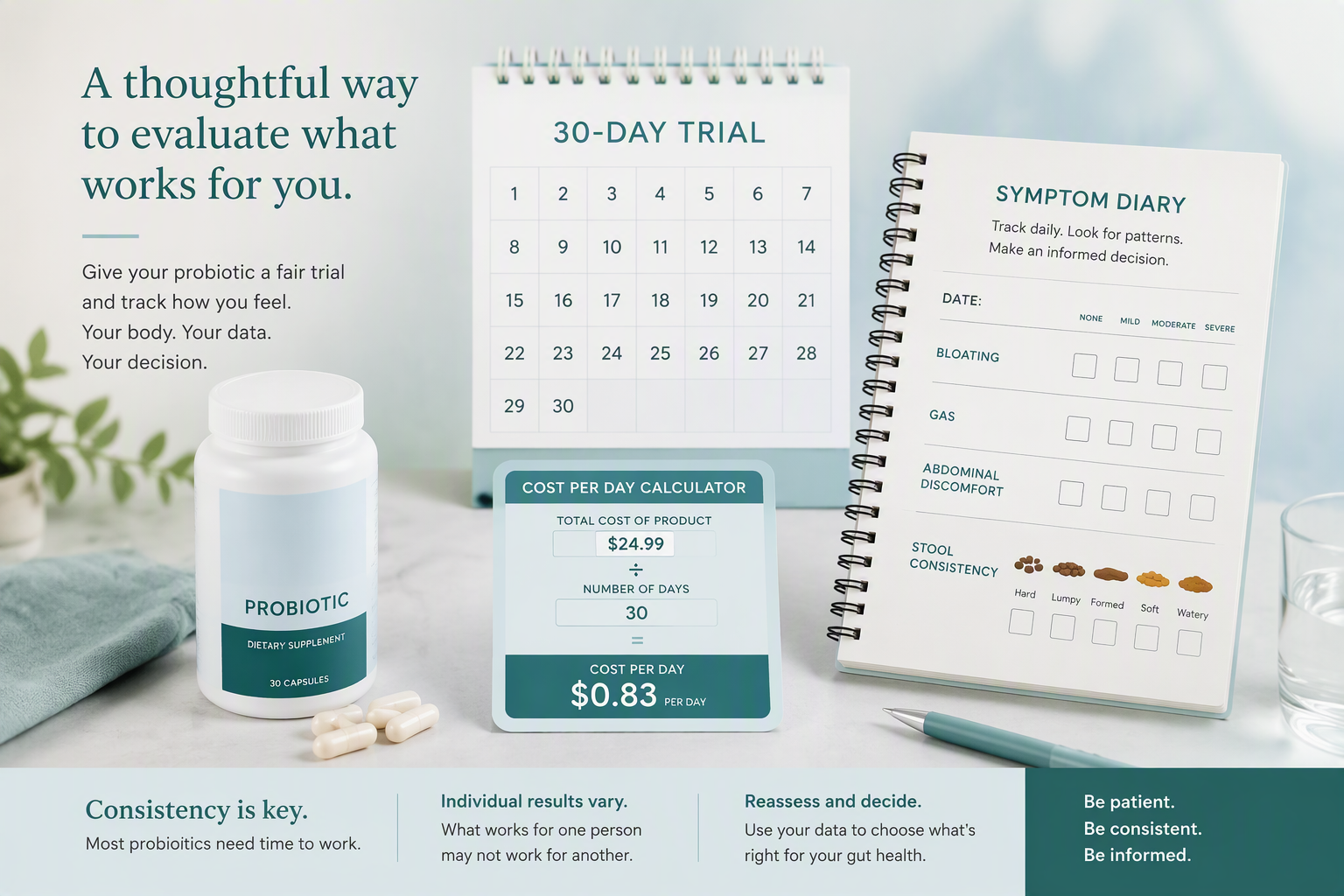
A practical 30-day trial includes:
- Target symptoms: Choose one or two symptoms, such as bloating after meals, gas, abdominal discomfort, or overall IBS disruption.
- Formula fit: Each once-daily capsule contains 1 billion colony-forming units (CFUs) at manufacture, with 10 million CFUs guaranteed through the best-by date. CFU totals alone do not establish effectiveness.
- Ingredient tolerance: Review the ingredient panel before buying if you are sensitive to inactive ingredients or additives.
- Value: Divide the package price by its daily servings to determine your 30-day cost, then continue only if the benefit feels worthwhile and tolerable.
A higher price, larger CFU number, or strong retailer rating does not demonstrate better IBS results. Compared with Seed probiotic, Garden of Life probiotic, or Spring Valley Probiotic, Align is easier to assess because it names a clinical strain code. A scan of roughly 30 leading digestive and IBS products suggested that strain-code disclosure is still uncommon, but that finding should be treated as internal research unless the scan methodology is published.
Biotics 8’s ten strain codes for men and Garden of Life’s 16-strain capsule both invite the same test: an exact strain code, relevant human research at the marketed dose, ingredient tolerance, and an acceptable cost per serving.
Digestive symptoms can have many causes, so consult a qualified healthcare professional for persistent, severe, worsening, or changing symptoms.
How Does Align Compare With Other Alternatives?
Compare probiotics by the strain code and the symptom you want to address, not by the largest CFU count or highest rating. Align identifies Bifidobacterium longum subsp. infantis 35624. The 35624 code matters more than the genus name on a label because probiotic taxonomy can change. In a scan of roughly 30 leading IBS and digestive products, almost none disclosed a clinical strain code. That means a 10-strain, 60-billion-CFU product without codes cannot be assumed comparable to Align for digestive health.
Evidence should match the exact organism, then the dose and finished formula used in human research. Findings on 35624 do not automatically apply to every product that lists the same species. The same caution applies to B. bifidum products that are not the MIMBb75 strain. The YourBiology vs Biotics 8 comparison illustrates an important gap: even a product with 10 disclosed strain codes may not have IBS trials for those specific strains.
Symptom priorities can help narrow your options:
- Broader IBS symptoms: In the 2005 O’Mahony human trial, 35624 performed better than placebo for IBS symptoms except bowel-movement frequency and consistency. Align may therefore fit broader symptom support better than a goal of changing stool frequency or form.
- Abdominal pain: Lactiplantibacillus plantarum 299v was studied in a small 40-person trial. All 20 participants receiving 299v reported pain resolution, compared with 11 of 20 receiving placebo. The small sample limits certainty.
- Formula simplicity: Align’s strain-centered formula may be easier to assess during a targeted trial. Inulin, enzymes, vitamins, herbs, and extra strains can make it harder to identify what you tolerate, especially if fermentable ingredients trigger symptoms.
When comparing probiotics for gut health, consider the clinical strain code, relevant human IBS research, dose support, formula and allergen fit, and cost per serving. Pendulum’s Akkermansia and its metabolic research shows how an organism can be genuinely interesting and still be the wrong match for bloating or bowel changes.
No product suits everyone.
Who Should Use Align Probiotic?
Align may be a reasonable daily option if you are an adult with occasional gas, bloating, or mild abdominal discomfort that feels familiar and is not getting worse. It is marketed to support digestive balance and symptoms, not to diagnose an unexplained digestive problem or replace medical care.
Adults with diagnosed IBS may prefer Align when they want a single, strain-identified probiotic rather than a broad multi-strain blend. It contains Bifidobacterium longum subsp. infantis 35624, a strain with substantial trial evidence in people with diagnosed IBS, and the strain code matters because evidence for one strain does not automatically apply to every product containing the same species.
A daily trial may fit if you can take one capsule consistently as part of a broader symptom-management routine. Align may help manage some symptoms, but it may not improve every person’s pain, bloating, diarrhea, constipation, or changes in bowel habits. Results vary by person, and any dietary or supplement advice should be individualized.
Professional guidance is especially important in these situations:
- Ingredient concerns: You have an allergy or sensitivity to an ingredient, or you have experienced probiotic side effects before.
- Higher medical risk: You have a weakened immune system, a serious underlying condition, or a complex medication regimen.
- Pregnancy or breastfeeding: A clinician or pharmacist can help determine whether a probiotic is appropriate, even when it is sold over the counter.
- Concerning symptoms: Persistent diarrhea or constipation, worsening pain, unexplained weight loss, rectal bleeding, fever, or symptoms that wake you from sleep need medical evaluation rather than self-treatment.
This adult-focused review is not a guide to selecting a probiotic for a child. Although Align markets pediatric products for children ages 4 and older, childhood abdominal symptoms, dietary needs, possible diagnoses, and formulations need separate assessment by a pediatric clinician.
Digestive symptoms can have many causes, and persistent, severe, or worsening symptoms warrant care from a qualified healthcare professional.
If you want to try Align, you can get it here.
Align Probiotic FAQs
These FAQs address what to consider before trying Align Probiotic, from daily use and possible side effects to IBS symptom fit and when medical guidance may be appropriate.
1. How Long Does Align Take to Work?
Align is designed for continued daily use, not immediate relief. Changes in bloating, abdominal discomfort, or bowel habits may appear sooner for some people, while others notice no meaningful benefit. Clinical-study timelines for Bifidobacterium longum subsp. infantis 35624 cannot predict how Align will affect your symptoms.
If symptoms remain unchanged after a consistent, reasonable trial, reassess rather than using it indefinitely. Persistent, severe, worsening, or unfamiliar digestive symptoms need evaluation from a qualified healthcare professional. Align may help manage symptoms for some people, but it does not replace diagnosis or prescribed treatment.
2. Can You Take Align With Antibiotics?
Antibiotics may affect the bacteria in Align, so ask your pharmacist or prescribing clinician whether it suits your specific medication and whether spacing doses is advisable. Its one-capsule daily routine can be taken with or without food, which may make timing easier.
Align supports daily digestion but does not replace antibiotics or other prescribed treatment. Take your antibiotic exactly as directed, and get prompt medical advice for severe, persistent, or worsening symptoms, including diarrhea during or after treatment.
3. Does Align Need Refrigeration?
No. Align is shelf-stable, so refrigeration is not required. Freeze-dried bacteria and protective blister packaging help preserve the capsules at room temperature, making them convenient for a desk, purse, or travel bag while you assess whether they help with gas and bloating. Store Align below 77°F (25°C), and keep each capsule in its original blister pack until use. Extended heat and moisture can still affect quality, so avoid hot cars and steamy bathrooms.
4. Can Align Help With Bloating?
Align may help with bloating when it is part of IBS, since its B. longum subsp. infantis 35624 strain has IBS-specific research. In an earlier Gastroenterology trial, 35624 performed better than placebo for IBS symptoms except bowel-movement frequency and consistency. That finding does not mean it will relieve every case of occasional bloating, which has many possible causes. Results vary, and temporary gas or bloating can occur when you first start it. Seek medical evaluation for persistent, severe, worsening, or otherwise concerning bloating.