


Seed's 24 named strains are not 24 evidence-backed doses. Although DS-01 identifies strain codes and guarantees 53.6 billion AFU through expiration, it doesn't disclose how much of each strain you take. That makes it impossible to compare a named organism with the dose used in its human studies.
A premium subscription can seem easier to justify when the label is detailed and the capsules need no refrigeration. Yet the pomegranate-derived prebiotic, which Seed describes as non-fermentable, can still coincide with bloating, bowel changes, or discomfort in sensitive people. Total AFU and capsule design don't establish that the finished blend will improve IBS symptoms.
Symptom-specific options such as Align's Bifidobacterium longum subsp. infantis 35624 offer a disclosed strain identity with relevant IBS research. A named strain at a stated dose gives you a clearer basis for comparing cost, tolerability, and likely fit.
Seed's 24 Strains Key Takeaways
- Seed names 24 strains, but does not disclose the dose of each strain.
- A 53.6-billion-AFU total cannot confirm research-matched dosing for any individual organism.
- AFU and CFU use different measurement methods and should not be compared unit for unit.
- Named strain codes improve transparency, but formulation breadth does not prove symptom relief.
- Seed's pomegranate-derived prebiotic may still cause bloating or bowel changes in sensitive people.
- Shelf-stable capsules and detailed labeling are practical strengths, not evidence of IBS effectiveness.
- Alternatives with disclosed strain doses may offer clearer symptom-specific value than Seed.
What Is Seed DS-01 Daily Synbiotic?
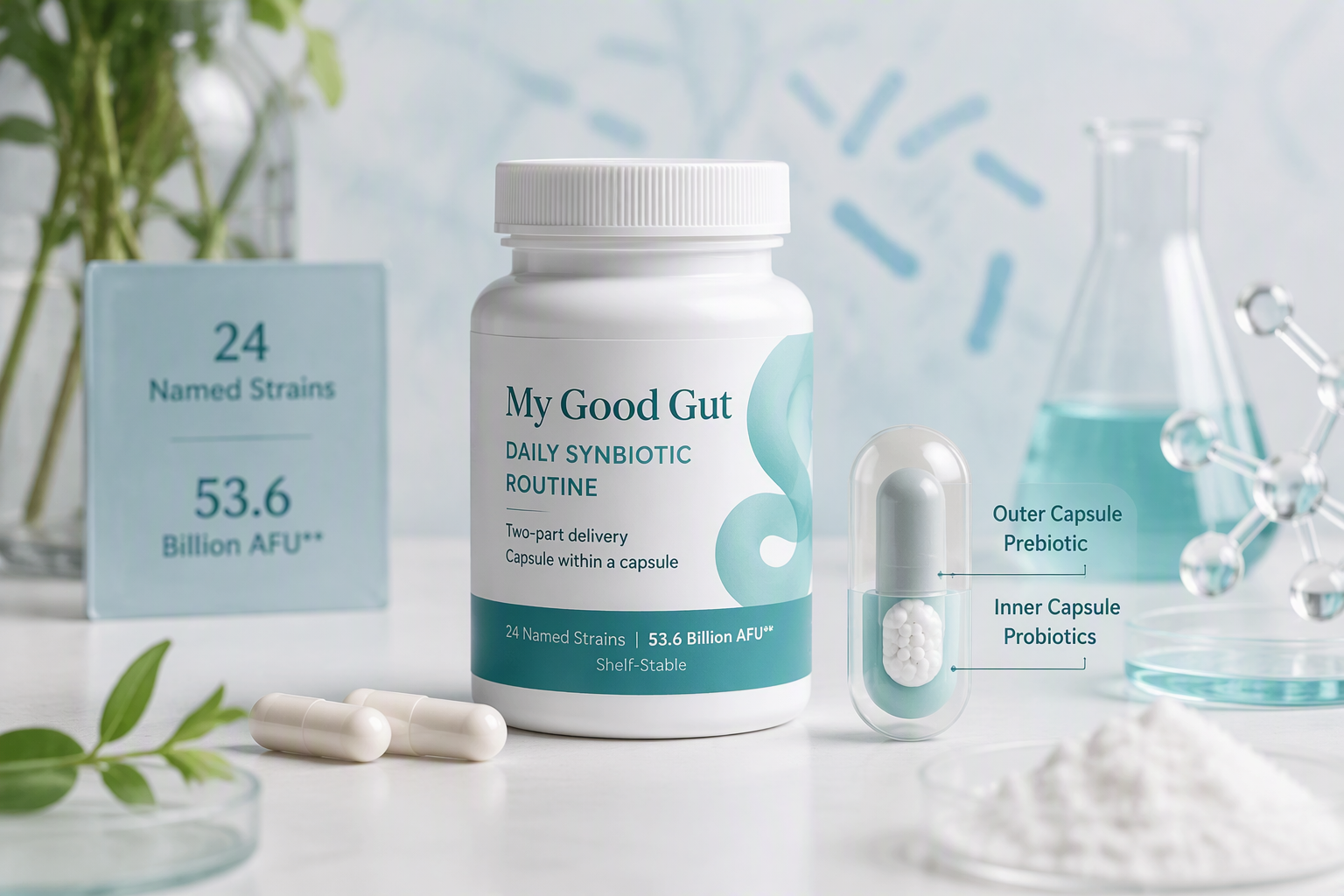
Seed DS-01 Daily Synbiotic is a premium, once-daily synbiotic for adults ages 18 and older. It combines probiotics, live microorganisms, with a prebiotic intended to support them. This gut health supplement is designed for general digestive support, not as a diagnosis, treatment, or replacement for care for irritable bowel syndrome (IBS), persistent bloating, constipation, or diarrhea.
The seed daily synbiotic names 24 probiotic strains, including Bifidobacterium longum, Bifidobacterium adolescentis, and Ligilactobacillus salivarius. Seed states that the formula provides 53.6 billion active fluorescent units through its expiration date. Active fluorescent units (AFU) count active microbial cells, while colony-forming units (CFU) are another common way to measure probiotics. AFU and CFU are different measurement systems, so their numbers should not be compared as though they mean the same thing.
A 24 strain probiotic offers formulation breadth, but more strains do not mean a better match for IBS, gas, diarrhea, bloating, or constipation. The seed probiotic label identifies its strains and total potency, yet it does not give the amount of each strain within the 53.6-billion-AFU total. That gap prevents you from matching an individual strain to the dose studied in its own human research.
Seed’s capsule-within-a-capsule design places one capsule inside another. The company says this may help protect the blend from stomach acid and release it farther into the digestive tract, including the small intestine. That is a product-design claim, not independent evidence that the finished formula improves IBS symptoms.
Prebiotics and probiotics can complement one another, but fermentable prebiotics may worsen gas or bloating if you are sensitive to these fibers. Named-strain probiotics and broad blends compared weighs strain evidence rather than strain count alone.
Results vary by person, and supplement choices should be individualized. Digestive symptoms can have many causes, so seek care for persistent, severe, or worsening symptoms.
What Features Does Seed DS-01 Offer?
Seed DS-01 Daily Synbiotic offers unusually detailed probiotic strain codes, but its 24-strain count does not show whether any strain is included at the amount used in human research. The seed daily synbiotic names strains associated with digestive, skin, cardiovascular, and micronutrient-related blends. That is more informative than a species-only label, yet a 24 strain probiotic is not automatically a good match for bloating, constipation, diarrhea, or IBS.
Several features may make the formula easier to use:
- Delayed-release capsule: The capsule-within-a-capsule design is intended to help probiotics move past stomach acid and farther into the digestive tract. Seed reports complete survival in simulated digestion, but probiotic survivability under lab conditions does not establish symptom improvement in people with IBS or other digestive concerns.
- Daily convenience: These vegan probiotics are gluten-free and need no refrigeration. As shelf-stable probiotics, they can fit more easily into a cabinet, office drawer, or travel bag.
- Packaging and testing: Seed describes allergen testing and packaging meant to reduce exposure to heat, moisture, and light. Those measures may support product stability, but they cannot predict how well the synbiotic will suit your symptoms.
Seed says DS-01 provides 53.6 billion AFU through the expiration date. AFU is Seed’s stated potency measure, and the company also uses whole-genome sequencing to confirm strain identity.
The major limitation is that Seed does not disclose the amount of each of its 24 strains. As a result, you cannot match an individual strain to the dose used in its own studies. Detailed probiotic strain codes show formulation breadth, not dose-matched evidence that the blend will relieve your symptoms.
Its prebiotic component also deserves caution. A synbiotic combines probiotics with an ingredient intended to feed beneficial microbes, but fermentable fibers can worsen gas, pain, or bloating in sensitive people. The labeling and convenience are meaningful strengths, while dose transparency and personal tolerability remain important unknowns.
Can Its Strains Be Matched to Research Doses?
A probiotic label supports a research-dose comparison only when it identifies the exact strain and states that strain’s daily amount. Probiotic evidence is strain-specific, so findings for one Lactobacillus rhamnosus strain do not automatically apply to another. The International Scientific Association for Probiotics and Prebiotics defines a probiotic as an identified strain supplied in an adequate amount (source).
Seed DS-01 offers more identity detail than many digestive supplements. It names all 24 strains, including Lactobacillus rhamnosus GG, or LGG. Those probiotic strain codes help you identify organisms with human research instead of leaving you with a genus and species label alone.
The seed probiotic dosage has one major evidence gap: Seed does not disclose how much of each of its 24 strains is in a serving. Seed states that the complete formula provides 53.6 billion AFU through expiration. AFU estimates viable cells through fluorescence, while Colony Forming Units CFU estimate organisms that can form colonies under laboratory conditions.
A label that allows a meaningful research comparison includes:
- Exact identity: The genus, species, and strain code.
- Individual daily amount: The AFU or CFU amount for each named strain.
- Relevant outcome: Research tied to the symptom you hope to help manage, such as IBS symptoms rather than antibiotic-associated diarrhea.
Without per-strain amounts, you cannot determine how much LGG, or any other individual strain, you receive each day. The 24-strain count reflects formula breadth, not 24 separately evidence-backed doses.
LGG shows why this distinction matters. It has published human research, with stronger support for antibiotic-associated and pediatric diarrhea than for IBS symptom control. One LGG-containing probiotic mixture was associated with a 42% reduction in IBS symptoms, but that finding cannot confirm Seed’s formula because the mixture and per-strain amounts differed.
If matching a clinical strain and dose matters most, Culturelle’s 10 billion CFU of LGG lists its strain and dose per capsule. That makes dose comparison possible, though it does not make LGG an IBS-specific solution.
What Do AFU and CFU Tell You?
With per-strain dosing still unknown, AFU vs CFU refers to two different ways of estimating live microbes, not a ranking of which probiotic is better. Colony Forming Units CFU estimate the microbes that can multiply into visible colonies under set laboratory culture conditions. AFU rely on fluorescent staining and flow cytometry to count cells considered alive or active, including some that may not grow on a culture dish.
Because these methods measure cells differently, AFU and CFU are not interchangeable unit for unit. A product with billions of AFU is not automatically more effective than one with a lower CFU total. Pendulum’s single-organism Akkermansia formula reports its dose in AFU too, at a tiny fraction of this total. The organisms, dose, testing method, and evidence behind each formula may be very different.
Seed states that DS-01 provides approximately 53.6 billion AFU through the expiration date. Some of its product materials list 56.3 billion AFU, while another blend-total figure is about 53.48 billion. That small difference is worth noticing, but the larger limitation is that each figure represents the entire formula, not the amount of each of its 24 named strains.
An expiration-date guarantee is more useful than a live-cell count measured only at manufacture, since probiotic viability can decline during storage. Still, AFU has not been independently shown to be more meaningful than CFU for bloating, bowel regularity, constipation, diarrhea, or other consumer outcomes.
The label helps you assess a few practical points:
- Formula breadth: DS-01 names 24 strains, offering more detail than many digestive probiotic labels.
- Per-strain dose: Seed does not disclose how much of each strain is included, so you cannot determine whether a named strain matches the dose used in its own research.
- Symptom fit: A larger whole-formula live-cell count does not show that the blend is better matched to your symptoms.
For a premium probiotic, a named strain paired with a research-matched dose is usually more informative than the largest total count on the bottle.
Could the Prebiotic Affect Tolerability?
Seed DS-01 contains a prebiotic concentrate from Indian pomegranate. Seed describes it as polyphenol-based and non-fermentable, unlike readily fermented fibers such as inulin. For prebiotic tolerance in IBS, that distinction may matter if inulin reliably causes gas and abdominal pressure, but it cannot guarantee comfort for every sensitive digestive system.
Gut microbes can rapidly use inulin, creating gas that may worsen bloating or cramping. A reportedly non-fermentable pomegranate-derived ingredient may be less likely to trigger that particular fiber-related response. Still, DS-01 is not automatically a low FODMAP probiotic, symptom-free, or a treatment for IBS.
Prebiotics and probiotics can both contribute to symptom changes when you start a synbiotic. Possible early Seed probiotic side effects include:
- Bloating or abdominal discomfort: This may relate to the 24-strain blend, the prebiotic, or an ordinary IBS flare.
- Looser stools or diarrhea: Product-specific tolerability data would be needed to link a new bowel-pattern change to the pomegranate ingredient itself.
- Constipation changes: Stool frequency or consistency can shift temporarily after starting a synbiotic.
Seed probiotics bloating can still happen despite the different prebiotic. The non-fermentable positioning is most relevant if fermentable fibers have repeatedly triggered gas for you, rather than as a prediction of your personal response.
Across 81 randomized controlled trials involving 9,253 participants, pooled adverse-event rates were 11.62% with probiotics and 10.61% with placebo. Serious events were uncommon, at 0.15% and 0.22%, respectively (source). These are raw pooled counts, not a formal safety comparison or a prediction for Seed, because many studies did not determine whether symptoms came from the probiotic or an ordinary IBS flare.
Stop the supplement and seek individualized medical guidance if diarrhea, pain, bloating, or other symptoms are persistent, severe, or worsening. Digestive symptoms can have many causes, and supplements do not replace medical evaluation when symptoms are new or changing.
How Does Seed DS-01's Cost Compare?
Beyond tolerability concerns, Seed sits at the premium end of the direct-to-consumer probiotic market. Its per-day cost is higher than many strain-identified retail probiotic capsules, such as UltraFlora, the 299v formula from Metagenics, so value depends on whether you prefer Seed's format and label detail over a lower-priced option.
The product is sold mainly as a subscription probiotic, with refill shipments that continue until you pause or cancel. That setup can simplify a routine that works for you, but it also creates an ongoing expense. Although some retail listings are available, terms may differ from the direct route, so confirm refill timing, cancellation details, and other purchase terms when you buy.
A multi-month option lowers the effective monthly cost, but it also asks for a longer commitment. If you have IBS or notice symptoms after fermentable fibers, a shorter trial may make more sense before committing to a synbiotic with a prebiotic component.
Seed identifies 24 strains and reports AFU, but those label details do not establish a dose-matched formula.
That gap means an individual Seed strain cannot be matched with the dose studied in its own research. Judge the product by whether you tolerate it, whether it fits your symptoms, and whether you can complete a fair trial rather than by its 24-strain count or total AFU figure.
Current pricing, subscription terms, and the exact strain panel sit on the Seed DS-01 Daily Synbiotic listing, and all three change often enough to check before committing to a month.
What Are Seed DS-01's Pros and Cons?
Seed DS-01 stands out for label detail and storage convenience, but its 24 named strains do not prove it will help a specific symptom. This seed probiotic review finds that Seed identifies every organism by genus, species, and strain code, an uncommon level of disclosure among digestive probiotics. It also guarantees 53.6 billion Active Fluorescent Units (AFU), a measure of active microbes, through the expiration date rather than only at manufacture.
Its practical strengths include:
- Clear strain labeling: Seed names all 24 organisms, including strain codes.
- Easy storage: The vegan, gluten-free, allergen-tested capsules are shelf-stable and do not need refrigeration.
- Routine-friendly design: The capsule-within-a-capsule format may suit travel, work, and consistent daily use.
- Instructions: Product testing gave first impression and instructions a 5 out of 5 rating.
The same details have limits. Seed does not disclose how much of each strain the formula contains, so you cannot compare an individual strain with the dose used in its research. Strain variety is not the same as 24 individually evidence-backed doses.
Important drawbacks include:
- Large capsule: A tester rated taste and swallowability 3 out of 5. Taste matters little for a swallowed capsule, but pill size can be a barrier if you already struggle with supplements.
- Premium cost: Seed’s subscription costs several times more per day than a typical retail probiotic capsule, and price per serving received a 1 out of 5 rating.
- Limited independent evidence: Seed reports findings on gut-barrier function, post-antibiotic recovery, and IBS, though some studies were Seed-sponsored or unavailable for independent review.
The added prebiotic is another consideration. Fermentable fibers may cause gas, bloating, cramping, or bowel changes, especially during an IBS flare, even though some users report less bloating after months of use. Is Seed probiotic worth it? That depends on whether label transparency and shelf stability outweigh the price and uncertain symptom-specific benefit. This Seed DS-01 review supports extra caution if you are sensitive to fermentable fiber or large pills.
Persistent, severe, or worsening digestive symptoms need individualized guidance from a qualified healthcare professional rather than a supplement alone.
Is Seed DS-01 Worth It?
Weighing those strengths and drawbacks, Seed DS-01 Daily Synbiotic may be worth considering if you value a shelf-stable synbiotic, meaning a probiotic paired with a prebiotic, and a label that identifies 24 genus, species, and strain codes. Those are practical formulation advantages for a busy routine, not proof that Seed probiotics for IBS will ease bloating, constipation, diarrhea, altered bowel habits, or Irritable bowel syndrome (IBS).
The main drawback is seed probiotic dosage transparency. Seed guarantees 53.6 billion Active Fluorescent Units (AFU), its measure of active microbes, through the expiration date. That is more useful than a count guaranteed only at manufacture, but the label does not reveal the amount of each of its 24 strains. As a result, you cannot compare a particular strain with the dose used in its clinical research. The total count and strain number show breadth, not dose-matched evidence for DS-01 itself.
Marketing claims, customer ratings, and a long strain list deserve less weight than research you can independently review. Some Seed-related studies may be sponsored, and ConsumerLab’s assessment of ingredients, benefits, and comparative claims may require a membership. A tester’s 4 out of 5 rating is personal experience, not clinical evidence.
When symptom-specific research matters most, a simpler product may offer better value:
- Named strain: A strain code helps you determine whether published research applies to that product.
- Condition-relevant evidence: Randomized, placebo-controlled IBS trials are more useful than a large combined AFU count.
- Disclosed serving dose: A stated dose can be compared with the amount studied in research.
For example, Align’s Bifidobacterium longum subsp. infantis 35624 has randomized, placebo-controlled IBS trial evidence. Metagenics UltraFlora Intensive Care lists Lactiplantibacillus plantarum 299v at 20 billion Colony-Forming Units (CFU), another live-microbe measurement, per two-capsule serving. Similar UltraFlora names can contain different organisms, so the 299v code matters.
Prebiotic tolerance in IBS also deserves attention. Fermentable fibers may increase gas or bloating, particularly for people who are sensitive to them. Probiotic studies commonly assess outcomes over 4 to 12 weeks, although some people notice changes within 2 to 4 weeks. Neither timeframe guarantees a benefit. Stop use and seek medical guidance for persistent, severe, or worsening symptoms.
Seed can be a reasonable personal trial if its delivery format suits your routine and the premium subscription price fits your budget. It is not clearly superior to a lower-complexity alternative with a disclosed dose and condition-relevant evidence, and it should not be expected to guarantee relief.
Who Should Use Seed DS-01?
Seed DS-01 may suit adults 18 and older seeking general digestive support for occasional bloating or irregular bowel patterns, not symptom-specific treatment. It names 24 strains and guarantees 53.6 billion Active Fluorescent Units (AFU), a measure of live microbial activity, through expiration. That is more useful than a count guaranteed only at manufacture. Still, the label does not reveal each strain’s amount, so the 24-strain total reflects breadth rather than probiotic evidence that individual strains match research doses.
For people comparing Seed probiotics for IBS, that distinction matters. Seed DS-01 is not a treatment for Irritable bowel syndrome (IBS) and does not replace diagnosis or medical care. It may be worth considering if Seed probiotics for bloating sounds appealing as general support, but it cannot promise targeted relief.
Its premium subscription price may be easier to justify when these practical features fit your routine:
- Convenience: The shelf-stable, two-capsule daily routine can travel easily and suit busy mornings.
- Dietary features: The vegan formula is gluten-free, soy-free, nut-free, sesame-free, and corn-free.
- Formula preference: A broad blend may appeal if you value named strain codes, even though per-strain doses remain undisclosed.
This may be a less comfortable first trial if fermentable fibers worsen your symptoms or probiotic dose changes tend to bother you. Its prebiotic can affect tolerability, and DS-01 is not automatically a low FODMAP probiotic.
Seed advises one capsule daily for the first three days, then two daily starting on day four. Stop and seek clinician guidance for persistent, severe, or worsening symptoms, and consult a qualified clinician before use if you are pregnant, immunocompromised, receiving medical treatment, or taking medication.
Which Evidence-Based Alternatives Fit Your Symptoms?
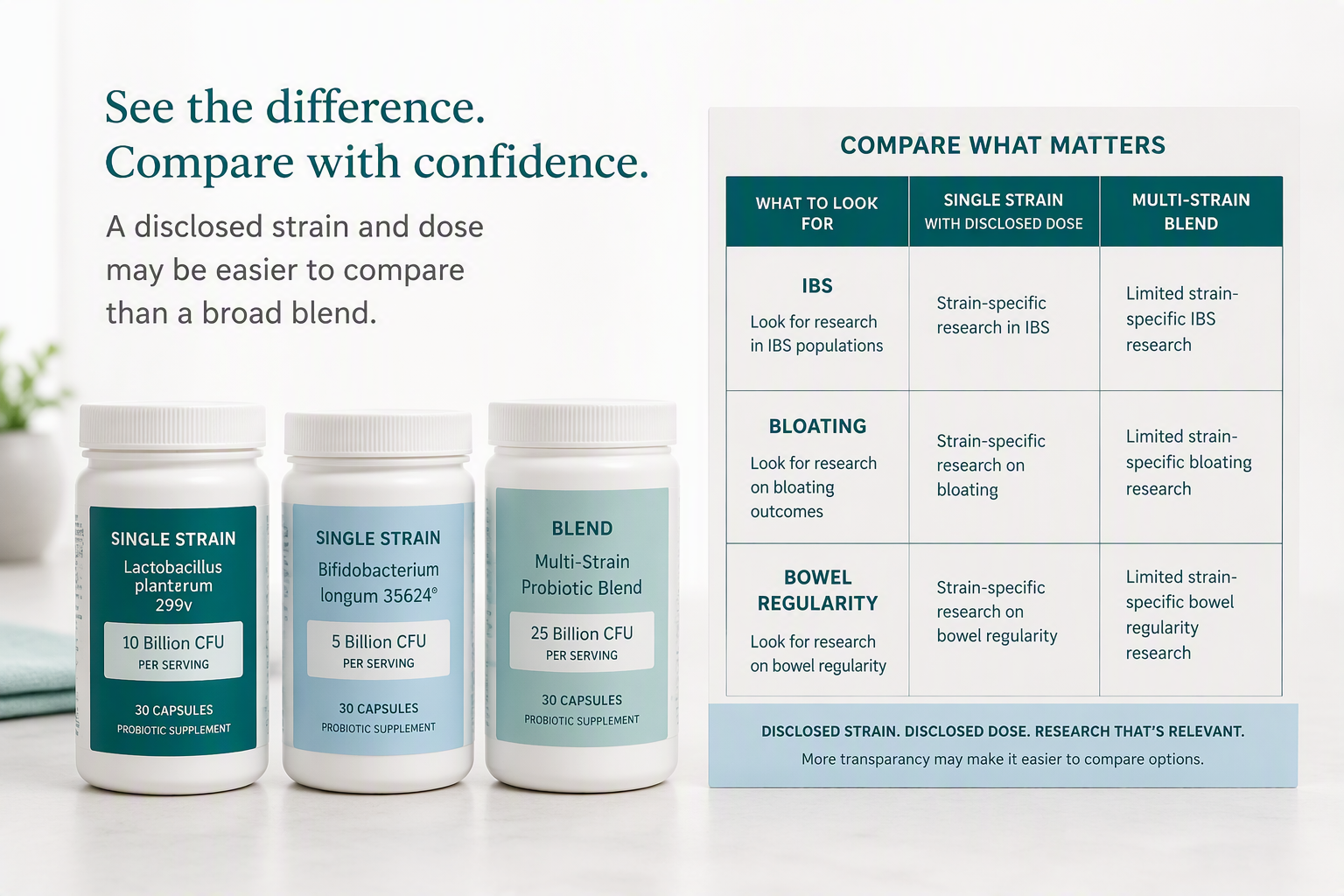
For symptom-specific needs beyond general digestive support, choose by your main symptom and by whether the label names a clinical strain at a usable dose, not by strain count alone. Seed DS-01 Daily Synbiotic lists 24 strains and guarantees 53.6 billion active fluorescent units (AFU) through expiration, but it does not disclose the amount of each strain. In AFU vs CFU, AFU measure viable cells using fluorescence, while colony-forming units (CFU) estimate cells that can grow in culture. Neither total confirms that a particular strain matches its studied dose.
Option | May fit best when | Label and evidence to weigh |
|---|---|---|
Align | Abdominal discomfort, bloating, and mixed IBS bowel habits predominate | Names Bifidobacterium longum subsp. infantis 35624. In a placebo-controlled trial, 35624 outperformed placebo on every measured symptom except stool frequency and consistency. |
Metagenics UltraFlora Intensive Care | Abdominal pain is the main concern | Provides 20 billion CFU of Lactiplantibacillus plantarum 299v per two-capsule serving. In a 40-person trial, all 20 participants receiving 299v reported pain resolution, compared with 11 of 20 receiving placebo. |
VSL#3 or Visbiome | Symptoms persist and you are discussing options with a clinician | VSL#3 provides eight strains and 112.5 billion CFU per capsule serving. Research on VSL#3 before 2016 applies to the original formulation, now sold as Visbiome, which is Low FODMAP Certified. |
For broad IBS symptoms, Align is the clearest single-strain choice in this comparison. Match the 35624 code, not merely a similar Bifidobacterium name, because genus names can change while the strain code stays the same. Align’s 35624 strain and its IBS evidence explains why that detail matters.
Metagenics may suit you when pain is the symptom you most want to address. Its trial result is promising, but 40 participants is a small sample, so it cannot predict your response. Confirm that the package specifically says 299v, since similarly named UltraFlora products contain different organisms and do not share its evidence.
High-dose blends belong in a clinician-guided conversation and never replace diagnosis or prescribed care. VSL#3’s medical-food designation is a regulatory category, not Food and Drug Administration approval, and its formula is not the one examined in pre-2016 studies.
If bloating started or worsened with Seed’s prebiotic or other fermentable fibers, another probiotic may not be the best next step. A clinician or registered dietitian can assess food triggers, constipation, lactose or fructan intolerance, medication effects, and other causes without unnecessary restriction.
Medical evaluation is more appropriate than another supplement trial for:
- Persistent, severe, or worsening pain, diarrhea, or constipation
- Bleeding, fever, or unintentional weight loss
- Symptoms that wake you at night
A named strain at a disclosed dose gives you more useful purchase information than a premium broad blend with unknown per-strain amounts, although neither guarantees benefit. Across pooled randomized trials, adverse events were broadly similar with probiotics and placebo, but gas, bloating, and bowel changes can still occur.
If you want to try Seed DS-01, you can check the current listing here.
Seed DS-01 Daily Synbiotic FAQs
These FAQs cover the practical details to consider before buying Seed DS-01 Daily Synbiotic, from its ingredients and evidence to side effects, safety, and fit for your digestive symptoms and daily routine.
1. Is Seed DS-01 Third-Party Tested?
Seed reports flow cytometry in AFU, whole-genome sequencing, simulated-digestion survival, and heat, moisture, and light stability testing for DS-01. It guarantees 53.6 billion AFU through expiration rather than only at manufacture. Those are meaningful company-reported quality practices, but they do not confirm independent testing of every finished retail batch. Without a third-party certificate of analysis or published finished-product results, the potency guarantee is not publicly independently verified.
2. Is Seed DS-01 FDA Approved?
No. Seed DS-01 is a dietary supplement, so it is not FDA-approved before sale as prescription drugs are. FDA approval is not a quality or effectiveness seal for probiotics, and the manufacturer remains responsible for safety and accurate labeling. More useful signals include its 24 named genus, species, and strain codes, manufacturing-quality information, and accessible third-party testing details.
Seed reports 53.6 billion AFU, a measure of probiotic survivability, through expiration. That matters for shelf-stable probiotics, but undisclosed per-strain amounts prevent you from matching each strain to doses used in clinical research.
3. Does Seed DS-01 Need Refrigeration?
Seed DS-01 Daily Synbiotic is made for room-temperature storage, so refrigeration is not needed. Seed attributes its shelf stability to a nested capsule and packaging designed to limit moisture, heat, and light exposure, though those product-design claims do not show clinical effectiveness. Keep the jar or travel vial sealed in a cool, dry place away from direct sun, humid bathrooms, and hot cars. The travel vial supports its two-capsule routine on trips, but follow the label’s storage directions and expiration date.
4. How Long Does Seed DS-01 Take?
Some people notice less bloating within days or weeks, but one tester’s improvement after four to five days reflects an individual experience, not a promise. Early gas, bloating, or symptom worsening can also occur, especially if you are sensitive to fermentable fibers.
A consistent daily trial of four to 12 weeks is more realistic than judging Seed DS-01 after a day or two. Its 24 strains and 53.6 billion AFU do not predict your timeline because individual strain doses are undisclosed. Seek medical advice for persistent, severe, or worsening symptoms.
5. Can You Take Seed DS-01 With Medications?
Seed DS-01 has no universal medication-interaction rule, but its 24-strain probiotic blend and prebiotic have not been studied with every prescription, dose, diagnosis, or immune condition. Check with a pharmacist or clinician before starting if you take multiple medications, use immunosuppressing treatment, are seriously ill, pregnant, or have a complex digestive or immune condition. New bloating, diarrhea, or constipation may complicate an existing condition.
Stop DS-01 and seek medical advice if digestive discomfort persists or worsens, but seek prompt care for allergic-reaction symptoms, severe abdominal pain, fever, vomiting, dehydration, bloody stools, or possible infection. Supplements do not replace prescribed treatment or medical evaluation.