


Bloating after a meal can make it seem as though food is simply sitting in your stomach. In fact, the small intestine digests food further, absorbs most nutrients and fluid, and passes the remainder to the large intestine. Its lining uses villi and microvilli to move usable nutrients across the intestinal wall.
Acidic chyme enters the duodenum, where bicarbonate, bile, and pancreatic enzymes prepare carbohydrates, proteins, and fats for absorption. The jejunum absorbs much of the available water and nutrients, while the ileum takes in vitamin B12 and bile acids before material reaches the colon.
Conditions such as celiac disease or SIBO can interfere with these jobs and may contribute to bloating, diarrhea, constipation, fatigue, or unintended weight changes. Knowing where digestion and absorption happen helps put digestive symptoms into clearer context.
Small Intestine Digestion Key Takeaways
- The small intestine completes most digestion and absorbs most nutrients, water, and electrolytes.
- The duodenum mixes acidic chyme with bile, bicarbonate, and pancreatic digestive enzymes.
- The jejunum absorbs much of the water, sugars, amino acids, and fatty acids.
- The ileum absorbs vitamin B12, bile acids, and remaining nutrients before the colon.
- Villi and microvilli expand the intestinal surface available for nutrient absorption.
- Segmentation mixes chyme, while peristalsis moves it gradually toward the large intestine.
- Celiac disease, Crohn's disease, and SIBO can affect digestion, absorption, or food movement.
What Does the Small Intestine Do?
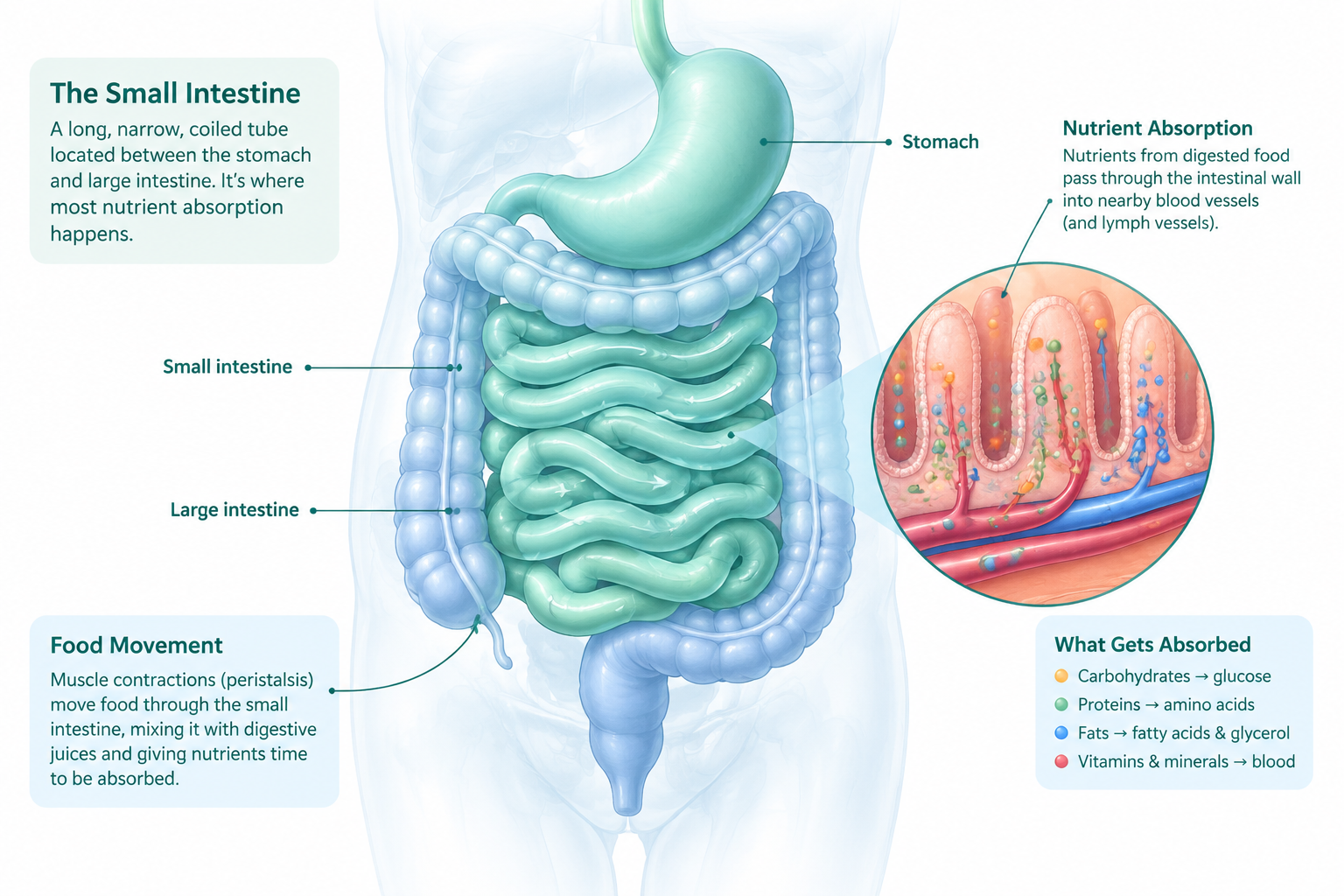
The small intestine is a long, narrow, coiled muscular tube between your stomach and large intestine. Although it is less than 1 inch wide, it averages about 22 feet, or 7 meters, in adults, allowing it to fit compactly in your abdomen. StatPearls describes this anatomy and its role in digestion (source).
In short, the small intestine finishes most digestion, absorbs nutrients and fluid, and sends what remains to the large intestine. Small intestine digestion builds on work that started in the mouth and stomach. Partly digested food mixes with stomach acid, digestive enzymes, and bile, a fluid that helps your body digest fats. Each has a different job, and together they break carbohydrates, proteins, and fats into forms your body can take in.
The main small intestine function is absorption. Nutrient absorption in the small intestine takes in most carbohydrates, proteins, fats, vitamins, and minerals, and about 95% of food nutrients are absorbed here, according to StatPearls. Efficient small intestine absorption matters because your body needs these materials for energy, growth, and everyday repair.
The lining also carries out water absorption, along with uptake of electrolytes such as sodium and chloride from food and digestive fluids. This helps maintain hydration and normal fluid balance. When diarrhea continues or absorption is poor, fluid and salts can leave your body faster than they are replaced, which may contribute to thirst, fatigue, lightheadedness, or weakness.
Rhythmic muscle contractions keep food moving through a clear sequence:
- Mixing: Muscles blend intestinal contents with digestive juices.
- Breaking down: Digestive processes reduce food to absorbable components.
- Absorbing: Nutrients, water, and electrolytes pass through the intestinal lining.
- Moving onward: Remaining material travels to the large intestine.
The digestive system from start to finish places this process in the full path food takes through your body.
How Do the Three Parts Work Together?
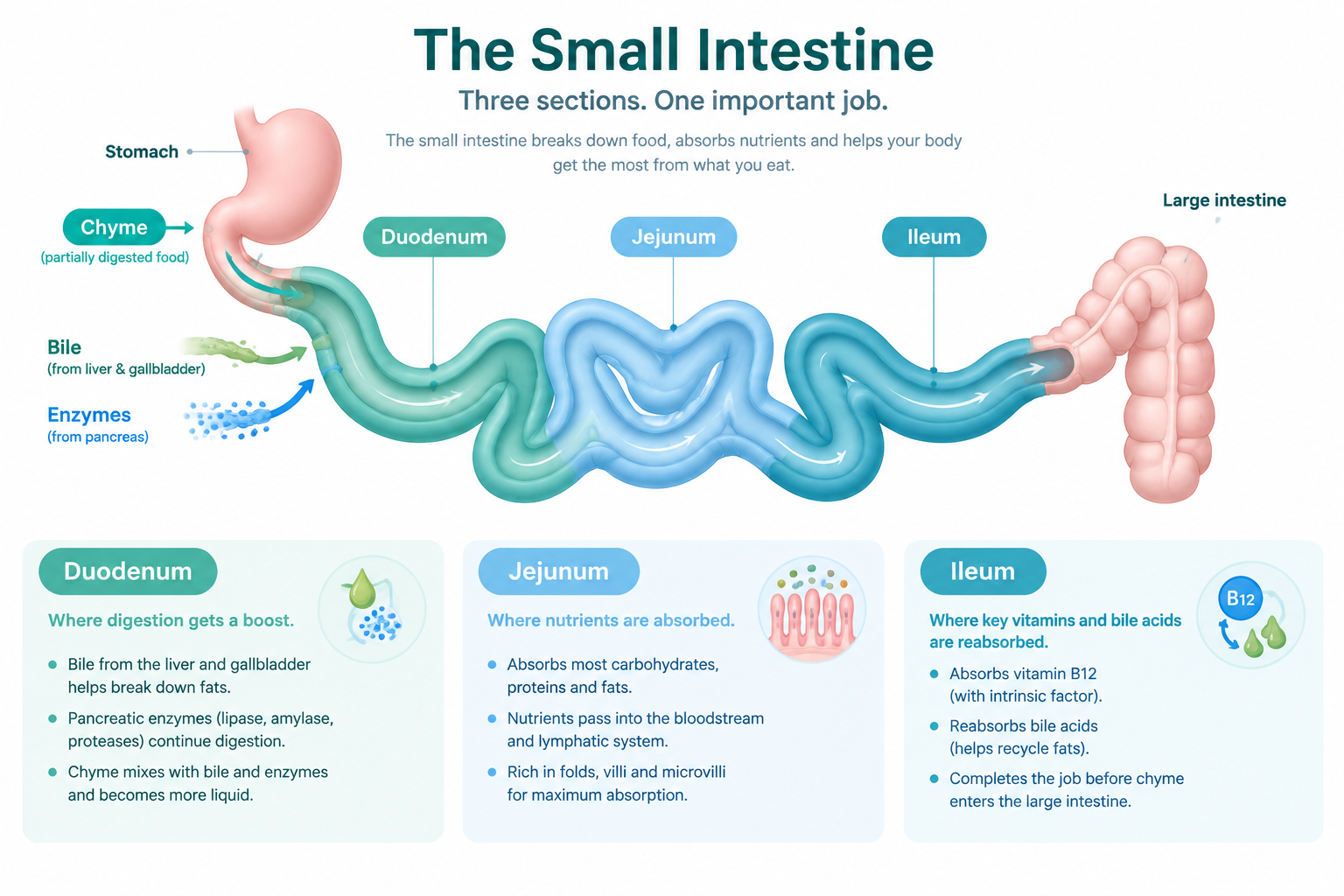
The parts of the small intestine work as one continuous route, turning partly digested food into nutrients your body can absorb before the remainder enters the large intestine. The duodenum, jejunum, and ileum work as a handoff, with each section preparing material for the next.
Section | Location and main input | Primary job | Examples of what it handles |
|---|---|---|---|
Duodenum | First, shortest, C-shaped section after the stomach, about 10 inches long | Mixes acidic chyme with digestive fluids | Bile, pancreatic enzymes, partly digested food |
Jejunum | Longest, heavily coiled middle stretch | Absorbs much of the water and nutrients | Sugars, amino acids, fatty acids |
Ileum | Final section before the large intestine | Absorbs remaining nutrients and passes material onward | Vitamin B12, bile acids |
Chyme is the soupy mixture of partly digested food and stomach fluid. The duodenum function starts when chyme leaves the stomach and mixes with bile from the gallbladder and enzyme-rich fluid from the pancreas. Bile breaks fat into smaller droplets, while pancreatic enzymes help break down carbohydrates, proteins, and fats. StatPearls describes this first stage of chemical digestion in its small bowel anatomy and physiology review.
The jejunum function centers on moving nutrients into your bloodstream. Muscular contractions keep food traveling as digestive juices continue working, while the intestinal lining takes in much of the water, most sugars, amino acids from protein, and fatty acids from fat. A large or high-fat meal may move more slowly, which can contribute to temporary fullness or bloating.
The ileum captures nutrients left behind, especially vitamin B12 and bile acids, then sends the remaining material through the ileocecal valve into the large intestine. This order matters because each segment depends on food being broken into smaller, absorbable parts before it arrives.
How Does Stomach Acid Enter Small Intestine Digestion?
At the first handoff in this sequence, a key duodenum function is to receive acidic chyme from the stomach and prepare it for small intestine digestion. This handoff is controlled rather than sudden, helping protect the intestinal lining while creating conditions where digestive enzymes can work.
The pyloric valve releases small portions of partially digested food into the duodenum instead of emptying the stomach all at once. Brunner's glands in the duodenal wall add alkaline mucus that shields the intestinal mucosa from that acid. Because chyme contains stomach acid, the duodenal lining responds to its acidity, volume, chemical contents, and the stretch it causes in the intestinal wall.
Several signals coordinate the response:
- Secretin: Acidic chyme prompts cells in the duodenum to release this hormone. Secretin tells the pancreas to send bicarbonate-rich fluid, which reduces acidity, protects the first part of the small intestine, and supports enzyme activity.
- Cholecystokinin (CCK): Fats and proteins trigger CCK release. This hormone slows stomach emptying, stimulates pancreatic digestive enzymes, and causes the gallbladder to contract.
- Mixing movements: The intestinal wall gently blends each portion of chyme with digestive fluids. This prevents a large acidic load from moving through before it has been processed.
Pancreatic fluid and bile enter the duodenum through the ampulla of Vater. While the pancreas provides the main acid buffer along with enzymes that break down carbohydrates, proteins, and fats, the liver makes bile, which the gallbladder stores and releases when needed.
Bile acids do not digest fat by themselves. Instead, they separate dietary fat into smaller droplets, giving enzymes more surface area to work on. Intestinal secretions and rhythmic muscle movements keep the mixture moving as chemical digestion continues, especially after meals higher in fat.
How Do Digestive Enzymes and Bile Help?
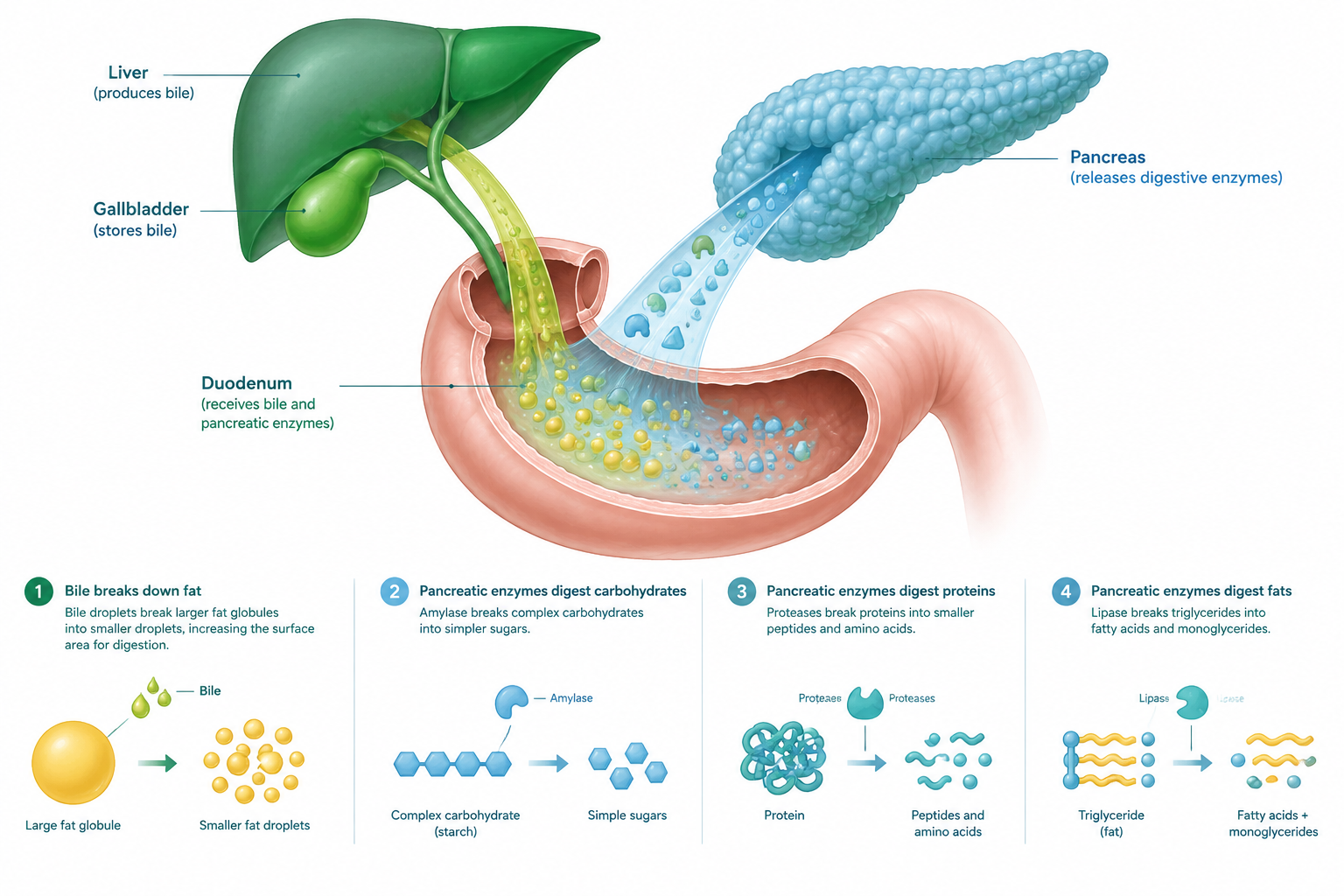
As food leaves your stomach and enters the duodenum, the first part of the small intestine, the pancreas, liver, and gallbladder work together. The pancreas releases bicarbonate to reduce acidity and sends digestive enzymes into the intestine. At the same time, bile made by the liver and released from the gallbladder mixes with the food. This handoff prepares nutrients for nutrient absorption in the small intestine.
Different nutrients are processed in different ways:
- Carbohydrates: Pancreatic amylase turns starches into smaller sugars. Enzymes on the intestinal lining, including sucrase, maltase, and lactase, then produce simple sugars such as glucose that can enter your bloodstream before food reaches the large intestine.
- Proteins: Pancreatic enzymes break dietary protein into peptides. Intestinal peptidases reduce these pieces further into amino acids and very small peptides, which support tissue maintenance.
- Fats: Bile acids, also called bile salts when combined with minerals, work with pancreatic lipase during fat processing. They do not cut fat apart. Instead, this creates more surface area for pancreatic lipase to release fatty acids, monoglycerides, and some glycerol for uptake by intestinal cells.
The villi in the small intestine, along with their tiny microvilli, create a broad surface for small intestine absorption. This is where the absorption of vitamins and minerals occurs alongside most fats, carbohydrates, proteins, water, sodium, chloride, and other electrolytes. The small intestine absorbs about 95% of carbohydrates and proteins, according to StatPearls.
Fat digestion also helps your body take in fat-soluble vitamins from food. The large intestine can absorb some leftover water and electrolytes, but it does not produce digestive enzymes. Greasy stools, unintended weight changes, or signs of poor nutrient uptake can occur with reduced pancreatic enzyme production, including exocrine pancreatic insufficiency (source).
How Do Villi Absorb Nutrients and Protect You?
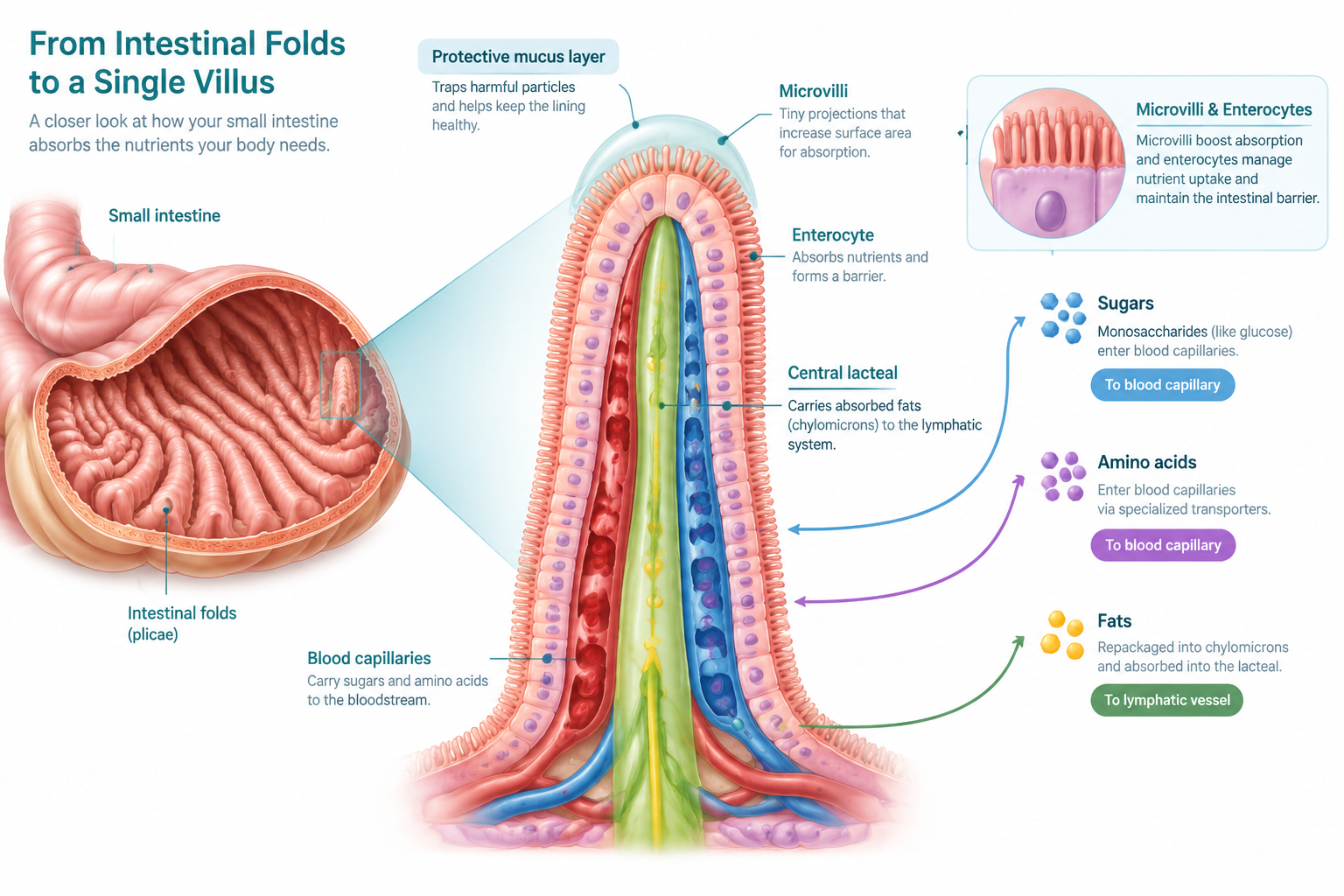
As enzymes and bile process food for absorption, circular folds slow and spiral chyme, giving it time to contact the intestinal mucosa, the lining. Millions of villi cover these folds, and microscopic microvilli form the brush border on each villus. Together, these layers give the small intestine a contact area many times larger than your skin, according to StatPearls, for final digestion and nutrient absorption.
Brush-border and other digestive enzymes break carbohydrates into simple sugars and proteins into amino acids or small peptides. Enterocytes, the cells covering each villus, move these nutrients into blood capillaries, which carry them first to the liver for processing.
After bile makes dietary fat easier for digestive enzymes to process, nutrients take two main routes:
Nutrients moving mainly into capillaries | Nutrients moving mainly into lacteals |
|---|---|
Sugars, amino acids, water, electrolytes, minerals, and many water-soluble vitamins | Most dietary fats and fat-soluble vitamins |
Travel in blood to the liver | Travel through lymph before joining the bloodstream |
Enterocytes package most absorbed fats into particles that enter lacteals, the tiny lymph vessels inside villi that make the lymphatic system the main route for fat absorption, while water absorption also happens here as water follows dissolved particles moving into the body. The ileum, the final part of the small intestine, has an important ileum function: absorbing bile acids and remaining nutrients.
The intestinal lining also controls what enters your body. Enterocytes selectively admit useful nutrients while limiting the passage of microbes and irritants. The gut barrier includes several protective features:
- Goblet cells: Produce mucus that lubricates and protects the surface.
- Paneth cells: Release antimicrobial substances that help limit harmful microbes.
- Rapid cell renewal: Replaces worn lining cells and maintains the protective surface.
Routine bloating or IBS symptoms do not automatically mean the lining is damaged. Persistent inflammation or injury can affect nutrient uptake and fluid balance, so ongoing diarrhea, unintended weight changes, or signs of nutrient shortfalls are worth discussing with your doctor.
How Does Food Move to the Large Intestine?
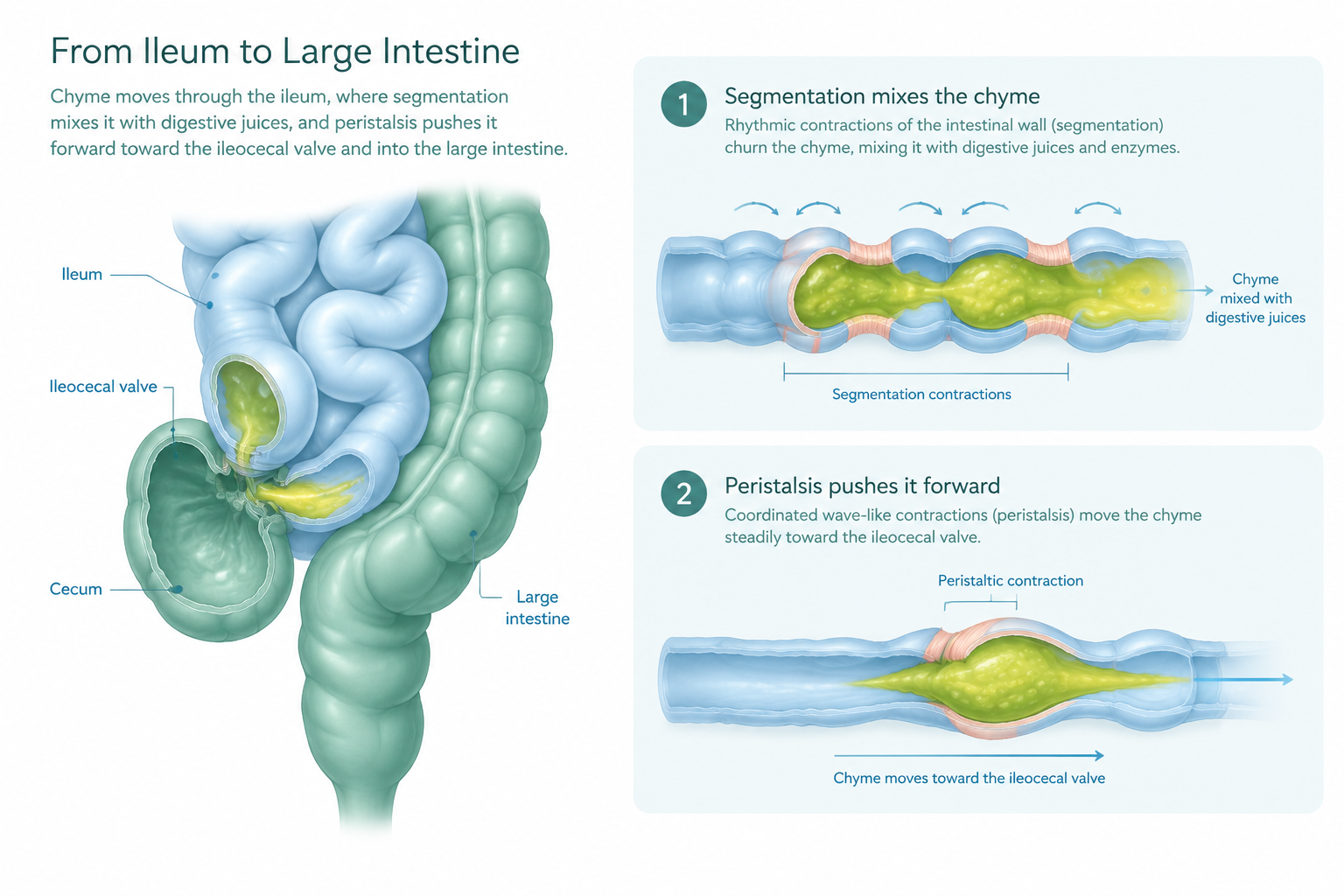
After most nutrients and some water have been absorbed, chyme travels through the small intestine’s folds toward the colon. The ileum function sets the stage for movement through the ileocecal junction into the large intestine, and small intestine motility, coordinated by the enteric nervous system, keeps that flow steady.
Two muscle patterns mix chyme and move it forward:
- Segmentation: Gentle, alternating squeezes divide and stir chyme in place. This repeated mixing brings it into contact with the intestinal lining and digestive juices, which supports absorption.
- Peristalsis: Wave-like muscle contractions create a slow squeeze behind chyme, moving it through the ileum while mixing it with digestive juices.
The pancreas, liver, and gallbladder continue coordinating bile and enzyme activity in the small intestine.
Celiac disease can damage the small-intestinal lining and cause malabsorption, which means your body has trouble taking nutrients from food. The National Institute of Diabetes and Digestive and Kidney Diseases explains this connection in its celiac disease guidance (source).
Chyme then passes through the ileocecal valve, a controlled opening between the ileum and the large intestine. By this point, chemical digestion is mostly complete, and most nutrients have been absorbed. Unlike the small intestine, the large intestine does not make digestive enzymes for further chemical breakdown.
Instead, the large intestine absorbs water and electrolytes, concentrates the remaining material into stool, and moves waste toward elimination. This difference helps explain why bowel-habit changes can have different causes, including some small intestine problems.
Which Problems Can Affect Small Intestine Function?
When problems with digestion, nutrient absorption, food movement, or the intestinal barrier arise, persistent bloating, diarrhea, constipation, cramping, fatigue, or unintentional weight loss can be signs of small intestine problems, but no single symptom identifies a specific condition. Problems with digestion, nutrient absorption, food movement, or the intestinal barrier can feel similar. If symptoms persist, worsen, or disrupt eating, work, or sleep, a medical evaluation can help identify the cause.
Peyer's patches and other immune tissue in the ileum provide immune defense in the small intestine, and small-bowel resection, surgery that removes a segment, reduces the surface available for absorption.
Several conditions can affect small intestine function:
- Celiac disease: Gluten causes immune damage to the small intestine’s nutrient-absorbing lining. It may lead to abdominal pain, diarrhea, malabsorption, weight changes, and fatigue.
- Crohn’s disease: This inflammatory bowel disease can affect any part of the digestive tract, including the small intestine. Inflammation may cause pain, diarrhea, poor nutrient absorption, and fatigue.
- Small intestinal bacterial overgrowth (SIBO): Excess bacteria in the small intestine may interfere with digestion and cause bloating, gas, discomfort, diarrhea, or constipation. These symptoms also have many other possible causes.
The ileum contains Peyer’s patches, areas of immune tissue that monitor intestinal bacteria and help defend against harmful microorganisms. This immune role is one reason digestive symptoms are not always tied to food choices alone.
Some symptoms need urgent care because they may signal a blockage or bleeding. An intestinal obstruction can slow or block the movement of food and fluids, while small-intestinal bleeding may be hidden or cause black or bloody stools, anemia, weakness, or dizziness. Seek urgent care for:
- Severe or sudden abdominal pain
- Repeated vomiting
- Abdominal swelling
- Fainting or marked dizziness
- Inability to pass stool or gas
Short bowel syndrome can develop when much of the small intestine has been removed or no longer works well, reducing fluid and nutrient absorption. Diarrhea, dehydration, and nutrient deficiencies can result.
Blood or stool tests, imaging, and capsule endoscopy, a swallowable camera, may help find inflammation, bleeding, or other causes. Knowing what does the small intestine do can make symptoms easier to place, while testing helps separate everyday discomfort from conditions that need targeted care.
Small Intestine FAQs
These FAQs cover common questions about the small intestine, including its role in digestion and symptoms that may cause concern. They can help you connect basic anatomy with digestive changes you notice from day to day.
1. How Long Is the Small Intestine?
An adult small intestine averages about 22 feet, or 7 meters, though its length varies and measurement methods differ. StatPearls describes it as a muscular tube between the stomach and large intestine. Compact loops let this middle-finger-width organ fit inside your abdomen while providing a large surface for digestion and nutrient absorption. Damage to that surface can contribute to malabsorption.
2. Can You Live Without a Small Intestine?
Generally, you cannot live without your entire small intestine. It completes most digestion begun in your mouth and stomach and supports the absorption of vitamins and minerals, fluids, and electrolytes. Surgeons can remove part of it, but extensive removal may cause short bowel syndrome, leading to malabsorption, diarrhea, dehydration, weight loss, and nutrient deficiencies. Severe intestinal failure may require nutrition through a vein, while intestinal transplantation is considered when other nutrition support cannot meet your needs.
3. What Foods Support Small Intestine Health?
No single food can support every aspect of small-intestine health. Regular, balanced meals with carbohydrates, protein, healthy fats, vitamins, and minerals provide nutrients the small intestine absorbs from food. Along with those nutrients, the small intestine also takes in water and electrolytes, including sodium and chloride, which help maintain hydration and fluid balance.
Choose fiber-containing foods based on your tolerance, and increase fiber slowly if it worsens bloating, pain, diarrhea, or constipation. Persistent symptoms, unintended weight loss, signs of dehydration, or concerns about small intestinal bacterial overgrowth warrant medical evaluation rather than increasingly restrictive eating.
4. Does the Small Intestine Contain Bacteria?
Yes. Bacteria live throughout your digestive tract, including the small intestine, but this area has a much smaller microbial community than the colon. In the ileum, Peyer’s patches are immune tissue that monitors microbes and helps limit harmful organisms. This normal balance differs from SIBO, when bacteria are too numerous or present in the wrong area and may contribute to bloating, gas, diarrhea, or abdominal discomfort.