


A high-CFU probiotic or a broad enzyme blend may seem like the sensible answer when dairy, beans, or ordinary meals leave you bloated. Digestive enzymes and probiotics serve different purposes: enzymes act on specific food components during a meal, while probiotics are live microorganisms tested for symptom-specific effects over time. The safer choice starts with your pattern, not the biggest number on a label.
Repeatable symptoms after dairy may support trying lactase with that meal, while gas after GOS-rich beans or legumes may respond to alpha-galactosidase. By contrast, bloating, constipation, diarrhea, or irregular bowel habits without a clear food trigger call for a probiotic with a full strain name and code, not a species name alone. A 2024 review supports judging probiotic effects at the strain level.
Greasy stools, unexplained weight loss, or persistent worsening symptoms need medical evaluation rather than a broad over-the-counter enzyme product. Fecal elastase-1 can help assess possible exocrine pancreatic insufficiency, which requires diagnosis and may require prescription treatment.
Digestive Enzymes vs Probiotics Key Takeaways
- Digestive enzymes break down specific food components during a meal.
- Probiotics may affect gut function over time, depending on the exact strain.
- Lactase may help lactose-related symptoms when taken with dairy.
- Alpha-galactosidase may help GOS-related gas from beans and legumes.
- High CFU counts do not prove a probiotic fits your symptoms.
- Test one supplement change at a time to identify benefits or side effects.
- Greasy stools, weight loss, severe pain, or blood in stool need medical evaluation.
How Do Digestive Enzymes and Probiotics Differ?
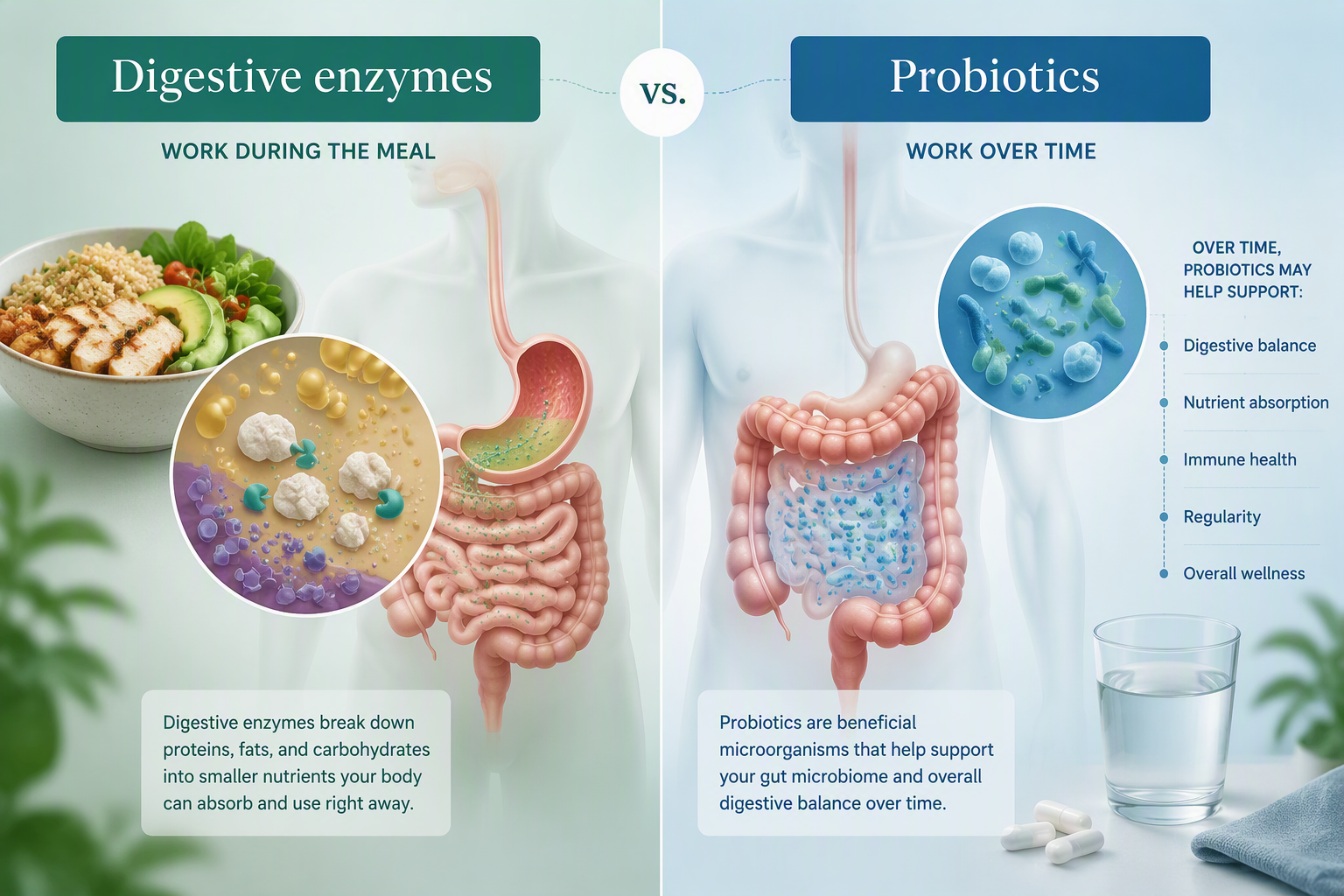
Digestive enzymes vs probiotics differ in both purpose and timing. Digestive enzymes are nonliving proteins that break food into smaller molecules your body can absorb during digestion. Probiotics are live microorganisms intended to support the gut microbiome, the community of microbes in your digestive tract, over time. They are not interchangeable.
What are digestive enzymes? Your mouth, stomach, pancreas, and small intestine make them as part of normal digestion. How digestive enzymes work is specific rather than broad: each enzyme acts on a particular food component, not on the microbiome.
Digestive aid | Main role | Practical fit |
|---|---|---|
Amylase | Breaks down starches and other carbohydrates | Carbohydrate digestion |
Protease | Breaks proteins into smaller building blocks | Normal protein digestion |
Lipase | Breaks dietary fat into fatty acids and related components | Normal fat digestion |
Lactase | Breaks down lactose, the sugar in dairy foods | Predictable symptoms after dairy |
Probiotics | May affect microbial balance and digestive function | A strain-specific trial for a defined symptom |
An over-the-counter enzyme blend will not automatically improve nutrient absorption or explain bloating, gas, constipation, diarrhea, or other bowel changes. Because the pancreas supplies lipase and protease, ongoing greasy stools, unintended weight loss, or repeated trouble with fatty foods needs medical evaluation rather than self-treating with a broad enzyme product.
Lactase shows where a targeted enzyme may fit. Taken around dairy, it helps break down lactose for people with lactose-related symptoms without altering the microbiome or addressing unrelated digestive concerns.
Probiotics are often marketed for general digestive support, but a species name or high colony-forming unit count does not establish that a product will help. Benefits can depend on the exact strain, dose, symptom, and person. A 2024 review supports evaluating probiotic effects at the strain level rather than assuming benefits from a category claim (source)).
Some enzymes also have narrow uses. Alpha-galactosidase may help with symptoms tied to galacto-oligosaccharides, fermentable carbohydrates in beans and some legumes, but that does not mean a general enzyme blend will help every irritable bowel syndrome (IBS) symptom. A broader probiotic supplement comparison can help you assess claims across categories.
A repeatable reaction after dairy or another identified food component may justify discussing a targeted enzyme. Wider bowel-pattern concerns call for a closer look at strain-specific probiotic evidence and other possible causes. Digestive symptoms can have many causes, so discuss persistent, severe, or worsening symptoms with a qualified healthcare professional. Results vary by person.
When Might a Targeted Enzyme Help?

Because a repeatable food reaction points to a specific trigger, a targeted enzyme trial can be reasonable when one food category reliably causes symptoms. Digestive enzymes therefore are not a broad fix for persistent bloating and gas, pain, diarrhea, constipation, or irritable bowel syndrome (IBS).
A short food-and-symptom record can help identify a pattern worth testing:
- Dairy-containing meals: Gas, cramps, bloating, or loose stools after milk, ice cream, or other lactose-containing foods may fit lactose intolerance. Lactase digests lactose and is taken with the dairy-containing meal.
- Beans and legumes: Repeatable bloating and gas after beans, lentils, chickpeas, or similar foods may relate to galacto-oligosaccharides (GOS), carbohydrates that ferment in the gut. Alpha-galactosidase can be tested before GOS-containing foods.
- No consistent trigger: Daily or unpredictable symptoms are less likely to respond to one enzyme. Over-the-counter digestive enzymes should not replace an evaluation for an underlying cause.
Keep a lactose-related trial simple by taking lactase with a dairy-containing meal and noticing whether the same amount of dairy causes less discomfort. If symptoms continue after avoiding lactose or choosing lactose-free foods, adding more digestive enzyme supplements is unlikely to solve the problem. A qualified healthcare professional can help assess other possible causes.
Alpha-galactosidase may help when GOS is the trigger, not for IBS as a whole. In a randomized crossover study, 21 of 31 participants with IBS were GOS-sensitive. Among those participants, the full alpha-galactosidase dose lowered median overall symptoms from 24.5 to 5.5 millimeters during three-day test periods (source). Because about one-third of participants were not GOS-sensitive, this result does not apply to everyone with IBS.
A single-target trial is easier to interpret than a broad blend of digestive enzymes. Test one suspected food at a time, keep the rest of your meals familiar, and note the food, timing, and symptoms to show whether an enzyme matches your trigger or simply adds cost and confusion.
Possible enzyme insufficiency needs medical assessment rather than self-treatment. Seek care for:
- Oily or greasy stools
- Unexplained weight loss
- Difficulty maintaining nutrition
- Persistent, severe, or worsening diarrhea, pain, bloating, or gas
Exocrine pancreatic insufficiency can occur with pancreatitis or cystic fibrosis. Prescription pancreatic enzyme therapy is different from a supplement trial and should not be replaced with over-the-counter digestive enzymes.
How Can You Audit a Probiotic Label?
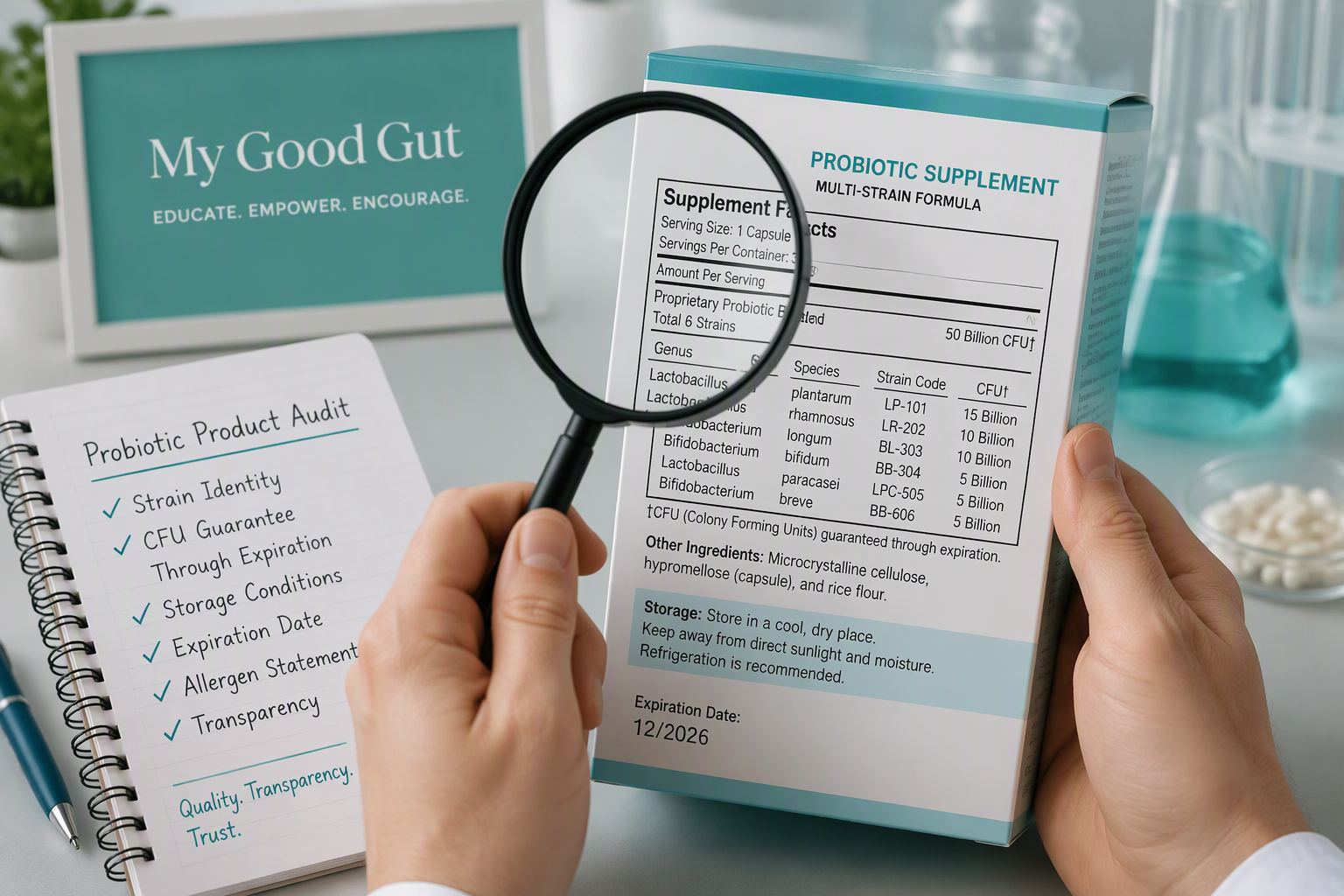
For bowel-pattern concerns that do not point to one food trigger, a reliable probiotic label identifies the exact organism studied, not just a species name or a large CFU number. For digestive health, look for the genus, species, and strain code. A label that says only “Bifidobacterium infantis” or “Lactobacillus plantarum” leaves out the detail that matters most because probiotic strains within one species can act differently.
This gap is common in the supplement aisle. A scan of roughly 30 leading digestive and IBS products found that almost none displayed a clinical strain code, even when colony-forming unit marketing was prominent. Broad claims about the gut microbiome, immunity, mood, or metabolism do not show that a particular product has evidence for your symptoms.
Use this audit when comparing probiotics:
- Confirm the full strain identity: Look for a scientific name and code, such as Bifidobacterium longum subsp. infantis 35624. This strain has IBS trial evidence, while a species-only label cannot be assumed to offer the same support.
- Match the code to your concern: The most relevant human study tests the identical strain in people with a similar condition and measures an outcome that matters to you. Research in general wellness may not apply to IBS, constipation, diarrhea, or lactose-related symptoms.
- Use the code when names change: Genus names can change after scientific reclassification, but codes such as 35624 and 299v remain tied to the studied organism. Evidence for Bifidobacterium bifidum MIMBb75 does not apply to another B. bifidum product without MIMBb75 on the label.
- Read the CFU guarantee carefully: Colony-forming units, or CFUs, should be guaranteed through the expiration date, not only at manufacturing. A 60-billion-CFU headline and a long strain list do not establish a condition-specific benefit.
- Check storage details: The package should state an expiration date, refrigeration or room-temperature limits, protection from heat and moisture, and potency through expiration. “Shelf-stable” or “delayed-release” claims do not replace these basics.
In the United States, FDA supplement regulation does not treat probiotics as FDA-approved medicines. Supplements cannot legally claim to diagnose, treat, cure, or replace care for digestive conditions. The National Institutes of Health notes that probiotic products vary substantially in both contents and supporting evidence (source).
Mild gas, bloating, or stool changes can occur after starting a probiotic. Speak with a qualified healthcare professional before use if you are severely ill, immunocompromised, or have a central venous catheter. Persistent symptoms also need medical attention (source).
A strain name, a relevant study, and a realistic potency guarantee give you a firmer basis for choosing a product than a high CFU number alone.
How Do You Choose Enzymes, Probiotics, or Both?
After checking strain identity and potency, choose the narrowest option that fits your most consistent pattern. Digestive enzymes are for predictable meal-related triggers, while probiotics are a strain-specific trial for recurring symptoms without one clear food cause. Taking both can make sense when those concerns are separate, but it is not automatically necessary.
Your pattern | Practical starting point | What to expect |
|---|---|---|
Symptoms after lactose-containing dairy | Lactase with the meal | Support during that meal |
Gas or bloating after GOS-rich foods | Alpha-galactosidase with foods that reliably trigger symptoms | Support during that meal |
Recurrent bloating or irregular bowel habits without a clear food link | One clearly identified probiotic strain | A consistent trial over weeks |
A known food trigger plus a separate bowel-pattern concern | A targeted enzyme and a separate probiotic trial | A clearer view of what helps |
Lactase and Alpha-galactosidase are most useful when lactose in dairy or GOS-rich foods is the specific trigger. In IBS, GOS sensitivity varies, so Alpha-galactosidase is not a broad solution for digestive symptoms.
These enzymes act only on the foods they match and are not intended to reset bowel habits or prevent symptoms from unrelated foods.
A probiotic trial may be more useful when bloating, constipation, diarrhea, or irregularity occurs across many meals. Effects, if they occur, can appear after two to four weeks, although a fair strain-specific trial may take up to eight to ten weeks. Results and evidence vary by strain and symptom.
A useful probiotic label includes:
- Organism and strain code: Look for a full name and code, such as Bifidobacterium longum 35624 or Lactiplantibacillus plantarum 299v. A species name alone does not identify the studied strain.
- Evidence beyond CFUs: A large colony-forming unit (CFU) count or a long list of unnamed probiotic strains does not show that the product fits your symptom.
- Extra ingredients: Prebiotic fiber can worsen gas for some people, especially when you are trying to identify what is helping or causing discomfort.
Evidence for one strain does not transfer to every product in the same species. The strain number also helps when labels use older or newer organism names.
Both approaches may fit if you have a known food trigger and a separate bowel-pattern concern. Avoid broad combinations of enzymes, probiotics, and prebiotic fiber when testing tolerance, since starting several active ingredients together can hide what improves or worsens gas and bloating.
Use a simple reassessment plan:
- Choose the option that best matches your main symptom pattern.
- Follow label directions and change only one variable at a time.
- Stop an enzyme if it does not help at trigger meals, or stop a probiotic after a reasonable strain-specific trial without meaningful benefit.
Speak with a qualified healthcare professional for unexplained weight loss, persistent diarrhea, severe pain, blood in stool, worsening symptoms, or suspected pancreatic enzyme insufficiency. Supplements can support a focused trial, but they do not replace diagnosis or prescribed treatment.
When Should You Seek Medical Evaluation?
While limited self-care with a focused supplement plan may be appropriate for occasional gas or bloating tied to a known food. Symptoms that persist, become severe, or get worse need medical evaluation because probiotics and digestive enzymes cannot identify or treat the condition behind them. Digestive symptoms can have many causes, so a qualified healthcare professional can help determine what fits your pattern.
Changes that suggest poor fat digestion or reduced nutrient absorption deserve assessment rather than a broad over-the-counter enzyme blend. Watch for patterns such as:
- Greasy, oily, pale, floating, unusually foul-smelling, or difficult-to-flush stools: These changes can occur when fat is not digested as expected.
- Ongoing diarrhea, recurring cramps, or gas and bloating that do not settle: These symptoms have several possible causes and need to be considered alongside your health history.
- Unexplained weight loss, low appetite, fatigue, or possible vitamin and mineral deficiencies: These can point to problems with food intake, digestion, or absorption.
One possible cause is exocrine pancreatic insufficiency, or EPI. With EPI, the pancreas does not produce or release enough digestive enzymes to break down food normally. Risk is higher for people with chronic pancreatitis, cystic fibrosis, pancreatic cancer, prior gastrointestinal surgery, or other pancreatic conditions. New bowel changes in these groups call for timely care, not a self-directed attempt to treat a suspected digestive enzyme deficiency.
A clinician may order fecal elastase-1, a noninvasive stool test that estimates pancreatic enzyme output. Fecal elastase results above 200 micrograms per gram are generally considered normal, results from 100 to 200 are indeterminate, and results below 100 provide good evidence of exocrine pancreatic insufficiency (source). A watery diarrhea sample can dilute the test and cause a falsely low result, so interpretation should include your symptoms and medical history. Cleveland Clinic notes that EPI can interfere with digestion and nutrition (source).
When EPI is confirmed or strongly suspected, pancreatic enzyme replacement therapy may be appropriate. Prescription digestive enzymes provide lipase, protease, and amylase to help digest fats, proteins, and carbohydrates. This type of enzyme replacement therapy differs from a supplement-store product because clinicians individualize the prescription, investigate the cause, and monitor weight and nutrition-related concerns.
Prompt medical attention is important with these warning signs:
- Blood in the stool or black, tar-like stools
- Severe or escalating abdominal pain
- Repeated vomiting or fever with significant diarrhea
- Dehydration, jaundice, or rapid unintentional weight loss
Supplement decisions should be individualized.
Digestive Enzymes vs Probiotics FAQs
These FAQs address common questions about digestive enzymes and probiotics, from symptom patterns and food-related concerns to safety, realistic expectations, and when guidance from a healthcare professional may help.
1. Can You Take Enzymes and Probiotics Together?
Yes, you can generally take digestive enzymes and probiotics together because they do different jobs: enzymes help break down food, while probiotics add live microorganisms. Taking both is not always needed, and digestive enzyme side effects or probiotic intolerance can still occur. Follow each product’s label, particularly for combination supplements that include enzymes, probiotics, or prebiotics. If symptoms persist or worsen, or you take medication or have a medical condition, ask a qualified healthcare professional or pharmacist whether the product fits your needs.
2. Who Should Avoid Digestive Enzyme Supplements?
Avoid self-directed digestive enzyme supplements if you have persistent, severe, or worsening symptoms, unexplained weight loss, ongoing diarrhea, greasy or pale stools, vomiting, blood in the stool, or significant abdominal pain. These signs may point to an underlying condition, not a digestive enzyme deficiency.
With suspected pancreatic disease or exocrine pancreatic insufficiency, avoid choosing over-the-counter digestive enzymes alone. A fecal elastase-1 result below 200 mcg/g needs follow-up, although watery diarrhea can cause a falsely low result. Pancreatic enzyme replacement therapy, a type of enzyme replacement therapy using prescription digestive enzymes, may be needed. Most healthy people produce enough enzymes, but malabsorption, nutrient deficiencies, lactose intolerance, and congenital sucrase-isomaltase deficiency warrant individualized clinical advice.
3. Are Probiotics Safe for Daily Use?
Daily probiotics are well tolerated by many healthy adults, but they are not automatically helpful or appropriate for everyone. Mild, temporary gas or bloating can occur. A high CFU count does not predict safety or benefit, so match the exact strain code, not only the species, to evidence for your symptoms and health context. Research on one strain does not apply to every similar product. Regular use makes sense only if the product is tolerated and has a realistic, strain-supported purpose. Speak with a qualified healthcare professional first if you are immunocompromised, seriously ill, have a central venous catheter, or have persistent or worsening digestive symptoms.
4. How Quickly Do Digestive Enzymes Work?
How digestive enzymes work is simple: they act on the food in that meal, so a matching enzyme may ease bloating and gas within hours. Results vary by enzyme, meal, and underlying cause, and relief is not guaranteed. Live cultures in food versus a capsule, how prebiotic fiber differs, and postbiotics made from non-living microbes address different digestive-support options. Ongoing, severe, or worsening symptoms do not confirm an enzyme deficiency and warrant evaluation by a qualified healthcare professional.
5. Which Foods Naturally Contain Probiotics?
Foods that may supply live microorganisms include yogurt labeled “live and active cultures,” kefir, unpasteurized sauerkraut, tempeh, and kimchi. Fermentation does not always mean live cultures remain at the time you eat a food, since heat processing can reduce or eliminate them. Choose options you enjoy and tolerate, without expecting guaranteed symptom relief.
Probiotic foods add live microorganisms, while prebiotic fiber resists digestion and nourishes microbes already in your gut. Some foods contain both and may be called synbiotic foods, though probiotics do not need prebiotics to function. Add fiber-rich plant foods gradually when they fit your digestive needs.