


A supplement labeled for gut health isn't automatically a good fit for IBS. Probiotics are live microorganisms, while postbiotics are inanimate microbial preparations or components, and neither is automatically better for bloating, pain, constipation, or diarrhea.
Labels often make the choice look simpler than it is. Some probiotic strains, including Bifidobacterium longum 35624 and Lactiplantibacillus plantarum 299v, have been studied in IBS, while postbiotic research for IBS remains limited and product-specific. The International Scientific Association for Probiotics and Prebiotics definition also means that not every fermented ingredient or bacterial byproduct qualifies as a postbiotic.
Storage stability can favor a postbiotic, but it doesn't prove symptom relief. Matching a clearly identified product to one target symptom, checking safety concerns, and reassessing after a consistent four-week trial can keep supplement decisions more practical and safer.
Probiotics vs. Postbiotics Key Takeaways
- Probiotics contain live microorganisms, while postbiotics contain inanimate microorganisms or their components.
- Neither option is automatically better for IBS symptoms.
- Probiotic benefits depend on the exact strain, dose, formulation, and symptom studied.
- Bifidobacterium longum 35624 and Lactiplantibacillus plantarum 299v have IBS-specific research.
- Postbiotics may be more storage-stable, but IBS evidence remains limited and preparation-specific.
- Immunocompromised, seriously ill, or medically vulnerable people should seek clinical advice before using probiotics.
- Try one clearly labeled product at a time and reassess meaningful benefit after four weeks.
What Are Probiotics and Postbiotics?

Probiotics are live microorganisms, while postbiotics are preparations made from inanimate microorganisms or their components. For bloating, constipation, diarrhea, or irregular bowel habits, that difference is the starting point for probiotics vs postbiotics. Neither category guarantees relief for irritable bowel syndrome (IBS), because usefulness depends on the specific preparation, your symptom pattern, and the quality of the evidence.
The probiotic definition is live microorganisms that, when taken in adequate amounts, provide a health benefit to the host. Familiar groups include Lactobacillus and Bifidobacterium, but benefits are strain- and product-specific. A genus or species name alone does not show an IBS benefit, and research on one strain cannot be applied to a product with a different strain code. Where probiotics sit among gut supplements puts those differences in context.
The postbiotic definition from the International Scientific Association for Probiotics and Prebiotics (ISAPP) is more precise than “anything made by bacteria.” A postbiotic is a preparation of inanimate microorganisms and/or their components that provides a health benefit to the target host. A fermented ingredient, bacterial fragment, or microbial byproduct is not automatically a postbiotic without a clearly characterized preparation and evidence for the intended outcome.
A useful probiotics and postbiotics comparison separates the categories this way:
Feature | Probiotics | Postbiotics |
|---|---|---|
Microorganisms | Living microbes | Inanimate microorganisms or their components |
Main consideration | Viability during storage and use | Characterization of the preparation |
Evidence needed | Research on the exact strain and product | Research on the exact preparation and outcome |
Short-chain fatty acids such as butyrate, peptides, and bacterial cell components may appear in postbiotic preparations. Still, a standalone metabolite does not automatically meet the postbiotic definition. Everyday fermented foods differ from both categories because fermentation alone does not establish a tested probiotic or postbiotic preparation.
Whether microbes are alive can affect storage stability, gut interactions, and safety considerations, not whether one option is simply stronger or better.
How Do Probiotics Work?
Because their live status shapes those practical differences, probiotics are live microorganisms that may affect conditions in the intestine while they pass through, rather than permanently replacing your resident gut microbiota. A practical probiotic definition requires the organism to stay alive during production and storage, then survive stomach acid and bile in sufficient amounts to be active in the intestine (source).
Bacterial groups including Lactobacillus and Bifidobacterium can interact with existing microbes and the intestinal lining. These possible actions do not mean a product will help manage bloating, constipation, diarrhea, or IBS for every person:
- Competition: A strain may compete with other microbes for nutrients or attachment sites.
- Environmental changes: Some bacteria make acids or other compounds that shift conditions in part of the gut.
- Barrier and immune effects: Certain strains may affect the protective intestinal lining and immune signaling.
Saccharomyces boulardii is a probiotic yeast, while Lactobacillus, Bifidobacterium, and Streptococcus thermophilus are bacterial groups. Their survival and effects should not be treated as interchangeable. Research involving S. boulardii CNCM I-745 and antibiotic-associated diarrhea does not establish the same result for other Saccharomyces strains or for IBS-like symptoms.
The full strain code matters more than a genus name or a high colony-forming unit (CFU) count. Codes such as 35624 and 299v identify specific organisms, and findings for one strain do not automatically apply to another product in the same broad group. Dose, formulation, storage, and capsule design also affect whether study results fit the product you are considering.
Blends with several live strains may work differently than a single-strain product because each organism can have different survival rates and functions. More strains do not automatically mean a broader benefit, so match the exact strain, dose, and formulation to the symptom you hope to help manage.
How Do Postbiotics Work?
Postbiotics, unlike the live microorganisms just described, may influence the gut without live bacteria needing to settle in your digestive tract. These preparations contain inanimate microorganisms, often heat-treated cells, along with useful cell parts and compounds they produce. Unlike probiotics, they do not need to survive stomach acid, stay alive on a store shelf, or colonize the gut to have a possible effect.
Bacterial cell components can communicate with cells in the intestinal lining and immune system. That signaling may support the intestinal barrier, the protective layer that helps control what passes from the intestine into the body, and may contribute to immune modulation. The International Scientific Association for Probiotics and Prebiotics describes these as possible biological actions, not proof that every product improves bloating, bowel changes, or other symptoms (source).
Short-chain fatty acids are another important part of the picture. Gut microbes create these microbial metabolites when they break down dietary substrates, including certain fibers. Butyrate is especially important because it fuels colon cells and may support barrier function and anti-inflammatory signaling. Still, not every microbial metabolite meets the formal definition of a postbiotic.
A postbiotic preparation may include several types of bioactive compounds:
- Peptides and enzymes: These may have antioxidant or antimicrobial activity.
- Vitamins and amino acids: These compounds may affect local metabolic activity in the gut.
- Cell-wall components: These can interact with intestinal and immune cells.
Potential postbiotic benefits depend on the specific preparation, source microorganism, and processing method. Results from one heat-treated strain or ingredient blend do not automatically apply to every product labeled as a postbiotic. For symptom relief, the product details matter more than broad gut-health claims.
What Evidence Supports IBS Symptom Relief?
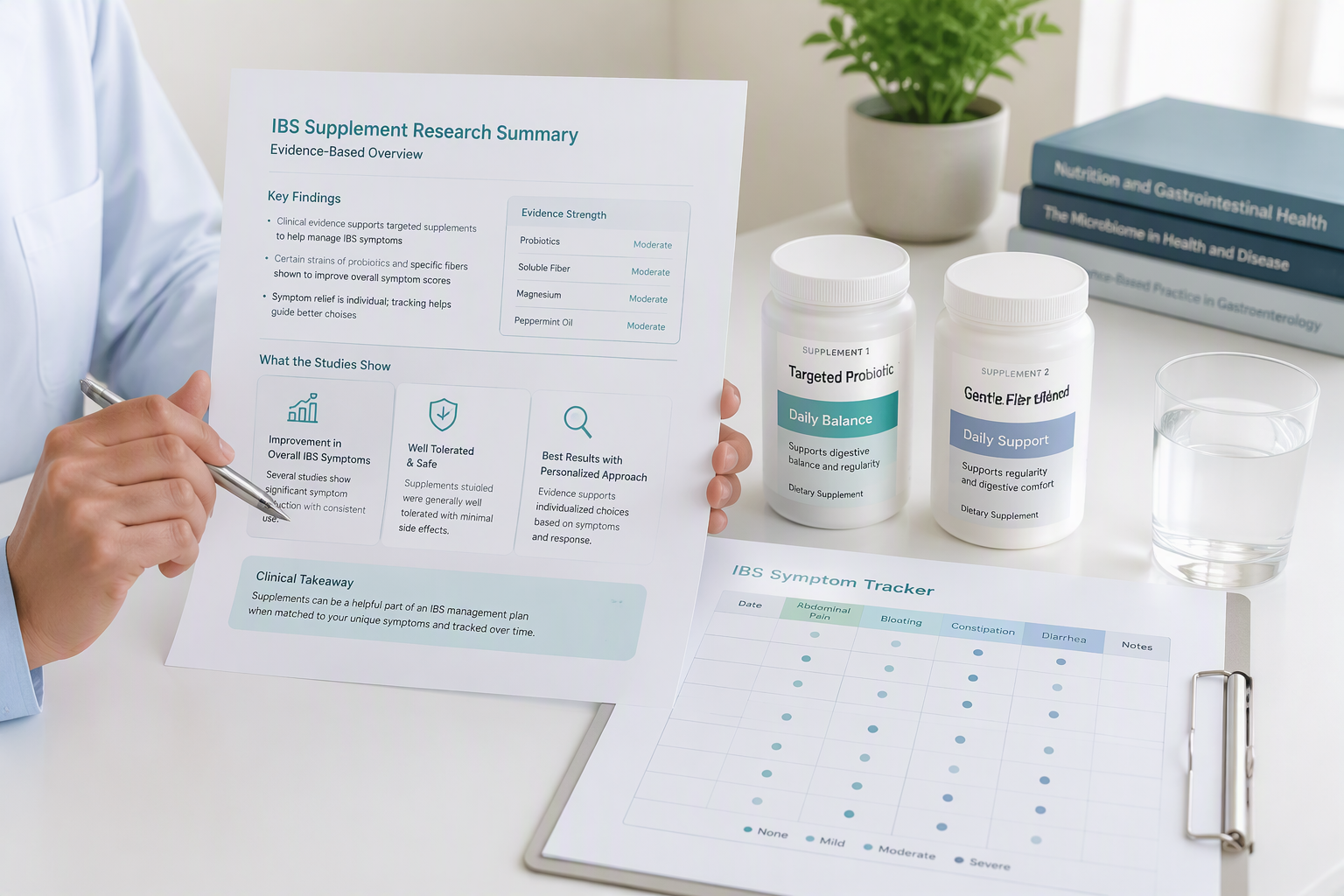
Given those different mechanisms, IBS evidence is most useful when it addresses the symptom that most disrupts your day, not when it promises broadly “better digestion.” Probiotic benefits may look different if your main concern is abdominal pain, bloating, constipation, diarrhea, urgency, overall symptom severity, or quality of life at work and home.
These outcomes are not interchangeable. IBS clinical trials may measure:
- Pain intensity or how often pain occurs
- Overall symptom relief or symptom-severity scores
- Bowel-movement frequency, stool consistency, or urgency
- Daily functioning and quality of life
Faster transit or more frequent bowel movements in healthy adults does not prove IBS relief. Results also need to fit the IBS subtype studied, whether constipation-predominant, diarrhea-predominant, mixed-pattern, or all subtypes combined.
Probiotics have more IBS-specific randomized, placebo-controlled clinical trials than postbiotics, but findings apply to particular strains and formulations. In a 362-person trial that included people across IBS bowel-habit subtypes, Bifidobacterium longum 35624 improved most measured symptoms compared with placebo. A separate 40-person study found that Lactiplantibacillus plantarum 299v reduced abdominal pain. The smaller study is encouraging, but it cannot predict how every person with IBS will respond.
Match the strain code, not the genus name alone, because labels may use older or newer organism names, while codes such as 35624 and 299v remain the clearest identifier. Evidence for one strain does not automatically apply to another product in the same genus, a multi-strain blend, or a formula that has changed since the study was published.
Postbiotic research is earlier in its development. Certain preparations may support selected digestive outcomes and may complement probiotics for some people, but IBS studies are fewer and differ in the preparation, dose, length, and participant group. Those differences make a reliable probiotic-versus-postbiotic comparison impossible at this point. A 2023 review also found substantial variation across probiotic IBS studies, which limits direct comparisons among treatments (source).
Lower symptom-severity scores and better quality-of-life scores can matter when IBS interferes with work, sleep, or routines. Still, treatment rankings are not the same as direct head-to-head proof. Give the most weight to well-designed IBS research that matches both your symptoms and the exact product you are considering.
Persistent, severe, or worsening digestive symptoms deserve evaluation from a qualified healthcare professional.
What Does Probiotic Evidence Show?
Probiotic benefits for IBS-like symptoms are mixed because results depend on the exact strain, the dose tested, and the symptom measured. A label that lists only Bifidobacterium or Lactobacillus does not confirm that it contains the organism studied in research. Think of a strain code as a full mailing address, while a species name is only the street name.
A review of randomized, placebo-controlled clinical trials found symptom benefits for five single strains:
- Bifidobacterium longum 35624: Often listed under its former name, B. infantis.
- Lactobacillus rhamnosus GG: Evidence for this strain does not apply to other L. rhamnosus products.
- Lactiplantibacillus plantarum 299v: Also called DSM 9843 and sometimes sold under its older Lactobacillus name.
- Saccharomyces cerevisiae CNCM I-3856: A different organism from other Saccharomyces supplements.
- Bacillus coagulans Unique IS2: Also identified as MTCC 5260 (source).
This shortlist does not make probiotics a universal IBS treatment. Research on one strain cannot be carried over to another product in the same species.
B. longum 35624 shows why matching the strain matters. Its main study was a multicenter, randomized, double-blind, placebo-controlled dose-ranging trial of 362 primary-care patients with IBS across bowel-habit subtypes. The trial reported that 80% of participants completed it, and several authors had affiliations with Procter & Gamble, the company that marketed the strain. Those details do not erase the findings, but they are important context when judging a single company-associated trial. Labels may still say B. infantis, so the 35624 code is the dependable match.
A clinically studied dose is the amount of a named strain used in the research. More colony-forming units, or CFUs, do not automatically mean better results. Some L. plantarum 299v products provide 20 billion CFU, but that does not mean any L. plantarum supplement at any dose will help. Match both the 299v code and the amount used in the study.
A consistent four-week trial makes changes easier to judge. Keep the same product and usual routine as steady as possible, then follow the symptom that matters most:
- Abdominal pain: Note whether pain happens less often or feels less intense.
- Bloating or gas: Record changes around the same time each day, since meals can affect both.
- Bowel habits: Track frequency, urgency, and consistency without treating one difficult day as failure.
- Daily function: Notice sleep, confidence leaving home, food flexibility, and missed work or plans.
Bowel changes may appear over days to weeks rather than immediately. If there is no meaningful benefit after about four weeks, repeatedly switching products can make it hard to tell what helped, what triggered symptoms, and what simply matched an IBS flare. A qualified healthcare professional can help you decide whether another approach better fits your symptoms.
Symptom severity and quality of life are related but not interchangeable. A probiotic may modestly reduce pain, bloating, or an overall symptom score without improving sleep, confidence leaving home, food flexibility, or disruption from unpredictable bowel habits. Evidence networks may rank different products highest for symptom severity and IBS quality of life, but those rankings do not prove that one probiotic is best for every outcome or every person.
Persistent, severe, or worsening digestive symptoms deserve evaluation by a qualified healthcare professional, since IBS-like symptoms can have many causes.
What Does Postbiotic Evidence Show?
Compared with the strain-specific probiotic findings above, postbiotics are promising, but evidence for diagnosed IBS and diarrhea-related symptom relief is far earlier and thinner than many product claims imply. Findings about inflammation, immune activity, or general digestive health do not establish that a postbiotic will reliably reduce bloating, abdominal pain, urgency, loose stools, or changes in stool frequency.
A postbiotic must meet defined preparation and health-benefit criteria. The International Scientific Association for Probiotics and Prebiotics outlined this definition in a consensus statement (source). Unlike probiotics, postbiotics contain no live organisms, which can make some products more stable. Greater stability does not, however, mean better IBS symptom relief.
The most relevant research tests a clearly identified postbiotic preparation in people with diagnosed IBS or persistent diarrhea and measures symptoms patients report. Studies in healthy adults, laboratory cells, or animals can point to possible effects, but they cannot predict whether a product will help during your IBS flare.
Researchers are examining several ways postbiotics might affect the digestive tract:
- Microbial metabolites: These substances may influence the gut environment and communication between microbes and intestinal cells.
- Intestinal barrier support: Some nonliving microbial components may affect the intestinal lining, which separates digestive contents from the rest of the body.
- Immune signaling: Certain cell components may influence immune activity, but a shift in an inflammatory marker is not the same as less pain or diarrhea.
- Short-chain fatty acids: These compounds, including butyrate, are associated with anti-inflammatory activity and intestinal-barrier support. That association does not show that a butyrate supplement improves IBS symptoms.
Animal research illustrates the limit of this early evidence. In post-weaning lambs, a Lactobacillus plantarum postbiotic improved antioxidant measures and ruminal barrier integrity. This is not human IBS evidence. A lamb’s rumen differs from a person’s colon, and diet, symptoms, and supplement response do not transfer neatly between them.
Postbiotic benefits also do not automatically carry over from one product to another because products can contain different heat-treated microbes, cell fragments, fermentation materials, or microbial metabolites, and their doses and manufacturing methods vary. Results for one named preparation should not be assumed to apply to every product sold as a postbiotic.
When weighing a postbiotic claim, the details that matter most include:
- The participants: People with IBS or chronic diarrhea provide more relevant evidence than healthy volunteers.
- The product identity: The specific preparation, ingredients, manufacturing method, and dose should be clear.
- The outcomes measured: Changes in abdominal pain, urgency, or loose stools matter more for IBS than laboratory markers alone.
- The study design: Placebo-controlled human trials provide stronger evidence than animal or test-tube studies.
For diarrhea-prone or IBS-like symptoms, a postbiotic may be an option with uncertain condition-specific benefit, not a replacement for diagnosis, prescribed treatment, or established symptom management. Digestive symptoms can have many causes, so persistent, severe, or worsening diarrhea should be evaluated by a qualified healthcare professional.
How Do Storage and Stability Compare?
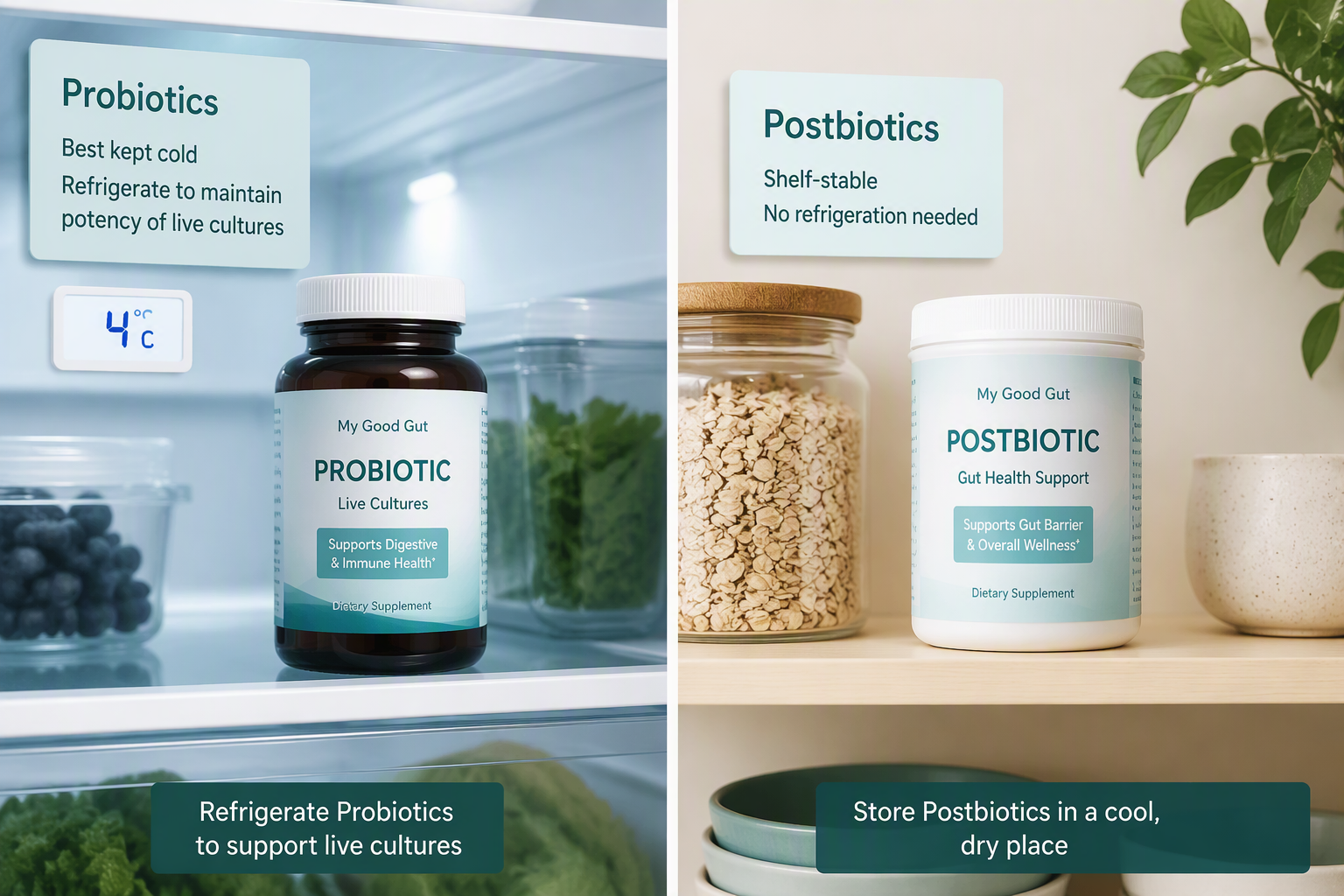
Probiotic safety and postbiotic stability differ because probiotics contain live microorganisms. Heat, moisture, stomach acid, and digestion can lower the number of live organisms that reach your gut. Postbiotics often remain steadier during manufacturing, storage, and digestion. That added stability does not mean they work better for IBS-like symptoms.
Consideration | Probiotics | Postbiotics |
|---|---|---|
Storage | May need protection from heat and moisture. | May be less vulnerable to warm bags or shipping delays. |
Digestion | Stomach acid and digestive transit can affect live organisms. | Not exposed to the risks of administering live organisms. |
Product limits | Labels should maintain the stated viable count through expiration when stored as directed. | Dose, ingredients, and limited evidence on large amounts still matter. |
Not every probiotic needs refrigeration, and non-living postbiotics are not automatically resistant to every condition. Follow the package storage directions rather than assuming a product is stable based on its category.
Either option can cause short-term digestive changes that resemble an IBS flare:
- Gas or bloating: A new ingredient or changes in fermentation may cause temporary fullness or pressure.
- Changed bowel habits: Stool frequency or consistency may shift, especially if the product also contains prebiotics or added fiber.
- Symptom confusion: A food trigger, illness, flare, or supplement reaction can look similar.
A 2023 review of 81 randomized controlled trials involving 9,253 participants reported adverse events in 11.62 percent of probiotic users, or 452 of 3,891 people, versus 10.61 percent of placebo users, or 379 of 3,572 people (source). In the same review, serious adverse events occurred in 0.15 percent of probiotic users, or 6 of 4,081 people, and 0.22 percent of placebo users, or 8 of 3,679 people. These raw pooled counts are not a formal safety comparison because many trials did not assess causality or separate ordinary IBS symptoms from flares.
Rare infections have been reported with live probiotics in people who are immunocompromised, seriously ill, or medically vulnerable.
When Can Probiotics Be Risky?
Probiotics are usually well tolerated by healthy adults, but probiotic safety changes when your body is under major medical stress. These products contain live microorganisms, and rare infections can occur when immune defenses are weakened. Speak with the clinician managing your care before starting a probiotic if you have immunocompromise related to a health condition, cancer treatment, transplant medicines, or high-dose steroids.
Extra caution is appropriate when illness or treatment has made you more vulnerable:
- Serious illness: Avoid starting a live-microbe supplement without medical guidance if you are critically ill, hospitalized, or recovering from major surgery.
- Central lines: A central venous catheter or other central line can provide a route into the bloodstream if an organism gets where it should not. This is uncommon, but it calls for medical advice rather than self-treatment.
- Biologic medicines: If you use an immune-modifying biologic such as infliximab, check with the prescribing specialist or another qualified healthcare professional first. The decision depends on the condition being treated, the degree of immune suppression, your health at the time, and the specific probiotic strain. A product marketed for general digestive health is not automatically suitable during treatment.
Mild gas, bloating, abdominal discomfort, or a temporary change in bowel habits can occur when you first begin a probiotic. With IBS, these effects may be difficult to tell apart from a typical flare. More capsules or a higher colony-forming unit count does not necessarily mean greater benefit. Any benefit is tied to the tested dose of a particular strain, while taking more may increase digestive symptoms instead.
Seek medical evaluation rather than self-managing with a probiotic if you have:
- Severe, persistent, or worsening abdominal pain
- Fever or dehydration
- Blood in your stool
- Unexplained weight loss
When Should You Use Caution With Postbiotics?
Postbiotics do not contain live microorganisms, so they do not raise the same infection concern that probiotics can pose for people with weakened immune systems. Still, inanimate does not mean risk-free. These preparations can contain biologically active compounds, and your response may depend on the specific preparation, amount, other ingredients, and your health history.
Safety research on postbiotics is still developing, particularly for long-term use, higher amounts, and people with IBS-like symptoms. Findings for one inactivated microorganism or component cannot establish the safety or benefit of every product sold under the postbiotic label. Postbiotics should not replace medical evaluation or prescribed treatment.
Talk with a qualified healthcare professional before trying a postbiotic if you are pregnant, breastfeeding, managing a complex medical condition, or taking prescription medication. Prompt medical care is important for symptoms such as:
- Unexplained weight loss
- Rectal bleeding
- Fever
- Dehydration
- Symptoms that wake you from sleep
- Persistent, severe, or worsening pain, diarrhea, constipation, or bloating
A clear label names the inactivated microorganism or components, describes the preparation, states the amount per serving, and lists all ingredients. Vague references to microbial metabolites or proprietary blends make it harder to compare a product with available evidence or identify ingredients that may not suit you.
The differences between probiotics vs prebiotics can help you avoid treating supplements as interchangeable. Where digestive enzymes fit also covers products with different roles.
Results vary by person, and any dietary or supplement advice should be individualized.
How Do You Read Probiotic and Postbiotic Labels?
Read the product’s identity before its front-label promise. A probiotic label should name the genus, species, and strain code, such as Bifidobacterium longum subsp. infantis 35624. “Bifidobacterium infantis” or “10 strains” tells you far less because findings from one strain do not transfer automatically to another, even within the same species. Be especially cautious when a species-only product makes IBS-related claims.
The dose matters only when it matches the exact strain and symptom studied. For probiotics, look for colony-forming units (CFUs) guaranteed through the expiration date, rather than a count listed only at manufacture. More CFUs do not necessarily make a product a better match for bloating, constipation, or diarrhea. Precision probiotics make it easier to compare a named strain, dose, and intended result with the available research.
The label should also explain what will remain in the bottle when you use it:
- Probiotic storage: Look for refrigeration instructions or directions to keep the bottle in a cool, dry place, along with a clear expiration date.
- Postbiotic identity: The label should name the source microorganism and identify the preparation, such as heat-treated, inactivated, fermented, or cell-free.
- Postbiotic amount: A useful label gives an amount per serving instead of hiding it in a proprietary blend.
- Intended endpoint: Prefer a preparation and dose connected to a specific purpose over broad wording like “supports gut health.”
Postbiotics do not need to remain alive, but their details still matter. “Postbiotic blend” does not tell you what preparation was tested, how it was made, or whether it was evaluated for IBS-like symptoms. Generic postbiotic claims deserve the same close reading as broad probiotic claims.
Read the full ingredient panel before a symptom-focused trial. Prebiotics, digestive enzymes, sweeteners, and other active ingredients can affect digestion, making it harder to identify what changed your symptoms. A simple, clearly labeled formula is not automatically more effective, but it is easier to compare with research and your own symptom goal.
Which Should You Choose?

Choose based on the symptom you want to address, not an overall winner in probiotics vs postbiotics. For IBS-type pain, bloating, diarrhea, constipation, or mixed bowel habits, consider probiotics only when a specific strain has evidence for that symptom. Symptom severity and quality of life are separate outcomes, and no matched human trials show that postbiotics work better than probiotics for IBS.
A practical probiotics and postbiotics comparison can lead to four reasonable choices:
- A strain-specific probiotic: This may fit when the label lists the genus, species, strain code, studied dose, and target symptom. Bifidobacterium longum subsp. infantis 35624 and Lactiplantibacillus plantarum 299v are clinically identified strains studied in IBS. The strain number is especially important because labels may use old or new genus names.
- A defined postbiotic: Postbiotics can suit you if you prefer a non-live preparation or need something less affected by heat, stomach acid, and storage. Postbiotic stability can make handling easier, but it does not show that the product will relieve IBS symptoms. Look for the inactivated microorganism and intended use, not broad microbiome claims.
- Neither without clinical guidance: Seek medical care before trying a supplement if symptoms are persistent, severe, or getting worse. The same applies to blood in stool, fever, dehydration, unexplained weight loss, severe abdominal pain, or a possible infection.
- A monitored trial: When a clinician identifies no safety concern, try one clearly labeled product at a time and set a stop point.
A high CFU total does not make a product better supported by evidence. A label that says only "Lactobacillus plantarum" cannot claim the findings for 299v, and a species-only Bifidobacterium product is not the same as 35624. Personalized probiotics and precision probiotics are areas of interest, but they do not replace matching the exact label to the strain studied.
Postbiotics and probiotics may complement each other, but they are not interchangeable treatments. IBS-specific evidence for postbiotics remains limited, and microbiome therapy is still an area of research rather than a universal answer.
Use extra caution if you take infliximab or another immune-suppressing medicine, are seriously ill, or are immunocompromised. Ask your prescriber before trying either option, since postbiotics are not automatically safer substitutes.
A cleaner trial avoids formulas with added prebiotics, fibers, sweeteners, or enzymes that can blur the cause of improvement or a flare. Keep meals and treatments steady where practical, track one target symptom and new side effects, and stop anything that worsens symptoms. Bowel changes may appear within days to weeks, and a four-week trial can be a reasonable point to reassess whether the product is helping.
Probiotics vs Postbiotics FAQs
These FAQs address the differences between probiotics and postbiotics, the limits of the research, and how safety or IBS symptoms may affect your choices.
1. Can You Take Probiotics and Postbiotics Together?
You may be able to take probiotics and postbiotics together, but no universal combination helps everyone with IBS-like symptoms. A probiotic provides a specific live strain, while a postbiotic contains nonliving microbial components or compounds. Their effects may complement each other, though taking both is not automatically more effective.
The right choice depends on the product’s ingredients and dose, plus your symptoms, health conditions, and medicines. Check for a strain code on probiotic labels, and consult a qualified healthcare professional before combining supplements, especially if you use immune-suppressing medication or have persistent, severe, or worsening symptoms.
2. Are Postbiotics Better Than Probiotics?
Postbiotics are not automatically better than probiotics. Their inanimate preparations are usually more stable during storage, stomach acid exposure, and digestion, which may suit you when product reliability matters. That advantage does not mean they provide better relief for IBS-like symptoms.
Some probiotic strains have been studied for specific digestive outcomes, while postbiotic research for IBS is newer and more limited. Benefits do not carry over between strains, doses, or preparations, so base your choice on your symptoms, label details, and personal tolerance.
3. Do Postbiotics Help With Diarrhea?
Postbiotics may be promising for diarrhea, but they are not an established treatment. Evidence is preliminary and product-specific, meaning results from one inactivated microbial preparation cannot be assumed for every postbiotic supplement or cause of diarrhea, and postbiotics should not replace rehydration, diagnosis, or prescribed care.
Saccharomyces boulardii CNCM I-745 has more specific evidence for antibiotic-associated diarrhea, but it is not a universal option, and findings do not transfer to other yeast strains. Seek prompt evaluation from a qualified healthcare professional for persistent, severe, or worsening diarrhea, especially with fever, blood or black stool, severe pain, or dehydration signs.
4. Do Postbiotics Need Refrigeration?
Usually not, and that is one of their clearer practical advantages. Because the microorganisms are already inactivated, a postbiotic preparation does not depend on keeping organisms alive through heat, moisture, or a long shipping delay the way a live probiotic can.
Follow the storage line on the label anyway, since added ingredients and packaging still vary by product. Shelf stability is a handling advantage rather than evidence that a postbiotic will ease your symptoms.
5. Can You Get Postbiotics From Food?
Fermented foods contain compounds produced during fermentation, and some of those remain after pasteurization even when the live cultures do not. That is not the same as a postbiotic preparation, which identifies the inactivated microorganism and the amount used in research.
Yogurt, kefir, sauerkraut, and kimchi can be worth eating on their own merits, but a food label will not tell you which fermentation-derived compounds it contains or how much. Match a named preparation to a study if you want an evidence trail.