


When you're deciding between fermented foods and probiotic supplements, neither is automatically better. The right choice depends on whether you want a nutritious food addition, a strain-specific trial for a digestive symptom, or both. Fermented foods are made with microbes, while probiotics must provide a demonstrated health benefit at an adequate dose under FAO/WHO criteria.
Kimchi, kombucha, sauerkraut, yogurt, and kefir can contain live cultures, but processing, storage, and batch variation affect what remains when you eat them. A supplement can list a named strain, such as Lactiplantibacillus plantarum 299v, plus its CFU amount and storage instructions, making it easier to compare with clinical research.
Tolerance matters as much as evidence when bloating, bowel changes, or IBS symptoms are active. Try one new food or product at a time, and seek medical advice for persistent, severe, or worsening symptoms.
Fermented Foods and Probiotics Key Takeaways
- Fermentation does not automatically make a food a clinically tested probiotic.
- Yogurt and kefir may contain live cultures, but labels and storage matter.
- Fermented foods provide nutrition and variety, not condition-specific probiotic treatment.
- Supplement evidence applies to the exact strain, dose, formula, and symptom studied.
- High CFU counts or multiple strains do not prove a product will help.
- Start one fermented food or supplement at a time to assess tolerance.
- Seek healthcare advice for severe, persistent, worsening, or unexplained digestive symptoms.
How Do Fermented Foods and Probiotic Supplements Differ?
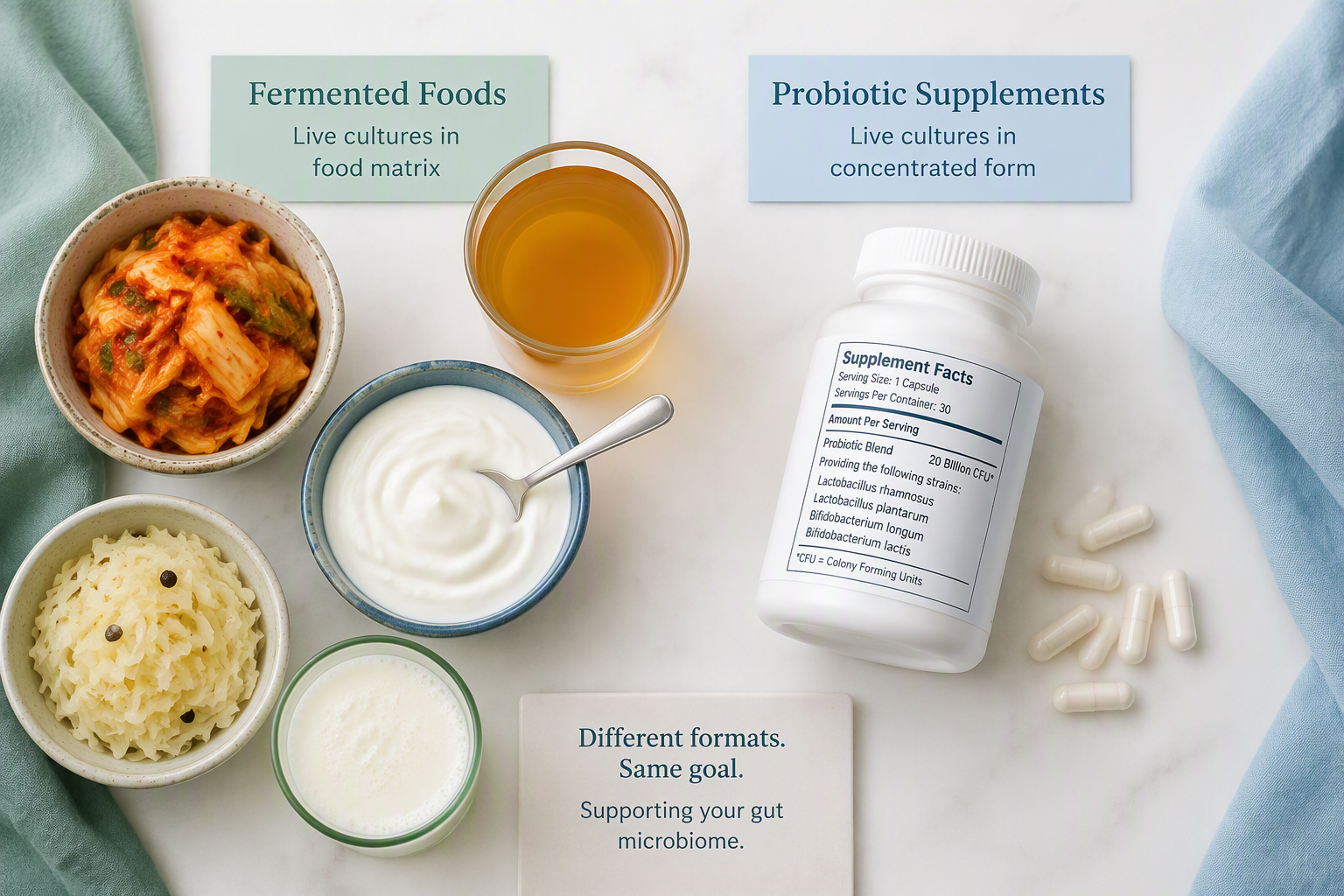
Fermented foods vs probiotic supplements differ because fermentation is a production method, while probiotics must meet a higher evidence standard. Fermentation uses selected microbes and enzymes to change food components, including sugars. Under the FAO/WHO probiotic definition, probiotics are live microorganisms consumed in an adequate amount that provide a demonstrated health benefit. The two categories can overlap, but a fermented label alone does not establish probiotic status.
This distinction matters when weighing probiotics vs fermented foods for bloating, irregular bowel habits, or irritable bowel syndrome (IBS)-like symptoms. Fermented foods can be nourishing, convenient meal additions, but they are not condition-specific treatments. Their microbes may also vary more than those in a supplement.
Yogurt and kefir are common examples of overlap. Refrigerated yogurt probiotics and kefir probiotics may contain live cultures, yet a product qualifies as probiotic only when its organisms remain alive through shelf life, are present at an adequate dose, and have evidence for a health benefit. A live-and-active-cultures statement is more useful than assuming every yogurt or kefir provides meaningful levels of live microorganisms.
Several details can affect whether fermented foods contain living microbes:
- Kimchi and sauerkraut: Raw, refrigerated products may contain live microbes, while heat treatment, storage, recipe changes, and shelf-stable packaging can reduce or eliminate them.
- Kombucha: The types and amounts of microbes can differ by brand and batch. Fermentation does not show that kombucha will help manage bloating, bowel changes, or IBS symptoms.
- Shelf-stable fermented vegetables: These foods may still add flavor and nutrients to meals, even when they do not provide reliable probiotic exposure.
Probiotic supplements are usually easier to compare because their labels may name the microorganism, strain code, and dose in colony-forming units (CFUs). That information allows you to match a product with research on a specific strain and intended use. A high CFU count, however, does not by itself show that a supplement is effective or well matched to your symptoms.
Strain names matter because findings for one organism do not automatically apply to another, even within the same species. Match the named strain and dose to evidence for your goal rather than choosing based on CFUs alone. Comparing probiotics with other gut products can help you place that choice within a broader routine.
Although fermented foods can be practical, family-friendly options and supplements offer a more defined way to try a named live culture, neither approach is automatically better or replaces medical evaluation, diagnosis, or prescribed treatment. Digestive symptoms can have many causes, so persistent, severe, worsening, or changing symptoms should be discussed with a qualified healthcare professional.
How Do Evidence and Consistency Compare?
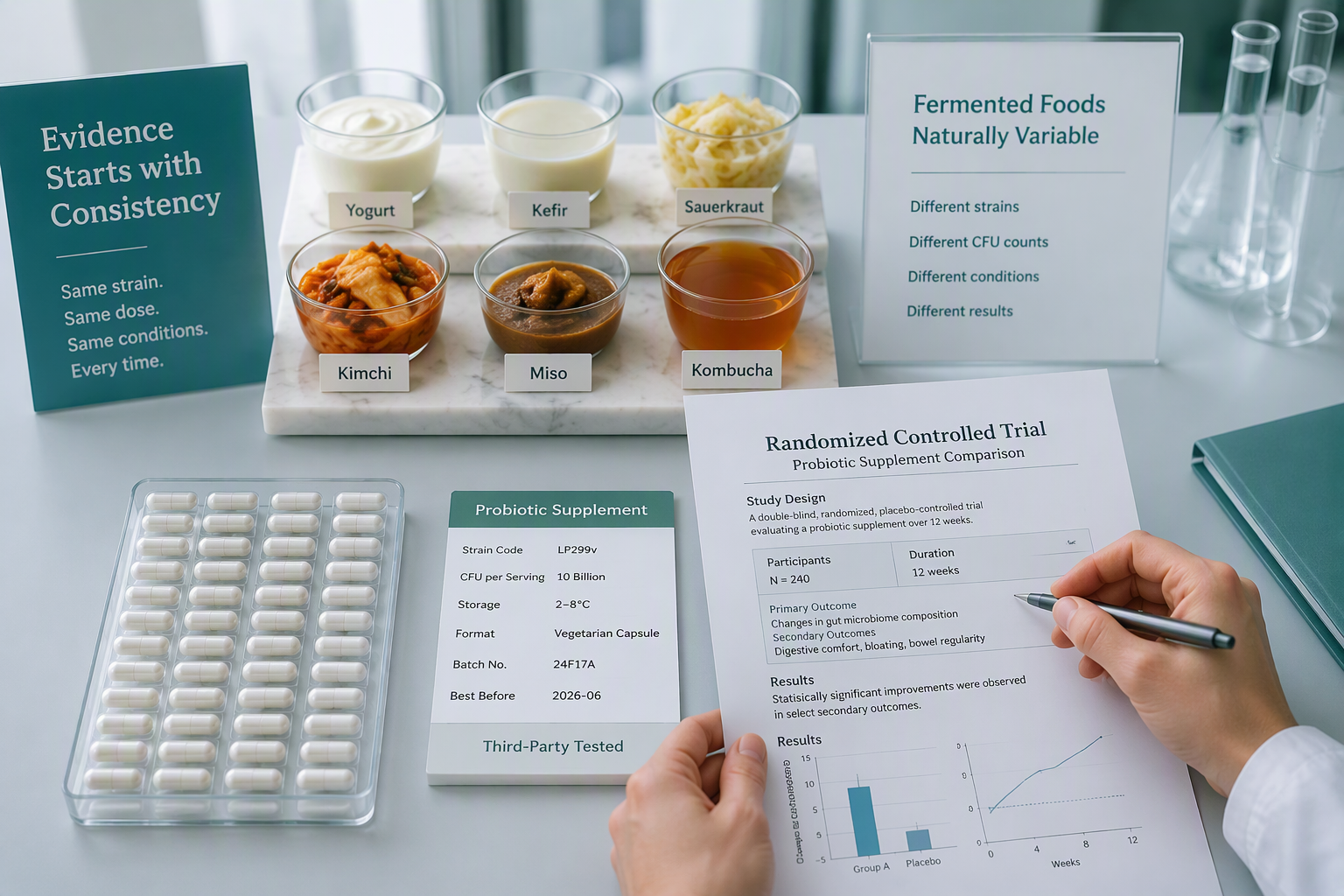
Against that distinction between food and supplement options, fermented foods and probiotic supplements answer different evidence questions, so results for one should not be assumed to apply to the other. Studies of yogurt, kefir, or kimchi assess the whole food, including its live microbes, nutrients, fermentation byproducts, serving size, and the person’s broader diet. A result for one fermented food cannot automatically transfer to a capsule, powder, or another fermented product, which may affect the gut microbiota differently.
The FAO/WHO probiotic definition, from the Food and Agriculture Organization (FAO) and World Health Organization (WHO), provides the framework for these evidence criteria. Fermentation alone does not make a food probiotic. For probiotic status, an organism should be identified at the strain level, ideally through genome sequencing, and supported by at least one randomized controlled trial (RCT) for a specific health benefit. Culture identity, amount, storage stability, and survival through digestion can all vary between products, according to an international expert consensus (source).
That difference affects what the research can tell you:
- Fermented-food research: Shows whether regular use of a specific food is tolerable and practical within a dietary pattern.
- Supplement research: Can test a named strain or formula for a defined outcome, such as antibiotic-associated diarrhea, bloating, altered bowel habits, or irritable bowel syndrome (IBS) symptoms.
- Evidence match: Limits conclusions to the participants and outcome studied. Findings in adults with diagnosed IBS do not necessarily apply to occasional bloating, and the reverse is also true.
Strain-specific benefits are the key evidence check for probiotic strains. A species name does not make products interchangeable. Evidence for Bifidobacterium bifidum MIMBb75, for example, does not support a product labeled only Bifidobacterium bifidum. The MIMBb75 code identifies the studied organism even when product labels use older or newer genus names.
Supplements may be easier to verify, but that does not mean they work better than foods. A clear label can name the strain, state colony-forming units (CFUs) per serving, and identify its intended use. A product containing Lactiplantibacillus plantarum 299v at 20 billion CFUs is more comparable to a clinical trial than one that lists only a species. Still, a scan of roughly 30 leading digestive products found that almost none disclosed clinical strain codes, making strain-level evidence difficult to verify from packaging.
Foods and supplements remain optional digestive-support tools, not universal answers. A supplement study applies only when the formula, strain identity, dose, participant group, and measured outcome still match the trial. Reformulation can make older evidence irrelevant, as studies published before 2016 evaluated the original De Simone formulation rather than the VSL#3 product sold after 2016.
What Evidence Supports Fermented Foods?
On the fermented-food side of this evidence comparison, fermentation can alter a food’s nutrients and create acids, peptides, and other microbial by-products, but it does not make every fermented food a proven probiotic. These changes may contribute to the health benefits of fermented foods, including flavor, shelf life, and nutritional variety. The International Scientific Association for Probiotics and Prebiotics applies these criteria for probiotic status (source).
That distinction is useful if you are comparing options for bloating, irregular bowel habits, or IBS-like symptoms. Even when heat removes living microbes, fermented foods may still provide fermentation-derived compounds. These compounds, often called postbiotics, are substances made during fermentation that remain in the food. A pasteurized yogurt, sauerkraut, or kombucha can still have food-level value, but it should not be expected to work like a tested live probiotic strain.
Whether a product contains live cultures depends on the food and what happened after fermentation. The label can help you make a more informed choice:
- Look for live and active cultures: Yogurt probiotics and kefir probiotics may be present when the package specifically identifies live or active cultures.
- Check how it is stored: Refrigeration can support the survival of living microbes, although a refrigerated product is not automatically a source of live cultures.
- Watch for heat treatment: Pasteurization, baking, smoking, and some filtering processes can destroy microbes after fermentation. Uncooked, refrigerated sauerkraut live cultures are more likely than those in canned or heat-treated sauerkraut.
- Expect natural variation: Ingredients, fermentation time, storage conditions, and product age can change the types and amounts of microbes present.
Kimchi and kombucha show why living microbes are not necessarily clinically tested probiotics. Traditional kimchi and many kombuchas can contain live cultures, but the organisms are often not identified by strain code, and their amount can also change between batches and during storage. Without a human study of that exact product for a specific digestive outcome, it is not reasonable to expect it to help manage gas, constipation, diarrhea, or IBS symptoms.
The same limit applies to labels that name Lactobacillus or Bifidobacterium. A food containing one of these species is not equivalent to a product tested with an exact strain, dose, and outcome. Findings for one strain cannot be applied to another strain, even within the same species, or to the shifting mix of microbes in kimchi, kefir, yogurt, sauerkraut, or kombucha.
Probiotic foods can add variety and fermentation-derived compounds to meals, but their effects are less consistent than those of a food or product studied for a defined purpose. Introduce one new food at a time so you can notice your own response.
What Makes Supplements More Consistent?
Where fermented foods can vary, supplements offer a more repeatable dose than fermented foods because they are made to deliver defined probiotic bacteria in capsules, powders, or sachets. That can make products easier to compare when you are considering support for IBS, bloating, or irregular bowel habits. Consistent dosing does not mean consistent results, however. These organisms may act as temporary visitors in your microbiome rather than permanently changing your gut microbiota.
A useful probiotic label names the genus, species, and, most importantly, the strain code. The code lets you match a product with the research behind it. For example, Lactobacillus plantarum 299v can be evaluated against studies of 299v, but findings on another L. plantarum strain do not automatically apply. Taxonomy can change, so a label may use Lactobacillus or Lactiplantibacillus, while 299v remains the more dependable comparison point.
Potency information also makes dose delivery easier to compare than it is with fermented foods, whose live cultures can vary by batch. Colony-forming units (CFU) estimate viable organisms that can form colonies, while active fluorescent units (AFU) use a different measurement method. Neither measure is automatically better. What matters is whether the labeled amount is available through the expiration date and matches the amount studied for your intended use.
When comparing supplements, focus on these details:
- Exact strain code: Match codes such as 299v, 35624, or MIMBb75 with the research instead of relying on a species name alone.
- Potency through expiry: A count guaranteed at manufacture may be less useful than one guaranteed through the expiration date.
- Storage instructions: Refrigeration requirements, shelf-stable status, and after-opening directions affect whether you receive the stated live-culture dose.
- Form and dose: Premeasured capsules, powders, and sachets can help you take the same stated amount each time.
Storage is part of product consistency, not minor fine print. Heat, moisture, and time after opening can affect live cultures, so following the package directions gives you the best chance of receiving the labeled dose. Even careful storage cannot guarantee a change in your digestive symptoms.
A larger number is not automatically a better fit. A 60-billion-CFU product listing 10 strains tells you nothing about which organisms were studied if no clinical strain codes appear on the label. More CFUs or more strains do not show that the organisms, or their combination, have been studied for your bloating, bowel-habit changes, or IBS symptoms.
Evidence follows the exact strain and formulation, not a broad species name or marketing claim. A supplement with a named strain, a relevant studied dose, and clear storage directions is easier to assess than a fermented food with changing culture levels.
Digestive symptoms can have many causes, and supplements do not replace diagnosis, prescribed treatment, or medical care.
How Do Nutrition and Tolerance Compare?

Fermented foods and probiotic supplements serve different purposes. Fermented foods can add nourishment to meals, while supplements offer a measured, portable dose of selected microbes. Neither choice automatically works better, and neither takes the place of a varied eating pattern that supports gut health.
Fermented dairy such as yogurt and kefir can supply protein and calcium. Fermented vegetables have a different profile, often contributing fiber and plant compounds. Traditional kimchi and kefir may both be fermented foods, yet their ingredients, nutrients, and usual portion sizes can vary widely.
The final food depends on more than the starting ingredients. Temperature, acidity, water activity, and fermentation time influence flavor, preservation, nutritional traits, and whether live cultures remain.
A sour flavor or gut health marketing does not prove that a product contains live cultures. Many shelf-stable pickles and sauerkraut products are preserved with vinegar instead of fermentation. Refrigerated products without vinegar are more likely to be fermented, but the ingredient list offers the clearest clue when you are looking for sauerkraut live cultures.
Convenience can guide your choice, but it does not show which option will be more effective. Fermented foods require shopping, refrigerator space, and room in regular meals or snacks. A probiotic supplement may fit better if you travel often, dislike fermented flavors, avoid dairy, or cannot eat these foods consistently. What prebiotics actually do can help clarify why added prebiotics in multi-ingredient products may matter for sensitive digestion.
Tolerance depends on the entire food or product, not the word probiotic alone. Common factors to consider include:
- Fermented dairy: Lactose digestion may be easier with yogurt or kefir for some people, but lactose can still trigger symptoms for others.
- Fermented vegetables: Large servings may be hard to tolerate because of fermentable carbohydrates, salt, acidity, or histamine-related sensitivity.
- Supplements: A new probiotic may temporarily cause gas, bloating, or bowel changes. Added prebiotics, sweeteners, flavorings, and multi-ingredient blends can also affect sensitive digestion.
A small, one-at-a-time trial gives clearer information than changing your entire routine. Start with a modest serving of one fermented food or one supplement, keep other major diet changes steady, and monitor symptoms for several days.
Persistent, severe, or worsening bloating, pain, diarrhea, constipation, or other digestive symptoms warrant advice from a qualified healthcare professional. Food and supplement choices should reflect your symptoms, medical history, and dietary needs.
How Do Fermented Foods Affect Tolerance?
Tolerance with fermented foods is highly individual, especially if you already have IBS-like symptoms. Some people enjoy them without trouble, while others notice temporary gas, bloating, cramping, or changes in bowel habits. Treat those symptoms as information about your response, not proof that fermented foods are always helpful or harmful.
A gradual trial makes patterns easier to spot and may limit discomfort. Add one fermented food at a time in a small, realistic portion with a familiar meal. A few spoonfuls of plain yogurt or a small serving of sauerkraut is easier to assess than introducing yogurt, kefir, kimchi, and kombucha in the same week.
Ingredients beyond the fermentation process can be the issue. Yogurt and kefir may cause discomfort because of lactose. Kimchi, sauerkraut, and other seasoned fermented foods can contain garlic, onion, spices, added sugar, or higher-FODMAP ingredients that trigger symptoms for some people with IBS. Check the ingredient list and note your response to one specific product before ruling out an entire food category.
Keep expectations grounded while testing a food:
- More symptoms are not a sign of success: Feeling more bloated after a new fermented food does not mean it is “working.”
- Tolerance does not guarantee relief: A food may be easy to eat without improving constipation, diarrhea, or abdominal pain.
- Serving size matters: A small amount with lunch may feel fine, while a larger portion, especially on an empty stomach, may not.
- Labels cannot forecast your response: Live cultures and nutrients may be present, but outcomes vary with the product, its ingredients, serving size, and your body.
Fermented foods and supplements serve different purposes. Enzymes compared with probiotic supplements can help clarify those differences, though neither option replaces medical evaluation for ongoing symptoms.
Take extra care if histamine intolerance is a concern, since fermented foods can be high in histamine. People with weakened immune systems or certain digestive conditions should ask a qualified healthcare professional before eating fermented foods regularly.
Seek medical evaluation instead of continuing food trials if you have significant pain, vomiting, fever, bleeding, unintended weight loss, or symptoms that persist, worsen, or disrupt daily life. Digestive symptoms can have many causes. Results vary by person, and dietary or supplement choices should be individualized.
How Do Supplements Affect Tolerance?
A probiotic supplement is not automatically easier or harder to tolerate than fermented foods. Your response may depend on the exact microorganism, dose, delivery format, and whether bloating, changing bowel habits, food sensitivities, or IBS symptoms are already active. A package that only says “probiotic” does not tell you whether the product will suit your digestive needs.
The full strain code matters more than a familiar genus or species name. Look for an identifier such as 35624 or 299v, since findings for one strain do not carry over to a similar-sounding product. Labels may use Lactobacillus or the newer Lactiplantibacillus name, but the number is the useful constant. For example, 35624 and 299v are separate strains, not interchangeable versions of the same supplement.
Formulation also affects what you are taking and how easily you can identify a trigger:
- Capsules and powders: These can have fewer added ingredients, but the full ingredient panel still matters.
- Gummies and flavored products: Sweeteners, flavorings, and sugar alcohols may contribute to gas or discomfort for some people.
- Multi-strain blends: More strains do not automatically mean better results, and a blend makes it harder to identify what is helping or causing symptoms.
- Products with prebiotics, fiber, or enzymes: These ingredients can affect digestion separately from the probiotic itself.
When you are trying to isolate a cause of discomfort, a simple, clearly labeled formula is usually easier to interpret than a product with several active ingredients and additives.
Colony-forming units (CFUs) count live microorganisms in a serving. They do not guarantee better tolerance or better results. A dose studied for one named strain should not be applied to another. If you choose to try a supplement, start with the label-directed amount instead of raising the dose quickly.
Mild gas, bloating, or temporary bowel changes can happen after starting a probiotic, but those symptoms can also reflect an IBS flare or another cause. Across 81 randomized trials involving 9,253 participants, raw adverse-event reports were 11.62% with probiotics and 10.61% with placebo (source). These are not a formal safety comparison because many trials could not determine whether symptoms came from the product or the underlying condition.
Supplements are optional, not a required substitute for fermented foods, medical care, or prescribed treatment. Stop the product if symptoms clearly worsen or do not settle. People with a medical condition or weakened immune system should consult a qualified healthcare professional before trying supplements.
Which Should You Choose?

After weighing evidence, nutrition, and tolerance, for fermented foods vs probiotic supplements, choose based on your goal, tolerance, and the level of evidence you need. Fermented foods can add nutrition and variety to your routine, while a probiotic supplement may fit better when you have diagnosed IBS symptoms and want to try an exact strain studied for that concern. Neither option replaces medical care.
A food-first approach can work well when you want everyday probiotic foods that also contribute to meals and snacks. If dairy agrees with you, plain yogurt or kefir is often a practical place to start. Kimchi, sauerkraut, and kombucha are foods first, not interchangeable strain-tested treatments for IBS.
Food choices still need to fit your symptoms:
- Dairy tolerance: Plain yogurt and kefir may not be a good fit if lactose worsens bloating, pain, or bowel changes.
- Potential triggers: Salt, spice, carbonation, added sugar, and fermentable ingredients can aggravate symptoms for some people.
- Live cultures: Fermentation does not guarantee that live microbes remain at the time you eat the food. Baking, roasting, filtering, and other processing can remove them, so many breads, beers, and chocolates are not reliable live-culture options.
Supplements are more useful for a focused trial of recurring symptoms. Strain-specific benefits matter because research applies to the complete microorganism name, not a species name or a high colony-forming unit (CFU) number alone. IBS-related research includes Bifidobacterium longum subsp. infantis 35624, Lactobacillus acidophilus DDS-1, Bifidobacterium bifidum MIMBb75, and Lactiplantibacillus plantarum 299v.
Evidence for 299v comes from a small IBS trial, so it cannot predict how you will respond. Research on one strain, condition, or product cannot be carried over to another, even when the names look similar. That is the main difference between probiotics vs fermented foods when you are looking for a specific symptom-focused option.
A probiotic label should make the research match clear:
- Full strain identity: Match the genus, species, and strain code, such as 35624 or 299v. Labels may use older or newer genus names, but the strain code remains the most useful identifier.
- Relevant human research: Look for studies of that exact strain for IBS or your particular digestive symptom. Evidence for antibiotic-associated diarrhea, acute diarrhea, or general bowel habits does not establish IBS benefit.
- Research-consistent dose: The amount should reflect the studied dose, with viability supported through the product’s shelf life rather than only when it was made.
- Formula tolerance: High CFU counts, multi-strain blends, bestseller status, and long ingredient lists do not prove benefit. Added prebiotics may also muddy a trial if they increase gas or bloating.
Align identifies 35624, which makes it easier to check against research than a multi-strain product that lists only species names and a CFU total. Still, a disclosed code alone does not prove an IBS benefit. Your gut health plan should be based on the evidence for that specific strain and your own response.
Try one fermented food or supplement at a time, starting conservatively. Track bloating, pain, stool changes, and urgency, and stop anything that clearly makes symptoms worse. Speak with a healthcare professional before using probiotics if you are immunocompromised, seriously ill, or receiving complex medical care, since digestive symptoms can have many causes.
Fermented Foods vs Supplements FAQs
These questions come up most often when people are deciding whether food or a capsule is the better route for their digestive symptoms.
1. Does Pasteurized Sauerkraut Still Contain Live Cultures?
Generally no. Pasteurization is a heat step applied after fermentation, and it inactivates the organisms that fermentation produced. Shelf-stable jars in the center aisle are usually pasteurized, while refrigerated products are more often not.
The food still carries the nutrients and fermentation-derived compounds it developed, so it is not wasted. It just should not be counted as a source of live cultures. If live organisms are the point, check for refrigeration and wording such as live and active cultures.
2. How Much Yogurt Matches a Supplement Dose?
There is no reliable conversion, because yogurt labels rarely state a strain code or a guaranteed count through expiration. A supplement that names an organism and its dose can be matched to a study; a serving of yogurt usually cannot.
That does not make yogurt a poor choice. It makes it a food choice rather than a measured dose, which matters when you are trying to reproduce what a trial tested.
3. Does Kombucha Count as a Probiotic Drink?
Sometimes, and it depends on the product. Kombucha is fermented, so live organisms may be present, but the cultures involved vary by producer and are seldom identified at strain level. Pasteurized versions will not contain live organisms at all.
Treat it as a fermented beverage rather than a defined probiotic. If you tolerate it and enjoy it, that is a reasonable place for it in a routine.
4. Should You Eat Fermented Foods and Take a Supplement?
You can, though it makes a trial harder to read. If you start both at once and symptoms change, you will not know which one did it.
If you are testing a supplement for a specific symptom, keep fermented food intake steady rather than increasing it at the same time. Change one variable, give it a defined period, and note what actually shifted.