


You've got a specific digestive problem and you're wondering whether a probiotic will touch it. The answer depends almost entirely on which problem you have. Antibiotic-associated diarrhea has real evidence behind it, bloating and constipation sit somewhere in the unsettled middle, and SIBO is a case where the wrong product can make things worse.
Labels flatten all of that into a single promise. A bottle advertising digestive support has usually never been tested for the symptom that brought you here, and the American Gastroenterological Association's guideline actually recommends against routine probiotics for acute infectious gastroenteritis in children.
Sorting by condition before comparing products is what keeps you from buying the right supplement for someone else's problem. Evidence attaches to a named strain code, never to the word probiotic on its own. See which strains have evidence by condition before matching a product to your symptoms.
Key Takeaways
- The answer depends on which digestive condition you have, not on probiotics generally.
- Antibiotic-associated diarrhea has the clearest supporting evidence of the problems covered.
- Bloating, constipation, and IBS-related symptoms show modest and inconsistent trial results.
- SIBO is the exception, where probiotics may worsen symptoms during an active flare.
- Guidelines advise against routine probiotics for acute infectious gastroenteritis in children.
- Evidence belongs to a named strain code, not a genus name or CFU count.
- Persistent, severe, or changing digestive symptoms need assessment before any supplement.
What Are Probiotics, and Why Does the Answer Vary by Condition?
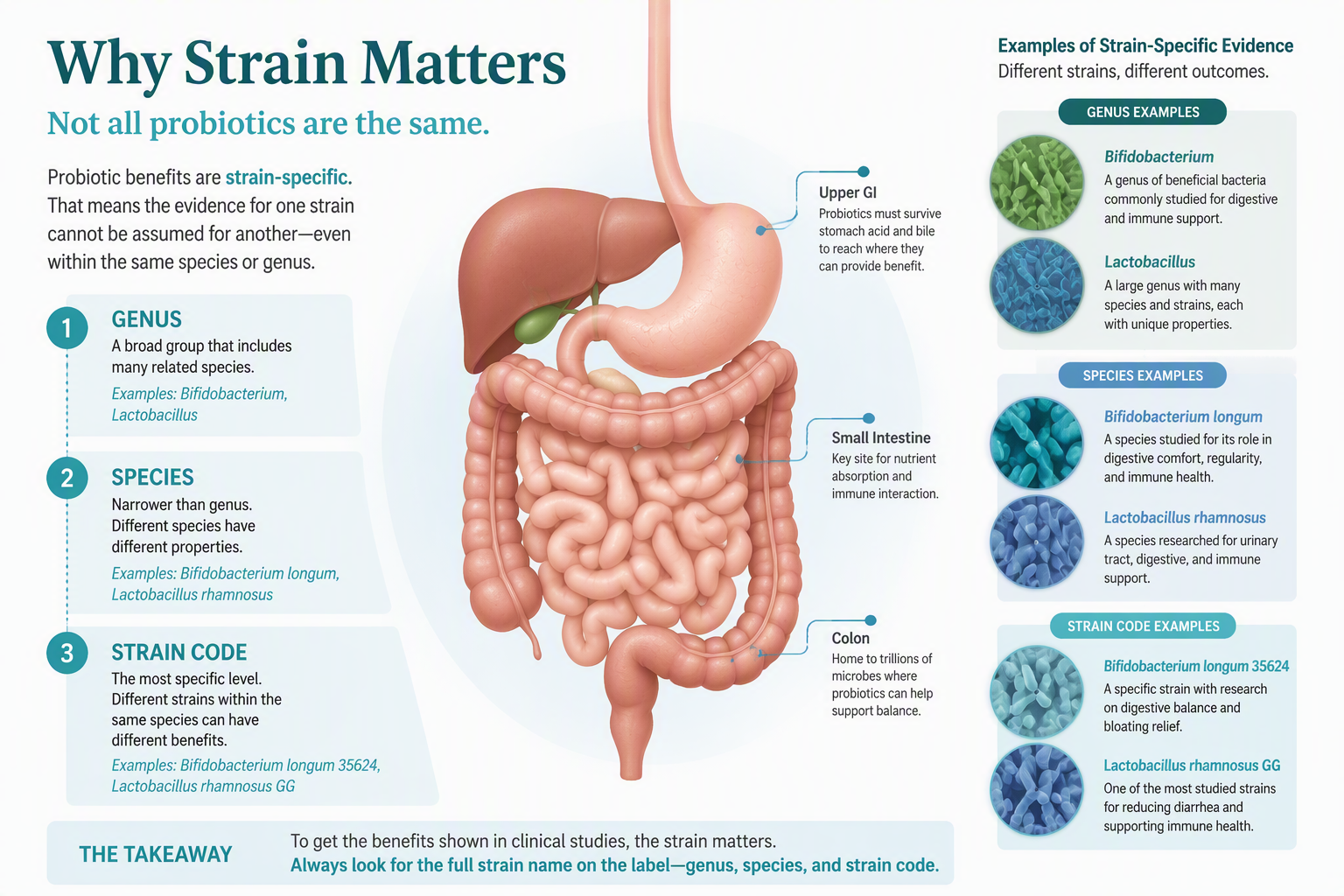
Probiotics are live microorganisms, usually bacteria or yeasts, that may offer a health benefit when consumed in adequate amounts. The useful question is not whether probiotics work in general, but whether a named strain may help manage the digestive problem you have, such as irritable bowel syndrome (IBS), constipation, diarrhea, bloating, or gas.
Some probiotic organisms resemble microbes that naturally live in the body. They are part of the gut microbiome, the community of microorganisms in your digestive tract. Still, a product is not automatically helpful because it is marketed for gut health, contains billions of colony-forming units (CFUs), or includes a familiar bacterial name.
A general probiotics guide can help with the broader picture. This guide focuses more narrowly on whether a particular strain has evidence for a particular symptom or condition, a distinction that matters when digestive symptoms disrupt meals, work, travel, or family routines.
The evidence differs by condition and by strain:
- Some uses have reasonable support: Certain strains have been studied in people with IBS, rather than only in laboratory studies or general wellness research.
- Other uses have mixed evidence: A probiotic may improve one symptom, such as abdominal pain, without changing bowel movement frequency or stool consistency.
- Some people may feel worse: Bloating or gas can increase, particularly when you first try a probiotic. For some digestive conditions, a probiotic may not be appropriate or may aggravate symptoms.
- Category names are not enough: Labels such as Lactobacillus or Bifidobacterium do not show whether the exact strain was tested for your concern.
Think of genus and species as a person’s last and first names, while the strain code identifies the individual. Bifidobacterium longum subsp. infantis 35624, Bifidobacterium bifidum MIMBb75, and Lactiplantibacillus plantarum 299v are distinct organisms. Evidence for one does not transfer to another product with a similar-sounding name.
That is why a supplement that helps one person’s IBS-related pain may do nothing for another person’s constipation. Neither outcome means all probiotics work the same way. The CFU count can also mislead because a higher number does not replace evidence for the named strain, the symptom studied, and the people included in the research.
Questions about how probiotics affect the gut microbiome, digestion, immunity, and health beyond the digestive tract belong with how probiotics affect the rest of the body. For choosing an approach to digestive health, match the evidence to your symptoms rather than relying on a broad product claim.
Which Digestive Problems Might Probiotics Help?
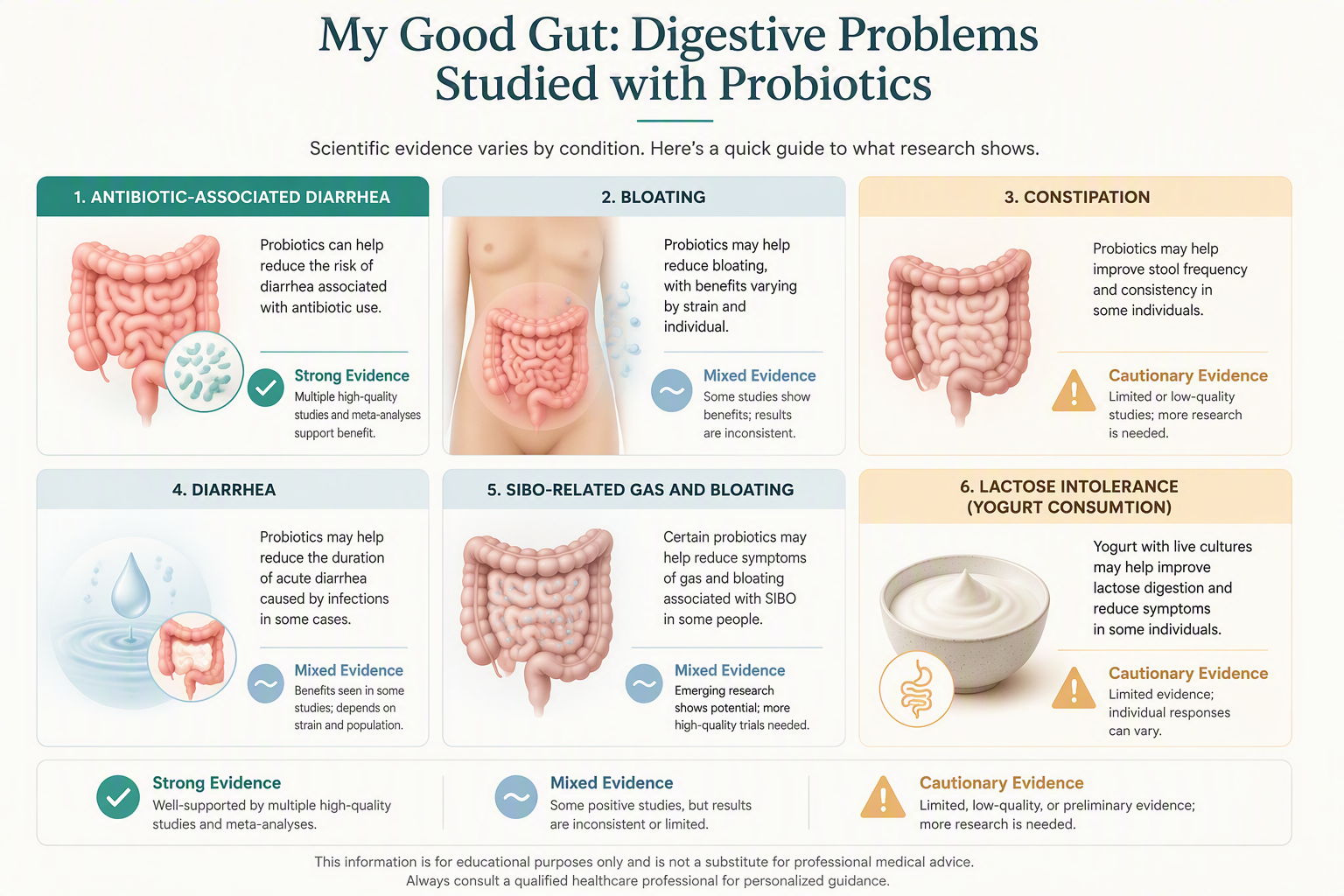
Whether probiotics may help depends on the digestive problem, the specific probiotic strains studied, and whether the label names a clinical strain code instead of only a genus and species.
- Antibiotic-associated diarrhea: This is the best-supported use in this group. Antibiotics can reduce helpful intestinal microbes along with the bacteria they target, and strain-specific probiotics, including Lactobacillus rhamnosus GG and Saccharomyces boulardii, may lower the risk of antibiotic-associated diarrhea. Probiotics after antibiotics covers the strains studied, dosing, and supplement timing during an antibiotic course.
- Bloating: Some probiotic strains have led to modest bloating improvements, particularly in people with IBS. Evidence is strongest for strains tested in IBS, not broad blends with a large colony-forming unit count but no strain code. Probiotics for bloating details the named options and what a realistic trial involves.
- Constipation: Findings are mixed. Some products have been studied for stool frequency, stool consistency, or transit time, but results are inconsistent and do not apply to every product. Probiotics for constipation explains what research has measured and why probiotics are not a first-line constipation treatment.
- Diarrhea: The cause determines whether probiotics are a reasonable option. Antibiotic-associated, short-term infectious, and IBS-related diarrhea have different evidence, and guidelines recommend against routine probiotic use in at least one of these settings. Probiotics for diarrhea separates these situations before you apply findings from one type to another.
- Small intestinal bacterial overgrowth (SIBO): Probiotics are not an established treatment for SIBO. During an active flare, they may worsen gas and bloating for some people, making this different from conditions where a cautious trial may fit. Probiotics for SIBO explains the evidence limits and reasons for added caution.
- Lactose intolerance: Live cultures may help digest lactose in a meal, but that narrow effect does not treat the condition itself. Probiotics for lactose intolerance compares cultured dairy foods, selected probiotics, and lactase enzyme products.
Outside these concerns, selected strains may help maintain remission in ulcerative colitis or pouchitis after surgery when used alongside standard care. That does not mean supplements replace prescribed treatment or a diagnosis.
How Strong Is the Overall Probiotic Evidence?

Overall probiotic evidence is strongest for a few defined medical uses, not for every digestive symptom. The American Gastroenterological Association’s clinical practice guideline is a useful reference because it evaluates probiotics by condition instead of treating all products as interchangeable (source)).
The evidence falls into three practical tiers:
- Guideline-supported uses: The clearest support is for preventing antibiotic-associated diarrhea and helping prevent pouchitis after ileal pouch surgery. Pouchitis is inflammation of a surgically created pouch, often after ulcerative colitis surgery, so it requires specialist care rather than self-treatment for bloating or irregular stools. Its evidence shows what focused guidance looks like when the condition, strain, and treatment goal are clearly defined (source).
- Possible but unsettled uses: For IBS, bloating, and constipation, results are modest and inconsistent. Probiotic benefits by strain matter more than a large colony-forming unit (CFU) number on the front label. Some strains may help pain, gas, diarrhea, constipation, or bowel regularity, but no product helps everyone or reliably improves overall IBS symptoms. The American College of Gastroenterology does not recommend routine probiotics for overall IBS symptom relief.
- Not supported for routine care: For acute infectious diarrhea or viral gastroenteritis in children, the guideline recommends against routine probiotic use. This corrects the common claim that probiotics shorten every stomach bug. Evidence for Crohn’s disease and ulcerative colitis, which are forms of inflammatory bowel disease, remains too limited for routine use outside clinical trials (source)).
The middle tier is where marketing often runs ahead of the evidence. A strain associated with one IBS symptom does not automatically help constipation, and a probiotic studied for bowel-movement frequency in healthy adults should not be treated as an IBS treatment. Similarly, a benefit reported for a specific strain does not transfer to another product with a different strain code.
Digestive symptoms can also signal something that needs medical attention rather than a supplement trial. Seek prompt medical care if diarrhea is accompanied by:
- Dehydration: Signs can include very dark urine, dizziness, or difficulty keeping fluids down.
- Blood in the stool: This should be evaluated rather than managed with a probiotic alone.
- Fever or significant abdominal pain: These symptoms may point to an infection or another condition that needs assessment.
Start with the condition you are trying to manage, then decide whether a probiotic trial is reasonable before comparing brands or CFU counts.
How Can You Choose a Quality Probiotic?

Choose probiotic supplements by matching the full strain name to the digestive problem you want to address. Evidence for strain-specific probiotics belongs to a named strain, not to a genus, a blend’s number of probiotic strains, or a large colony-forming units count on the front label.
That distinction is easy to miss when a product is marketed for “general digestive health.” A supplement may list Bifidobacterium or Lactobacillus yet contain a different strain from the one studied for IBS, bloating, constipation, or diarrhea. Look for the genus, species, and strain code together, such as Lacticaseibacillus rhamnosus GG.
Colony-forming units, or CFUs, measure the number of live microorganisms intended per serving. A higher CFU number does not automatically make a product more useful. The condition and the strain studied for that condition matter more than the count on the package.
Fermented foods and probiotic foods can be worthwhile parts of your eating pattern, but they do not replace a supplement tested for a specific symptom. Food labels also rarely name the clinical strain code needed to match a condition-specific study.
Common food sources include:
- Yogurt labeled with live and active cultures.
- Kefir.
- Unpasteurized sauerkraut and kimchi.
- Kombucha, miso, and tempeh.
Pasteurization can reduce or remove live microorganisms, so check fermented-food labels for live and active cultures when that is your goal. Even then, these foods may not contain the specific probiotic strains evaluated in clinical research.
Supplement quality also involves details beyond the front-panel CFU claim. Capsules, powders, and liquids can all be appropriate formats, but the Supplement Facts panel, CFU guarantee through the expiration date, storage instructions, and ingredient list still matter. Choosing a quality probiotic walks through those label details and format comparisons before you buy.
How Should You Trial Probiotics Safely?
Dose timing, trial length, and tracking symptoms against a baseline belong to building a daily probiotic routine, so what follows here is only the part that changes with the condition.
A useful probiotic trial begins with one symptom target. Before choosing probiotic supplements, decide what improvement would matter most for your digestive health instead of looking for a general sense of feeling better.
A symptom target may be:
- Fewer loose or urgent stools when diarrhea is the main concern.
- Easier, more comfortable bowel movements when constipation is the problem.
- Less bloating after meals when fullness disrupts work or family routines.
- Fewer symptoms after dairy when lactose-containing foods seem to trigger discomfort.
Mild gas, bloating, or looser stools can occur during the first few days. These common probiotic reactions often settle, but they do not show that a product is helping. Check the expiration date and storage directions, too. Live organisms can lose viability over time, and some products require refrigeration.
Stop the product if an active digestive problem becomes noticeably worse rather than settling. This is especially important with SIBO, where added bacteria or fermentable ingredients may worsen symptoms for some people. Products that combine probiotics with enzymes, fiber, or prebiotics can also muddy the results, which is why probiotics compared with other options is worth reading before you mix categories. Prebiotics are nondigestible fibers that feed beneficial gut bacteria, with food sources including onions, garlic, bananas, and oats, but prebiotics may increase gas in sensitive people.
Neither a higher probiotic dosage nor more colony-forming units automatically makes a product a better match. A single, clearly identified product is easier to judge when other major diet and routine changes stay as steady as practical. Antibiotics can disrupt beneficial gut bacteria as well as harmful bacteria and contribute to diarrhea, while certain probiotics may help prevent or lessen antibiotic-associated diarrhea. Other medications can affect bowel habits and the gut microbiome, so professional guidance is appropriate when medication-related factors may be involved.
When Should You Stop Self-Treating Digestive Symptoms?

A probiotic is a supplement, not a diagnosis. It may help manage certain digestive symptoms for some people, but it is not a universal treatment for every digestive condition. If symptoms persist, become severe, or change from your usual pattern, medical assessment matters more than trying another product. A supplement that seems helpful can also delay finding the cause.
Stop self-treating and seek medical assessment when any of these signs are present:
- Blood in the stool.
- Unintentional weight loss.
- Persistent vomiting.
- Fever.
- Severe or worsening abdominal pain.
- Signs of dehydration, such as dizziness, very dark urine, or being unable to keep fluids down.
- Difficulty swallowing.
- A change in bowel habits lasting more than a few weeks.
These signs do not always mean a serious condition is present, but they need more attention than a supplement trial. Ongoing diarrhea, constipation, bloating, or pain can have many causes, including medication effects, infection, food intolerance, inflammatory conditions, and conditions that need testing or treatment.
Probiotic safety also depends on your overall health. Talk with a clinician before starting a probiotic if any of the following apply:
- You have a weakened or compromised immune system.
- You are seriously ill or hospitalized.
- You have a central venous catheter.
- You are pregnant or breastfeeding.
- You are managing a diagnosed condition, including inflammatory bowel disease.
Rare bloodstream and other systemic infections have occurred in medically vulnerable people who use probiotics. That concern differs from the mild gas or temporary bowel changes that some otherwise healthy adults notice when they begin a supplement. Probiotics should not replace medical care, prescribed treatment, or a proper diagnosis.
Age changes the decision, too. Adult probiotic research does not automatically apply to infants, young children, or frail older adults. Premature infants need specialist guidance in particular because their infection risks and medical needs differ sharply from those of healthy adults. A pediatrician, geriatric clinician, or treating specialist can help determine whether a product is appropriate and whether symptoms should be evaluated first.
A careful probiotic trial may be reasonable only when no warning signs are present and the likely cause of symptoms is already reasonably clear. For example, someone with previously evaluated IBS may decide with a clinician to try one clearly identified strain for a limited time. New nighttime diarrhea, unexplained weight loss, or escalating pain should not be treated as routine IBS.
For most digestive concerns, the realistic benefit is modest symptom improvement, not a cure or a replacement for medical care.