


A label that says Bifidobacterium and 50 billion CFU doesn't tell you whether a probiotic fits your bloating, constipation, or IBS symptoms. Bifidobacterium probiotics contain selected live bacteria from a broad genus, and benefits depend on the exact strain, dose, and concern being studied.
B. lactis HN019 and BB-12 have been studied for bowel-movement frequency and transit time, while B. longum subsp. infantis 35624 has separate, mixed IBS findings. Product labels can also hide the details that matter, including a missing strain code, a proprietary blend, or inulin that may cause gas on its own. Matching the full organism name and CFU dose to human research offers a more useful starting point than front-label claims.
Most healthy adults tolerate these products, though temporary gas, cramping, or stool changes can occur. Severe immune suppression, serious illness, or persistent and worsening digestive symptoms call for guidance from a qualified healthcare professional.
Bifidobacterium Probiotics Key Takeaways
- Bifidobacterium is a broad genus, so species and strains are not interchangeable.
- Match the complete strain code and dose to human research for your specific symptom.
- HN019 and BB-12 have constipation research, not proof of IBS treatment.
- Large CFU totals and proprietary blends cannot replace clear strain identification.
- Fermented foods and gradual fiber increases support gut health but lack supplement-level strain precision.
- Temporary gas, bloating, cramping, or stool changes can occur during probiotic trials.
- Seek medical guidance for medically vulnerable situations or persistent, severe, or worsening symptoms.
What Is a Bifidobacterium Probiotic?
Bifidobacterium is a genus, or broad biological group, of naturally occurring Bifidobacterium bacteria in the human gut microbiota. A Bifidobacterium probiotic is a food or supplement containing selected live bacteria from this genus. It is not a catch-all name for every digestive-health product, and having Bifidobacterium in the gut does not mean every product will help every person or symptom.
These bacteria are closely associated with the colon and lower intestines, where oxygen is limited and dietary carbohydrates reach resident microbes. Members of the genus can also occur in the mouth and vagina. Their presence is normal, so you do not need to remove, replace, or “fix” them with a supplement.
A few traits help explain where these organisms tend to live:
- Gram-positive bacteria: They have a cell-wall structure used to classify bacteria in the laboratory.
- Low-oxygen growers: Many grow with little or no oxygen, which fits the lower digestive tract.
- Non-motile and non-spore-forming: They do not move independently or make the hardy spores produced by some other bacteria.
- Carbohydrate metabolizers: Many break down carbohydrates and produce lactic acid during metabolism.
These features provide biological context, not proof that a supplement can treat bloating, constipation, diarrhea, lactose-related symptoms, or irritable bowel syndrome (IBS).
Bifidobacteria also have an important early-life role. They are among the first microbes to settle in the digestive tract after birth, and Bifidobacterium in breastfed infants may make up a large share of infant gut flora. Specialized carbohydrates in human milk nourish certain infant-associated species. As diet, environment, and the wider microbial community change with age, their relative abundance often declines.
That early role explains scientific interest, but an adult supplement cannot recreate an infant-like microbiota or guarantee symptom relief. Adults have different microbial communities, and digestive symptoms can have many causes. The types of probiotics differ by species and strain, not simply by the genus named on a package.
“Bifidus” on yogurt and other cultured-food labels is commercial shorthand for Bifidobacterium. It does not identify the exact species or strain, show how many live organisms remain, or establish evidence for a specific use. A useful label names the strain, the viable amount, and research on that exact combination.
Persistent, severe, or worsening digestive symptoms deserve evaluation from a qualified healthcare professional.
Which Bifidobacterium Species and Strains Matter?
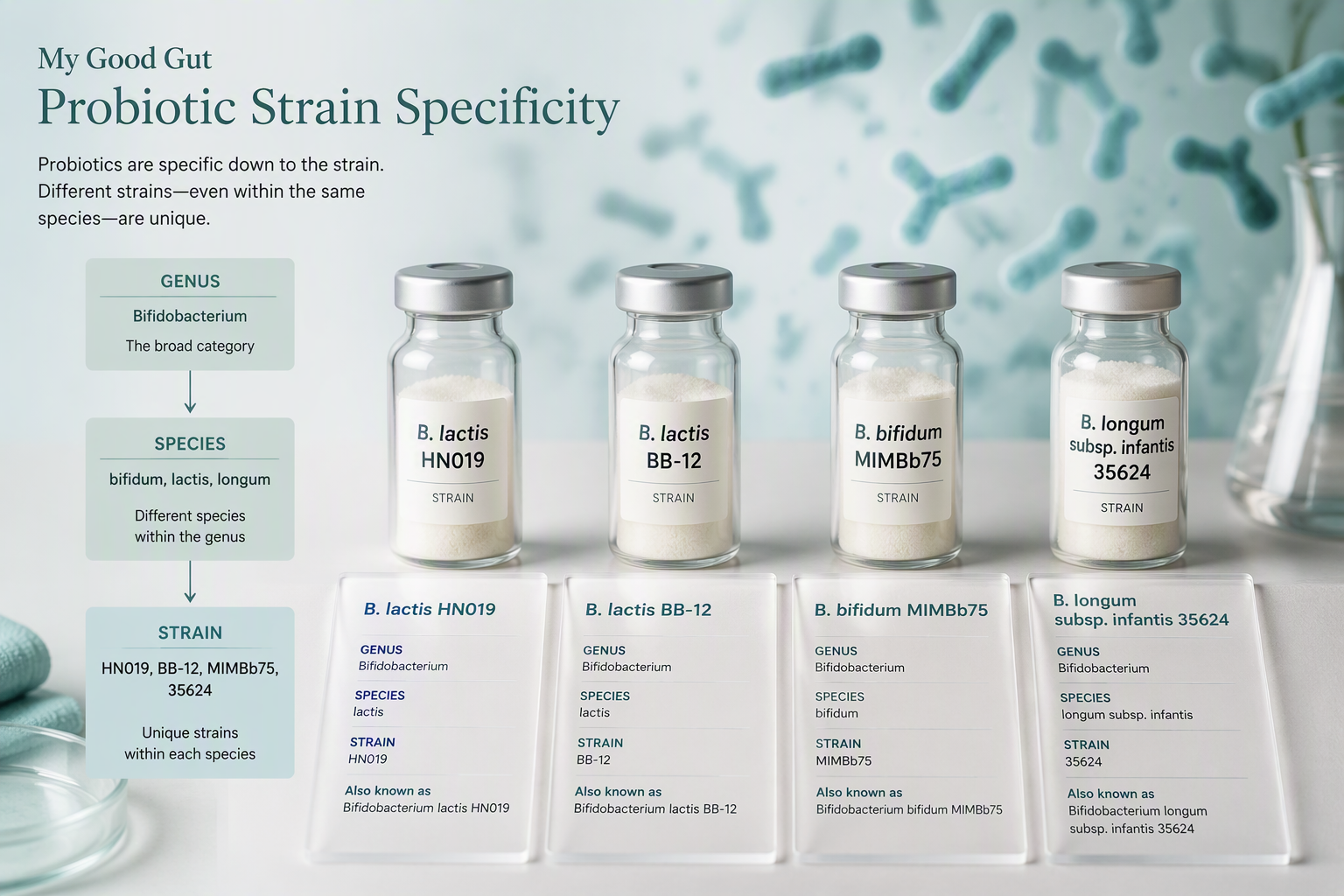
Bifidobacterium is a broad genus, not one uniform probiotic. A species name narrows the identity, while a full strain designation identifies the exact organism studied. This probiotic strain specificity matters because a digestive effect linked to one strain cannot be assumed for another strain in the same species or a closely related strain.
Common species include Bifidobacterium longum, Bifidobacterium bifidum, Bifidobacterium breve, Bifidobacterium infantis, and Bifidobacterium animalis. These oxygen-sensitive bacteria are common members of the human gut microbiota, but a label that says only “Bifidobacterium” does not give enough information to assess the research behind a product.
Bifidobacterium longum is often studied for digestive health, but its strains are not interchangeable. B. longum BB536 and B. longum subsp. infantis 35624 are distinct organisms with separate evidence records. Older studies and product materials may call 35624 B. infantis or Bifantis, so matching the full current designation, B. longum subsp. infantis 35624, helps you evaluate the right study or supplement.
A few label details can prevent misleading comparisons:
- Bifidobacterium bifidum and Bifidobacterium breve: Both appear in infant, family, and adult formulas, but neither replaces B. longum or the other species. B. bifidum BBi32 differs from B. breve BBr60, A1, B632, and BR03. Evidence for one named strain does not establish the same result for the others.
- Bifidobacterium infantis: A label that gives only this name leaves the strain unidentified. IM1 and EVC001 are separate strains and need their own human evidence. They should not be treated as versions of 35624.
- Bifidobacterium animalis subsp. lactis: Packaging may shorten this name to B. lactis or Bifidobacterium lactis, but neither identifies a strain. HN019 and BB-12 are different strains, so broad digestive claims are less useful than research on the exact organism named on the label.
The same careful label reading applies to other probiotics. Bacillus coagulans strains have their own strain-specific evidence.
Bacillus spore probiotics are also a separate group, rather than substitutes for Bifidobacterium products.
A single-strain supplement makes it easier to match a product with its research. A multi-strain formula can also be reasonable when every organism is disclosed, such as a blend listing B. breve BBr60, B. bifidum BBi32, and B. longum BL21. By contrast, “10 strains” without strain codes does not let you connect the formula to human research. Colony-forming unit totals and product popularity cannot make up for missing identification.
For bloating, constipation, diarrhea, or irritable bowel syndrome, look beyond the genus name. The most useful information is the full species-and-strain designation, the dose studied, and whether human evidence fits your specific concern.
What Does the Evidence Say About Bifidobacterium?
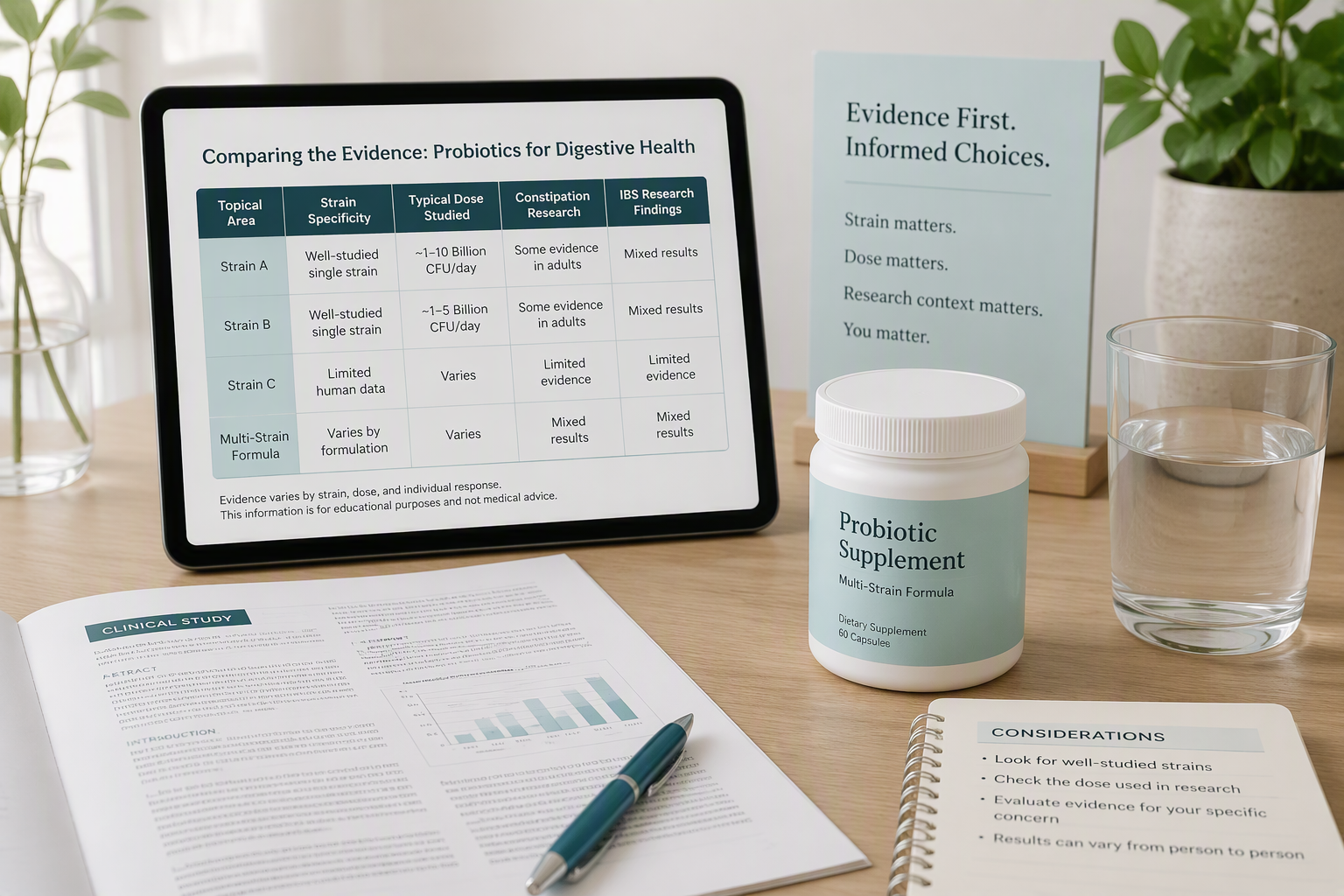
After separating species and strains, human evidence is strain-specific. Certain fully identified Bifidobacterium strains may help with bowel regularity or selected digestive symptoms, but a genus name, a high colony-forming unit count, or laboratory findings cannot predict how a product will affect you. Research on Bifidobacterium and dietary fiber helps explain complex dietary fiber digestion, the Bifid shunt, and production of short-chain fatty acids, but these mechanisms do not establish symptom relief in people.
A practical evidence map looks like this:
- Supported for selected uses: Some B. lactis and B. longum strains have improved stool frequency or transit time in constipation studies.
- Mixed for irritable bowel syndrome: A few specific strains have positive trial results, while others have not beaten placebo on key symptoms.
- Emerging for diarrhea and immune measures: Research is ongoing, but Bifidobacterium products are not interchangeable for antibiotic-associated diarrhea, infections, or immune protection.
- Preclinical for some claims: Research on harmful microbe defense, intestinal barrier support, and tumor inhibition from cell, animal, or microbiome studies still needs confirmation in human trials.
For occasional constipation, certain B. lactis and B. longum strains may be reasonable options when the label identifies the exact strain and dose. B. lactis HN019 and BB-12 have been studied for transit time and bowel-movement frequency in general adult populations, not as treatments for irritable bowel syndrome.
IBS research requires especially careful label reading. A multicenter, randomized, double-blind, placebo-controlled dose-ranging trial studied B. longum subsp. infantis 35624 in 362 primary-care patients with IBS across bowel-habit subtypes (source). An earlier trial of 35624 improved most measured symptoms but did not improve bowel-movement frequency or stool consistency, a limitation that matters if those are your main concerns.
B. bifidum MIMBb75 has separate evidence. In a four-week randomized, double-blind, placebo-controlled trial, 122 patients received MIMBb75 or placebo once daily, including 60 who received the strain, and the MIMBb75 group reported better overall symptoms and quality of life (source). Those findings apply to MIMBb75, not to B. bifidum supplements with other strain codes.
Population and outcome measures can change the answer, even with the same strain. In 275 people with abdominal discomfort and bloating who had not sought medical care, rather than people diagnosed with IBS, B. longum 35624 did not significantly outperform placebo for discomfort or bloating severity, though probiotic users had more bloating-free days (source). That result should not be treated as proof for or against every IBS population.
Certain Bifidobacterium strains are being studied for infectious and antibiotic-associated diarrhea, while probiotics overall may lower antibiotic-associated diarrhea risk in some settings. Evidence for Lactobacillus species, including Lactobacillus rhamnosus GG, does not transfer to Bifidobacterium products. Saccharomyces boulardii is a different organism with its own research base.
Immune findings remain early. In a three-week study of older adults, B. lactis HN019 was associated with changes in helper T cells, cellular immune function, and leukocyte phagocytosis. B. animalis subsp. lactis is often studied for healthy immune responses, but marker changes do not show that it prevents or treats illness.
Early research has examined B. animalis IM386 for lactose-intolerance symptoms and B. longum NCC3001 and B. longum 1714 for IBS-related mood and stress. Animal tumor-inhibition findings for B. longum BB-536 are not cancer-prevention evidence. Match the strain code and dose to human research.
How Does Bifidobacterium Work in Your Gut?
Because human results cannot be inferred from a genus name alone, Bifidobacterium mainly uses carbohydrates that reach your large intestine without being fully broken down by your digestive enzymes. That is why Bifidobacterium and dietary fiber are closely connected. Depending on the strain and your usual diet, these bacteria can ferment certain fibers and complex carbohydrates. Some strains can also use lactose or fructose.
Complex dietary fiber digestion is a shared process, not the work of one microbe alone. Bifidobacterium commonly produces acetate and lactate, plus other organic acids. Other gut microbes may then use those compounds to make additional short-chain fatty acids, including butyrate. As a result, a probiotic’s effects can depend on the wider microbial community already present in your colon.
These fermentation products may influence the gut environment in a few ways:
- Local pH: Organic acids can lower pH in parts of the colon, which may make conditions less favorable for some unwanted microbes.
- Colon-lining support: Short-chain fatty acids may provide fuel for cells lining the colon and support normal intestinal function.
- Microbial teamwork: One strain may supply acetate or lactate while another microbe converts those compounds into butyrate. This cross-feeding helps explain why the same supplement can affect people differently.
These are biologically plausible, research-supported mechanisms. They do not show that a probiotic will resolve bloating, constipation, diarrhea, or IBS. Bifidobacterium benefits cannot be predicted from a genus or species name alone.
Some strains may also support the intestinal barrier, which includes protective mucus and tightly connected intestinal cells that separate gut contents from the rest of your body. Certain Bifidobacterium may compete with Escherichia coli and Clostridioides difficile for nutrients and attachment sites, or produce compounds that limit their growth. That activity is not a guaranteed shield against infection.
Gut microbes and their byproducts also communicate with immune cells. Some strains may influence balanced immune signaling, including mucosal immunoglobulin A (IgA), which helps protect mucosal surfaces. Bifidobacterium animalis subsp. lactis is among the groups studied, but results from one strain and study population do not automatically apply to every product or person.
The gut-brain connection is another emerging, strain-specific area of research. Microbial metabolites, immune signals, and nerve pathways could affect stress responses or aspects of mental well-being, but a general Bifidobacterium supplement is not a treatment for anxiety, depression, or neurological conditions.
Your diet, existing microbiome, health conditions, medicines, dose, and exact strain all matter. Results vary by person, and any dietary or supplement advice should be individualized.
Choose Food, Fiber, or Supplements

Since diet and individual tolerance can shape probiotic effects, food, fiber, and supplements each have a place based on your goal, tolerance, and need for probiotic strain specificity. Fermented foods add variety to your diet, prebiotic plants nourish Bifidobacterium already living in your gut, and a targeted probiotic supplement allows a trial of one named strain. None is a reliable answer for every digestive symptom.
Yogurt labeled with live or active cultures and kefir may contain Bifidobacterium. Sauerkraut, kimchi, and tempeh can also have live microorganisms, but fermentation does not confirm which ones are in the product. Many foods mainly contain Lactobacillus, and culture lists, storage instructions, and expiration dates can vary between brands and batches.
Small, regular servings of a fermented food you tolerate can be a sensible first step for general dietary support. Food is less precise than a supplement because the species, strain identity, live-organism amount, and storage stability may differ. A fermented food can still be nutritious even if it is not a dependable Bifidobacterium source.
For constipation, low fiber intake, or longer-term support of your gut microbes, gradually increasing tolerated fiber-rich foods may be more useful than starting with a broad probiotic blend. Foods with inulin and oligosaccharides include:
- Alliums: Onions, garlic, and leeks contain fermentable prebiotic fibers.
- Vegetables: Asparagus and Jerusalem artichokes provide inulin but can be difficult for some people to tolerate.
- Legumes and grains: Legumes and some whole grains may support resident Bifidobacterium over time.
If you have IBS or sensitivity to high-fermentable oligo-, di-, monosaccharides and polyols (FODMAP) foods, add one new fiber source or small serving at a time. Fermentable fibers can initially cause gas, bloating, cramping, or stool changes, especially after a low-fiber diet. Increase only when symptoms remain manageable. When gas does not settle, methylcellulose or partially hydrolyzed guar gum may be gentler alternatives to inulin-heavy products.
A targeted probiotic supplement is often the cleaner trial when you want to compare a named strain and CFU dosage with relevant research, cannot eat fermented foods regularly, or react to mixed formulas. Capsules, powders, and chewables are available over the counter. Bifidobacterium-only products, including multi-strain formulas without Lactobacillus, can reduce variables when fermented foods, histamine, or Lactobacillus seem to trigger symptoms, but they are not automatically better for every concern.
A practical decision path looks like this:
- Choose tolerated fermented foods for general dietary variety.
- Increase fiber and prebiotic plants gradually for bowel regularity and long-term microbial support.
- Trial one strain-identified supplement for a specific purpose while keeping other major changes stable.
Persistent, severe, or worsening digestive symptoms need evaluation from a qualified healthcare professional.
How Do You Read a Bifidobacterium Label?

If a supplement trial fits your goal, start with the symptom you want to address and identify the exact organism studied for that use. For constipation, diarrhea, IBS, bloating, or support after antibiotics, a label that says only Bifidobacterium cannot confirm a relevant species or strain.
Read the full organism name. It includes the genus, species or subspecies, and strain code, such as Bifidobacterium longum BB536, Bifidobacterium breve BBr60, Bifidobacterium bifidum BBi32, or Bifidobacterium longum subsp. infantis 35624. Strains within the same species are not interchangeable, so evidence for one named strain does not carry over to a species-only label.
A practical label check includes three comparisons:
- Match the concern: Find human research on the full strain for your specific symptom rather than assuming it applies to every digestive concern.
- Match the dose: Compare the study dose with the CFU dosage in the daily serving listed in the Supplement Facts panel.
- Check disclosed amounts: A proprietary-blend total cannot show whether a particular strain reaches the amount used in research. A larger total CFU number does not remove that uncertainty.
A single-strain probiotic supplement is often simpler to assess. Align Probiotic identifies B. longum subsp. infantis 35624, while a multi-strain formula is only assessable when each species, strain code, and amount appears on the label. Seed DS-01 Daily Synbiotic is described as a multi-strain product, but the label details should be verified directly before stating the exact strain count, potency through expiration, or whether per-strain amounts are disclosed.
AFUs and CFUs are different measurement systems and cannot be compared directly. VSL#3 also illustrates an important probiotic safety distinction: medical-food status is not Food and Drug Administration (FDA) approval, and studies published before 2016 did not test the formula sold under that name. After confirming strain and dose, review storage, expiration, allergens, and added prebiotic fiber.
How Can You Use Bifidobacterium Safely?

Bifidobacterium foods and supplements are generally well tolerated by healthy adults and children, though temporary gas, bloating, mild cramping, or changes in bowel habits can occur. These effects may stand out more if you are sensitive to fermentable foods or change several diet and supplement habits at once. Mild symptoms do not necessarily mean a product is harmful or that Bifidobacterium benefits are out of reach.
A cautious trial makes it easier to tell whether a product suits you. Add one Bifidobacterium food or supplement at a time, follow the label directions, and avoid treating a higher colony-forming unit (CFU) count as automatically better. A simple formula is often easier to assess because prebiotic fibers such as inulin and chicory root can cause gas or bloating on their own.
Match the product to your main goal, whether that is constipation, diarrhea, IBS, bloating, antibiotic-related support, or general digestive health. Check for research on the complete strain code rather than relying on the species name, a large CFU number, or front-label claims. Evidence for Bifidobacterium bifidum MIMBb75, for example, applies to MIMBb75 and not to every product labeled B. bifidum.
Before starting, note your usual symptoms so changes are easier to spot:
- Bloating and pain: Record how often they occur and whether they affect meals, work, sleep, or daily activities.
- Stool pattern: Note constipation, diarrhea, frequency, and urgency.
- Other changes: Include cramping, nausea, or symptoms that began after adding the product.
Pause the product if mild symptoms become uncomfortable. If the same reaction returns after you try it again, the strain or another ingredient may not be a good fit. Probiotics do not replace prescribed treatment, diagnosis, or medical evaluation.
Clinical guidance is especially important before using a high-dose probiotic supplement in higher-risk situations:
- Serious or critical illness: This includes people receiving hospital-based care.
- Severe immune suppression or a weakened intestinal barrier: These conditions can change the safety considerations for live microorganisms.
- Complex medical care: Recent major surgery, feeding tubes, and central venous catheters warrant individualized advice.
This precaution is meant for medically vulnerable settings and should not alarm otherwise healthy readers.
Prompt medical evaluation is appropriate for:
- Persistent, severe, or worsening abdominal pain
- Ongoing diarrhea or constipation
- Repeated vomiting, fever, or dehydration
- Blood in the stool or unexplained weight loss
- Symptoms that repeatedly wake you from sleep
Digestive symptoms can reflect an IBS flare, infection, medication effect, or another condition. A qualified healthcare professional can help distinguish a possible probiotic reaction from a problem that needs different care.
Bifidobacterium Probiotic FAQs
These FAQs address Bifidobacterium probiotics, including strain labels, possible digestive uses, side effects, and when symptoms may call for guidance from a qualified healthcare professional.
1. Do Bifidobacterium Probiotics Need Refrigeration?
Check the storage statement on your exact product label, since some Bifidobacterium probiotics are shelf-stable and others need refrigeration. Heat and humidity can lower viability, so keep capsules tightly closed in their original container, away from hot cars and steamy bathrooms. Look for a live-organism guarantee through expiration, not only at manufacture. A higher CFU count alone does not determine fit. The named strain, dose, formulation, and evidence matter too. For refrigerated deliveries, confirm temperature-controlled shipping and contact the manufacturer if a package arrives warm or instructions are unclear. Temporary gas, bloating, or cramping may occur at first.
2. Do Bifidobacterium Levels Change With Age?
Bifidobacterium makes up a large share of the infant gut microbiota, especially in breastfed babies, but its relative abundance is generally lower in adults and later life. This age-related pattern is not a deficiency or a target number. A lower test result alone does not show that you need a supplement or identify a dose. For probiotic safety, choose a named strain based on your symptom, such as IBS, constipation, or antibiotic-associated diarrhea, and seek medical guidance for persistent symptoms.
3. Are Bifidobacterium Probiotics Safe for Infants?
Bifidobacteria are common early gut residents, particularly in breastfed infants, and usually become less dominant with age. Infant-associated types include B. longum subsp. infantis, B. longum subsp. longum, B. bifidum, and B. breve. B. animalis subsp. lactis may be labeled B. lactis. Their natural presence does not show that every supplement is safe or helpful, including products discussed for irritable bowel syndrome.
Talk with your pediatrician before giving an infant a Bifidobacterium supplement. Medical guidance is especially important for premature, hospitalized, medically fragile, immunocompromised babies, and those with central lines or complex health conditions.
4. Can Bifidobacterium Probiotics Worsen SIBO?
Bifidobacterium is not automatically harmful if you suspect SIBO, but a probiotic may temporarily increase gas, bloating, or discomfort. Responses are personal and strain-specific. Although some strains may help certain IBS symptoms, mixed IBS evidence cannot predict how you’ll respond to SIBO-like symptoms.
The word “Bifidobacterium” alone is not enough to choose a product. Match the exact species and strain code to your concern, and avoid adding, switching, or increasing probiotics to self-treat persistent bloating. Digestive symptoms have many causes, so severe, worsening, or ongoing symptoms warrant assessment from a qualified healthcare professional.