


Seeing "Lactobacillus" on a supplement label doesn't tell you whether it will help your bloating, IBS, diarrhea, or lactose-related symptoms. Lactobacillus probiotics are live microorganisms found in fermented foods and supplements, but their possible benefits and safety depend on the exact strain, dose, formula, and your health situation.
A product labeled L. acidophilus is not automatically equivalent to one containing DDS-1 or NCFM, just as LGG is not interchangeable with every L. rhamnosus product. The 2020 Lactobacillus reclassification can add another layer, since plantarum 299v may appear under either an older or newer genus name. Matching the full strain code and expiration-date CFU amount to a specific goal is more useful than choosing the largest number on the package.
Temporary gas or mild stomach upset can occur, and people with immune suppression, serious illness, damaged heart valves, or short bowel syndrome should seek medical advice before starting a supplement. Persistent, severe, or worsening digestive symptoms need medical evaluation rather than a probiotic trial alone.
Lactobacillus Probiotics Key Takeaways
- Lactobacillus benefits depend on the specific strain, dose, formulation, and health goal.
- Match genus, species, and strain codes instead of relying on a broad Lactobacillus label.
- LGG has stronger support for antibiotic-associated diarrhea than for IBS symptom control.
- Plantarum 299v has limited evidence for selected IBS symptoms, including abdominal pain.
- High CFU totals do not show whether a studied strain is present at an effective dose.
- Fermented foods may contain live cultures but rarely provide standardized strain codes or doses.
- Seek medical advice before probiotics with immune suppression, serious illness, premature infancy, or complex medical conditions.
What Are Lactobacillus Probiotics?

Lactobacillus probiotics are live microorganisms found in fermented foods and dietary supplements. The genus is widely studied, but products with a Lactobacillus name are not interchangeable because evidence applies to a specific organism, dose, and formula.
Lactobacillus is a broad group of probiotic bacteria that can occur in the digestive, urinary, and genital tracts. For example, Lactobacillus acidophilus has been identified in the mouth, intestines, and vagina. These lactic acid bacteria use sugars to produce lactic acid, which can make an environment less favorable to some unwanted microbes and help support microbial balance.
Potential Lactobacillus benefits are often framed as support for digestion, nutrient absorption, immune function, or the gut microbiota. Results vary, however, based on the body site, your health goal, the product's formulation, and individual factors. A product may be considered after illness or medication disrupts the gut microbiota, including in some cases of antibiotic-associated diarrhea, but it does not automatically prevent or treat an infection.
A label usually identifies the organism at three levels:
- Genus: Lactobacillus is the larger bacterial group.
- Species: L. acidophilus and L. rhamnosus are examples of probiotic species.
- Strain: A letter-and-number code, such as GG or LRa05, identifies the particular version studied.
A probiotic is a live microorganism shown to provide a health benefit when consumed in an adequate amount. For that reason, match the complete strain code, dose, and formulation to your goal rather than relying on a high colony-forming unit (CFU) count. Lactobacillus rhamnosus GG has better support for antibiotic-associated diarrhea and some childhood diarrhea than for IBS symptom control. Its pediatric evidence has been reviewed alongside Bifidobacterium animalis subsp. lactis BB-12 (source).
The same strain-specific approach distinguishes these products from spore-based probiotics, which contain different organisms. Digestive symptoms can have many causes, so persistent, severe, or worsening symptoms need evaluation by a qualified healthcare professional.
Why Do Species and Strain Codes Matter?

A Lactobacillus name identifies only part of a probiotic. Think of it as an address: Lactobacillus is the genus, acidophilus is the species, and DDS-1 or NCFM identifies the particular strain studied. Lactobacillus acidophilus DDS-1 and L. acidophilus NCFM are distinct probiotic bacteria, so results for one do not automatically apply to the other or to a product labeled simply “acidophilus.”
That detail matters when you are choosing a product for bloating, bowel changes, diarrhea, lactose-related symptoms, or IBS. A broad Lactobacillus label cannot predict a benefit for a particular concern, and the same applies to L. rhamnosus GG, L. plantarum, L. reuteri, L. gasseri, and Lacticaseibacillus paracasei. Evidence must match the strain, probiotic dosage, and health goal.
Scientific naming can also be confusing. Some organisms once classified as Lactobacillus now appear under names such as Lacticaseibacillus, though a new name does not always mean a new organism. The strain code helps connect an older study with a newer label and prevents findings from being carried over to a separately deposited strain.
Lab traits can guide early research, but they do not establish digestive benefits in people. Acid and bile survival, intestinal-cell adhesion, antimicrobial activity, and lactase activity still need human studies of the same strain at a comparable dose. Higher colony-forming units, which measure live microbes, also do not guarantee a better fit for your symptoms. Bacillus coagulans and a probiotic yeast should likewise be assessed by their own organism-specific evidence.
A useful label check includes:
- Complete identification: Look for the genus, species, and strain code.
- Expiration-date potency: Choose products that guarantee colony-forming units through expiration, not only at manufacture.
- Per-strain amounts: A 50-billion-CFU, 16-strain blend may still hide whether any strain is supplied at the studied dose.
A missing strain code does not prove a product is ineffective, but it limits your ability to compare it with the human research that matters most.
Which Lactobacillus Strains Fit Your Goal?
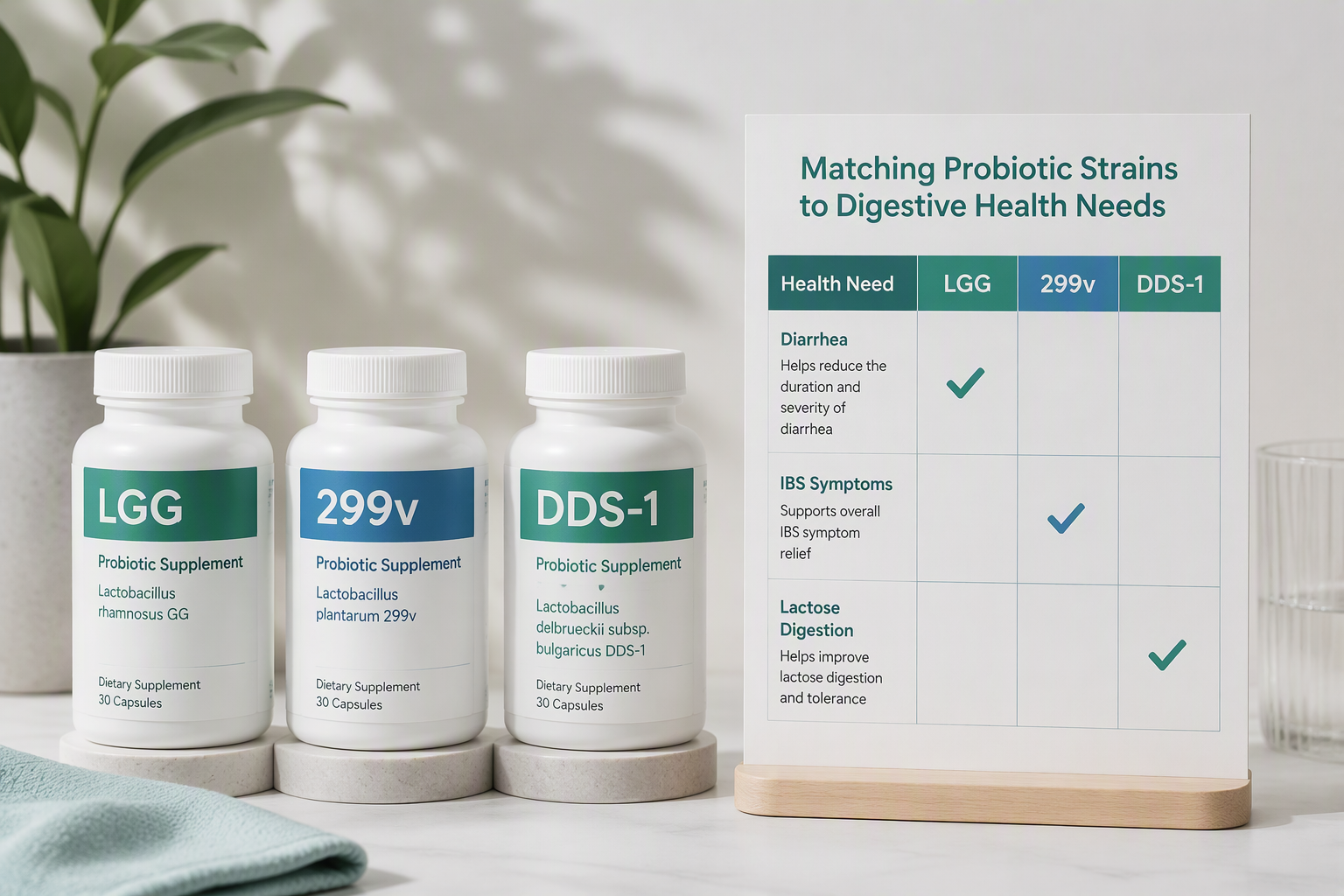
With the strain code as your starting point, match your symptom and medical context with the exact genus, species, strain code, dose, and outcome studied. Lactobacillus and digestion is not one broad benefit category. Lactobacillus acidophilus, Lacticaseibacillus rhamnosus GG (LGG), and Lactiplantibacillus plantarum 299v have different evidence and are not interchangeable just because a label groups them as “Lactobacillus.” The National Institutes of Health notes that probiotic effects depend on the specific microorganism and intended use (source).
This goal-to-evidence map can help you focus on label details that matter:
Your goal | Strain details worth checking | Important context |
|---|---|---|
Bloating, abdominal discomfort, or irregular bowel habits | Lactiplantibacillus plantarum 299v or a named Lactobacillus acidophilus strain | Evidence is limited and symptom-specific. The code, dose, and measured outcome should match your concern. |
Diarrhea during or after antibiotics | LGG | LGG has better support for antibiotic-associated diarrhea than for IBS symptom control. |
IBS symptoms | 299v | Lactobacillus and IBS evidence is strain-specific. In a small randomized trial of 40 patients, all 20 participants taking 299v reported abdominal-pain resolution, compared with 11 of 20 taking placebo (source). |
Lactose-related symptoms | L. acidophilus DDS-1 or NCFM | Lactobacillus and lactose digestion research applies to particular strains and doses, not the species name alone. |
The 299v study’s small sample limits how broadly its findings apply. That matters when considering irritable bowel syndrome probiotics, since a promising result for one strain does not establish that another probiotic will ease the same symptoms.
For post-antibiotic support, not every rhamnosus strain should be treated like LGG. Lacticaseibacillus rhamnosus LRa05 has research in pediatric acute diarrhea, not IBS, so results in children do not establish benefits for adults.
Lactose digestion is a separate goal from IBS or bloating. Some Lactobacillus acidophilus strains support lactase production, meaning they make the enzyme that breaks down lactose, or milk sugar. DDS-1 and NCFM have lactose-digestion research, but the product label should name the strain and provide a dose relevant to lactose-related outcomes.
Bifidobacterium species have separate research for IBS and bowel-pattern concerns, so a blend’s total colony-forming unit (CFU) count does not tell you which ingredient fits your goal.
Before comparing products, check the label for:
- Clinical strain code: Look for identifiers such as 299v, DDS-1, or LGG instead of a species name alone.
- Daily dose and formulation: Compare the amount and delivery form with the product studied when that information is available.
- Measured outcome: Favor evidence tied to your concern, such as antibiotic-associated diarrhea, abdominal pain, or lactose digestion.
More CFUs do not make an unnamed strain a better match. Vaginal and urogenital Lactobacillus research involves different strains, routes, and populations, so it should not guide a digestive choice. Persistent, worsening, or severe symptoms warrant advice from a qualified healthcare professional.
What Does Evidence Show for Digestive Symptoms?
Across the digestive goals above, Lactobacillus and digestion are not one-size-fits-all. Certain products may reduce gas, bloating, or mild discomfort, but the effect depends on the strain, dose, formula, and cause of your symptoms. Probiotics may support recovery of the gut microbiota after illness or medication use, yet they do not reliably relieve every digestive complaint or replace medical evaluation.
For Lactobacillus for diarrhea, evidence is strongest in specific settings. Lactobacillus rhamnosus GG, or LGG, has clearer support for antibiotic-associated diarrhea and some pediatric diarrhea than for everyday bloating or IBS. Results for acute pediatric diarrhea have been inconsistent, and available evidence does not support probiotics as a dependable way to prevent or manage Clostridioides difficile-related diarrhea. LRa05 is a different strain from LGG, so findings for one cannot be applied to the other.
Lactobacillus and lactose digestion deserve separate consideration. Live cultures in fermented dairy foods may help some people tolerate lactose more comfortably, although the food, culture, and degree of lactose intolerance all affect lactose digestion. A label that only names “Lactobacillus acidophilus” does not show that the product was studied for lactose-related symptoms, because the complete strain code must match the research.
Lactobacillus for bloating and Lactobacillus and IBS have mixed evidence across products and symptoms. Lactiplantibacillus plantarum 299v, sometimes labeled Lactobacillus plantarum 299v, has limited placebo-controlled evidence for abdominal-pain relief. The strain number matters more than whether a label uses the older or newer genus name.
Looking beyond a high CFU count helps you judge what a product may reasonably offer:
- 35624: Bifidobacterium longum subsp. infantis 35624 is not a Lactobacillus strain, but it has stronger IBS-specific evidence than many Lactobacillus products.
- 299v: This strain has research for selected IBS symptoms, including abdominal pain.
- DDS-1: Lactobacillus acidophilus DDS-1 performed well in a network ranking, but rankings do not show it will outperform every alternative for an individual.
- LGG: Its clearest evidence is for antibiotic-associated and pediatric diarrhea, not IBS symptom control.
Choose a product that identifies its genus, species, and clinical strain code for your goal instead of relying on a large CFU number or a broad digestive-support claim. Results vary by person, and a strain studied for one outcome may not help another.
How Do You Read a Lactobacillus Label?
To apply that strain-specific digestive evidence, read the organism name all the way through, including its genus, species, and strain code. That code is what lets you compare a product with research related to your specific goal. For example, Lacticaseibacillus rhamnosus GG and Lactiplantibacillus plantarum 299v identify particular strains. A label that says only “Lactobacillus blend” or “Lactobacillus acidophilus” cannot be connected to a specific clinical trial.
A 2020 reclassification divided Lactobacillus into several genera, so the same strain may appear under different genus names. One label may say Lactobacillus plantarum 299v, while another says Lactiplantibacillus plantarum 299v. The genus changed, but 299v did not. When comparing Lactobacillus supplements, match the strain code rather than relying on the first word of the name.
A useful strain check includes:
- Full identification: Confirm that the label names the genus, species, and strain code.
- Research match: Check whether the exact code, not simply the species, appears in research related to your symptoms or goal.
- Probiotic dosage: Compare the daily amount of the named strain with the amount used in the study. Colony-forming units describe quantity, but a multi-strain blend total cannot show whether one studied strain reaches its research dose.
This approach helps separate a clearly identified strain from a broad blend whose evidence cannot be matched with confidence.
Can Fermented Foods Provide Lactobacillus?

Unlike supplements identified by strain code and dose, fermented foods can contribute Lactobacillus and other lactic acid bacteria, but they are not standardized probiotic treatments. Their beneficial bacteria can vary by recipe, starter culture, brand, batch, salt, fermentation time, temperature, and storage.
Common Lactobacillus food sources include:
- Yogurt and kefir
- Sauerkraut, kimchi, and sourdough
- Tempeh and kombucha
Yogurt probiotics and kefir probiotics may contain Lactobacillus acidophilus, but other products use different cultures. "Live and active cultures" can be useful label wording, especially for refrigerated dairy foods. Still, refrigeration and that phrase do not confirm a specific strain code, a studied dose, or the organism used in a clinical trial.
Lactobacillus plantarum, often labeled Lactiplantibacillus plantarum under updated naming, is commonly associated with sauerkraut, kimchi, and sourdough. Tempeh and kombucha may contain mixed bacterial and yeast communities. Lactobacillus rhamnosus is commonly used in probiotic supplements for digestive and immune support, while food labels do not always identify the same strain in the same way.
Heating, cooking, and pasteurization can greatly reduce or eliminate live microbes. A shelf-stable fermented food may still be enjoyable and nutritious, but it may not supply meaningful live cultures.
When comparing food with a supplement, check for:
- Live-culture wording: "Live and active cultures" suggests organisms may be present but does not identify a study-backed strain.
- Full organism name: A species name alone, such as Lactobacillus acidophilus, cannot match the product to research.
- Strain code and dose: Compare a full code and CFU amount with research on the symptom you are considering, rather than relying on "fermented" or a high CFU number.
Many live fermented foods can provide Lactobacillus, but their relevance to a specific symptom may be harder to judge.
Who Should Avoid Lactobacillus Supplements?
Lactobacillus supplements are usually well tolerated by many healthy adults, children, and full-term infants, but safety depends on the person, the strain, and the product. Still, probiotic safety also depends on why you plan to use it. A supplement cannot provide a diagnosis or replace prescribed treatment or medical care.
Medical guidance is important before you start Lactobacillus probiotics if any of the following apply:
- Severe illness or hospitalization: The small possibility of serious infection or other complications can have greater consequences during an acute illness.
- A weakened immune system or significant underlying disease: Immune-suppressing medicines, cancer treatment, transplant care, and complex health conditions can change whether a product is appropriate.
- Premature infancy: A pediatrician should guide decisions about Lactobacillus supplements for premature babies rather than general online advice or package claims.
- Damaged heart valves or short bowel syndrome: These conditions require an individualized discussion with a treating clinician before probiotic use.
Recent surgery, implanted medical devices, and complex digestive disease also call for a product-specific review. Bring the exact package or a photo of the Supplement Facts panel to your appointment, since the species, strain code, dose, and added ingredients matter and a multi-ingredient formula may be tolerated differently than a single-strain product. Possible eczema-related benefits reported for some Lactobacillus probiotics do not outweigh these precautions.
Stop the supplement and seek prompt medical advice if you develop a fever, signs of infection, or concerning symptom worsening.
Results vary by person, and any dietary or supplement advice should be individualized.
Lactobacillus Probiotic FAQs
These FAQs address common questions about Lactobacillus probiotics, from reading strain labels and weighing possible digestive benefits to recognizing when persistent symptoms need input from a healthcare professional.
1. When Should You Take Lactobacillus Probiotics?
Follow the product label first, since Lactobacillus timing varies by strain, dose, capsule design, and whether it is taken with food or before a meal. One acid-resistant L. acidophilus product directs users to take two capsules with water before a meal, but that is not a universal schedule. Consistency matters more than a perfect hour. Choose a strain and dose that fit your health goal and medical context, and follow storage directions because some products require refrigeration while others are shelf-stable.
2. Can You Take Lactobacillus With Antibiotics?
Some Lactobacillus strains may help manage antibiotic-associated diarrhea, but Lactobacillus for diarrhea is not a one-size-fits-all option. Evidence for Lactobacillus rhamnosus GG does not automatically apply to another L. rhamnosus or L. acidophilus product, so check the complete strain name and code on the label. Benefits for Clostridioides difficile-related diarrhea remain less certain.
Antibiotics can disrupt the gut microbiota, and a probiotic may support recovery for some people. Ask your prescriber or pharmacist about timing and probiotic safety, especially with serious illness, immune suppression, or a central venous catheter.
3. How Long Do Lactobacillus Probiotics Take?
No single timeline applies to Lactobacillus probiotics. Whether you notice a change depends on your health goal, the specific strain and dose, the length of its research, and your individual response. Some strains may help certain IBS symptoms, but evidence is mixed, and results from one Lactobacillus product do not carry over to another.
Use the strain-specific study timeframe rather than expecting immediate relief. One IBS research review suggested that single-strain products, doses below 10 billion CFUs daily, and courses under eight weeks may help some symptoms, but this is not a universal schedule.
4. Can Lactobacillus Probiotics Cause Gas?
Yes. Lactobacillus for gas may cause temporary bloating, gas, or mild stomach upset during the first few days. Some strains and doses may instead ease these symptoms, but results vary by person. Watch for discomfort that settles rather than worsens. Stop the product and contact a healthcare professional for severe or persistent abdominal pain, ongoing diarrhea or vomiting, fever, allergic-reaction symptoms, blood in the stool, or worsening digestive symptoms, and get individualized advice first if you are seriously ill or have a weakened immune system.