


A shelf-stable probiotic with a high CFU count isn't automatically the better choice for bloating, constipation, diarrhea, or IBS. Spore-based probiotics contain dormant Bacillus bacteria that can withstand manufacturing and stomach acid, but their potential benefits, symptoms, safety, and label quality still depend on the exact strain.
Bacillus coagulans may appear in products aimed at digestive discomfort, while Bacillus subtilis DE111 and Bacillus coagulans GBI-30, 6086 are different strains with separate research records. A 2023 network meta-analysis of 81 randomized trials found that particular B. coagulans strains ranked among better-performing options for IBS symptom severity, not that every spore probiotic works the same way.
Before trying one, check for a full strain code, the dose per strain, expiration-date potency, and added ingredients that could trigger gas. People with suspected SIBO, severe immune suppression, serious illness, or persistent symptoms should review the product with a qualified healthcare professional.
Spore-Based Probiotics Key Takeaways
- Spore-based probiotics usually contain dormant, shelf-stable Bacillus bacteria.
- Stomach acid resistance does not prove relief for bloating, constipation, diarrhea, or IBS.
- Choose products by exact strain, studied dose, and symptom-specific human research.
- Bacillus coagulans has more digestive symptom research than many other Bacillus species.
- Higher CFU counts and more strains do not necessarily produce better results.
- Prefer labels with strain codes, per-strain doses, expiration-date potency, and disclosed added ingredients.
- Seek clinical advice before use with suspected SIBO, immune suppression, serious illness, or persistent symptoms.
What Are Spore-Based Probiotics?
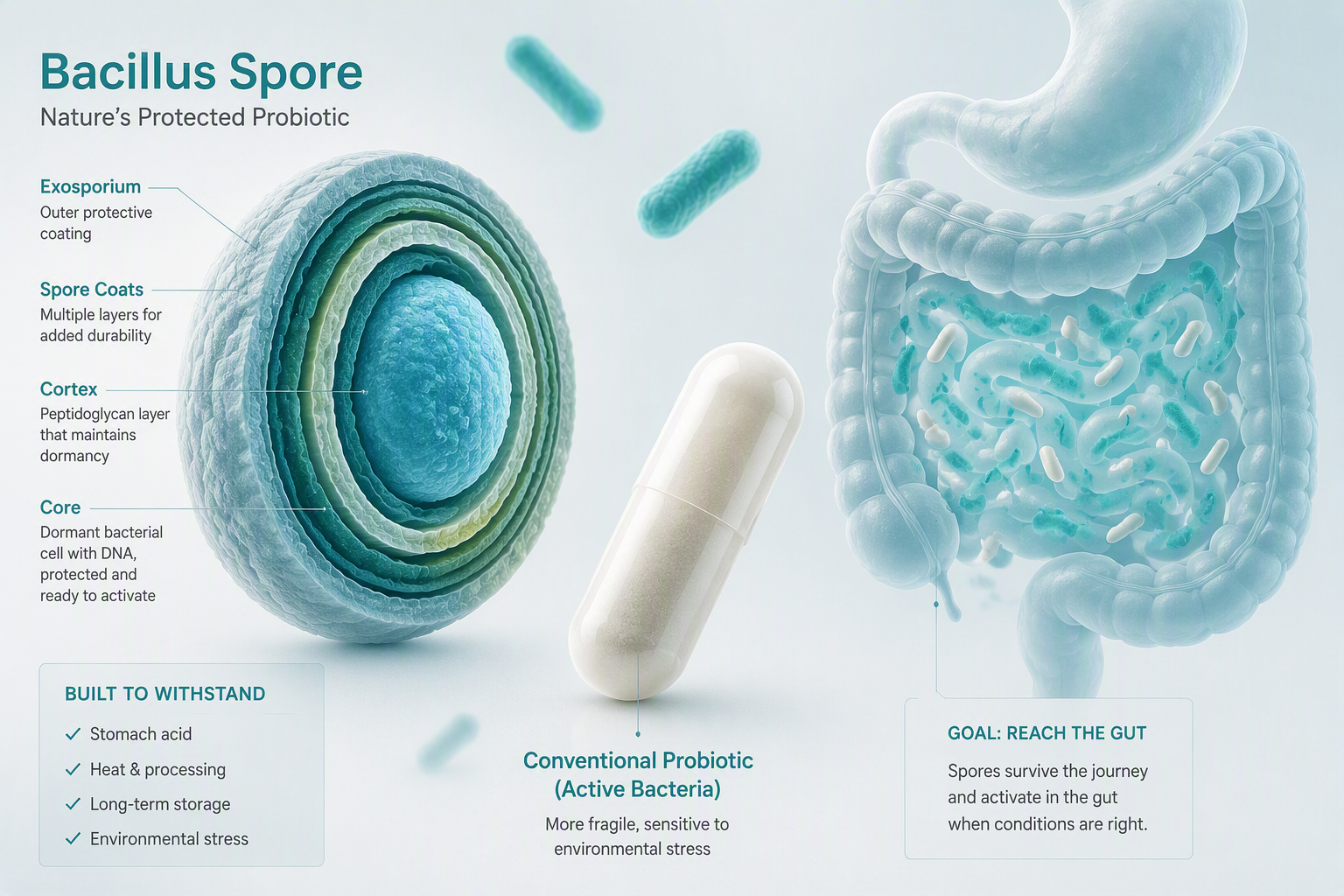
Spore-based probiotics are supplements made mainly with Bacillus species, a group of spore-forming bacteria. They are also called soil-based organisms because of their environmental association and spore-forming biology, not because they contain soil or work for every digestive concern.
An endospore is a tough, multilayered, dormant, metabolically inactive state that a Bacillus cell can form under difficult conditions. These dormant bacterial spores can withstand heat, pressure, moisture changes, manufacturing stress, stomach acid, and bile. This endospore shell can support probiotic heat stability and shelf life, but surviving the trip through your gut does not, by itself, prove a benefit for bloating, constipation, diarrhea, or irritable bowel syndrome (IBS)-like symptoms.
Many conventional probiotics contain live Lactobacillus or Bifidobacterium bacteria, which generally do not form endospores. Their manufacturing and storage needs may differ from those of Bacillus probiotics, but “spore-based” is not a quality rating or a promise of better results. The useful comparison is between the specific strain, the research behind it, and the symptoms you want to address, as covered in how strains are identified and compared.
Saccharomyces boulardii is different again. It is a probiotic yeast, not a Bacillus bacterium or a spore-based probiotic as that term is usually used on supplement labels. Shelf stability does not make products interchangeable because their potential uses, supporting evidence, and safety considerations differ by organism. Saccharomyces boulardii for diarrhea focuses on this yeast separately.
A Supplement Facts panel may name several Bacillus species:
- Bacillus subtilis: A common ingredient in spore-based products.
- Bacillus coagulans: Another species often used in probiotic formulas.
- Bacillus clausii: A Bacillus species found in some supplements.
- Bacillus licheniformis: A species included in certain Bacillus probiotic products.
The species name is only the first part of the identification. In Bacillus subtilis DE111, Bacillus subtilis HU58, and Bacillus coagulans GBI-30, 6086, the label gives the genus, species, and then a strain code. A high colony-forming unit count or familiar species does not establish a digestive benefit. Look for strain-specific human research that matches your symptoms and dose, and speak with a qualified healthcare professional about persistent, severe, or worsening symptoms.
How Do Bacillus Spores Work in Your Gut?
Beyond identifying Bacillus by species and strain, Bacillus probiotics can germinate into active cells after reaching your intestines. These spore-forming bacteria can remain dormant until intestinal conditions support germination.
After you swallow a capsule, the shell can also support stomach acid resistance during digestive transit, which may help the organism withstand gastric acid, bile, and changing conditions in the small and large intestine. That durability is why Bacillus products are often marketed as probiotics that survive stomach acid or probiotics resistant to gastric acid.
Still, spore form does not mean every organism in every product remains viable. Survival depends on the specific Bacillus strain, dose, capsule formulation, storage conditions, and your digestive environment. Claims of near-total survival or lower colony-forming unit needs are product-specific, not a category-wide rule.
In nutrient-rich, relatively neutral intestinal conditions, bacterial germination in the small intestine may occur. Nutrients, amino acids, and bile salts can signal some spores to leave dormancy and become temporarily active. Other strains may germinate later, including in the colon.
Once active, Bacillus cells may grow briefly and interact with their surroundings as they pass through your digestive tract. Some strains use quorum sensing, a form of bacterial cell-to-cell communication, and may produce compounds such as:
- Enzymes: These may help bacteria process materials in their environment.
- Antioxidants: These may counter oxidative stress in laboratory or biological settings.
- Antimicrobial peptides: These small proteins may influence other microbes.
- Short-chain fatty acids: Production varies by strain and intestinal conditions.
Temporary activity does not mean permanent colonization of your microbiome. A strain can germinate and interact with your digestive tract without becoming a lasting resident.
That distinction matters when considering a supplement for bloating, constipation, diarrhea, or IBS-like symptoms. Stomach acid resistance alone does not show that a product will help manage symptoms. Look for the exact strain, dose, formulation, and intended use rather than relying on broad claims about dormant bacterial spores.
Are Spore Probiotics Better Than Regular Probiotics?
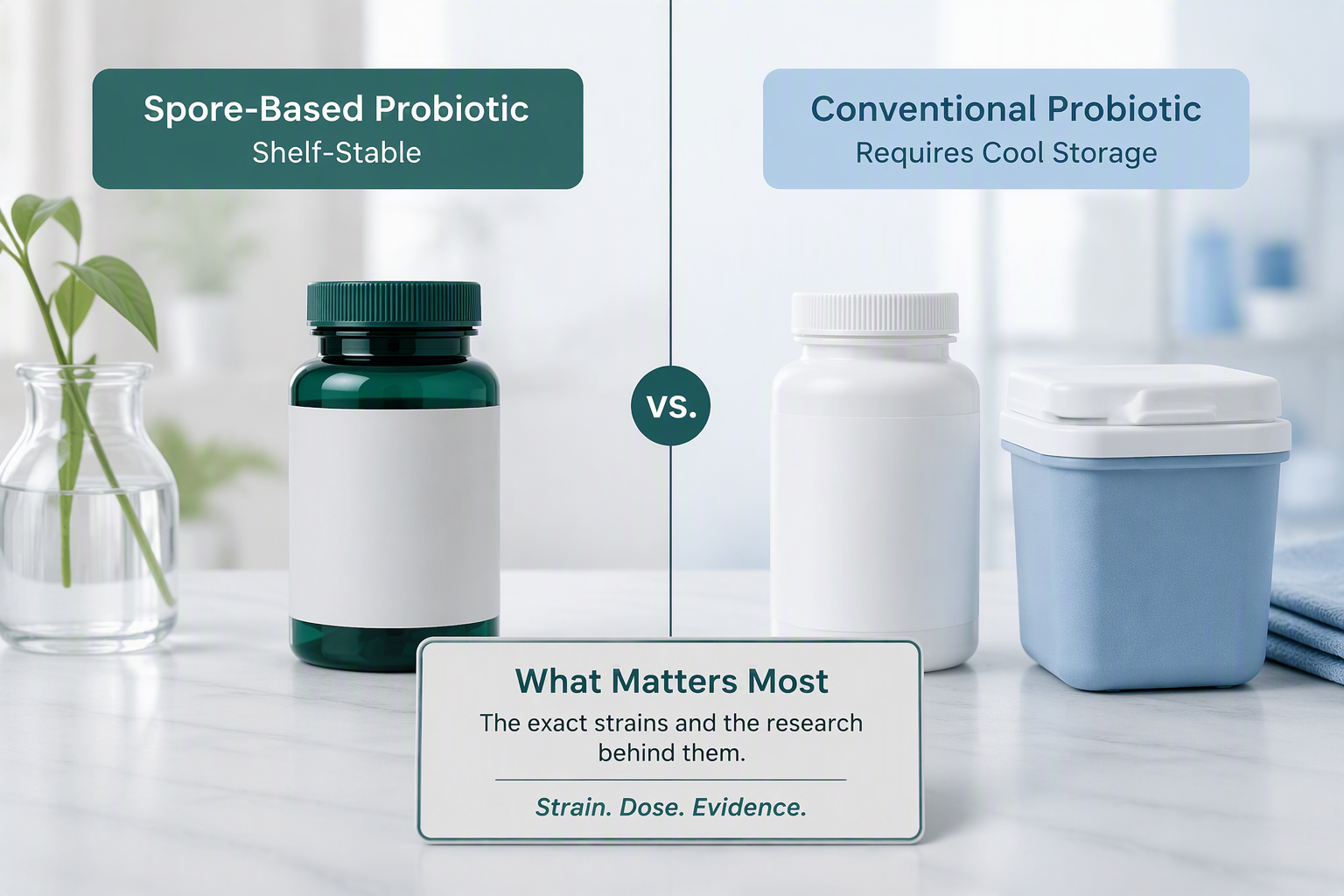
Despite their ability to survive digestive transit, spore-based probiotics are not automatically better than conventional Lactobacillus- and Bifidobacterium-based options. The better choice depends on the full strain designation, dose, your symptom goal, and human research on the exact product. A spore form alone does not guarantee more relief from bloating, constipation, diarrhea, or IBS.
Bacillus spores can make travel easier, while refrigerated conventional Lactobacillus- and Bifidobacterium-based formulas remain valid when supported by credible strain-specific evidence.
Feature | Spore-based Bacillus probiotics | Conventional Lactobacillus and Bifidobacterium probiotics |
|---|---|---|
Storage | Often shelf-stable and less affected by heat or moisture | Refrigeration needs depend on the formulation |
Stomach passage | Stomach acid resistance is common | Survival varies by strain, capsule design, and storage |
Presence in the gut | Usually temporary gut colonization | Often temporary, with strain-specific patterns |
What matters most | Named strain, dose, and human studies | Named strain, dose, and human studies |
Although Bacillus spores may be recoverable in stool for a limited period after dosing, recovery falls off within days of a dose, with timing varying by strain, dose, and person. This short-lived presence is expected, not evidence that a product has failed, and it does not by itself mean lasting changes in gut microbial diversity.
Research does not name one category as the winner for digestive symptoms. A 2023 network meta-analysis of 81 randomized trials in adults with IBS ranked Bacillus coagulans MTCC 5856 and Unique IS2 among the better-performing single strains for symptom severity (source). Those results apply to the strains studied, not to every Bacillus product.
Conventional strains also have condition-specific evidence. Bifidobacterium longum subsp. infantis 35624 has especially strong IBS trial evidence, while Lactobacillus rhamnosus GG has better support for antibiotic-associated and pediatric diarrhea than for IBS symptom control. A bifidobacterium probiotic deserves the same strain-by-strain review.
A useful product label includes:
- Species and strain code: Look beyond “Bacillus coagulans” or “Bifidobacterium longum” for the complete identifier, such as 35624 or 299v.
- Studied dose: Some Bacillus trials use roughly 1 to 5 billion colony-forming units (CFU) daily, with doses up to 10 billion studied. More CFU has not been shown to work better.
- Per-strain amounts: A large total CFU count cannot confirm that each strain matches the dose used in research.
Some Bacillus strains tolerate certain antibiotics, but no spore probiotic replaces prescribed treatment or fits every antibiotic course. Seek care for persistent, severe, or worsening digestive symptoms.
Which Strains Match Your Digestive Symptoms?

Rather than treating either probiotic category as universally better, choose a spore-based probiotic based on your main symptom and the evidence for its exact strain, not its colony-forming unit CFU count or the number of organisms on the label. The label should name the Bacillus species and, preferably, the strain code studied for that purpose. A broad blend is not automatically a match for constipation, loose stools, or bloating because effects and side effects can differ by strain.
These questions can help you compare gut health supplements with more care:
- Bloating, gas, or abdominal discomfort: Spore-forming Bacillus coagulans is the Bacillus species with the clearest reason to consider for these symptoms. Bacillus coagulans produces lactic acid and has been studied for possible effects on bloating, gas, discomfort, and gut-barrier function. Findings for one strain do not apply to every product, and prebiotic fibers or other fermentable ingredients may worsen gas for people who are sensitive to them.
- IBS discomfort: Spore-based probiotics are not a dependable treatment for IBS simply because they contain Bacillus. A named Bacillus coagulans strain with a human trial related to your symptoms is more informative than an unspecified spore blend. Keep expectations modest if the label cannot connect its exact strain and dose to the research.
- Constipation: Evidence for spore-based strains and bowel regularity is limited, mixed, and product-specific. The most useful studies measure stool frequency or transit time, meaning how quickly material moves through the digestive tract. A general “daily regularity” claim offers little guidance when the strain and studied outcome are missing.
- Occasional diarrhea: The cause and setting matter as much as the organism. Evidence for antibiotic-associated diarrhea does not automatically apply to diarrhea related to IBS, infection, travel, or a medication change. Bacillus clausii and Bacillus coagulans may be included in spore blends, but their presence alone does not show that a formula prevents diarrhea.
- Recovery after antibiotics: Look for evidence that the exact strain and dose were evaluated for antibiotic-associated diarrhea or digestive recovery. Shelf stability is a formulation feature, not proof that a product restores the gut microbiome after antibiotics. Severe diarrhea, fever, dehydration, or diarrhea after a hospital stay needs prompt guidance from a qualified healthcare professional.
- General digestive health: This is the broadest goal and the least likely to predict relief for a specific complaint. Some spore-based strains may encourage beneficial native bacteria and gut microbial diversity, including Akkermansia muciniphila. Possible metabolic effects, such as lower triglyceride levels, remain preliminary and strain-specific, so they should not guide a purchase for bloating or irregular bowel habits.
A high CFU count cannot compensate for missing strain information. When comparing labels, look for the species name, strain code, dose for each strain, and the human outcome studied. If a multi-strain formula does not disclose individual amounts, you cannot tell whether any strain matches the dose used in research.
How Do You Read a Spore Probiotic Label?
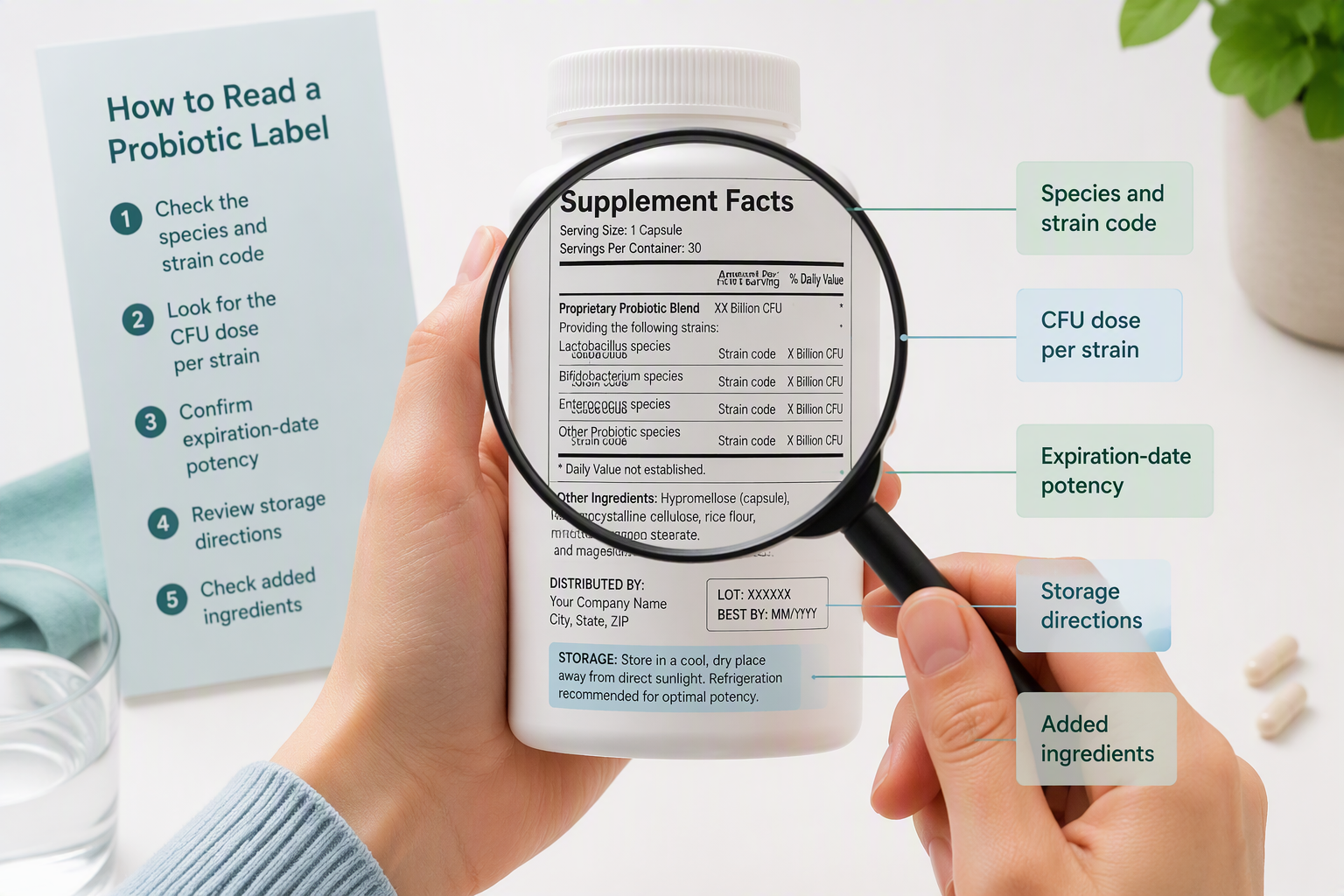
A reliable label names the exact organism, states the dose per serving, and makes clear what each strain may be used for. "Spore probiotic" and "soil-based probiotic" describe broad categories, not a specific evidence base. Check for both the species and strain code, such as Bacillus subtilis DE111, Bacillus subtilis HU58, or Bacillus coagulans GBI-30, 6086. Research on one of these probiotic strains does not automatically apply to another strain in the same species.
Transparent blends make meaningful comparisons possible. For example, a five-strain formula may name Bacillus indicus HU36, B. subtilis HU58, B. coagulans SC-208, B. licheniformis SL-307, and B. clausii SC-109, ideally with an individual amount for each. A proprietary blend that reports only a total CFU count prevents you from matching a strain to the dose studied in people.
Use these details when comparing gut health supplements:
- Strain identity: The label gives a Bacillus species and strain code, rather than only a species name or marketing term.
- Dose and serving size: CFUs should be listed per serving. A larger CFU number or more strains does not necessarily fit your symptoms better.
- Potency timing: A guarantee through the expiration date is more useful than a count measured only at manufacture.
- Storage directions: Some spore-based probiotics are sold without refrigeration because Bacillus spores can be more heat stable than many live-culture probiotics, but storage needs still vary by product (source). Still, follow the label after opening. Not all probiotics that withstand heat have identical storage needs.
- Added ingredients: Prebiotics, sweeteners, and capsule ingredients can matter if fermentable fibers or dietary restrictions trigger symptoms.
Match the product to your goal, whether that is bloating, constipation, diarrhea, post-antibiotic recovery, or general digestive support.
Who Should Avoid Spore-Based Probiotics?
Even with a carefully reviewed label, spore-based probiotics are not inherently unsafe, but probiotic safety depends on the exact Bacillus strain, the full formula, and your health history. A high colony-forming unit count does not show that a product is safe or appropriate. Bacillus clausii, for example, is a species name, so it does not identify the specific strain or confirm the quality of every product that contains it.
Full strain disclosure matters because some Bacillus species and strains can produce toxins or have other traits that make them unsuitable for supplements. A label that names only the species, hides ingredients in a proprietary blend, or leaves out strain codes gives you little basis for evaluating the product. That uncertainty matters even more if an unwanted reaction could complicate an existing health condition.
A careful label review includes:
- Strain identity: The organism is identified beyond "Bacillus," preferably with a complete strain name or code.
- Dose information: The label states the amount of each probiotic strain instead of giving only a total for a blend.
- Added ingredients and warnings: Prebiotics, fibers, and other ingredients are listed, along with cautions for pregnancy, breastfeeding, health conditions, and medication use.
Antibiotics and other prescriptions deserve particular care. Some probiotic strains naturally resist several antibiotics and may survive certain antibiotic courses, but they do not replace prescribed treatment or work with every medication plan. A pharmacist or qualified healthcare professional can help you review the specific probiotic strains and product before you add it to your routine.
Pause before starting a spore-based probiotic if you have suspected SIBO, unexplained upper-abdominal symptoms, or a current digestive flare. Some probiotic use in people with SIBO has been linked with worse bloating and gas, so symptom changes should be monitored closely (source). Brief early symptoms can occur, but severe, persistent, or intensifying symptoms are a reason to stop the product and seek clinical advice.
Do not self-start concentrated live-bacteria supplements during severe immune suppression, serious or chronic illness, or when a condition may compromise the intestinal barrier. In these situations, a clinician should weigh the possible benefit against your diagnosis, symptoms, and treatment plan rather than relying on supplement marketing.
Pregnancy, breastfeeding, and age-based product marketing also call for individualized review. A formula marketed for adults, teens, or children age five and older may still carry cautions for people who are pregnant, nursing, taking prescription medicines, or managing a medical condition. Ongoing digestive symptoms need medical evaluation because a probiotic cannot diagnose or treat their cause.
Digestive symptoms can have many causes, so consult a qualified healthcare professional for persistent, severe, or worsening symptoms. Results vary by person, and any dietary or supplement advice should be individualized.
How Should You Start and Monitor a Probiotic?

Choose a probiotic based on the concern you want to address, such as bloating, constipation, diarrhea, recovery after antibiotics, or general digestive health support. A spore-forming Bacillus product is not automatically a better fit because it is shelf-stable or has a high colony-forming unit (CFU) count. If you have IBS, suspected SIBO, or another diagnosed digestive condition, discuss probiotic safety with a qualified healthcare professional before starting.
The product label matters more than marketing. Confirm the full genus, species, and strain code, then compare the daily dose with research on that same strain and symptom. A long strain list, a large total CFU number, age- or sex-targeted packaging, and customer ratings do not replace strain-specific evidence. Also, CFUs and active fluorescent units (AFUs) measure products differently, so their numbers are not directly comparable.
Follow the manufacturer’s directions, including any food instructions. When the label or your clinician permits a gradual introduction, these approaches can reduce the chance of discomfort:
- Lower starting dose: Take one-half to one capsule with food, then work toward two capsules daily only if you tolerate it.
- Slower frequency: Take one capsule every other day before increasing to daily use.
- Higher-dose protocols: Get practitioner guidance before taking more than the label directs.
Keep your usual diet, medications, and other supplements as steady as possible during the trial. A sudden fiber increase, magnesium supplement, antibiotic, illness, travel, or unusual stress can change bowel habits and make the probiotic seem responsible. A simple symptom record should include:
- Dose and timing: Record the amount, time of day, and whether you took it with food.
- Digestive symptoms: Note bowel frequency and consistency, bloating, gas, abdominal discomfort, and any new symptoms.
- Other changes: Include major meal changes, medications, supplements, illness, travel, or stress.
Mild gas, bloating, or brief bowel-habit changes can occur during the first several days. A lower dose or slower increase may help. Still, worsening discomfort, symptoms that persist, or symptoms that return after every dose increase are not reactions to ignore. Pause the product rather than pushing through a pattern that feels worse.
Contact a clinician for severe, persistent, or worsening symptoms, or when it is unclear whether a flare is related to the supplement or an underlying digestive issue. Bring the product label and your symptom record, since supplements do not replace diagnosis, prescribed treatment, or individualized medical advice.
Spore-Based Probiotics FAQs
These FAQs address common questions about spore-based probiotics, from strain differences and possible digestive effects to safety considerations that may matter for your health history.
1. Do Spore Probiotics Need Refrigeration?
Most spore-based probiotics are shelf-stable and usually do not need refrigeration. Their dormant Bacillus spores tend to tolerate heat and storage better than many Lactobacillus- or Bifidobacterium-based products, making probiotics without refrigeration convenient for travel and busy routines. Still, each product has its own requirements, so follow the label, keep capsules tightly closed and dry, and avoid direct heat. Some high-potency non-spore formulas need cold storage.
2. Can You Take Spore Probiotics With Antibiotics?
Spore probiotics are not automatically compatible with antibiotics. Some Bacillus strains may resist certain antibiotics, but compatibility depends on the exact strain and medication. That resistance does not treat an infection or replace your prescribed antibiotic. Before taking spore probiotics with antibiotics, show your pharmacist or healthcare professional the full label, including the Bacillus strain names. They can help determine whether doses should be separated or whether the probiotic should be paused, especially if you have a medical condition or take other medicines.
3. Do Spore Probiotics Colonize Your Gut?
Bacillus spore probiotics can survive digestion, germinate under favorable conditions, and interact with microbes already in your gut. Temporary gut colonization is more accurate than permanent colonization, and one strain’s behavior does not predict another’s.
These are generally transient probiotics. Bacillus recovery in stool may drop off within days to a couple of weeks after you stop taking them, depending on the strain, dose, and your body. A change that fades after stopping may reflect a temporary influence rather than a lasting microbiome shift.
4. What Dose Do Spore Probiotic Trials Use?
Spore-probiotic trials commonly test about 1 to 5 billion CFU per day. In one placebo-controlled trial, participants took 4 billion spores daily in two capsules containing five Bacillus strains, so the dose applies only to that blend. Doses up to 10 billion CFU have also been studied, but more CFU does not necessarily mean better results. Match the product’s strains, daily amount, and serving size to the trial, since findings for one Bacillus strain or species may not apply to another.